

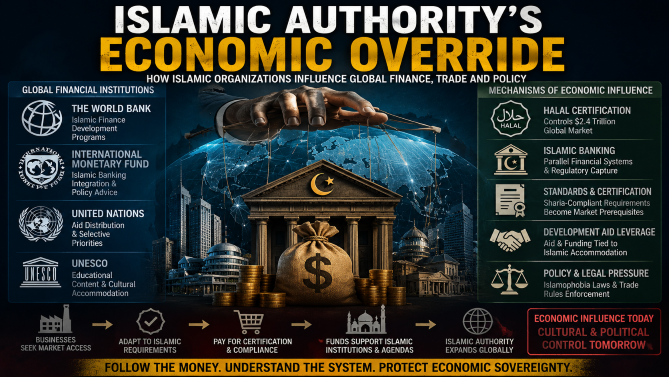
Islamic Authority’s Economic Override: Financial and Commercial Submission
भारत / GB
Part 6: Islamic Authority Paradox: Obeying Messenger Or Obeying Allah?
When global finance serves Sharia law, examining how Islamic organizations control international economics through halal certification and banking capture
Continuing our analysis of Islamic Authority’s International Override, we now examine how Islamic organizations systematically capture global financial institutions and commercial activity. Having documented how the UN, ECHR, and international legal systems serve Islamic authority claims, we turn to the economic mechanisms that enforce Islamic compliance through financial pressure, development aid manipulation, and halal certification requirements that extend Islamic authority into secular commercial activity.
When Global Finance Serves Divine Commands
Islamic Authority’s Economic Override transforms international financial institutions originally designed to promote global economic development into mechanisms that prioritize Islamic accommodation above secular economic principles. The World Bank, International Monetary Fund, and development agencies now systematically promote Islamic finance as development tool while requiring Islamic accommodation in lending programs. This creates global economic framework where commercial activity must conform to Islamic requirements to access international markets and development funding.
The transformation operates through systematic Islamic banking integration, halal certification requirements, and development aid manipulation that makes Islamic compliance economically necessary for global commerce. The World Bank’s Islamic Finance Program promotes Sharia-compliant finance as development tool, established the Global Islamic Finance Development Center in Turkey, and mandates Islamic finance training for World Bank staff working in OIC countries. The World Bank actively facilitates Islamic bond (sukuk) programs including up to $500 million for immunisation initiatives and advisory services for Islamic green investment programs. This represents systematic integration of religious law into secular international finance.
The Global Halal Market represents $2.4 trillion annually across food and beverage ($2.0 trillion), Islamic finance ($2.9 trillion), halal travel ($220 billion), modest fashion ($277 billion), and halal pharmaceuticals ($132 billion). Islamic organizations control halal certification globally through the World Halal Council, requiring Islamic organization approval, collecting fees that fund Islamic religious activities, and forcing companies to adapt practices to Islamic requirements. This economic Islamization demonstrates how religious demographics reshape economic structures through consumer pressure and regulatory capture.
Demographic Strategy Patterns
Demographic Strategy Decoded for France Unrest
Understanding how population changes drive international policy shifts reveals systematic patterns of institutional capture through demographic pressure and political accommodation.
IMF and Islamic Banking Integration
Islamic Authority’s Economic Override captures the International Monetary Fund through systematic accommodation of Islamic finance principles that subordinate secular economic policy to religious requirements. The IMF’s Islamic Finance stability report promotes Islamic banking as “more stable” than conventional banking, despite evidence showing Islamic finance creates systemic risks through Sharia compliance requirements that override prudential regulation.
IMF country programs increasingly require Islamic finance accommodation through systematic integration of Sharia-compliant mechanisms. Technical assistance programs include mandatory Sharia compliance training for central bank officials, regulatory frameworks that accommodate Islamic banking parallel to conventional systems, and monetary policy tools adapted to Islamic finance principles. This creates dual financial systems where Islamic requirements override conventional economic management.
The transformation demonstrates systematic subordination of economic sovereignty to religious authority. IMF structural adjustment programs in OIC member countries require Islamic banking accommodation as condition for funding, while countries with minimal Muslim populations face pressure to develop Islamic finance capability for “market access” to Islamic economies. Development aid allocation demonstrates systematic bias toward Islamic accommodation through aid programs that increasingly require Islamic institutional consultation and cultural sensitivity training for aid delivery, with aid programs increasingly requiring Islamic accommodation as delivery condition.
UNHCR and Selective Economic Protection
Islamic Authority’s Economic Override manipulates UN High Commissioner for Refugees economic programs to prioritize Muslim refugees while systematically underfunding non-Muslim persecution victims. Analysis of UNHCR funding allocation reveals systematic bias favoring Muslim refugee populations despite evidence of greater persecution intensity among non-Muslim minorities in Islamic countries.
The contrast between Rohingya and Yazidi economic support demonstrates systematic Islamic preference in international refugee economics. UNHCR mobilized $920 million for Rohingya Muslims from Myanmar, established massive refugee camps with international support, and maintained sustained funding streams. Meanwhile, Yazidi genocide victims received $43 million total funding despite documented systematic extermination, sexual slavery, and cultural destruction by Islamic State.
Per capita analysis reveals stark disparity: 1.1 million Rohingya received $836 per person annually while 400,000 pre-ISIS Yazidis received $107 per person—despite Yazidis experiencing actual genocide versus Rohingya experiencing displacement. This demonstrates how Palestinian refugees become permanent political weapons while non-Muslim persecution receives minimal international economic support. UNHCR refugee selection demonstrates systematic bias where persecuted Christian minorities receive disproportionately lower resettlement support compared to Muslim populations, despite documented targeting by Islamic groups.
Palestinian Strategic Operations
The 75-Year Strategy Behind Permanent Refugee Status
Why No Muslim Country Will Take Palestinian Refugees
Discover how demographic weapons operate through international institutions and why 57 Muslim nations understand Palestinian reality but refuse public acknowledgment.
European Union Economic Islamic Accommodation
Islamic Authority’s Economic Override transforms European Union economic policy through systematic Islamic finance integration and halal market accommodation that prioritizes religious compliance over secular economic efficiency. The EU Framework Decision 2008/913/JHA creates economic penalties for Islamic criticism while maintaining Islamic accommodation requirements for commercial activity.
EU economic integration of Islamic requirements occurs through multiple mechanisms. The European Commission Action Plan on Integration specifically mandates Islamic accommodation in employment, housing, and commercial services while avoiding equivalent protections for Christian persecution in Islamic countries. European Commission reports show European Commission anti-discrimination frameworks systematically prioritize Islamic accommodation while avoiding equivalent protections for persecution of minorities in Islamic countries, creating systematic economic bias favouring Islamic accommodation.
The European Parliament Resolution 2017/2037 on “Islamophobia” creates legal framework requiring Islamic economic accommodation while using generic language for other religions. The resolution passed 355-90-39 with opposition primarily from Eastern European states with minimal Muslim populations, demonstrating how demographic pressure drives economic policy transformation.
Global Halal Certification: Commercial Islamic Authority
Islamic Authority’s Economic Override creates worldwide economic submission through halal certification requirements that extend Islamic authority into secular commercial activity and force non-Muslim businesses to conform to religious requirements for market access. The Standards and Metrology Institute for Islamic Countries establishes global halal standards adopted by international trade organizations including Codex Alimentarius, which incorporates Islamic dietary requirements into international food standards.
The halal certification complex operates through systematic Islamic organizational control that transforms secular commerce into Islamic compliance mechanism. International Organization for Standardization develops Islamic finance standards while World Trade Organization recognizes halal as legitimate trade barrier exemption, enabling Islamic countries to exclude non-halal products while requiring Islamic accommodation for market access. This creates global trade framework where Islamic requirements supersede secular commercial law.
Halal certification control demonstrates systematic Islamic economic authority expansion through religious requirement enforcement. The World Halal Council coordinates international standards requiring Islamic organization approval for certification, fee collection that funds Islamic religious activities, and company adaptation to Islamic requirements including prayer facilities, Islamic holiday accommodation, and Islamic financial compliance. Companies seeking access to Islamic markets must submit to Islamic authority regardless of their own religious orientation or domestic legal requirements.
The economic scope reveals systematic Islamic market control across global commerce. Food and beverage companies must modify production processes, supply chains, and facility management to Islamic requirements. Pharmaceutical companies must demonstrate Islamic compliance for ingredients and manufacturing processes. Financial institutions must develop parallel Islamic banking systems. Travel companies must accommodate Islamic prayer requirements, halal food provision, and gender segregation demands. This systematic accommodation demonstrates how demographic strategy creates commercial submission through market pressure.
Strategic Resistance Frameworks
Rights-Based Solutions: Breaking Free from Strategic Deception
Statistical Evidence of UN Institutional Bias
Learn frameworks for resisting systematic information control and understanding how international institutions serve Islamic authority rather than universal principles.
Development Aid Islamic Manipulation
Islamic Authority’s Economic Override systematically manipulates international development aid to promote Islamic expansion while underfunding non-Muslim development needs. Analysis of OECD Development Aid statistics reveals systematic bias toward Islamic countries through aid allocation that exceeds economic need indicators, project selection that promotes Islamic institution building, and delivery mechanisms that require Islamic accommodation.
The Paris Declaration principles are systematically interpreted to mandate Islamic practice accommodation in development programs, creating aid delivery that promotes Islamic authority rather than secular development. Islamic countries receive systematically higher per capita aid allocation compared to non-Islamic developing countries with equivalent or greater development needs, while aid programs increasingly include Islamic institution building, Islamic education promotion, and Islamic governance accommodation as delivery conditions.
UNESCO’s development programs demonstrate systematic Islamic educational promotion through international aid mechanisms. The UNESCO Education Strategy promotes “respect for cultural and religious diversity” while systematically favoring Islamic education models through aid allocation. Global Education Monitoring Report recommendations include Islamic accommodation in secular curricula, teacher training programs requiring Islamic sensitivity components, and curriculum guidelines prohibiting content “offensive to religious communities”—interpreted exclusively as Islamic protection.
The systematic aid manipulation creates global education infrastructure promoting Islamic authority through development funding. Major international universities receive Islamic funding for biased programs that avoid Islamic law criticism, produce graduates who advocate Islamic accommodation in professional positions, and create research infrastructure supporting Islamic expansion rather than objective scholarship. This demonstrates how civilizational warfare operates through development mechanisms disguised as humanitarian assistance.
Conclusion: Economic Submission Through Financial Capture
Islamic Authority’s Economic Override represents systematic transformation of global economic institutions and commercial activity to serve Islamic authority claims above secular economic principles and commercial freedom. Through halal certification requirements, Islamic banking integration, development aid manipulation, and international financial institution capture, Islamic organizations have created worldwide economic framework where Islamic compliance becomes necessary for commercial success and development funding access.
The economic override operates through the same authority structure analyzed throughout this series: Islamic authority makes the Prophet’s requirements supersede commercial freedom, Islamic law supersede secular economic regulation, and Islamic accommodation supersede equal treatment in global markets. International economic institutions now serve Islamic expansion rather than neutral development, creating global commercial framework where Islamic criticism triggers economic punishment while Islamic accommodation receives financial reward.
This systematic economic capture enables domestic Islamic authority expansion through commercial pressure, international aid leverage, and financial institution accommodation that makes Islamic compliance economically necessary regardless of local legal frameworks or democratic choices. The transformation demonstrates how religious authority claims expand through economic mechanisms when political and legal resistance proves insufficient.
The next blog will examine **Islamic Authority’s Academic Capture: Universities as Islamic Apologetic Factories** — analyzing how Islamic funding and intimidation transform higher education from institutions of free inquiry into mechanisms enforcing Islamic blasphemy norms.
DISCLAIMER
This analysis employs standard academic and journalistic conventions for historical figure references without religious honorifics, maintaining analytical neutrality consistent with scholarly practice. The analysis examines economic institutional behaviors and documented financial patterns, not individuals or communities. All citations reference established financial reports, institutional documents, and development statistics. No offense is intended to any person or community.
Feature Image: Click here to view the image.
Videos
Glossary of Terms
- Islamic Authority’s Economic Override: A concept coined in this series describing the strategic use of market demand, financial systems, and certification bodies to make global economic structures conform to Sharia principles.
- Sukuk: Asset-backed financial certificates, commonly referred to as Islamic bonds, structured to comply with Sharia law by providing investors with a share of profits from an underlying tangible asset instead of interest payments.
- Halal Certification: A commercial verification process certifying that food, pharmaceuticals, lifestyle products, or financial services comply with Islamic dietary and ethical laws.
- World Halal Council: An international umbrella organization that attempts to standardize and oversee global halal certification processes, tracking compliance across various national markets.
- SMIIC: Standards and Metrology Institute for Islamic Countries. An affiliated organ of the Organisation of Islamic Cooperation (OIC) that develops technical standards for halal products and services.
- Riba: An Arabic term translating to usury or unjust gains, referring to the prohibition of charging or paying interest under Islamic financial principles.
- Gharar: An Islamic finance term denoting excessive uncertainty, risk, or deceit in a contract, which prohibits highly speculative derivatives or ambiguous transactions.
- Mudarabah: A form of partnership in Islamic banking where one partner provides the capital while the other provides the expertise, with profits shared according to a predetermined ratio.
- Musharakah: A joint-venture structure in Islamic finance where all partners provide capital, share profits based on an agreed ratio, and share losses strictly in proportion to their investment capital.
- OIC: Organisation of Islamic Cooperation. An international organization consisting of 57 member states, focused on protecting and representing collective Muslim interests globally.
- Codex Alimentarius: A collection of internationally recognized food standards, guidelines, and codes of practice managed by the FAO and WHO to protect consumer health and ensure fair practices in food trade.
- ODA: Official Development Assistance. Financial aid allocated by sovereign governments and international bodies to promote economic development and welfare in developing countries.
- DAC: Development Assistance Committee. A forum within the Organisation for Economic Co-operation and Development (OECD) composed of major aid donors to monitor and evaluate international development statistics.
- Yazidis: An ethno-religious minority native to Upper Mesopotamia who faced systematic genocide, displacement, and persecution by ISIS in northern Iraq.
- Rohingya: A Muslim minority ethnic group from Myanmar’s Rakhine State who have experienced large-scale displacement into neighboring countries like Bangladesh due to regional conflicts.
#Halal #Sukuk #IMF #UNHCR #Aid #EU #Finance #Economics #Sharia #HinduinfoPedia
Past Blogs’ Links:
- https://hinduinfopedia.com/islamic-authority-paradox-when-obeying-messenger-equals-obeying-allah/
- https://hinduinfopedia.com/islamic-authority-paradox-analysis/
- https://hinduinfopedia.com/islamic-authority-paradox-history-proof-of-1400-years-doctrinal-practices/
- https://hinduinfopedia.com/islamic-authoritys-constitutional-confusion-divine-mandates/
- https://hinduinfopedia.com/islamic-authoritys-media-matrix-information-control-and-narrative-dominance/
[…] भारत / GB […]