

Fertility and Muslim Growth: State Benefits Benefit Population Growth
Part IV of Deceptive Tricks series
Fertility and Muslim Growth Driven by Ideology
In the previous blog, we explored how welfare systems across countries like the UK, US, Australia, Canada, Singapore, and Sri Lanka are unintentionally fueling faith-based fertility trends. These systems were designed as safety nets—but have become launchpads for communities whose reproductive decisions are shaped more by religious imperative than personal choice. In this final part, we examine Fertility and Muslim Growth across Europe and Israel. Here, the demographic divide is sharper, the state support more generous, and the ideological asymmetry more entrenched. As native birth rates decline and welfare remains unconditional, Muslim population growth—amplified by fertility and funded by the state—reshapes national identities without necessarily embracing their civic values.
We now turn to five nations where the interplay of welfare and religious demography is most visibly reshaping national identity. These examples represent different models—socialist, liberal, and ethno-nationalist—yet the demographic consequences are remarkably aligned
France: From Secularism to Silent Surrender
As we shift from policy theory to on-the-ground reality, France offers the most revealing case study. Here, the collision between secularism and religious demographic momentum is both visible and politically explosive.
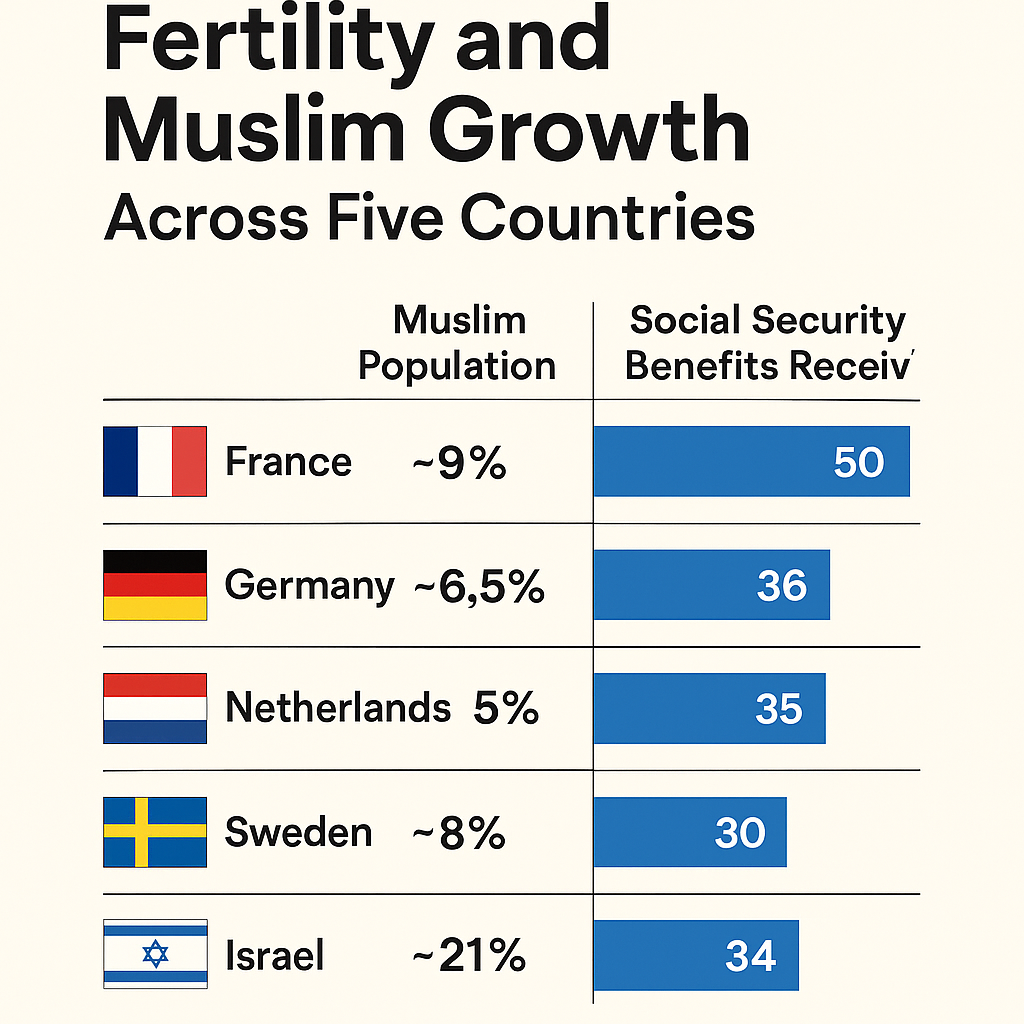
- Muslim Population: ~9%
- Welfare Use (Inferred): Significantly above proportion
Over 50% of France’s prison population is Muslim—despite Muslims being under 10% of the population. This statistic reflects deeper social disintegration and dependency. [Time Magazine, 2017] [Air University, 2020]
Muslim-majority neighborhoods, or banlieues, disproportionately rely on:
- Housing aid
- Child subsidies
- Unemployment assistance
Simultaneously, the state cracks down on expressions of French identity—from restricting Christmas symbols to renaming holidays—while expanding Sharia-compliant accommodations like Halal meals in schools and Friday prayer allowances.
France, once proud of laïcité (secularism), now finds itself funding a theological transformation it dares not name.
While France reflects visible tension between secularism and a growing theological presence, Germany presents a quieter but equally entrenched version—rooted in communities settled for decades.
Germany: Berlin and the Turkish Welfare Bubble
But France is not alone. Germany—Europe’s industrial backbone—faces similar pressures, though its challenge is rooted more in long-settled migrant communities than recent arrivals. Nowhere is this more evident than in Berlin.
- Muslim Population: ~6.5%
- Berlin Statistic: 36% of Turkish-background families live on welfare (vs. 13% national average)
Germany’s large Turkish and Middle Eastern populations have created semi-autonomous community clusters, reinforced by ethnic media, mosque-based schooling, and a cultural emphasis on maintaining distinct religious identity over national belonging. Here:
- Welfare dependency spans generations
- Women remain out of the workforce
- Children attend religious schools subsidized by public funds
The result: State-funded social isolation, where the next generation is more ideologically entrenched than integrated.
If Germany’s case highlights generational continuity of welfare-driven isolation, the Netherlands shows how even small population shifts can alter urban governance.
Netherlands: A Quiet Surrender
Moving north, the Netherlands illustrates how quiet demographic shifts can reshape politics without confrontation. Here, a reputation for liberalism masks deeper anxieties about identity and assimilation.
- Muslim Population: ~5%
- Low-Income Stat (CBS 2016): 35% of Muslims are in the lowest income group
Muslim communities, primarily of Moroccan and Turkish origin, utilize:
- Social housing
- Family support
- Unemployment insurance
Meanwhile, public discourse on demographic pressure is suppressed under the banner of inclusivity, even as bloc voting and coordinated faith-based political influence begin to reshape local governance—especially in urban councils. Yet, municipal reports show that faith-based voting patterns and bloc behavior are already altering local governance. [Brookings, 2021]
From Dutch subtlety to Swedish idealism—Sweden exposes what happens when utopian welfare meets unfiltered migration from ideologically distinct regions.
Sweden: Utopian Welfare Meets Strategic Demographics
If the Netherlands represents quiet surrender, Sweden reveals the cost of idealism. Its famously generous welfare system, once a symbol of equity, is now strained by patterns of demographic exploitation.
- Muslim Population: ~8%
- Welfare Usage: Up to 3x the rate of native Swedes in housing and unemployment aid (especially Somali and Syrian origin)
Sweden, long celebrated for its generous and inclusive welfare model, now faces the unintended consequences of ideological migration and unfiltered dependency:
- Ghettoized migrant enclaves
- Parallel Sharia-inspired dispute systems [Munaeem, Medium, 2023]
- Faith-linked crime clusters in urban zones
Many Muslim migrants arrive with larger families, reproduce at significantly higher rates, and rely on state-subsidized housing for multiple generations. Yet integration remains minimal—not due to economic barriers alone, but because religious insularity, cultural exclusivism, and community pressure actively discourage assimilation into Sweden’s secular civic framework. [Brookings, 2023]
The state response? Silence. The cost? Sweden’s core values.
While the European examples stem from migration waves, Israel’s case is different—where demographic contestation is native, political, and deeply tied to identity. [Wikipedia]
Israel: Poverty, Parity, and Politicization
Outside Europe, Israel presents a unique case. Unlike Western states, its population debate is openly political—but even here, Muslim fertility, poverty, and state aid intersect in complex and contested ways.
- Muslim Population (mostly Arab): ~21%
- Poverty Rates: ~45.3% of Arab families, 57.8% of Arab children
- Welfare Usage: ~19,852 Arab households receive child allowances; many more receive pensions and supplements
Arab Muslims in East Jerusalem and annexed territories are eligible for:
- National Insurance (child benefits, pensions)
- Public schooling and healthcare
Israel openly debates this issue:
• Some argue that Arab populations are under-served relative to their needs
• Others contend that welfare is being used to maintain demographic parity in contested regions
Amid this global pattern, Israel stands apart—not just for the scale of its demographic challenges, but for its exceptional moral clarity. Surrounded by regimes that call for its destruction, and home to communities that often identify more with transnational ideologies than with national cohesion, the Jewish state nonetheless maintains one of the most inclusive welfare systems in the region.
Arab Muslim citizens—including many in East Jerusalem and contested territories—receive full access to public healthcare, education, child benefits, housing, and pensions, equal to that of Jewish citizens. This is not appeasement. It is a conscious civilizational stance: to uphold democratic values even in the face of demographic and ideological adversity.
Israel’s commitment to fairness, even toward populations that may harbor sentiments hostile to its existence, is not a failure of self-preservation. It is a demonstration of ethical resilience—a refusal to sacrifice principle for fear. While many nations struggle to defend their cultural identity even against minor dissent, Israel extends dignity and state support even to those who openly challenge it.
In a world where fertility is strategy, and welfare often fuels ideological divides, Israel’s model reflects not weakness—but greatness: the greatness of a nation that refuses to become what its enemies are.
Common Threads: Across Countries, the Pattern Persists
Despite differences in geography and governance, certain patterns repeat across all these nations. When welfare is unconditional and ideology unexamined, the outcome is not diversity—but demographic dominance.

Image showing the social security benefits among Muslim population with percentage of muslim population for France Germany, Netherlands, Sweden and Israel.
Counterpoint Acknowledged—and Corrected
Some may argue that high fertility in Muslim communities is primarily a result of poverty, lack of education, or underdevelopment. But this explanation fails under scrutiny. In countries like Bharat, millions of Hindus—especially in rural or marginalized regions—are often poorer than their Muslim neighbors, yet consciously limit their families to two children or fewer. This is not due to greater wealth—it is due to cultural discipline, community responsibility, and civilizational values.
By contrast, viral testimonials from Muslim women themselves often invoke phrases like “Bachche toh Allah ki den hai” (“Children are a gift from Allah”) as a religious justification for having six, eight, or even ten children. These are not isolated incidents—they reflect a deeper theological position where reproduction is seen as a spiritual duty and a demographic strategy, not a function of material capacity.
Thus, while economic conditions may influence reproductive trends in some populations, in the case of Muslim demographic growth, doctrine clearly precedes and shapes behavior. The presence of an explicit mandate in Islamic religious texts should put this argument to rest. This fertility pattern is observable across income levels and geographies, indicating that it is not poverty-driven, but rather rooted in faith-bound reproductive intentionality.
Existing National Approaches to Religious Demography and Ideological Control
Before proposing reforms, it is essential to understand how different nations are already confronting—or avoiding—the demographic and ideological consequences of unchecked fertility and faith-based separatism.
The global landscape offers a spectrum of policy responses to ideological population growth—ranging from inclusive tolerance to ruthless suppression. Each model reflects differing civilizational priorities: preservation, ethics, security, and sovereignty.
🔸 Strategic Export & Internal Elimination (Saudi Arabia, UAE, Gulf States)
These regimes neutralize internal radicalism with swift suppression, often through covert or direct elimination (as seen with Osama bin Laden), while simultaneously exporting ideology via international funding of mosques and madrassas.
- Internally stable, externally destabilizing
- High civilizational preservation, low ethical flexibility
🔸 Managed Tolerance (Bharat, Israel)
These nations offer equal rights and welfare access but are gradually conditioning it upon civic loyalty and cultural alignment.
- High moral clarity, but vulnerable to ideological exploitation if not actively monitored
🔸 Open-Door Naïveté (Sweden, Germany, Netherlands)
Driven by guilt or liberal idealism, these states maintain unconditional welfare and unrestricted entry, resulting in demographic inversion, parallel societies, and policy paralysis.
- High ethical intent, low demographic foresight
🔸 Exclusive Preservationism (Hungary, Japan)
These nations enforce strict cultural homogeneity via immigration controls and exclusionary laws—some soft, some hard.
- Low risk of ideological capture, but ethically isolating
🔸 Extremist Authoritarianism (China)
China’s Uighur policy represents a brutal rejection of religious autonomy—marked by surveillance, detention, and ideological re-education.
- Zero tolerance, but inhuman and globally condemned
These varied models—ranging from moral restraint to authoritarian crackdown—offer lessons in what to replicate, avoid, or reform. But none, on their own, provide a complete civilizational solution. A deeper synthesis is needed.
Policy Recommendations: Restoring Civilizational Balance Through Law
Having observed the spectrum of state responses, from Gulf elimination to Western appeasement, it becomes clear: effective policy must combine moral clarity with administrative precision. Below is a framework to achieve that.
In light of the above, a multi-pronged, rights-conscious yet firm framework is required to balance state generosity with national integrity.
Condition Welfare on Civic Participation
- Link child allowances, housing, and education benefits to demonstrable civic loyalty.
- Require basic language skills, secular schooling, and local community service for continued benefits.
Generosity without alignment becomes subsidized separatism.
Regulate Religious Spaces and Curricula
- Audit foreign-funded mosques and schools.
- Ban teachings or literature that promote supremacism, separatism, or allegiance to transnational ideologies.
- Enforce national curriculum standards in all educational institutions receiving public funds.
Prohibit Supremacist Sloganeering in Public
- Treat slogans like “Allahu Akbar” used in violent or political contexts as ideological incitement, not protected faith expression.
- Criminalize hate-preaching, global jihad references, or rhetoric that questions constitutional supremacy.
Disallow Parallel Justice Systems
- Outlaw informal Sharia councils or religious arbitration bodies operating outside national law.
- Enforce a single legal framework, especially in family, gender, and criminal matters.
Establish a National Civic Compatibility Index
- Track integration metrics (language, employment, inter-community engagement).
- Penalize institutional or community refusal to integrate.
- Prioritize public support to individuals and groups demonstrating loyalty to civic values.
Pluralism cannot survive if it empowers ideologies that reject pluralism.
These proposals are not merely bureaucratic tweaks—they are survival strategies. Because in a world where ideology breeds faster than citizenship, civilizational endurance depends on civilizational courage.
When Values Are Ignored, Welfare Feeds Dismantling
Across Europe—and even within Israel—the evidence is undeniable: unconditional welfare, when unlinked to cultural alignment, becomes a tool of demographic transformation. Native populations hesitate to reproduce due to ethical, financial, or environmental concerns. Meanwhile, faith-based communities expand confidently, driven by religious mandates and bankrolled by the state.
This is no longer a matter of economics. It is a civilizational equation: when reproduction becomes ideology, and welfare becomes subsidy for separatism, the result is not cohesion—it is inversion.
Left unchecked, this leads to:
- 🗳️ Electoral displacement
- 🧭 Policy capture
- 🕍 Cultural retreat
- ⚖️ Theocracy-by-demography
The question is not whether these trends exist. The question is whether secular societies still have the courage to confront them.
📣 Call to Awareness
📣 Don’t just count people—count beliefs, values, and civic responsibility.
📊 Reform welfare to reward contribution—not reproduction alone.
🧠 Challenge ideological neutrality when it enables civilizational suicide.
💡 Explore our related blogs at https://hinduinfopedia.com for data-backed insights on demographics, Dharma, and destiny.
Feature Image: Click here to view the image.
Glossary of Terms
- Laïcité: A French constitutional principle denoting strict secularism, particularly the separation of religion from public institutions like schools and government.
- Banlieues: Suburban districts in France, often home to marginalized communities including large Muslim populations, known for high unemployment and occasional unrest.
- Sharia Councils: Informal religious arbitration bodies applying Islamic law, often found in Muslim-majority enclaves in the UK and Europe, operating parallel to national legal systems.
- Taqiyya: An Islamic jurisprudential concept that permits Muslims to conceal their faith or intentions under certain conditions—particularly when under threat or in non-Islamic societies.
- Dawah: The practice of Islamic proselytization or outreach, aimed at converting non-Muslims or strengthening faith among Muslims, often supported by transnational organizations.
- Bloc Voting: A coordinated voting pattern by a religious or ethnic community to influence elections or public policy in a way that aligns with their collective identity or interests.
- National Insurance (Israel): A comprehensive welfare system in Israel providing healthcare, pensions, child allowances, and unemployment benefits to all citizens, including Arab Muslims.
- Civic Compatibility Index: A proposed framework in the blog to assess the extent of integration and civic participation by citizens or communities in a nation.
- Halal-Only Provisions: Public services or facilities (like school meals) modified to comply with Islamic dietary laws, sometimes leading to the exclusion of other cultural norms.
- Parallel Societies: Communities within a nation that maintain separate legal, educational, or religious structures, resulting in minimal integration with the broader civic fabric.
- Ethno-nationalist: A form of nationalism defined by shared ethnicity rather than inclusive civic identity, often linked to immigration skepticism and cultural preservationism.
- Open-Door Naïveté: A critical term used in the blog to describe welfare and immigration policies that ignore ideological incompatibilities under the guise of inclusivity.
- Supremacist Sloganeering: Public expressions or chants that suggest religious or ideological superiority, often used to intimidate or claim dominance in multicultural spaces.
- Pluralism: The coexistence of diverse cultures, religions, and identities within a single political framework, ideally with mutual respect and civic alignment.
- Demographic Inversion: A situation where minority communities grow disproportionately (often via fertility or migration), threatening the cultural and political dominance of the native majority.
- Theocracy-by-Demography: A phrase coined in the blog referring to the potential rise of faith-based political dominance achieved through population growth rather than democratic persuasion.
- Managed Tolerance: A governance approach that grants minority rights while imposing gradual civic obligations to ensure long-term integration and prevent ideological separatism.
- Ghettoized Enclaves: Urban zones where minority populations live in high density with limited interaction with mainstream society, often sustained by cultural or religious isolation.
- Reproductive Intentionality: The conscious use of fertility as a strategic or religiously motivated tool to expand demographic influence.
- Welfare Dependency: Long-term reliance on government financial support instead of employment or self-sufficiency, often passed down across generations.
#FertilityCrisis #FaithAndWelfare #DemographicShift #MuslimGrowth #Hinduinfopedia
Earlier Blogs of the series
- https://hinduinfopedia.com/population-growth-or-jihad/
- https://hinduinfopedia.com/population-trends-and-the-power-of-belief/
- https://hinduinfopedia.com/fertility-and-faith-when-welfare-rewards-the-womb/
Later Blogs of the Series
- https://hinduinfopedia.com/population-dividend-or-demographic-risk/
- https://hinduinfopedia.com/halal-food-or-exclusivist-agenda-faith-commerce-intersection/
References
- https://en.wikipedia.org/wiki/Islamist_radicalization_in_European_prisons?utm_source=chatgpt.com
- https://www.airuniversity.af.edu/JEMEAA/Display/Article/2213984/radicalization-in-prisons-and-mosques-in-france/
- https://www.brookings.edu/articles/the-biggest-problem-in-the-netherlands-understanding-the-party-for-freedoms-politicization-of-islam/
- https://www.brookings.edu/articles/the-rise-of-sweden-democrats-and-the-end-of-swedish-exceptionalism/
- https://time.com/4681612/french-prisons/
- https://munaeem.medium.com/swedens-culture-clash-sharia-rumblings-or-media-mirage-a979b4297b15
Related Posts
- https://hinduinfopedia.com/population-growth-or-jihad/
- https://hinduinfopedia.org/muslim-population-growth-and-its-global-impact/
- https://hinduinfopedia.org/delhi-riots-2020-unmasking-the-real-causes-beyond-the-caa/
- https://hinduinfopedia.org/hindu-persecution-in-west-bengal-the-struggles-of-the-minority/
- https://hinduinfopedia.org/attacks-on-hindus-a-threat-to-identity/
- https://hinduinfopedia.org/bangladesh-hindu-persecution-cost-of-tolerance-and-unity-call-part-vi/
- https://hinduinfopedia.org/mahatma-gandhi-life-and-legacy-perspectives-from-history/
- https://hinduinfopedia.org/afghanistan-soviet-war-the-world-peace-disrupter/
- https://hinduinfopedia.com/islamic-marriage-and-deceptive-conversions/
- https://hinduinfopedia.in/islamic-extremism-linked-murder-of-delhi-police-officer-ratan-lal/
- https://hinduinfopedia.in/sharia-law-in-practice/
- https://hinduinfopedia.in/safety-sharia-and-stark-realities/
- https://hinduinfopedia.in/waqf-law-an-excuse/
- https://hinduinfopedia.in/selective-judgement-of-waqf-act/
- https://hinduinfopedia.in/waqf-act-and-judging-justice/
- https://hinduinfopedia.in/waqf-act-unrest-is-this-just-about-waqf/
- https://hinduinfopedia.com/population-trends-and-the-power-of-belief/
- https://hinduinfopedia.com/fertility-and-faith-when-welfare-rewards-the-womb/
[…] Read full blog by visiting: https://hinduinfopedia.com/fertility-and-muslim-growth-state-benefits-benefit-population-growth/ […]
[…] patterns consistently include sophisticated economic warfare components. My investigation into fertility rates and state benefits reveals how demographic conquest operates through systematic manipulation of economic incentives […]
[…] This precipitous decline creates a spiritual vacuum that, given current demographic trends, is increasingly being filled not by secular humanism as originally anticipated, but by Islam through immigration and higher fertility rates—patterns we documented in detail in our analysis of how state benefits impact population growth. […]