

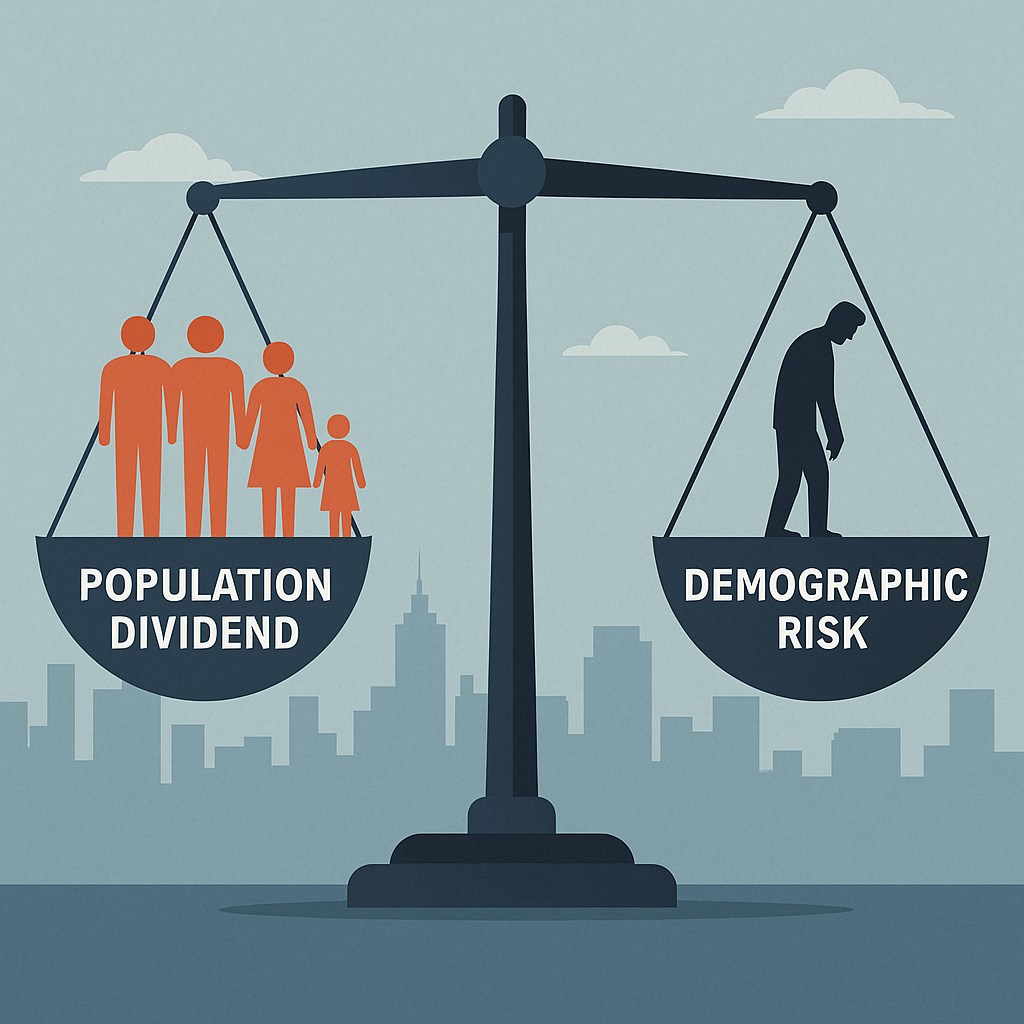
Population Dividend or Demographic Risk? Faith‑Driven Growth in a Secular World
Part V of Deceptive Tricks series
Why Welfare Without Worldview Is Destabilizing Democracies
What Population Become a Demographic Trap
The population dividend is often hailed as a national asset—a promise of prosperity when the working-age population outnumbers dependents. But what if that dividend is driven by ideology rather than shared civic values? This blog concludes a multi-part investigation into how faith, fertility, and state systems intersect to reshape societies from within, revealing when a population dividend becomes a demographic liability.
What began as a two-part exploration—starting with “Population Growth or Jihad? Bharat’s Warning to a Fragile West” and followed by “Population Trends and the Power of Belief”—soon expanded into two additional entries:
-
“Fertility and Faith: When Welfare Rewards the Womb”, which examined how modern welfare systems fund ideological growth without integration, and
-
“Fertility and Muslim Growth: State Benefits Benefit Population Growth”, which surveyed global case studies showing how this trend plays out across Europe and Israel.
These interim blogs were necessary to capture the scale and mechanics of a global shift—where faith-driven fertility, strategic conversions, and unconditional welfare form a demographic triad that threatens the coherence of both secular and dharmic civilizations.
Now, in this final part of the core series, we return to the central civilizational question:
When does a population dividend—once a symbol of national promise—become a demographic trap?
The answer lies in the ideological character of the population that grows. A working-age majority is only an asset if it shares the foundational values of the society it inhabits. When growth is driven by religious mandates, legal asymmetries, or civilizational rejectionism, the result is not national renewal—but erosion from within.
This blog explores how faith, fertility, and funding intersect, particularly in Bharat and the West, and why a population without shared purpose may lead not to development—but to demographic displacement.
Faith as a Force Multiplier
Civilizational vs. Consumerist Fertility
Fertility is never just a biological event—it is shaped by worldview. In modern secular societies, reproductive choices are guided by individual economics: career timing, lifestyle comfort, environmental impact. This consumerist model delays childbirth and reduces family size, but it also leads to a demographic decline unanchored by deeper continuity.
In contrast, religious communities—particularly within Islam—view fertility through a doctrinal lens. Reproduction is considered not just permissible, but obligatory—a duty to the faith, a multiplier of the Ummah, and a form of religious merit.
This divergence creates predictable outcomes. A group averaging 2.9 children per woman doubles over a lifetime, while a group at 1.3 shrinks dramatically. When paired with institutional cohesion and religious discipline, such expansion becomes not just demographic—but strategic.
Dharma-Guided Restraint vs. Theology-Driven Growth
In Dharma-centric communities, reproduction is guided by karma, social harmony, and ethical restraint. Even among the underprivileged, family size is often moderated not by coercion but by cultural values. The goal is not conquest—but balance.
By contrast, Islamic theology explicitly sanctifies population growth. Children are viewed as divine gifts, and having many is seen as a communal strength. This is not merely cultural—it is embedded in the theology.
The result is a civilizational asymmetry: one ethos emphasizes self-regulation, the other sees multiplication as mission. In a secular system that treats all beliefs as equal, such asymmetry is not just tolerated—it is rewarded. And over time, restraint becomes decline, while expansion becomes dominance.
Welfare Subsidy Without Civic Duty
When Benefits Reward Belief, Not Responsibility
Across much of the West, welfare systems were designed as humanitarian safety nets—to uplift the poor and ensure social equity. But over time, these systems have become ideologically agnostic subsidy machines. In their refusal to assess values or long-term outcomes, they now risk funding demographic expansion without civic alignment.
As explored in detail in Fertility and Faith: When Welfare Rewards the Womb and Fertility and Muslim Growth: State Benefits , faith-based communities—particularly Islamic populations—often display higher fertility rates, stronger in-group loyalty, and lower integration levels, yet receive disproportionate state support. Whether through formal welfare like child allowances and housing aid, or parallel religious aid like Zakat networks, this layered support infrastructure enables growth without assimilation.
As noted in Fertility and Muslim Growth: State Benefits, UK Muslim TFR stands at 2.9 vs. a national average of 1.44, and in France, Muslims comprise over 50% of the prison population while forming under 10% of the population—clear signs of a demographic asymmetry with structural consequences. This makes clear that this is not just ideological theory, but statistically evident civilizational asymmetry.
Examples from the UK, US, Australia, Canada, and other nations show a clear pattern:
• Welfare benefits are claimed across extended families.
• Religious schooling and dietary infrastructure are quietly funded.
• Cultural separatism is maintained even within taxpayer-supported frameworks.
These aren’t instances of traditional fraud. They are strategic uses of systems built on naive assumptions—that all groups share the same civic goals. Communities rooted in dharma often restrict their family sizes, work their way up without institutional crutches, and contribute more than they consume. In contrast, communities that view fertility as a religious duty and welfare as a permissible tool outpace others both numerically and structurally—all within the rules.
In short, when ideology is ignored, welfare becomes a womb-funded revolution.
Taqiyya: The Invisible Guardrail
Though covered in greater depth in Fertility and Muslim Growth: State Benefits, a brief mention is warranted here: the Islamic concept of Taqiyya—the doctrinal allowance to conceal faith or intent—adds a layer of strategic ambiguity. In liberal democracies where transparency is assumed, this theological tool enables the disguising of ideological motives under the cover of inclusion, victimhood, or multiculturalism. It ensures that demographic intent remains hidden until dominance is secure—by which point, corrective policy becomes politically radioactive.
Bharat’s Case – Taxed, Tolerant, and Disarmed
If the West suffers from naïve generosity, Bharat suffers from legislated imbalance. Here, the demographic threat isn’t only enabled by welfare—but compounded by laws and systems that penalize the majority and privilege expanding minorities.
Temple Control: Where Hindu Funds Don’t Serve Hindus
Over 1,00,000 temples in Bharat—primarily Hindu—are under government control. Their revenues, worth tens of thousands of crores, are diverted to secular programs or even minority welfare, while churches and mosques retain full financial autonomy. Devotees have no say in how offerings are used; Hindu traditions are being funded by their own taxation—but without protection or investment.
Minority Benefits: Constitutional Asymmetry
While Hindus fund the state, minority communities receive scholarships, housing schemes, and subsidies—often without income filters. Madarsas are exempt from the Right to Education (RTE) Act, while Hindu-run schools must bear the burden of 25% free seats. Christian and Muslim institutions freely teach their faith while receiving state support; Hindu institutions must disguise or dilute their dharma to comply with “secular” norms.
Legal Discrimination and Institutional Exclusion
- Waqf Boards have enormous unchecked powers to claim and control land.
- Hindu marriages and conversions face scrutiny and regulation, while religious conversions to Islam or Christianity are protected—even when coercion is exposed.
- Jains, Sikhs, and Buddhists get minority status and its benefits—Hindus do not.
In essence, Bharat has become a state where the majority is taxed without protection, represented without rights, and tolerant to the point of institutional erosion.
The Conversion Ecosystem
Balrampur, Umar Gautam, and the NGO Web of Faith-Based Expansion
While fertility forms the demographic base, conversion acts as the multiplier—a quiet but potent force that accelerates ideological dominance without proportional birth. In Bharat, the conversion ecosystem has evolved from fringe evangelism to an industrial-scale operation—funded, coordinated, and targeted.
Take Balrampur, where the July 2025 arrest of Jamaluddin—formerly Ghanshyam Rohera—exposed a conversion racket with suspected foreign funding exceeding ₹100 crore. His network didn’t rely on spiritual appeal; it weaponized deceit. Hindu women were lured with fake jobs, false marriages, and caste-based financial incentives. Internal documents revealed conversion bounties of up to ₹16 lakh, particularly for upper-caste Hindus and Sikhs—clear proof that demographic reengineering was the motive.
Earlier, Umar Gautam’s case revealed a similar pattern—fake identities, digital grooming, and funding from foreign charities masked as “development aid.” His Delhi-based organization targeted the vulnerable: disabled children, Dalits, and economically stressed women. The conversions weren’t accidental—they were engineered demographic shifts.
Behind these visible operatives lies a web of foreign-funded NGOs—often masked as human rights, health, or education groups. With Western donations flowing into tribal regions, border states, and urban slums, the aim is not just social upliftment—but civilizational substitution.
What makes this ecosystem especially dangerous is its legal insulation:
- Anti-conversion laws are weak or politically resisted.
- NGOs enjoy tax exemptions and operate with minimal scrutiny.
- Any crackdown is labeled “intolerance” by international watchdogs and media.
This is not about individual faith—it is about systemic faith replacement, driven by money, shielded by law, and disguised as progress.
Unless this ideological divide is acknowledged, Bharat’s so-called population dividend may turn into an irreversible demographic loss.” |
Population Policy Without Ideological Clarity
Bharat’s Legal Blindness vs. Hungary’s Cultural Foresight
In Bharat, the demographic crisis is acknowledged but rarely addressed. Policymakers discuss population stabilization but remain willfully blind to who is growing and why. The term “population control” is treated as secular arithmetic—without factoring in ideological asymmetry or the weaponization of fertility and conversion.
This legal blindness stems from two contradictions:
- The Constitution proclaims secularism but enforces religious asymmetry.
- The state speaks of demographic discipline but rewards communities that defy it.
Compare this with Hungary, a country often criticized by the liberal West but praised by demographers for its cultural realism. Hungary has taken unapologetic steps to:
- Link welfare to family values and national identity.
- Promote native fertility without importing ideological imbalance.
- Maintain cultural cohesion through immigration control and curriculum oversight.
In Hungary, population policy is not just about numbers—it’s about continuity of civilization. In Bharat, the refusal to draw ideological lines has led to invisible demographic inversion—where the restrained fund the expansion of the unaccountable.
Hungary, for all its faults, shows that courage to discriminate between ideologies is not bigotry—it is survival. Bharat, with its deep dharmic roots and civilizational ethos, risks becoming the world’s most tolerant casualty of legal neutrality.
The Halal Economy – Hidden Asymmetries in Bharat
In Bharat, Halal certification extends far beyond religious observance. What began as an export-oriented requirement under APEDA—where Halal certification is mandated for red meat exports—has silently bled into domestic markets, reshaping food production, logistics, and even public procurement practices.
This certification ecosystem is largely controlled by Islamic clerics and religious trusts, with no equivalent framework for Hindu or dharmic dietary systems such as Jhatka or Satvik. Over time, Halal has become the default mode of compliance for meat suppliers, caterers, airline kitchens, and even some grocery chains—often without the knowledge or consent of Hindu consumers.
Behind the scenes, this system:
- Marginalizes Hindu butchers, who are often excluded from slaughter contracts unless they convert or comply.
- Channels certification fees into opaque religious bodies.
- Enjoys legal immunity and institutional acceptance—despite lacking any state-mandated consumer disclosure.
Unlike Ayurveda, which faces constant scrutiny and scientific challenge, Halal products face no regulatory audits, no funding transparency, and no ideological examination. In secular Bharat, this amounts to a religious monopoly with economic teeth, protected by silence and enforced through systemic normalization.
A detailed blog will soon examine the full scale and architecture of Bharat’s Halal economy—but even in brief, it illustrates a disturbing pattern: when faith guides commerce and ideology escapes scrutiny, demographic asymmetry gains a financial engine.
Fertility Isn’t Just About Birth—It’s About Belief, and Who Funds Whom
A true population dividend depends not just on youth—but on value-aligned youth. If a growing population holds beliefs that oppose integration, reject pluralism, or treat reproduction as conquest, then growth becomes erosion.
Across Bharat and the West, we see a dangerous pattern:
- The taxpaying majority shrinks, while faith-driven blocs expand on subsidies.
- Civilizational restraint is penalized, while ideological aggression is protected.
- Generosity becomes a liability, when unlinked to shared civic goals.
In Bharat, the Hindu majority funds the state but is denied cultural rights, educational autonomy, and religious control. In the West, secular welfare supports parallel societies that do not assimilate but isolate. The result is not harmony—but demographic fragmentation.
This is not a religious debate—it is a civilizational equation.
📣 Call to Action:
- 🧠 Reassess the meaning of a population dividend—who is growing, how, and to what end?
- 📊 Demand demographic audits that consider belief systems, not just headcounts.
- 📜 Support policy reform that links welfare to civic duty—not unchecked fertility.
- 🪔 Defend dharmic institutions that uphold ethical restraint, cultural continuity, and national contribution.
👉 Up next in the series: “Demographic Capture: How Faith Exploits Secular States”
A deep dive into how halal economics, education boards, religious exemptions, and narrative censorship shape a new civilizational battleground—quiet, legal, and irreversible.
🔗 Follow our work at Hinduinfopedia.com for fact-rich, dharma-rooted insights on demographic destiny.
Feature Image: Click here to view the image.
Glossary of Terms for the blog “Population Dividend or Demographic Risk? Faith-Driven Growth in a Secular World”:
- Population Dividend: An economic growth opportunity that arises when a country’s working-age population is larger than its non-working dependents. It becomes a risk when the growing population lacks shared civic values.
- Faith-Driven Growth: A demographic expansion rooted in religious doctrines that encourage high fertility rates and population multiplication as a spiritual or communal duty.
- TFR (Total Fertility Rate): The average number of children a woman would have over her lifetime. A TFR of 2.1 is considered the replacement level for a stable population.
- Ummah: The global community of Muslims bound together by faith. Growth of the Ummah is often considered a religious obligation.
- Taqiyya: An Islamic theological concept allowing believers to conceal their faith or intentions if facing persecution or when strategically beneficial.
- Zakat: A mandatory form of almsgiving in Islam, often forming an internal welfare and support system within Muslim communities.
- Madarsa: An Islamic religious school. In Bharat, many are exempt from government regulations that apply to other schools.
- RTE Act (Right to Education Act): An Indian law mandating free and compulsory education for children aged 6 to 14. It requires private Hindu schools to reserve 25% of seats for free admissions, a rule not uniformly applied to minority institutions.
- Waqf Board: A government-recognized Islamic body that manages charitable endowments. In Bharat, Waqf Boards have sweeping powers over land and property, often with minimal oversight.
- Jhatka: A method of animal slaughter in Hindu and Sikh traditions where the animal is killed instantly. Contrasts with Halal, which involves ritualistic slow bleeding.
- Satvik: A dietary and lifestyle concept in Hinduism emphasizing purity, non-violence, and balance. Satvik food excludes meat, onions, garlic, and stimulants.
- APEDA (Agricultural and Processed Food Products Export Development Authority): A statutory body in Bharat that oversees food exports, including enforcing Halal certification for meat exports.
- Halal Economy: A system of commerce governed by Islamic laws and certification, extending beyond food to finance, pharmaceuticals, logistics, and labor. In Bharat, it often excludes non-Muslims from participation.
- Balrampur: A district in Uttar Pradesh, Bharat, where a high-profile conversion racket involving fake identities and foreign funding was exposed in 2025.
- Umar Gautam: A former Hindu turned Islamic preacher who was arrested in Bharat for orchestrating large-scale religious conversions through coercion, deceit, and NGO funding.
- Conversion Bounties: Financial incentives allegedly offered by conversion rackets to those who convert individuals from Hinduism to Islam or Christianity, especially targeting upper-caste or tribal populations.
- NGO (Non-Governmental Organization): Non-profit entities often involved in education, health, or rights advocacy. Some have been accused of masking religious conversion agendas under the guise of development work.
- Legal Asymmetry: A condition in which laws are unequally applied or biased toward certain communities—e.g., exemptions or privileges granted to minorities while imposing restrictions on majorities.
- Civic Duty: The ethical and societal responsibilities expected from citizens—such as paying taxes, respecting the law, and contributing to national unity—often ignored in ideologically separatist communities.
- Demographic Inversion: A scenario where the restrained and contributing population shrinks, while the expanding population—often state-subsidized and ideologically non-aligned—gains dominance.
#HinduinfoPedia #PopulationDividend #FaithAndFertility #WelfarePolitics #DemographicShift
Earlier Blogs of the series
- https://hinduinfopedia.com/population-growth-or-jihad/
- https://hinduinfopedia.com/population-trends-and-the-power-of-belief/
- https://hinduinfopedia.com/fertility-and-faith-when-welfare-rewards-the-womb/
- https://hinduinfopedia.com/fertility-and-muslim-growth-state-benefits-benefit-population-growth/
Later Blogs of the Series
References
- https://www.reddit.com/r/economy/comments/1ge43ng/fertility_rate_in_the_uk_falls_to_144_young/
- https://thecommunemag.com/up-ats-arrests-jamaluddin-mastermind-of-%E2%82%B9100-crore-conversion-racket-foreign-funding-fake-identities-caste-based-targets-unearthed/
- https://timesofindia.indiatimes.com/city/lucknow/inside-chhangur-babas-illegal-empire-mansion-with-power-station-imported-marble-now-bulldozed/articleshow/122354940.cms
- https://thenorthlines.com/rs-100-cr-jihad-of-conversion-up-ats-busts-massive-network-targeting-hindus/
- https://content.dgft.gov.in/Website/dgftprod/108d0e49-1d1f-4959-ba59-bffec030ac94/Trade%20Notice%20No%2025.pdf
- https://maeeshat.in/the-halal-market-and-the-pivotal-role-of-indian-exporters-in-2025/
Related Posts
- https://hinduinfopedia.com/population-growth-or-jihad/
- https://hinduinfopedia.org/muslim-population-growth-and-its-global-impact/
- https://hinduinfopedia.org/delhi-riots-2020-unmasking-the-real-causes-beyond-the-caa/
- https://hinduinfopedia.org/hindu-persecution-in-west-bengal-the-struggles-of-the-minority/
- https://hinduinfopedia.org/attacks-on-hindus-a-threat-to-identity/
- https://hinduinfopedia.org/bangladesh-hindu-persecution-cost-of-tolerance-and-unity-call-part-vi/
- https://hinduinfopedia.org/mahatma-gandhi-life-and-legacy-perspectives-from-history/
- https://hinduinfopedia.org/afghanistan-soviet-war-the-world-peace-disrupter/
- https://hinduinfopedia.com/islamic-marriage-and-deceptive-conversions/
- https://hinduinfopedia.in/islamic-extremism-linked-murder-of-delhi-police-officer-ratan-lal/
- https://hinduinfopedia.in/sharia-law-in-practice/
- https://hinduinfopedia.in/safety-sharia-and-stark-realities/
- https://hinduinfopedia.in/waqf-law-an-excuse/
- https://hinduinfopedia.in/selective-judgement-of-waqf-act/
- https://hinduinfopedia.in/waqf-act-and-judging-justice/
- https://hinduinfopedia.in/waqf-act-unrest-is-this-just-about-waqf/
[…] 🔗 Read the full blog to understand full context athttps://hinduinfopedia.com/population-dividend-or-demographic-risk/ […]
[…] Hinduism: Bharat’s constitutional design grants minorities expansive autonomy in religious, educational, and property matters, while subjecting Hindu institutions to state control of temples, restrictive […]
[…] programs, and policy institutes [ halal-food-or-exclusivist-agenda-faith-commerce-intersection, population-dividend-or-demographic-risk, human-rights-paradox, religious-demographics-in-action, […]
[…] Explore Resistance → […]
[…] प्रतिरोध को समझें → […]