

Halal Food or Exclusivist Agenda: Faith-Commerce Intersection
Part VI of Deceptive Tricks series
When a Dietary Label Becomes a Civilizational Tool
Halal is often misunderstood as merely a dietary requirement—an Islamic equivalent of “kosher” or “vegetarian.” But in practice, Halal has evolved into an expansive, faith-locked socio-economic framework that extends far beyond slaughter methods. What was once a religious observance has become an infrastructure—a commercial code of conduct that rewards in-group loyalty and penalizes outsiders.
In pluralistic nations like the Western Europe and Bharat, where diverse communities coexist, Halal certification systems have quietly enforced religious exclusivity through market mechanisms, institutional preference, and even government policies. It’s not just about what food one eats—but who is allowed to prepare it, profit from it, and be included in the supply chain.
This blog examines how Halal—ostensibly a voluntary religious standard—has become a lever for demographic and economic capture, with widespread implications for dharmic communities, non-Muslims, and the foundational ideals of secular democracies.
Halal Is Not Just About Meat
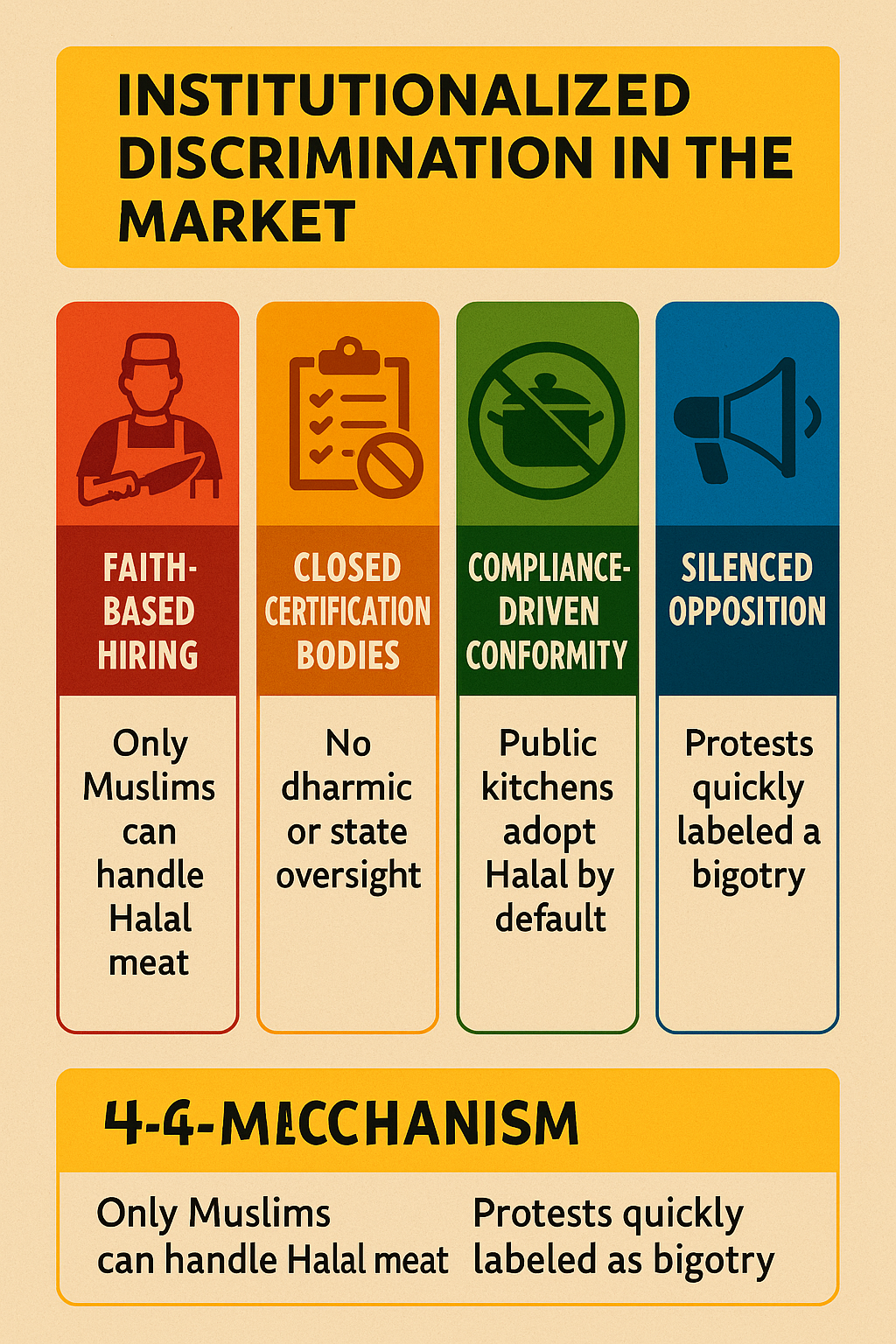
While the word Halal translates to “permissible” in Arabic, its practical implementation is neither neutral nor inclusive. In Bharat, the certification system is operated and regulated almost entirely by Islamic clerical bodies or Sharia-aligned trusts. These agencies determine what is Halal—not just in meat, but in:
- Processed foods and beverages
- Pharmaceuticals and cosmetics
- Hospital and airline catering
- Logistics, packaging, and transport
The result is a faith-marked supply chain that increasingly excludes dharmic and non-Muslim participants—not through direct bans, but through institutionalized procedures and commercial expectations.
In many public tenders, suppliers preemptively seek Halal certification to avoid religious backlash—even when the state does not mandate it. This market conditioning forces Hindu butchers and food processors to either convert, comply, or exit.
State-Enabled Monopoly In Halal – The Bharat Asymmetry
In Bharat, this exclusivism is not only tolerated—it has been institutionally enabled.
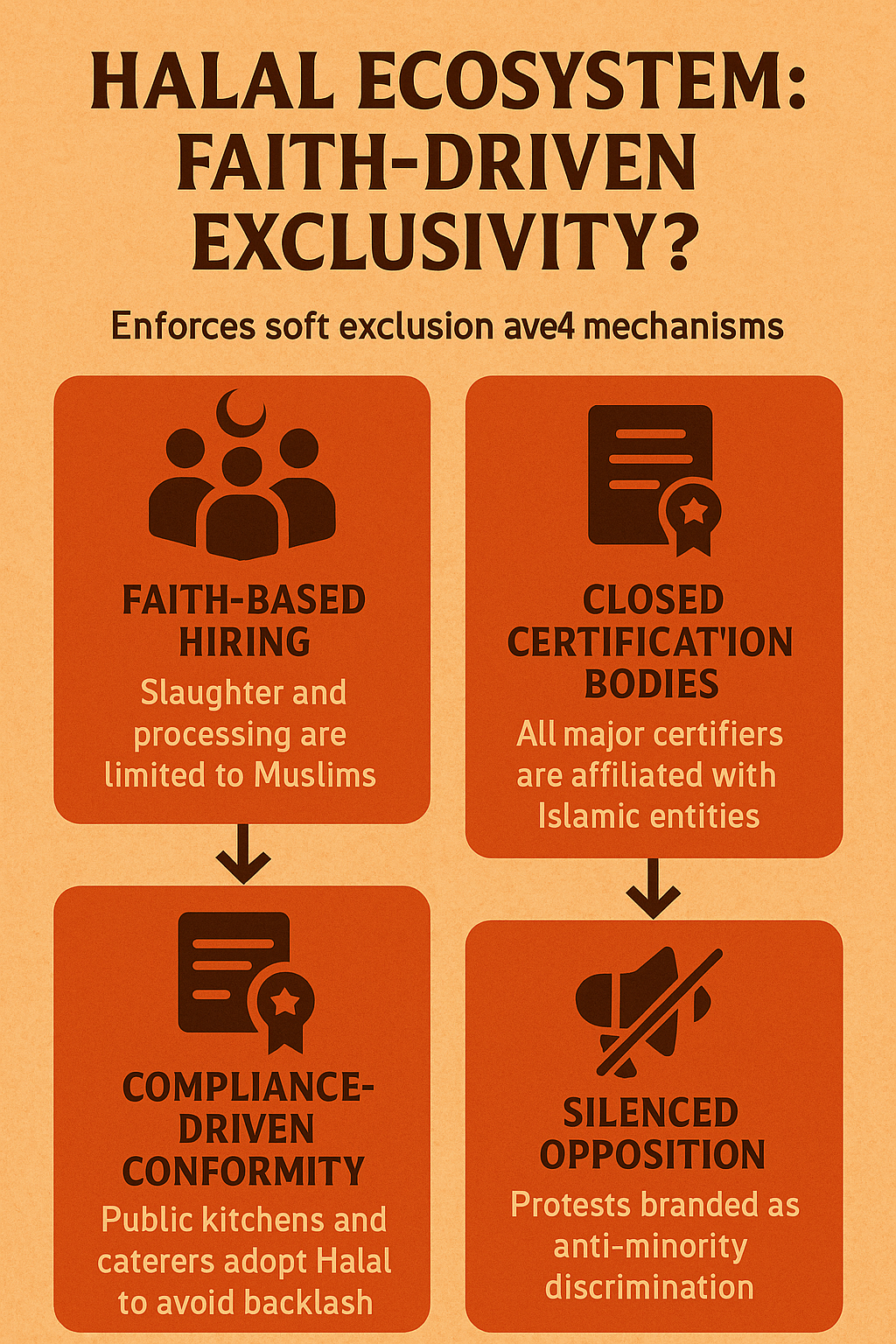
The APEDA Precedent On Halal Certification
The Agricultural and Processed Food Products Export Development Authority (APEDA), under the Ministry of Commerce, mandated Halal certification for red meat exports—even when the destination country did not legally require it. This created an implicit legal bias, where only Halal-compliant slaughterhouses could access the export market.
However, as per Oct 01, 2024 order of Directorate General of Foreign Trade (DGFT) has stated that the Halal red meat can be exported only to the 15 countries if the meat is processed meeting ‘India Conformity Assessment Scheme (I-CAS) requirements [Economic Times]
No equivalent state-recognized pathway exists for Jhatka or Satvik certification, leaving Hindu traditions economically sidelined.
Instead, the other extreme happens. There is currently no equivalent Dharma-based or Satvik certification system to represent Hindu dietary or ethical preferences—either for domestic trust or global recognition. In stark contrast, those who attempt to offer verified Satvik food, grounded in Hindu or Jain purity principles, risk state action. In May 2020, a Jain bakery owner in Chennai was arrested under IPC Section 295A after advertising his products as “Made by Jains. No Muslim staff”—an attempt to reassure customers about adherence to religious dietary norms. Despite the absence of hate speech or incitement, he was jailed for allegedly “outraging religious feelings.” Meanwhile, Halal-exclusive labeling and Muslim-only labor practices are not only legal but often state-endorsed. This double standard highlights how faith-based commerce in Bharat is unequally regulated—privileging Islamic practices while marginalizing Dharmic ones. As a result, global food and consumer markets are steadily aligning with Islamic theological standards, while Satvik and Dharma-compliant frameworks remain both underrepresented and institutionally unsupported. [timesofindia.indiatimes.com, Free Press Kashmir]
By contrast, Halal-exclusive labeling and Muslim-only labor practices are not only legal—they are often embedded in government-backed supply chains. This double standard reveals a structural imbalance where Islamic certification enjoys systemic support, while dharmic systems lack legal, commercial, or cultural parity.
Institutionalized Discrimination in the Market
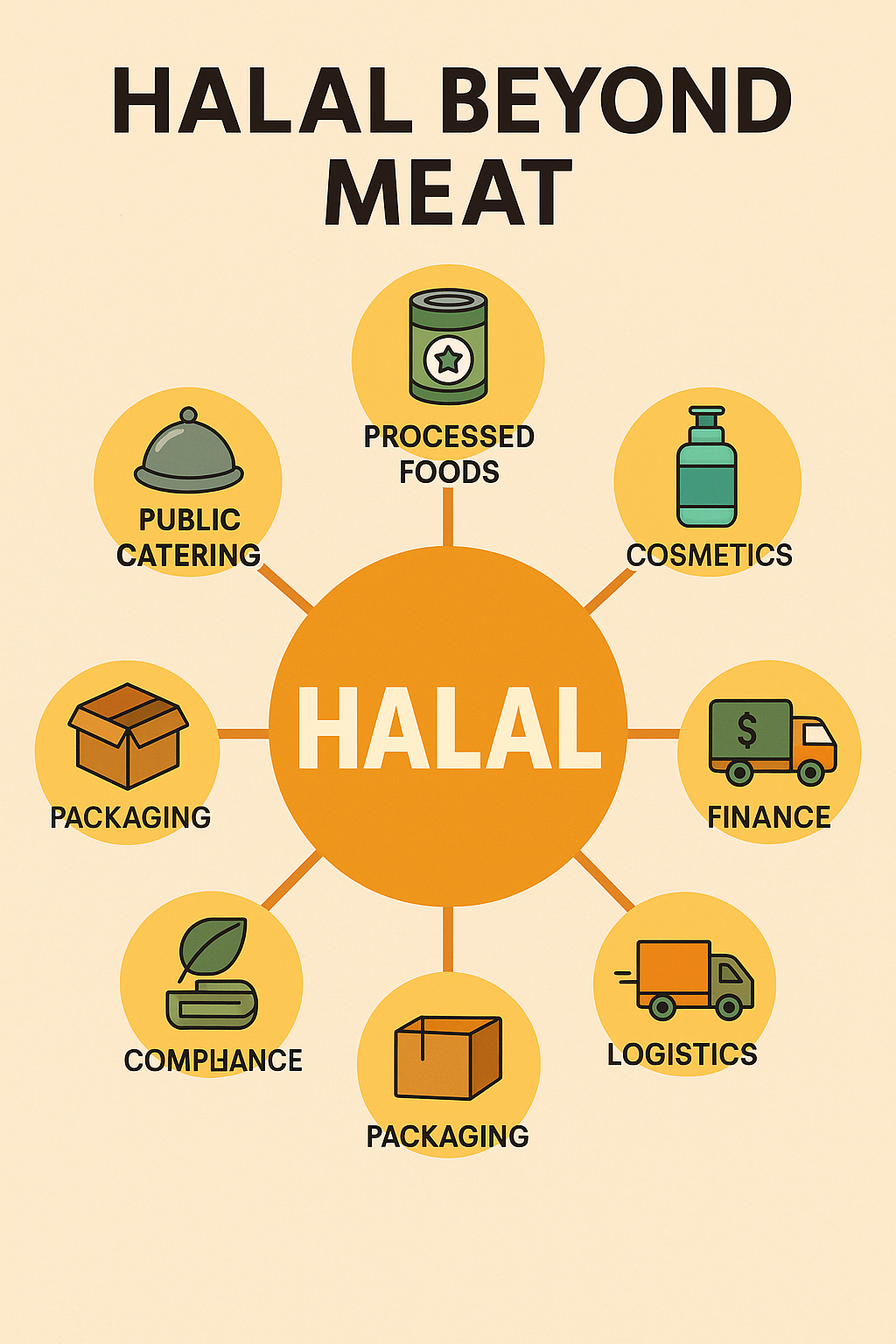
At the level of ground operations, the Halal ecosystem enforces soft exclusion through four mechanisms:
1. Faith-Based Hiring
Slaughter and processing rules require that only Muslims handle Halal meat. Even in export or bulk catering industries, Hindu butchers are often told they must convert to get hired.
2. Closed Certification Bodies
All major Halal certifiers in Bharat are religious entities or Islamic boards. No dharmic oversight or state audit exists. Certification fees are funneled into private religious institutions—with no clarity on where funds go.
3. Compliance-Driven Conformity
Public kitchens, airline caterers, even food stalls often adopt Halal by default—not out of law, but fear of rejection or violence. Hindu or Jain preferences are considered optional, but Halal is seen as mandatory.
4. Silenced Opposition
Attempts to protest this exclusivism are quickly branded as “Islamophobic” or “anti-minority,” despite legitimate civil rights concerns. When the UP government attempted to regulate domestic Halal labeling in 2023, mainstream media and international lobbies decried it as intolerance, despite the state’s exemption for exports.
5. Misuse of Funds
Halal certification is often presented as a neutral religious requirement, but its proceeds flow into opaque institutions without audit or regulatory checks. One of Bharat’s largest certifiers, Jamiat Ulama-e-Hind, has used its legal wing to defend individuals accused in major terror cases—including the 2008 Ahmedabad blasts—and to file petitions against films exposing Islamist violence. Public funds are monitored. Halal fees are not. [Read more in Annexure]
Beyond Meat – Halal in Pharma, Finance, and Cosmetics
Halal isn’t confined to food. In recent years, it has extended its influence into pharmaceuticals, personal care products, and finance—sectors that have nothing to do with consumption rituals but everything to do with institutional capture.

Halal in Cosmetics and Personal Care
Many global and domestic brands now voluntarily obtain Halal certification for products like soaps, lotions, and shampoos. This often means:
- Exclusion of alcohol and non-Halal animal derivatives—regardless of their safety or scientific utility.
- Certification from Islamic clerics—whose approvals are often required even for herbal or Ayurvedic products.
- Dharmic symbols or traditions, such as “gomutra” or “Panchagavya,” are either dropped or left uncertified to avoid Halal conflict.
Halal in Pharmaceuticals
Even capsules and injectables are being brought under Halal scrutiny. Manufacturers now seek Halal-friendly alternatives for gelatin or enzymes—even where no legal necessity exists. The result? Dharmic and secular science is filtered through religious standards.
Halal in Finance
Halal-compliant financial instruments, known as Sharia finance, are marketed as ethical alternatives. But in reality, they limit investment options to Islamic-approved ventures and exclude companies based on religious guidelines. In Bharat, some fintech startups have adopted these models, pushing faith-based economic segregation under the guise of inclusion.
Exclusivity by Design – Faith-Locked Supply Chains
Halal’s operational model is closed-loop and self-reinforcing. It is not just about certification—it is about creating an economic network that begins and ends within one community, structured around:
- Muslim-owned abattoirs and food-processing plants
- Certification bodies run by Islamic clerics
- Retailers, exporters, and distributors tied into a Halal-only ecosystem
The consequences are chilling:
- Non-Muslim entrepreneurs are quietly pushed out of key segments.
- Hindu religious slaughter methods like Jhatka are invisible, unsupported, or vilified.
- Dharmic dietary preferences lack any state support or regulatory parity.
What makes this more dangerous is the institutional silence around it. Halal compliance has become normalized—even expected—without consumer awareness, consent, or alternatives.
No Equivalent for Dharma – Legal Asymmetry
Unlike Islamic certification, there is no government or regulatory mechanism that promotes or protects dharmic dietary systems. Despite a sizeable demand for:
- Jhatka-certified meat
- Ayurveda-compliant products
- Satvik food labeling in airlines, hospitals, and schools
…none of these have legal backing or institutional promotion.
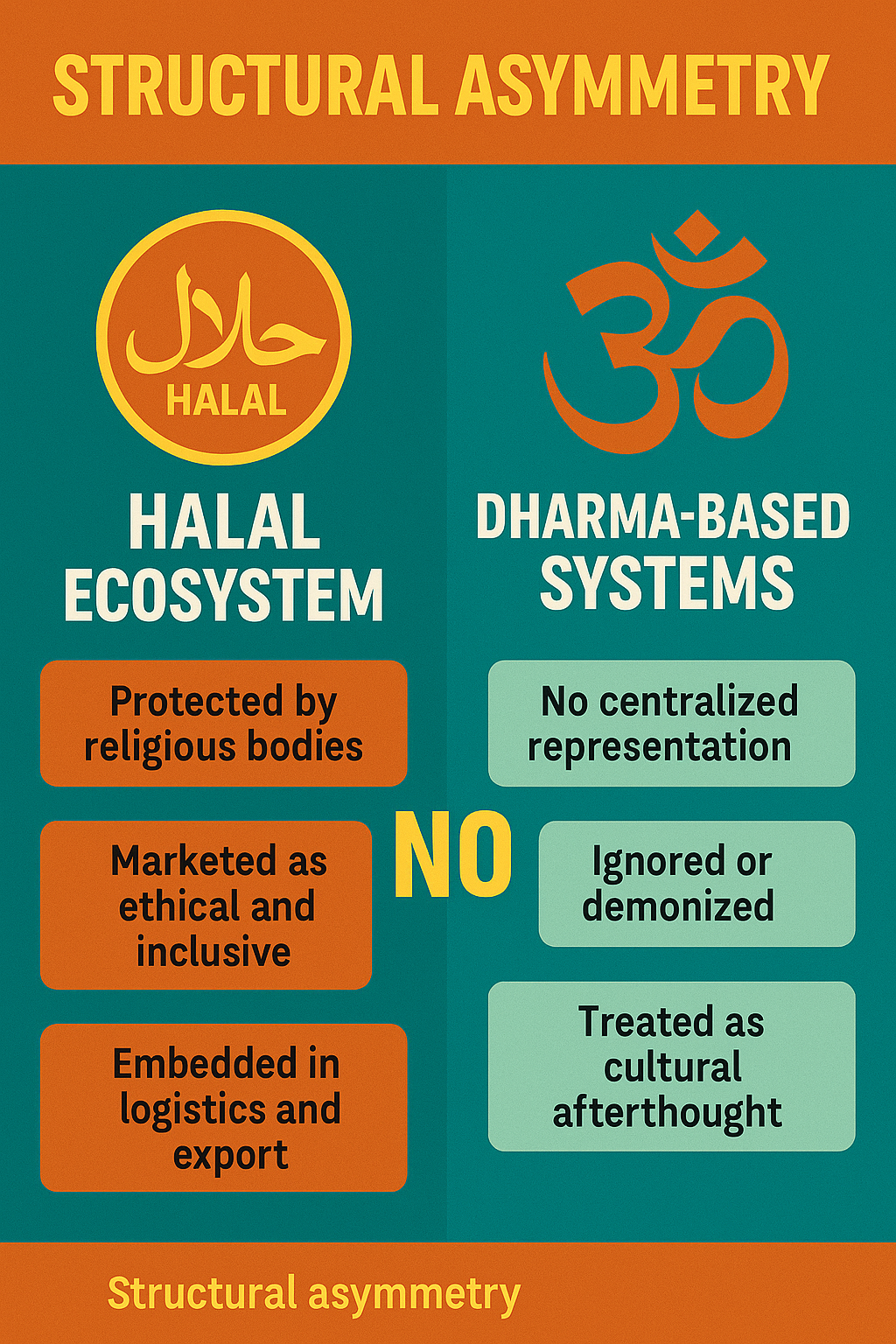
The asymmetry is structural:
| Halal Ecosystem | Dharma-Based Systems |
| Protected by religious bodies | No centralized representation |
| Marketed as ethical and inclusive | Ignored or demonized |
| Embedded in logistics and export | Treated as cultural afterthought |
This is not a level playing field. It is a faith-marked monopoly operating under the blindfold of secularism.
Halal Funds and the Ideological War Chest
Behind the sanitized label of “Halal certification” lies a deeper infrastructure—one that not only governs meat but finances ideological influence and legal warfare. Bharat’s most prominent certifier, Jamiat Ulema-e-Hind, doubles as a socio-political body with a track record of defending individuals accused of terrorism—including those linked to banned outfits like Lashkar-e-Taiba, Jaish-e-Mohammed, and ISIS.
🧾 Legal Activism with Ideological Roots
As reported by Times of India (July 2021), Jamiat runs a national legal cell to assist Muslims charged under anti-terror laws. These are not isolated acts of compassion, but systematic legal defenses even in high-profile bomb blast and foreign network cases.
Financial Opacity, Strategic Allegiances
While Jamiat collects Halal certification fees from across Bharat’s food supply chain, it maintains no transparent audit of how those funds are used. Meanwhile, OpIndia reports its legal and ideological backing for Zakir Naik, a fugitive charged with hate speech and terror financing.
Public Confrontation, Strategic Silence
When challenged by VHP and other Hindu groups, Jamiat did not deny its legal involvement with terror-accused individuals—it demanded “proof of funding,” ignoring the ethical question of why a religious certifier should be allowed to operate as a parallel defense institution.
This is not merely about food. It’s about how religious commerce can double as a legal firewall against national security laws—with no checks, no audits, and no parity.
The Narrative Shield – When Critique Becomes a Crime
For a system so expansive, Halal certification has remarkably little scrutiny. When questioned, it invokes a ready-made shield: the accusation of Islamophobia. Even legitimate consumer, economic, or legal objections are quickly reframed as hate speech, silencing all debate.
Media Deflection and Narrative Engineering
When Uttar Pradesh sought to regulate domestic Halal labels in 2023 (while exempting exports), the backlash was immediate. National outlets branded the move “intolerant,” and international lobbies raised alarms over “targeting minorities”—despite clear documentation of anti-competitive practices and consumer deception.
Soft Censorship, Hard Consequences
Critics face accusations of bigotry, even when they raise economic or legal questions:
- Why is there no state-backed Jhatka or Satvik label?
- Why is Halal often adopted in schools, hospitals, and flights without disclosure?
- Why are certification fees collected without financial audits?
Yet, none of these questions receive answers—only labels.
Double Standards in Civil Liberties
This weaponization of identity politics allows Halal proponents to enjoy full religious autonomy—while Hindu dietary systems are dismissed as casteist, regressive, or optional. Multiculturalism becomes a tool of selective empowerment.
When Debate Is Denied, Democracy Withers
Pluralism does not mean surrender. If one system of faith-driven commerce is allowed to regulate public food, finance, and legal defense networks—without parity, transparency, or debate—then secularism becomes a fig leaf for religious monopolies.
A full investigation into the funding pipelines and certification networks will be detailed in a follow-up blog. This section draws from publicly reported cases covered in mainstream news sources such as Times of India, Deccan Herald, Hindupost, and OpIndia.
Halal as Civilizational Infrastructure—Not Just a Choice
To treat Halal as “just a food preference” is to ignore its multi-sectoral reach, exclusive design, and theological rigidity. In Bharat, a secular state, the quiet normalization of Halal without equivalent recognition for dharmic systems violates both economic fairness and cultural dignity.
When only one belief system is permitted to regulate certification, supply chains, and public compliance—with legal tolerance and cultural silence—pluralism becomes performance. Economic asymmetry then feeds demographic advantage.
This is not a call to ban Halal. It is a call to unmask its exclusivist mechanics and demand equal civilizational footing for all communities.
📣 Call to Action
- 🏷️ Demand labeling parity—if Halal is labeled, so must Jhatka or Satvik be.
- 🧾 Insist on consumer disclosure—public kitchens, airline meals, and school catering must declare food standards.
- ⚖️ Challenge state bias—why is there no Hindu certification body with legal backing?
- 💬 Educate others—Halal is not just a choice; it is a system of economic control that must be balanced by equal representation.
Feature Image: Click here to view the image.
Annexure:
Attempts to protest the exclusivism of the Halal certification ecosystem are routinely dismissed as “Islamophobic” or “anti-minority,” even when rooted in legitimate consumer rights and civil liberties concerns. For example, when the Uttar Pradesh government moved to regulate domestic Halal labeling in 2023 (while exempting exports), a coordinated backlash ensued—fueled by mainstream media outlets and international lobbying groups. The framing was one-sided: economic transparency was called intolerance, and consumer protection became a communal controversy.
But the deeper issue isn’t just labeling—it’s what lies beneath the label.
Organizations like Jamiat Ulama-e-Hind (JUH), one of India’s largest Halal certifying bodies, also operate expansive legal and ideological defense networks. These activities are often funded through certification fees, yet they are not disclosed in public audits.
In 2022, JUH’s president Maulana Arshad Madani publicly declared that the group would challenge the conviction of the accused in the 2008 Ahmedabad bomb blasts, which killed 56 people (Economic Times).
In July 2025, JUH filed a petition in the Delhi High Court to ban the film “Udaipur Files”, which depicted the beheading of Kanhaiya Lal Teli by Islamists. The group claimed the film was “communal” and demanded censorship despite the film being based on judicial proceedings (LiveLaw).
According to OpIndia, JUH’s legal cell has provided legal support to over 700 individuals accused of terror-related crimes, including links to Al-Qaeda, ISIS, and Lashkar-e-Taiba—with funding and legal resources drawn from religious donations and possibly Halal certification revenue.
In other terror-linked cases, such as the Chandan Gupta murder during a Tiranga rally, JUH and other groups were reported to have offered legal shelter to the accused, portraying law enforcement action as communal targeting (Organiser).
Meanwhile, in cases where Muslim organizations have withdrawn legal aid—such as the Malad ISIS case in Mumbai—it was under media scrutiny and public pressure, not internal accountability (TOI).
These instances expose a chilling pattern: certification bodies are not neutral institutions. They collect unregulated funds under the guise of religious compliance but use them to shape public discourse, protect radical actors, and challenge counter-terror laws—while remaining shielded from public audits and regulatory parity.
Glossary of Terms:
1. Balrampur: A district in Uttar Pradesh, India, where a major conversion racket was exposed in July 2025 involving Jamaluddin, formerly Ghanshyam Rohera, accused of targeting Hindu women through fraud and coercion.
2. Jamaluddin (formerly Ghanshyam Rohera): A key accused in the ₹100 crore Balrampur conversion racket who used deceitful tactics such as fake jobs, false marriages, and financial lures to convert Hindu women.
3. Umar Gautam: A Delhi-based Islamic preacher and head of a conversion-focused NGO accused of forcibly converting disabled children and Dalits under the guise of charity and development aid.
4. Conversion Bounties: Financial incentives allegedly offered by conversion networks to operatives for successfully converting individuals from Hinduism, often higher for upper-caste Hindus and Sikhs.
5. Demographic Reprogramming: A strategic attempt to alter the religious and cultural composition of a population through targeted conversions, migration, or birth-rate manipulation.
6. NGO Web: A network of non-governmental organizations, often foreign-funded, that operate in sectors like education, healthcare, and human rights but are alleged to be involved in covert religious conversion.
7. Foreign-Funded NGOs: Organizations in India receiving donations from overseas entities, sometimes accused of misusing funds for proselytization under the guise of humanitarian work.
8. Development Aid: Financial or material assistance provided ostensibly for economic or social development, often used by some NGOs as a cover for religious conversion activities.
9. Anti-Conversion Laws: State-level laws in India aimed at preventing religious conversions by force, fraud, or inducement; often criticized as weak or inconsistently enforced.
10. Dalits: Historically marginalized communities in the Hindu caste system, frequently targeted by missionary groups for conversion under the pretext of social upliftment.
11. Caste-Based Incentives: Targeted financial or material rewards offered during conversions based on an individual’s caste identity, often used to exploit caste-based vulnerabilities.
12. Civilizational Substitution: The process by which an indigenous culture or religious identity is gradually replaced by another, often through systemic efforts like conversion or demographic pressure.
13. Legal Insulation: A condition where individuals or organizations are shielded from scrutiny or action due to legal loopholes, exemptions, or political protections.
14. Human Rights Watchdogs: International or domestic organizations that monitor and report on human rights violations; often criticized in Bharat for one-sided portrayals when conversions are investigated.
15. Demographic Dividend: An economic term describing the potential growth benefit from a younger, growing population; in the blog, it is contrasted with demographic loss through conversion.
#HinduinfoPedia #ReligiousConversion #FaithEngineering #NGOFunding #DemographicChange
Earlier Blogs of the Series
- https://hinduinfopedia.com/population-growth-or-jihad/
- https://hinduinfopedia.com/population-trends-and-the-power-of-belief/
- https://hinduinfopedia.com/fertility-and-faith-when-welfare-rewards-the-womb/
- https://hinduinfopedia.com/fertility-and-muslim-growth-state-benefits-benefit-population-growth/
- https://hinduinfopedia.com/population-dividend-or-demographic-risk/
Key References
1. Export–Domestic Halal Spillover (APEDA & Salaam Gateway)
- APEDA continues to mandate Halal certification for export-oriented red-meat plants, with domestic observance shaped by export-preparation practices
- https://salaamgateway.com/story/halal-even-by-no-name-india-continues-to-export-meat-by-islamic-requirements-despite-govt-dropping-t
2. Export Scale & Economic Weight
- India’s Halal meat exports reached approximately USD 3.2 billion in 2024, comprising over 50% of buffalo meat exports
- https://salaamgateway.com/story/halal-even-by-no-name-india-continues-to-export-meat-by-islamic-requirements-despite-govt-dropping-t
- The India Conformity Assessment Scheme (i-CAS) – Halal was updated in 2024 to streamline certification for OIC imports
- https://salaamgateway.com/story/halal-even-by-no-name-india-continues-to-export-meat-by-islamic-requirements-despite-govt-dropping-t
3. Certification Governance & Religious Control
- Halal certification in India is handled by religious NGOs/Islamic trusts (e.g., Jamiat Ulema-e-Hind), not by the state
- https://en.wikipedia.org/wiki/Halal_certification_in_India
4. Domestic Commercial Compliance
- Even after removing the word “Halal” from manuals, industry insiders confirmed that Halal practices continue dominantly among export processors
Salaam Gateway.
5. Opposition & Regulatory Response
- The 2020 decision to drop “Halal-only” in APEDA manuals sparked criticism from Hindu groups, who flagged economic losses for non-Muslim butchers .
- Ombudsman filings in the Supreme Court highlighted concerns about misleading certification of non-food products .
6. Halal Expansion Beyond Food
- Halal certification now extends into cosmetics, personal care, and pharmaceuticals, with growing financial and technological backing Corpuspublishers.com.
7. Market Influence of Halal Labels
- Studies show the Halal label significantly affects consumer decisions, especially in cosmetic and skincare sectors radenintan.ac.id.
8. Jamiat Ulama-e-Hind
Related Posts
- https://hinduinfopedia.org/muslim-population-growth-and-its-global-impact/
- https://hinduinfopedia.org/delhi-riots-2020-unmasking-the-real-causes-beyond-the-caa/
- https://hinduinfopedia.org/hindu-persecution-in-west-bengal-the-struggles-of-the-minority/
- https://hinduinfopedia.org/attacks-on-hindus-a-threat-to-identity/
- https://hinduinfopedia.org/bangladesh-hindu-persecution-cost-of-tolerance-and-unity-call-part-vi/
- https://hinduinfopedia.org/mahatma-gandhi-life-and-legacy-perspectives-from-history/
- https://hinduinfopedia.org/afghanistan-soviet-war-the-world-peace-disrupter/
- https://hinduinfopedia.com/islamic-marriage-and-deceptive-conversions/
- https://hinduinfopedia.in/islamic-extremism-linked-murder-of-delhi-police-officer-ratan-lal/
- https://hinduinfopedia.in/sharia-law-in-practice/
- https://hinduinfopedia.in/safety-sharia-and-stark-realities/
- https://hinduinfopedia.in/waqf-law-an-excuse/
- https://hinduinfopedia.in/selective-judgement-of-waqf-act/
- https://hinduinfopedia.in/waqf-act-and-judging-justice/
- https://hinduinfopedia.in/waqf-act-unrest-is-this-just-about-waqf/
Follow us:
- English YouTube: https://www.youtube.com/@Hinduofficialstation
- Hindi YouTube: https://www.youtube.com/@HinduinfopediaIn
- X: https://x.com/HinduInfopedia
- Instagram: https://www.instagram.com/hinduinfopedia/
- Facebook: https://www.facebook.com/Hinduinfopediaofficial
- Threads: https://www.threads.com/@hinduinfopedia
[…] Halal Food or Exclusivist Agenda: Faith-Commerce Intersection […]
[…] https://hinduinfopedia.com/halal-food-or-exclusivist-agenda-faith-commerce-intersection/ […]
[…] extends beyond demographics into what functions as economic warfare. Our investigation into halal food practices—verified in both Indian and international market analyses—shows exclusionary patterns that go […]
[…] Economic Persecution: Systematic property confiscation and economic exclusion that mirrors the patterns I documented in my analysis of halal food exclusion mechanisms. […]
[…] attack on festivals aligns with patterns in economic exclusion. Our blog Halal Food or Exclusivist Agenda detailed how faith-based commerce sidelines Hindus from food supply chains and certification […]
[…] districts like Malda, Sambhal, Bradford. Prevent the economic displacement that accelerates exodus. Economic segregation precedes residential […]
[…] connection between the Halal economy, Zakat flows, and food contamination networks is traceable — not hypothetically, but through the […]