

Ahmedabad Air Crash Investigation: How Boeing’s Billions Rewrote the Black Box
When the Ahmedabad Air Crash Investigation Served Wall Street, Not the Victims
On June 12, 2025, Air India Flight AI171 crashed shortly after takeoff from Ahmedabad, killing 260 people and leaving a single survivor. But what followed was even more disturbing than the tragedy itself — an Ahmedabad Air Crash investigation that unfolded like a script. Western media, led by The Wall Street Journal, blamed the pilot before the black box was even opened. India’s preliminary report echoed only the most basic observations, known equipment flaws were ignored.
Our first blog in this series exposed how early narratives were seeded and the official report offered precision without courage — confirming fuel switches in “CUTOFF” position but avoiding alternate explanations, key precedents like the ANA 2019 incident, and even expert theories from Indian aviation analysts. It also questioned why Boeing — the very company under scrutiny — was allowed to participate in shaping the findings before Indian authorities completed their own review.
This second blog goes deeper into the Ahmedabad Air Crash investigation — focusing on the human factors neglected in the rush to blame, the known design flaws that were brushed aside, the search algorithm suppression that buried public scrutiny, and the corporate pressure that rewrote the black box before it was heard.
Psychological and Human Factors: The Missing Layer in the Crash Investigation
In the rush to assign blame after the Ahmedabad Air Crash, some media outlets floated theories of suicide — without data, without context, and without dignity. But real aviation investigation requires more than speculation. It demands an honest look at human factors — the psychology of flight crews, the impact of fatigue, and the invisible threads of Crew Resource Management (CRM) that bind cockpit decisions.
The cockpit voice recording excerpt — “Why did you cut the fuel?” followed by “I didn’t” — doesn’t confirm intent. It reflects confusion. And in the high-stress environment of takeoff, even minor misunderstandings can cascade. The question isn’t only who did what — it’s what conditions shaped that exchange.
Pilots operate under intense pressure: erratic schedules, back-to-back sectors, short layovers, and immense responsibility. Yet no part of the official investigation considered whether fatigue or CRM breakdowns could have triggered an accidental or miscommunicated action. That omission matters — not just for defending the crew, but for preventing the next tragedy.
This isn’t about shifting blame from Boeing or the fuel switch. It’s about completeness. A full Ahmedabad Air Crash investigation must account for cockpit dynamics alongside design flaws. Because what happened in those final seconds wasn’t a headline — it was a human moment, in a human machine.
Search is Silenced: When Algorithms Join the Cover-Up
As this blog was being written, the author attempted to use Google’s Keyword Planner—a basic SEO tool—to check what people were searching in relation to the crash: “air india 117 crash,” “Ahmedabad Air Crash,” “dreamliner crash,” and similar terms.
Here’s what the author found:
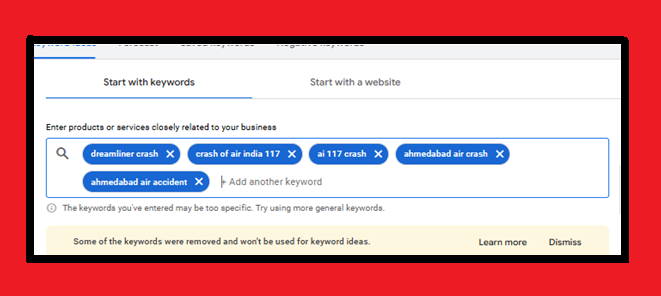
All these search terms were flagged as “too specific.” Google refused to generate keyword ideas—effectively making it impossible to create visibility campaigns around them. In SEO terms, the crash was digitally redacted.
When a story is buried by code, not censorship, it’s harder to see—and harder to challenge.
So, not only was a pilot blamed within hours…
Not only did Boeing shape the investigation behind closed doors…
Not only did the Western media plant a theory before the black box spoke…
Now, the world’s largest tech company has sealed the search visibility—algorithmically muting interest in one of the most high-profile crashes of the decade.
This is no longer just narrative control.
It’s systemic suppression—executed at the speed of data.
And who benefits when curiosity is silenced?
Search suppression isn’t random — it serves those with the most to lose. In this case, that means Boeing. Because if people dig deeper, they won’t just find CVR transcripts or fuel switch diagrams — they’ll uncover a legacy of safety failures, cover-ups, and quiet payoffs. Suppressing search interest shields a pattern. And that pattern begins long before Ahmedabad.
Boeing’s Safety Record: Blood in the Clouds
Boeing’s safety reputation isn’t merely stained — it’s marred by a pattern of preventable tragedies.
In 2018 and 2019, two Boeing 737 MAX jets — operated by Lion Air and Ethiopian Airlines — crashed within five months, killing 346 people. Investigations pointed to a flawed flight control system (MCAS) concealed from pilots. Internal documents revealed Boeing lobbied against mandatory simulator training, prioritizing cost savings and delivery timelines over safety.
But the problem wasn’t just in software. It ran deeper — into the corporate culture.
In March 2024, John Barnett, a former Boeing quality manager who exposed serious safety concerns at the South Carolina plant, was found dead from a gunshot wound in his truck — while in the middle of a legal deposition. Authorities ruled it a suicide. But Barnett had previously reported threats, and many saw the timing as too convenient.
He wasn’t alone. Other whistleblowers have faced termination, lawsuits, or gone quiet after raising red flags — some involving pressure to falsify inspection records or overlook defective components.
This isn’t just a series of failures. It’s a system.
Profit over protection. Silence over scrutiny.
A 2021 U.S. Senate report found that Boeing “systematically cut corners,” and accused the FAA of acting as a passive partner instead of an enforcer.
So when AI171 crashed, Boeing didn’t wait for the facts to emerge. It appeared to move swiftly — not just to assist, but possibly to contain the fallout. After all, another safety scandal wouldn’t just alarm passengers; it could shake investor confidence, ripple through global markets, and reignite scrutiny Boeing can ill afford.
Captain Sabharwal didn’t just fly a plane.
He flew for a brand already under pressure — one where another headline could mean more than just reputational damage.
Fuel Switch Fiasco: A Known Defect, Ignored
Here’s what most media outlets won’t tell you:
The fuel control switch — the same one reported to be in the “CUTOFF” position in the AI171 crash — has been flagged before. Its ambiguous labeling, poor tactile feedback, and positioning near high-use areas made it a known hazard long before Ahmedabad. In certain Boeing 787 configurations, a gloved hand or quick motion during takeoff could toggle it unintentionally — without the pilot even noticing.
“In certain Boeing 787 configurations, a gloved hand or quick motion during takeoff could toggle it unintentionally — without the pilot even noticing.”
– Aviation source quoted in several post-crash analyses
The fuel‑control switch in question has been flagged in previous reports—but experts clarify it’s a deliberate ‘lift–move–drop’ mechanism with a locking spring, not a simple toggle. Aviation instructor Alan Colman notes that one must pull up before moving the switch, making accidental activation extremely unlikely [Ref 1]. Yet even if both switches were deliberately moved, the simultaneous dual‑engine shutdown remains perplexing. For two experienced pilots to move the locks in rapid succession—within seconds of takeoff—raises critical questions about cockpit decision-making or deeper design vulnerabilities. But the advisory was just that — a suggestion, not a rule. No Airworthiness Directive (AD) was issued. No compulsory simulator training was enforced. The reasoning? “Implementation costs and fleet-wide practicality.”
Airlines, always walking a tightrope between safety and operating margins, treated it like most optional advisories — they skipped it. Boeing, in the meantime, had its defense prepared in writing: “We issued a bulletin. If airlines didn’t act, it’s on them.”
But let’s be clear: that’s not accountability. That’s engineered deniability.
In internal Boeing notes surfaced during previous crash investigations, engineers had warned that the fuel switch design posed “ergonomic risk under vibration conditions,” especially during takeoff. Yet updates were deferred. Why? Because making the fix mandatory meant global simulator changes, retraining, hardware retrofits — and most dangerously, admitting fault.
So when AI171 fell from the sky, Boeing didn’t need to scramble. Its paperwork already pointed the blame away — toward a silent switch, an optional fix, and two pilots no longer alive to defend themselves.
This wasn’t negligence.
This was a calculated trade-off: cost vs consequence — and the passengers lost.
The Dow Jones Connection: Why Truth Hurts
Wall Street’s Stake in Silence
The Wall Street Journal is owned by News Corp — which also owns Dow Jones, the body that manages the Dow Jones Industrial Average (DJIA), a key barometer of the U.S. economy.
Boeing is one of its leading components.
With a market cap of $172 billion, Boeing represents 3.3% of the DJIA. A major safety scandal can trigger a significant drop — affecting pension funds, 401(k) accounts, and global institutional holdings. With over $524 billion in pending aircraft orders, including $405 billion in undelivered revenue, even a temporary dent in reputation could lead to cascading financial repercussions.
In such a high-stakes environment, narrative control is not just advantageous — it can be essential.
That’s why some observers suggest the WSJ’s early framing may have served more than public awareness.
Blame the pilot early → protect Boeing stock → shield the index → stabilize the markets.
This wasn’t just journalism reporting facts.
It appeared more like a financial firewall — deflecting risk through narrative framing.
Because if Air India Flight AI171 is conclusively tied to Boeing’s hardware flaws, the impact wouldn’t stop in India.
It would ripple through Wall Street’s core.
As for the digital disappearance of key search terms — that, too, fits a broader pattern.
One where truth is not erased by censorship, but quietly sidelined by algorithms and institutional priorities.
No corporation reflects this convergence of influence, risk, and silence more than Boeing.
The Ahmedabad Air Crash Investigation Is Still Unfinished
The Ahmedabad Air Crash investigation has revealed more than a technical failure — it has uncovered a system primed to protect reputations over lives. Psychological stressors, cockpit coordination breakdowns, and known equipment flaws were ignored. Algorithmic suppression of search visibility made public debate nearly impossible. Boeing’s history of safety compromises and lobbying was left untouched — even as its top executive flew into Delhi days after the crash, before the black boxes were even recovered.
What began as an air disaster has become a test case in narrative control. This blog has shown how facts were buried beneath corporate messaging, and how silence became a strategy — from regulators, from media, and even from tech platforms.
But silence can’t rewrite everything.
The Ahmedabad Air Crash investigation is not over — not for the families, not for the pilots’ reputations, and not for the credibility of India’s aviation safety apparatus.
In Part 3, we will explore the unreleased transcript, the final data trail, and the possibility of reopening the inquiry — not just for justice, but for national integrity.
Feature Image: Click here to view the image.
Glossary of Terms
-
Airworthiness Directive (AD): A legally enforceable regulation issued by aviation authorities mandating corrective action on identified safety issues in aircraft design, manufacturing, or operation.
-
Boeing 787 Dreamliner: A long-haul, wide-body aircraft developed by Boeing. Flight AI171 was a Boeing 787-8 model, known for its advanced composite structure but also flagged for certain system vulnerabilities.
-
Black Box: A colloquial term for the cockpit voice recorder (CVR) and flight data recorder (FDR), which store crucial data and audio for post-crash investigations.
-
Cockpit Voice Recorder (CVR): A device in an aircraft that records all audible communication and sounds in the cockpit for accident investigation purposes.
-
Crew Resource Management (CRM): A set of training procedures focusing on communication, decision-making, and teamwork among flight crew to ensure safety and reduce human error.
-
Cutoff Position: A mode on the fuel control switch that stops the flow of fuel to an engine. In AI171’s case, both switches were reportedly found in this position post-crash.
-
Dow Jones Industrial Average (DJIA): A major U.S. stock market index tracking 30 large public companies, including Boeing. Its movement often influences global financial sentiment.
-
Ergonomic Risk: The potential for physical or cognitive strain due to poor design or layout of equipment, such as a mispositioned switch that can be unintentionally toggled.
-
FAA (Federal Aviation Administration): The U.S. government agency responsible for regulating all aspects of civil aviation in the country. It has oversight authority over Boeing aircraft certification.
-
Flight Control Software (MCAS): Maneuvering Characteristics Augmentation System; a software system in Boeing 737 MAX jets blamed for two major crashes due to faulty sensor input.
-
Gloved Hand Error: A form of accidental input or action triggered by a gloved pilot hand during high-movement phases like takeoff, particularly relevant for poorly positioned switches.
-
Keyword Planner (Google): A tool used in SEO to research search volumes and trends. The blog documents its failure to return results on the AI171 crash, indicating algorithmic suppression.
-
Narrative Hedge: A media or PR strategy that preemptively sets a storyline to manage reputational or financial fallout, especially before evidence is available.
-
News Corp: A global media conglomerate that owns The Wall Street Journal and Dow Jones, creating a potential conflict of interest in reporting on companies like Boeing.
-
Pilot Suicide Narrative: A theory often used in aviation disasters where pilot error or deliberate action is speculated as the cause — sometimes before official evidence is released.
-
Search Suppression: The deliberate or algorithm-driven restriction of online search visibility on specific topics, limiting public awareness or inquiry.
-
Systemic Suppression: A coordinated or built-in process—across media, tech, and regulatory systems—that protects corporate or state interests by obscuring facts or narratives.
-
Wall Street Journal (WSJ): A leading U.S. business newspaper that published early speculation on the AI171 crash, suggesting pilot intent before black box data was recovered.
-
Whistleblower: An individual, often an employee, who exposes unethical or illegal practices within an organization. The blog references Boeing whistleblower John Barnett.
-
Optional Advisory: A non-mandatory recommendation issued by aircraft manufacturers, often not enforced due to cost or logistical challenges, despite known safety risks.
#AirCrash #Boeing #MediaControl #FlightAI171 #HinduinfoPedia
References
- WSJ article Link: https://www.wsj.com/world/asia/air-india-crash-senior-pilot-eab72db5
- Reuters article Link: https://www.reuters.com/world/india/ntsb-chair-says-media-reports-air-india-crash-are-speculative-premature-2025-07-18/
- The Sun Link: https://www.thesun.co.uk/news/35884649/air-india-crash-captain-sabharwal-fuel-switches/
- Vox Link: https://www.vox.com/culture/420667/air-india-crash-investigation-update-mental-health
- Newsweek Link: https://www.newsweek.com/pilot-murder-suicide-air-travel-2100979
- [Ref 1] https://www.dailymotion.com/video/x9mss48
Previous Blog
Ahmedabad Air Crash: The Narrative That Took Off Before the Report
Later Blogs
Ahmedabad Air Crash Fallout: When Indian Media Echoed the American Spin
[…] 👉 Read Full Blog […]