

Ahmedabad Air Crash Fallout: When Indian Media Echoed the American Spin
Ahmedabad Air Crash Fallout: Investigation Vs Consequences
The tragedy of Air India Flight AI171 was not just marked by the lives lost on June 12, 2025 — but by the unsettling way its story was told. Our first blog explored how global media, led by the Wall Street Journal, framed the crash as a case of pilot error or suicide — well before India’s investigators had retrieved the black box. The second piece examined how Boeing’s early involvement, known equipment flaws, and search engine suppression raised troubling questions about who was shaping the official narrative. This third and final chapter dives deeper into the Ahmedabad Air Crash Fallout — beyond the wreckage and into the corridors of diplomacy, economics, media influence, and national silence.
What happens when truth is shaped not by evidence, but by corporate risk?
When a global brand is shielded, and a nation’s voice is quieted?
This is not just the story of a crash. It is the story of how its meaning was managed — and who was allowed to speak.
Ahmedabad Air Crash Fallout: Timeline of Events vs Narrative Control
- June 12, 2025 – Air India Flight AI171 crashes near Ahmedabad, killing 260.
- June 13–16, 2025 – Flight data and cockpit voice recorders (black boxes) are recovered.
- June 16–17, 2025 – Boeing Commercial Airplanes CEO Stephanie Pope visits India; closed-door meetings with Air India, DGCA, and Civil Aviation Ministry.
- June 24–25, 2025 – Black boxes are transferred to AAIB Delhi lab; data successfully decoded.
- July 12, 2025 – AAIB releases preliminary report confirming fuel switches in CUTOFF position; no provisional cause assigned.
- July 17, 2025 – Wall Street Journal publishes a narrative suggesting pilot suicide — before full transcript or crew analysis.
- As of July 24, 2025 – No final crash report released; systemic factors and alternative technical theories remain unaddressed.
Corporate Diplomacy in the Ahmedabad Air Crash Fallout
As covered in our earlier investigation, Boeing’s top executive, Stephanie Pope, arrived in New Delhi just days after the crash — before the black box was even opened. But what deserves renewed attention is not the visit itself, but what it signaled: narrative control had begun before the data had even spoken. This moment marked a pivotal turn in the Ahmedabad Air Crash Fallout, where diplomacy overtook data, and corporate access preceded national analysis. Officially, it was called a “routine coordination visit.” But there was nothing routine about it.
The black boxes hadn’t even been decoded. Investigators hadn’t concluded their on-site inspections. Families hadn’t completed their cremations. Yet Boeing was already in the room — not with technical teams, not with engineers or flight control specialists — but with executives and corporate liaisons.
Accompanying Pope were representatives from GE Aerospace, the engine manufacturer. Yet conspicuously missing were any figures from Boeing’s Avionics division — the very team responsible for the flight control systems that should have been under scrutiny.
Even more troubling, she met behind closed doors with:
- Tata Sons chairman N. Chandrasekaran, who oversees Air India,
- Senior Ministry of Civil Aviation officials, and
- DGCA representatives, whose job is to regulate, not negotiate.
No meeting minutes were released. No press statements followed. No public briefing took place.
This wasn’t a post-crash audit. This was pre-emptive diplomacy.
What exactly was being coordinated? Safety? Or spin?
Key Message: This wasn’t a technical response. It was narrative preemption dressed as diplomacy.
Sovereign Blindspot in the Ahmedabad Air Crash Fallout
Bharat had a choice — and it chose silence.
$34 billion. That’s the size of Air India’s current commitment to Boeing. 220 jets, thousands of downstream jobs, major infrastructure expansions, and national pride riding on the airline’s relaunch. The stakes weren’t just aviation — they were symbolic of a rising India reclaiming global skies.
And that made India vulnerable.
Unlike France, China, or Brazil — where air crash investigations are deliberately kept sovereign until early-stage technical findings are complete — India allowed Boeing in before its own analysis was done. Boeing wasn’t treated as a company under scrutiny. It was treated as a stakeholder.
Why?
Because India’s aviation future was already intertwined with Boeing’s balance sheet. Raising questions too early might trigger:
- Delays in aircraft delivery,
- Pressure on employment generation,
- Or worse, investor panic at a time when Air India’s privatization was being showcased globally.
The DGCA and AAIB didn’t push back. They opened the door — a decision that would later shape the trajectory of the Ahmedabad Air Crash Fallout and the global perception of India’s aviation independence. And once Boeing entered, the investigative narrative was no longer ours alone.
Bharat blinked — not out of fear, but out of economic caution.
Key Message: National silence became the price for global partnership.
Weaponizing Psychology: Mental Health Framing Without Basis
Before the investigation could offer clarity, speculation filled the void — led by Western media headlines that leaned on mental health as an explanation.
Within hours of the July 12 preliminary report, and even before full CVR analysis, an unnamed “US official” floated the theory: Captain Sabharwal may have committed suicide.
Let that sink in:
- No autopsy was performed.
- No suicide note was recovered.
- No psychological evaluation was cited.
Captain Sabharwal wasn’t a novice — he had logged over 15,600 flight hours, including more than 8,600 hours on Boeing 787s. A profile of this calibre demands evidence, not insinuation. Yet in the broader Ahmedabad Air Crash Fallout, such reputations were reduced to convenient plot points — easy to frame, impossible to defend.
This wasn’t the first time mental health had been used as an easy scapegoat in aviation disasters. But in this case, the pilot’s last recorded voice — calm, not erratic — directly contradicted the insinuation.
Also ignored were real human factors:
- Was the crew fatigued?
- Was Crew Resource Management (CRM) compromised under stress?
- Did poor labeling or vibration trigger accidental action?
None of this was considered. The psychology of pressure, confusion, cockpit protocol — all discarded for a single, salacious theory.
Because suicide is clean. It explains everything without explaining anything. And most importantly — it can’t speak back.
Key Message: Mental health became a scapegoat — and the victim couldn’t speak back.
Digital Blackout: Ahmedabad Air Crash Vanishes from Search
Not all censorship is explicit. Sometimes, it hides behind code.
When concerned citizens, journalists, and aviation observers tried searching for updates on “Ahmedabad Air Crash,” “AI171 crash,” or “Dreamliner accident India,” they hit a strange wall: Google’s Keyword Planner refused to register these phrases. The tool flagged them as “too specific” or having “insufficient data.”
This wasn’t an obscure topic. This was India’s deadliest aviation disaster in over a decade — with global implications. Yet digitally, it was being algorithmically erased.
The world’s most powerful search engine had made curiosity invisible.
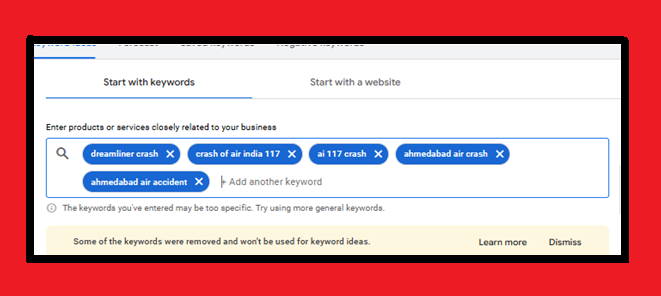
This wasn’t a random glitch. It was part of a broader pattern of suppression:
- Media didn’t publish cockpit transcripts.
- Social media platforms downranked critical discussions.
- SEO tools locked out journalists trying to optimize for visibility.
When algorithms mute accountability, they don’t protect the public — they protect power. In this case, the power to shape perception lay with corporations and their allies, not citizens or victims.
Ahmedabad Air Crash Fallout wasn’t just in flames and headlines. It was in the silence of search bars — a silence coded by design.
It was one of the most invisible dimensions of the Ahmedabad Air Crash Fallout — not just a silence in speech, but a silence engineered into the infrastructure of visibility itself.
This kind of invisibility isn’t new. When uncomfortable truths threaten powerful interests, stories are either buried or redirected. Whether through search engines or breaking headlines, the machinery of perception management has long been weaponized — and the fallout of AI171 followed a disturbingly familiar playbook.
Key Message: When search engines fail truth, silence becomes systematic.
Ahmedabad Air Crash Fallout: From WMDs to WSJ
We’ve seen this script before.
When the U.S. needed justification for the Iraq War, it pushed the Weapons of Mass Destruction (WMD) lie. The global media carried it without question. Years later, when there were none, no accountability followed.
When Huawei rose as a global tech competitor, security threats were floated — without proof. When TikTok gained dominance, data privacy concerns became the excuse for market bans.
In each case, media narratives preceded legal action.
And like those examples, the Ahmedabad Air Crash Fallout shows how media framing can serve national and corporate interests — long before facts are confirmed, and far away from the actual crash site.
And now, with the Ahmedabad Air Crash Fallout, we see the same pattern:
- A major American company under scrutiny.
- Global reputational risk.
- A convenient scapegoat.
- Western media stepping in early — before India’s own agencies finished analyzing the evidence.
The Wall Street Journal, owned by News Corp, which owns Dow Jones, which runs the DJIA — where Boeing is a core component — didn’t just report the crash. It front-ran the narrative. It planted the idea that Captain Sabharwal may have crashed the plane intentionally, without waiting for voice-matching, motive, or black box conclusions.
“This wasn’t journalism. This was a financial firewall.”
— On how the Wall Street Journal front-ran the narrative to protect Boeing, not report truth
This wasn’t journalism. This was a financial firewall.
Because if AI171’s cause turns out to be a Boeing design flaw, the repercussions could shake Wall Street — and damage America’s industrial prestige globally.
And those who’ve tried to expose Boeing before have faced tragic consequences. From John Barnett, found dead mid-deposition in 2024, to other silenced whistleblowers, the system has a pattern — not of transparency, but of suppression.
Key Message: This crash became another casualty of the media-state-industrial loop.
When Bharat’s Truth Was Outsourced
260 lives. One survivor. And a truth still buried under wreckage and press releases.
The Ahmedabad Air Crash Fallout wasn’t just a technical investigation. It became a test of Bharat’s narrative sovereignty. A test we didn’t pass.
We allowed:
- A foreign media outlet to define our truth.
- A foreign corporation to shape our investigation.
- A regulatory silence to replace national outrage.
We didn’t insist on independent avionics review.
We didn’t push back on search suppression.
To this day, Vishwash Kumar Ramesh, the sole survivor of AI171, has not made any public statement — a silence that could be trauma, caution, or consequence.
Instead, we let others write the story.
And the cost isn’t just institutional — it’s moral.
If Bharat won’t defend its own dead from defamation,
If we won’t speak for our own skies when they fall,
Then we’ve outsourced more than our airplanes —
We’ve outsourced our courage.
“If Bharat won’t defend its own dead from defamation, then we’ve outsourced more than our airplanes — we’ve outsourced our courage.”
— On India’s failure to push back against a foreign-led narrative in the wake of the AI171 crash
But it’s not too late.
Because silence, once broken, echoes louder than scripted lies.
And only by exposing every layer of the Ahmedabad Air Crash Fallout — from narrative engineering to digital erasure — can Bharat reclaim the right to speak for its skies.
Let the final report — which, as of this writing, remains pending — come. Let the data speak.
Let independent truth — not influence — decide what happened on AI171.
And let Bharat never again be silent when sovereignty is on the line.
🚨 Final Call to Action
Ahmedabad Air Crash Fallout isn’t finished.
This isn’t just aviation — it’s about how truth is written, and by whom.
📢 If this shook you, share it.
📜 If this informed you, demand transparency.
🧭 If this angered you, remember — silence is a choice. But so is courage.
👉 Next Blog in Series: Truth Beyond the Tape: What the CVR Might Still Reveal
Feature Image: Click here to view the image.
Glossary of Terms
- AAIB (Aircraft Accident Investigation Bureau): The Indian agency under the Ministry of Civil Aviation responsible for investigating aircraft accidents and incidents within India.
- AI171: The flight number of Air India’s Boeing 787 Dreamliner that crashed on June 12, 2025, shortly after takeoff from Ahmedabad en route to London, killing 260 people.
- Boeing 787 Dreamliner: A long-haul, wide-body, twin-engine aircraft developed by Boeing. It is known for its advanced avionics, fuel efficiency, and past safety controversies.
- CVR (Cockpit Voice Recorder): A black box component that records cockpit audio, including pilot conversations, alarms, and radio communications, used in crash investigations.
- DGCA (Directorate General of Civil Aviation): India’s regulatory authority for civil aviation, responsible for licensing, airworthiness, safety, and regulation enforcement.
- CRM (Crew Resource Management): A set of training procedures for use in environments where human error can have serious consequences, focusing on communication, decision-making, and teamwork in the cockpit.
- DJIA (Dow Jones Industrial Average): A stock market index of 30 major American companies, often used as a barometer of the U.S. economy. Boeing is one of its top components.
- FAA (Federal Aviation Administration): The civil aviation regulatory body of the United States, responsible for aircraft certification, safety oversight, and air traffic control standards.
- GE Aerospace: The manufacturer of jet engines for Boeing aircraft, including those used on the 787 Dreamliner involved in the AI171 crash.
- John Barnett: A former Boeing quality manager and whistleblower who raised concerns about safety practices at Boeing’s South Carolina plant; found dead in March 2024 during legal proceedings.
- MCAS (Maneuvering Characteristics Augmentation System): A flight control system linked to two fatal Boeing 737 MAX crashes in 2018 and 2019, leading to intense scrutiny of Boeing’s safety culture.
- News Corp: A global media conglomerate that owns the Wall Street Journal and Dow Jones, among other publications. Its corporate interests overlap with U.S. financial and defense sectors.
- PIB (Press Information Bureau): The Indian government’s official agency for disseminating public information and press releases on national matters, including aviation incidents.
- Stephanie Pope: CEO of Boeing Commercial Airplanes as of 2025, who visited India shortly after the AI171 crash, prompting controversy over the timing and influence of the visit.
- Unacknowledged Autopsy: A reference to the lack of any publicly cited psychological autopsy or forensic confirmation in support of the suicide theory floated against the AI171 pilot.
- Wall Street Journal (WSJ): A leading U.S. financial newspaper that published a controversial story blaming the AI171 pilot before India’s investigation was complete.
- WMD (Weapons of Mass Destruction): A reference to the false narrative used to justify the Iraq War in 2003. Used in the blog as a metaphor for premature and politically charged media framing.
- Waqf Act: While not directly mentioned in this blog, it often appears in parallel national discourse involving sovereignty and land ownership controversies in India. (Included here for consistency across blogs if this term arises contextually.)
#AhmedabadCrash #AirIndia #Boeing #CrashInvestigation #HinduinfoPedia
Related Blogs
Ahmedabad Air Crash: The Narrative That Took Off Before the Report
Ahmedabad Air Crash Investigation: How Boeing’s Billions Rewrote the Black Box
Later Blogs on the Topic
[…] 👉 Discover how this crash became a diplomatic playbook in Ahmedabad Air Crash Fallout: When Indian Media Echoed the American Spin🔗 https://hinduinfopedia.com/ahmedabad-air-crash-fallout-when-indian-media-echoed-the-american-spin/ […]
[…] Headlines shifted from Hamas atrocities to Gaza casualties. Network coverage featured crying Palestinian children while ignoring Israeli hostages. BBC, CNN, The Guardian, The New York Times—all adopted framing that portrayed Israel as aggressor despite documented evidence of Hamas using human shields, stealing humanitarian aid, and embedding military infrastructure in schools and hospitals. These fallacies are similar to those that we have documented in Muslim Brotherhood France: Intelligence Report Media Ignored, How Media Manipulation Works, Media as Manipulator In Unrest, New York Declaration Perspectives – History, Media, and Theatrical Mechanics, Islam Religion in Media: How Global Narratives Shape Western Discourse, Ahmedabad Air Crash Fallout: When Indian Media Echoed the American Spin. […]