

Ahmedabad Air Crash Analysis: Voices, Silence, and Truth
Table of Contents
ToggleAhmedabad Air Crash Analysis: The Missing Witness
In the aftermath of Air India Flight AI171’s tragic crash on June 12, 2025, every part of the narrative moved faster than the facts. Even before the black box was recovered, a widely circulated Wall Street Journal article (July 17, 2025) suggested pilot suicide as the likely cause — a claim made without CVR access — a claim dissected in our first blog, The Narrative That Took Off Before the Report. Later, we uncovered how Boeing’s top executive, Stephanie Pope, met Indian aviation officials before the CVR (Cockpit Voice Recorder) was even decoded — a detail buried beneath diplomacy, covered in How Boeing’s Billions Rewrote the Black Box.
Despite the noise, one thing has remained oddly quiet: the cockpit voice recorder.
It is supposed to speak for those who no longer can. Yet weeks after the crash, no full CVR transcript has been released. Only fragments, leaks, and implications.
Despite CVR decoding reportedly completed by late June, no full transcript has been released as of July 25.
And that silence is louder than any headline.
This blog presents a focused Ahmedabad Air Crash Analysis that questions not just the cause, but how the cause was framed before all evidence was heard.
Because while data recorders capture systems, the CVR captures human truth — the tone of voice, tension in decision-making, background alerts, and interpersonal dynamics. It is here, beyond spreadsheets and spin, that the final moments of AI171 still wait to be heard in their entirety.
Ahmedabad Air Crash Analysis: What the CVR Truly Holds
The Cockpit Voice Recorder (CVR) is often misunderstood as a basic audio device. In reality, it is a tightly looped, encrypted acoustic witness — capturing up to 2 hours of cockpit sounds: pilot conversation, alarms, engine hum, switch clicks, and even the subtlest signs of distress or confusion.
In air crash investigations, it offers what no chart can: context. Not just what decisions were made — but how, why, and under what emotional state.
It has settled disputes, exonerated accused pilots, revealed training gaps, and exposed equipment-induced confusion. It is not a replacement for the Flight Data Recorder (FDR) but its psychological mirror.
In the case of AI171, however, CVR was not allowed to play that role publicly.
We know, from the July 12 preliminary report, that fuel switches were found in the “CUTOFF” position. We also know, from Blog 1 and 2, that no motive, suicide note, or psychological red flags were offered for Captain Sabharwal. Yet, the WSJ still implied intent — citing unnamed sources even before the CVR was reportedly decoded.
- If the CVR is clear, why hasn’t it been shared?
- If it’s ambiguous, why has only one theory dominated headlines?
- These are questions not just of data but of narrative suppression.
A thorough Ahmedabad Air Crash Analysis must include the CVR’s full psychological footprint — not just data, but human dynamics.
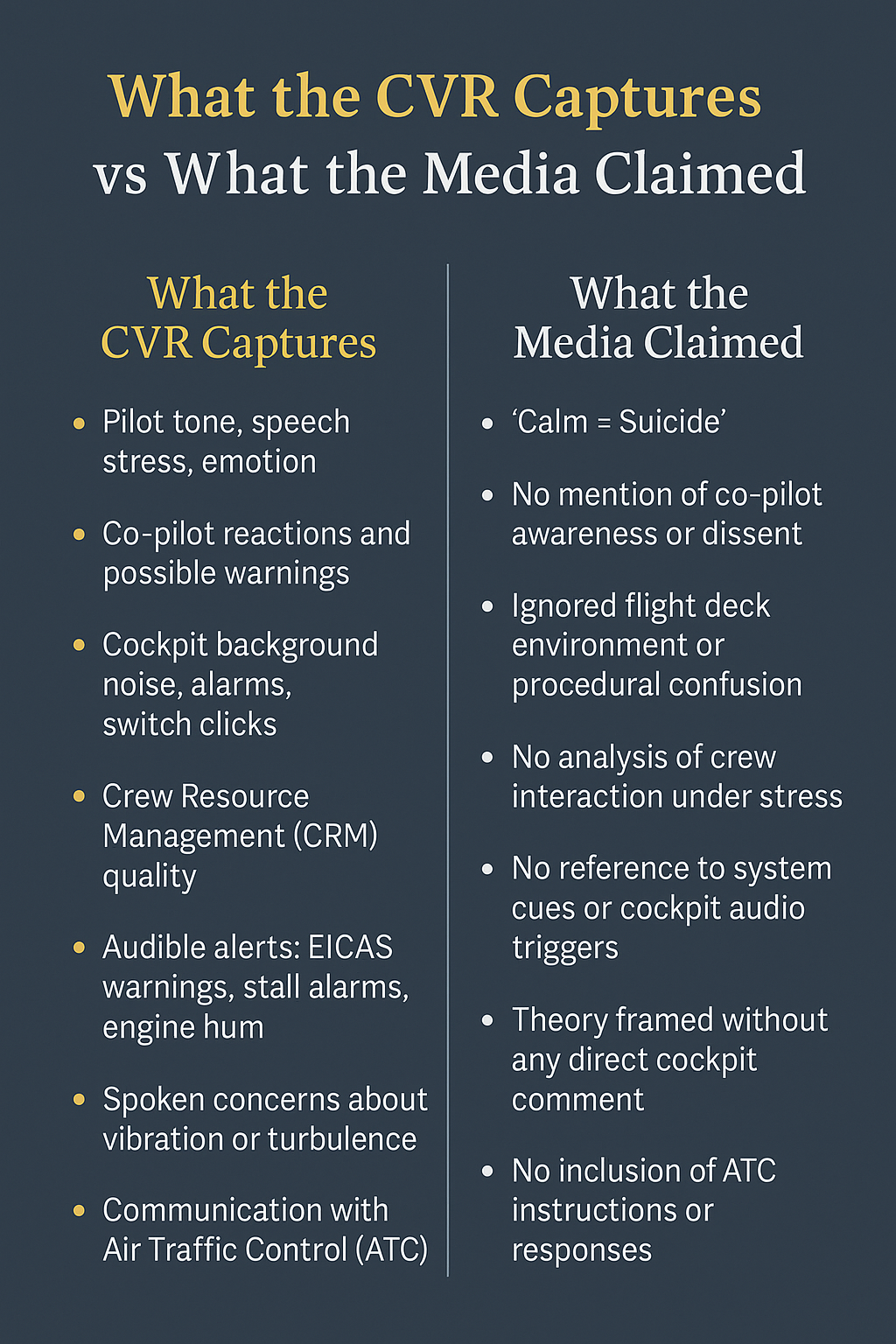
Calmness or Cause? CVR Silence in the Ahmedabad Air Crash Analysis
One of the most sinister elements of the AI171 media narrative was how calmness — a trait expected from an experienced pilot — was twisted into suspicion.
Captain Rakesh Sabharwal had logged over 15,600 flight hours, with more than 8,600 hours on the Dreamliner itself. According to leaked insider summaries, his voice in the cockpit — moments before the crash — showed no signs of panic. It was controlled, alert, and composed. [Ref 1]
This composure was then misused to suggest intent.
The logic, if stretched to its breaking point, went like this: “If he wasn’t shouting, he wasn’t shocked. If he wasn’t shocked, he planned it.”
This gross misuse of psychology is not new. Similar patterns followed crashes like Germanwings 9525 — where mental health became the scapegoat. But in that case, the CVR confirmed erratic behavior, audible breathing, and the captain’s attempts to return to the cockpit. Even though
In AI171, no such content has been publicly released. Yet the theory of suicide emerged before the CVR was even accessed — a fact previously documented in The Narrative That Took Off Before the Report. In this blog, we revisit it only to contrast how a composed tone, ironically, became a basis for assigning guilt.
The victim’s silence was weaponized.
The survivor stayed silent.
And the tape that could have broken the pattern? Still unheard.
What the CVR Could Reveal: A Deeper Ahmedabad Air Crash Analysis
Beyond conspiracy or speculation, there are simple, critical truths that a full CVR review could confirm or debunk:
- Did Captain Sabharwal express concern about controls, systems, or vibrations?
- Were there mechanical sounds consistent with switch vibration or cockpit turbulence?
- Did the co-pilot raise any doubts or challenges?
- Was there ATC miscommunication or missed instruction?
- Were warnings (like EICAS or engine alerts) audible in the background?
- Were the engines shut down in response to an avionics error — such as a false ground proximity alert, spurious fire detection, or other misread signals?
Yet in any serious Ahmedabad Air Crash Analysis, these cockpit cues are indispensable for separating mechanical confusion from intentional error.
So far, none of this has been shared in the public domain. Intentionally? Perhaps!
Even the co-pilot’s emotional state — if heard on tape — could clarify whether this was a crew coordination error, a technical misinterpretation, or a more complex psychological breakdown under stress.
In high-profile aviation cases like Lion Air JT610 or Air France 447, CVR data played a corrective role, showing how spatial disorientation or poor CRM, not malice, caused crashes.
In India’s case, however, the black box seems to have been decoded but not fully disclosed.
This is where truth may still lie beyond the tape — but not beyond reach.
The Survivor’s Silence: Ahmedabad Air Crash Analysis
In a crash where 260 souls perished, one man lived.
Vishwash Kumar Ramesh, a 40-year-old British-Indian national seated near the emergency exit, survived AI171’s fatal descent. He was pulled from the flaming wreckage conscious — a living witness to the final minutes inside the cabin.
But weeks have passed.
No official statement.
No press interaction.
No public interview.
Not even a confirmed quote from medical or legal authorities.
In The Narrative That Took Off Before the Report, we noted how the Wall Street Journal published theories about suicide without waiting for crew interviews or CVR data. In Ahmedabad Air Crash Fallout, we examined how national silence may have been a strategic choice — driven by Boeing’s massive economic entwinement with India.
But the survivor’s silence is different. It is human, personal — and, possibly, pressured.
- Has he been medically unable to speak?
- Was he coached or cautioned?
- Did he observe signs of mechanical failure or crew struggle?
- Could his memory disrupt the neat narrative of pilot intent?
We don’t know. Because he hasn’t been allowed to tell us.
And in a crash investigation, a lone living voice should not be quieter than corporate PR.
But this silencing is not unique — it follows a wider pattern observed in other global aviation disasters, where cockpit voices are curated or concealed to fit early media spin.
Ahmedabad Air Crash Analysis: Will India Let the Data Speak?
As of late July 2025, no final report has been released. The preliminary report — issued merely to meet the 30-day statutory deadline — conceals more than it reveals. Selective excerpts from the cockpit voice recorder were leaked, enabling media outlets to sensationalize fragments while ignoring the broader context. And still, India — a nation with over a billion citizens and a rising global aviation sector — remains officially silent.
Why?
Because as covered in Ahmedabad Air Crash Fallout, $34 billion in Boeing deals, Air India’s global rebranding, and geo-corporate diplomacy have tied our tongues. When Boeing officials landed in Delhi, they met not engineers, but narrative managers. They entered before the wreckage was even analyzed.
The CVR could redeem that process.
If released in full — not just through Western publications or anonymous officials, but through transparent Indian institutions — it could:
- Reaffirm pilot competence.
- Expose deeper systemic flaws.
- Clarify potential mechanical anomalies.
- Restore public confidence in Indian aviation independence.
And most importantly, it could reclaim the story from those who rushed to write it — before even hearing it.
Ahmedabad Air Crash Analysis Can’t Be Complete Without the Tape
AI171’s crash was tragic. But its aftermath is shameful.
We let a global outlet accuse a seasoned pilot before hearing his voice.
We let a corporation land before our data did.
We let algorithms erase visibility while the only living survivor stayed invisible.
And we still have the CVR — decoded, complete, and hidden.
In any other country, this would trigger outrage. In France or Brazil, the CVR would lead the investigation. In the U.S., legal discovery would mandate transparency (at least for the public record).
But in India, even as the voice exists, it remains unheard.
This blog is not about conspiracy — it is about competence and courage.
If Captain Sabharwal was guilty, let the tape prove it.
If he was not, let the tape defend him.
If there was a design flaw, let the background noise expose it.
If there was confusion, let the tone of voice reveal it.
But don’t let a nation be gaslit — not by headlines, not by handshakes.
Until the full CVR is made public, any Ahmedabad Air Crash Analysis remains incomplete — a verdict without a voice.
Let truth emerge not from negotiation, but from the recorder we built exactly for this moment.
Truth still waits — in 2 hours of audio.
Not encrypted anymore.
Just unwelcome.
Feature Image: Click here to view the image.
Glossary of Terms
-
Cockpit Voice Recorder (CVR): A flight recorder device installed in aircraft to capture audio from the cockpit, including pilot conversations, alarms, and ambient sounds. It is a key tool in air crash investigations to understand human factors.
-
Flight Data Recorder (FDR): An onboard device that records technical parameters of flight systems such as altitude, speed, throttle position, and autopilot settings — offering a mechanical counterpart to the CVR.
-
EICAS (Engine Indicating and Crew Alerting System): A display system used in modern aircraft (like Boeing 787) that provides engine performance data and alerts to the crew about system malfunctions or warnings.
-
CRM (Crew Resource Management): A set of training procedures used in aviation to improve communication, decision-making, and teamwork among cockpit crew members during routine and emergency operations.
-
MCAS (Maneuvering Characteristics Augmentation System): An automated flight control system that adjusts aircraft pitch to improve handling, linked to Boeing 737 MAX crashes; cited in comparison for media narratives and CVR interpretations.
-
Preliminary Report: A legally mandated summary released within 30 days after an aviation accident, offering early findings without assigning definitive causes.
-
Ground Proximity Warning System (GPWS): An avionics system that alerts pilots if the aircraft is in immediate danger of flying into terrain. False activations can influence pilot response.
-
Black Box: A non-technical term used to refer to the CVR and FDR, typically stored in a reinforced unit to survive crashes and assist investigations.
-
AI171 (Air India Flight 171): The ill-fated Dreamliner flight that crashed in Ahmedabad on June 12, 2025, resulting in 260 fatalities and one survivor.
-
Narrative Framing: A media or institutional tactic of shaping public perception by selectively highlighting or omitting information, especially in crisis situations.
-
Stephanie Pope: The Chief Operating Officer of Boeing who reportedly visited Indian officials during the early stages of the AI171 investigation — a detail relevant to potential influence over the probe.
-
Unnamed Sources: A media term referring to individuals cited anonymously, often used to leak unverified or strategic information in sensitive cases like aviation disasters.
-
Dreamliner (Boeing 787): A modern long-haul aircraft with advanced avionics and composite materials; the model involved in the AI171 crash.
-
Selective Leak: The partial and strategic release of information — such as specific CVR lines — that can shape public opinion before a full report is made available.
-
CRM Breakdown: A failure in cockpit teamwork or communication that can lead to misunderstandings, errors, or delayed responses during flight emergencies.
#CVR #AirCrash #PilotVoice #AviationNews #HinduinfoPedia
References
- [Ref 1] https://indianexpress.com/
- www.reuters.com
- https://www.nytimes.com/boeing-737-max
- https://www.commerce.senate.gov/2020/12
Earlier Blogs on the Topic
Ahmedabad Air Crash: The Narrative That Took Off Before the Report
Ahmedabad Air Crash Investigation: How Boeing’s Billions Rewrote the Black Box
Ahmedabad Air Crash Fallout: When Indian Media Echoed the American Spin
[…] 👉 For a full, human-centered breakdown of the Ahmedabad Air Crash Analysis, read the detailed investigation at:https://hinduinfopedia.com/ahmedabad-air-crash-analysis-voices-silence-and-truth/ […]