

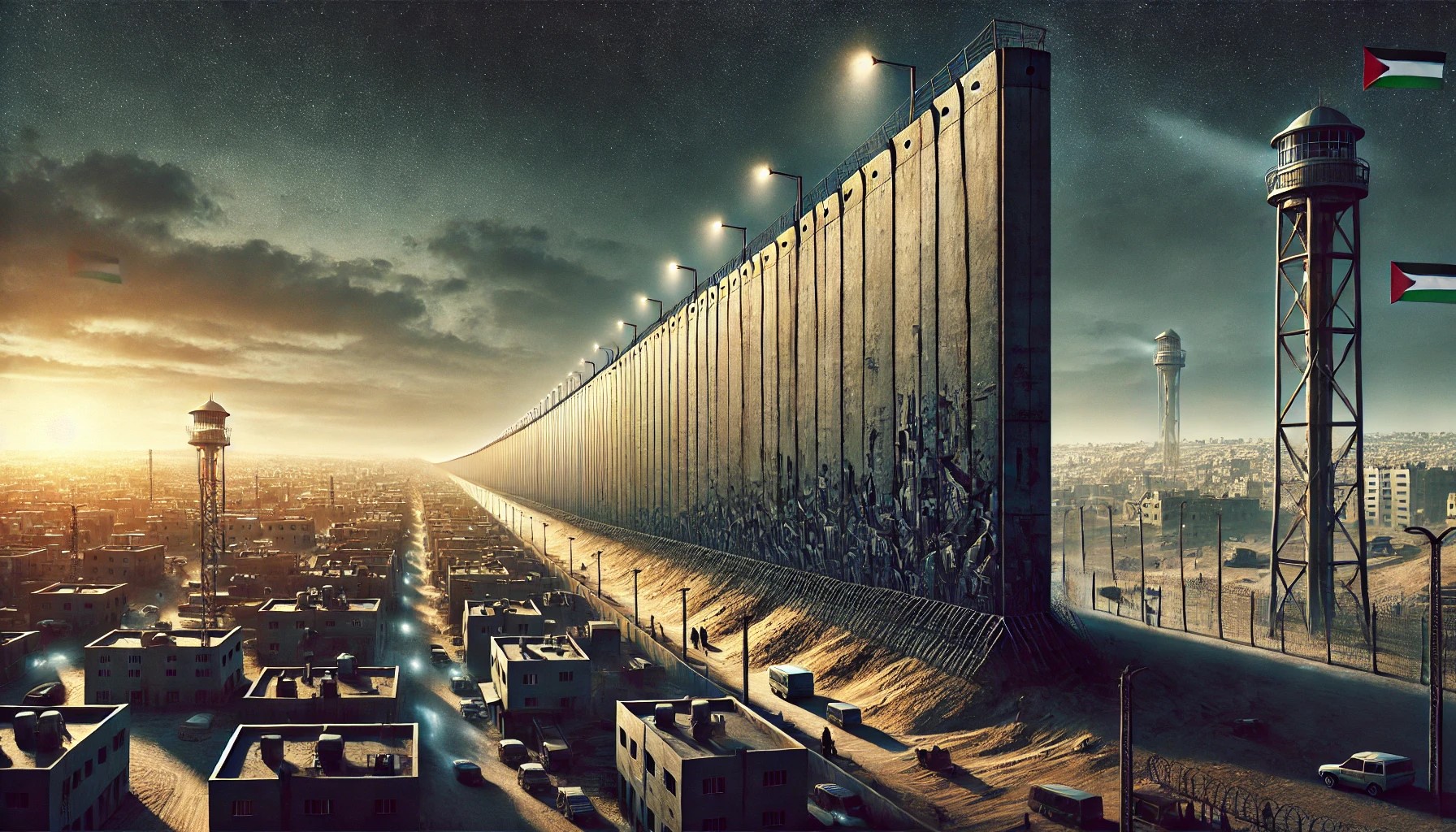
The Berlin Wall of Gaza: What Happens When Hamas Falls?
GB/भारत
Part 7: The Walls of Truth: What 57 Muslim Nations Know
The Wall Everyone Could See and The Wall No One Talked About
In the series analyzing the construction and existence of the Palestine–Egypt 18-meter underground wall [Some sources like ScienceDirect show the depth as 30m]—its circumstances, intent, and consequences—we present the seventh part, comparing this barrier with the Berlin Wall and identifying it as the Berlin Wall of Gaza.
For years, the world focused on Gaza’s physical walls. Egypt’s underground steel barrier plunged 18 meters deep. Israel’s security fence stretched for miles. International media photographed these barriers. Human rights groups measured them. Politicians condemned them.
But understanding why Egypt built what we call the Berlin Wall of Gaza requires examining another barrier—one cameras couldn’t capture. This invisible wall went deeper than Egypt’s steel, reached higher than any concrete structure, and proved stronger than any military fortification.
This was the wall of control Hamas built within Gaza itself. The psychological barrier that forced compliance through fear, demanded performance through terror, and prevented truth through systematic oppression.
Every Muslim nation that studied Jordan, Lebanon, and Kuwait understood why Egypt’s 18-meter barrier existed. They knew it protected against importing the organizational control that builds psychological walls within populations.

Explore Hindu Wisdom
Explore Sanatan Dharma →
The Three Walls of Gaza
The Visible Wall: Egypt’s Berlin Wall of Gaza
Egypt’s 18-meter underground barrier represents the most dramatic physical response to Gaza’s security situation. This engineering marvel—steel curtain driven deep into earth, flooded tunnels, militarized buffer zones—earned its designation as the Berlin Wall of Gaza.
International media covered every aspect of this wall. Photographs showed construction. Reports documented displacement of Egyptian citizens in Rafah to create buffer zones. Human rights organizations condemned the barrier.
The Berlin Wall of Gaza was visible, measurable, and easily criticized. Eighteen meters deep. Specific tonnage of steel. Precise length of border fortification. The international community had numbers, photographs, and concrete evidence to critique.
But Egypt wasn’t building the Berlin Wall of Gaza against refugees. Egypt was building walls against the ideology that creates internal control systems. Egypt had watched what happened to countries that accepted Palestinian organizations. Egypt studied Black September in Jordan and Lebanon’s collapse.
The Berlin Wall of Gaza represents Egypt’s choice: steel and concrete over civil war.
The Political Wall: Hamas Organizational Control
The second wall was Hamas governance apparatus. The systematic control structure that maintained power through documented use of aid diversion, exploitation of civilian infrastructure, and suppression of dissent.
Hamas ran Gaza as authoritarian system. Children educated in Hamas-controlled schools. Media monitored by Hamas. Public speech regulated. Dissent punished. International investigations documented these patterns of control.
This wall was visible to those who looked carefully. Human rights organizations documented Hamas governance practices. Testimonies revealed systematic control mechanisms. But international focus remained predominantly on physical barriers rather than organizational structures.
The political wall of Hamas control helps explain why Egypt built the Berlin Wall of Gaza—not to trap Palestinians, but to prevent importing this control system into Egypt.

Understand Global Deception
Explore Geopolitical Analysis →
The Wall Within: Psychological Control Through Fear
The deepest wall was psychological. This barrier operated through fear, preventing open expression, demanding public compliance, and creating environment where survival required performance.
This wall had no measurements. You couldn’t photograph it. You couldn’t document its construction with satellite imagery. But it operated continuously, affecting every aspect of life under Hamas control.
This wall was infinite in depth. It reached into private thoughts, family conversations, personal beliefs. No aspect of life remained untouched by the requirement to demonstrate loyalty.
This wall was unlimited in height. It controlled public speech, shaped permissible thought, determined what could be hoped for, what could be questioned, what could be challenged.
This wall was absolute in strength. Steel can be cut. Concrete can be broken. Political regimes can be overthrown. But psychological control through systematic fear—that barrier required collapse of the entire control apparatus to break.
This invisible wall within Gaza is what made the visible Berlin Wall of Gaza necessary. Egypt built physical barriers against the organizations that create psychological barriers.
The Original Berlin Wall: When Walls Fall, Truth Emerges
November 9, 1989: East Germans celebrated on the Berlin Wall. They danced with champagne. They embraced West Germans. They wept openly.
The celebration wasn’t primarily about concrete destruction. The celebration was about freedom to speak truth. Freedom to cross borders. Freedom to live without Stasi monitoring every word. Freedom to hope without fear.
The Berlin Wall was physical barrier backed by totalitarian regime backed by psychological control through fear. When East Germans celebrated the wall’s fall, they celebrated liberation from all three: the concrete, the regime, and the fear.
The parallel with the Berlin Wall of Gaza is instructive. Just as the original Berlin Wall kept East Germans imprisoned while presented as protection, the Berlin Wall of Gaza exists because Egypt understood what happens when organizations that build internal walls are imported.
Just as East Germans couldn’t speak freely about communism until the regime fell, Gazans cannot speak freely about Hamas while organizational control persists.
Just as the Stasi created climate of fear in East Germany, Hamas’s control structure creates similar climate in Gaza through documented tactics of intimidation and suppression.
The comparison between the original Berlin Wall and the Berlin Wall of Gaza reveals why physical barriers exist: not as primary oppression, but as responses to organizational control that creates psychological oppression.
Documented Evidence: Hamas Control In Gaza
While we cannot verify claims of celebration, we can document established facts about Hamas governance that explain why Egypt built the Berlin Wall of Gaza:
Aid Diversion and Control
Israeli Defense Forces documented internal Hamas documents showing systematic exploitation of humanitarian aid. These documents reveal organizational policies for controlling aid distribution.
Hamas operatives were recorded complaining about leadership hoarding supplies. “They took everything, stole everything. Soon we won’t find anything to eat or drink,” one operative stated in intercepted communications.
Independent reporting confirms aid reaching black markets rather than civilians, with Gazans forced to purchase at inflated prices what should have been free humanitarian assistance.
Use of Civilian Infrastructure
Comprehensive analysis by the Henry Jackson Society documented Hamas’s systematic use of civilian areas for military purposes. The report examined placement of military infrastructure within schools, hospitals, and residential areas.
U.S. officials confirmed that “Hamas does use hospitals, along with a lot of other civilian facilities, for command-and-control, for storing weapons, for housing its fighters.”
Israeli intelligence documented Hamas preventing civilians from evacuating combat zones, using displaced populations as protection against military operations.
These documented practices explain why the Berlin Wall of Gaza exists—Egypt protects against importing organizations with these operational patterns.

🇮🇳 India-Focused Analysis
Explore Bharat’s Voice →
Building the Berlin Wall of Gaza:
What Egypt Knew
Return to Egypt’s 18-meter steel barrier—the Berlin Wall of Gaza. The wall everyone condemned. The wall international community demanded Egypt remove.
Egypt wasn’t building the Berlin Wall of Gaza against refugees. Egypt was building walls against organizations that create internal control systems.
Egypt had studied the pattern:
Jordan accepted Palestinians. The PLO created state within state. The PLO built organizational loyalty structures that superseded loyalty to Jordan. King Hussein fought civil war rather than allow those systems to destroy Jordan’s sovereignty.
Lebanon accepted Palestinians. The PLO created state within state. The PLO built sectarian divisions and factional loyalties that superseded Lebanese national identity. Lebanon collapsed into 15-year civil war. The organizational control structures destroyed the nation.
Kuwait accepted Palestinians. When Iraq invaded, Palestinians sided with invaders. The organizational loyalty to Palestinian political objectives trumped gratitude to Kuwait. Kuwait expelled hundreds of thousands Palestinians after liberation.
The pattern was consistent: Palestinian organizations don’t just challenge host country sovereignty. They build parallel loyalty structures. Systems of control. Mechanisms that create divided allegiance.
The Berlin Wall of Gaza protects against importing that organizational control. Egypt chose 18 meters of concrete over importing systems that destroy national cohesion.
The documented evidence of how Hamas operates in Gaza—aid control, civilian infrastructure exploitation, prevention of evacuation—proves Egypt’s assessment correct. The Berlin Wall of Gaza protects against organizations that build these control systems.

Explore Premium Intelligence →
The 57-Nation Verdict And the Berlin Wall of Gaza
Fifty-seven Muslim-majority countries have reached near unanimous consensus: never permit the naturalization of Palestinian refugees.
This isn’t Egypt alone building the Berlin Wall of Gaza. This is 57 nations, each in their own way, building barriers against importing organizational control systems.
Saudi Arabia: Absolute prohibition on Palestinian naturalization. Saudi Arabia will fund Palestinian causes, will host Palestinian leadership, will donate billions. But will never grant citizenship. Because Saudi Arabia knows citizenship enables organizations that create parallel loyalty structures within Saudi society.
UAE: Same policy. Palestinians can work, can reside, can build businesses. Can never naturalize. Because UAE knows permanent status enables organizations that build divided allegiances within Emirati populations.
Every Muslim nation that studied Jordan, Lebanon, and Kuwait: Same conclusion. The risk isn’t hosting refugees. The risk is importing organizations that build internal control systems, parallel governance structures, and divided national loyalties.
The Berlin Wall of Gaza represents Egypt’s physical manifestation of this universal understanding. Fifty-seven nations made the same assessment. Some built physical walls. Some built legal barriers. Some built absolute prohibitions. But all reached identical conclusion.
The documented evidence from Gaza—systematic aid diversion, exploitation of civilian areas, organizational control over population movement—validates what 57 nations already knew. The Berlin Wall of Gaza protects against proven operational patterns.
The Comparison Revelations: Syria vs Palestine
Since 2011, millions of Syrians fled civil war. Where did they go?
Turkey: Accepted over 3.6 million Syrian refugees.
Lebanon: Accepted approximately 1 million Syrian refugees.
Jordan: Accepted over 650,000 Syrian refugees.
Germany: Accepted over 1 million Syrian refugees.
Multiple European nations: Accepted hundreds of thousands combined.
Turkey alone accepted more Syrian refugees in 13 years than the entire Muslim world accepted Palestinian refugees in 75 years.
Why the difference?
Syrian refugees fled violence seeking safety. They arrived as individuals and families. They didn’t arrive with organizations demanding autonomy. They didn’t establish parallel governance. They didn’t build organizational control systems in host countries.
Palestinian refugees arrived with the PLO, Hamas, PFLP, Islamic Jihad, and dozens of other organizations. These organizations didn’t just seek refuge. They established parallel control structures. They built organizational systems. They created divided loyalties.
The difference isn’t ethnicity or religion. The difference is organizational structures with documented patterns of operation.
This explains the Berlin Wall of Gaza. Egypt studied the difference between accepting refugees (which Turkey did with Syrians) and importing organizational control systems (which Jordan, Lebanon, and Kuwait experienced with Palestinians).
The Berlin Wall of Gaza represents Egypt’s determination to accept the first while preventing the second.
This 57-nation consensus carries lessons beyond the Middle East. Europe, now experiencing its own demographic transformation, faces strikingly similar patterns.
Is Europe Watching: The Pattern Repeats
Europe is experiencing demographic transformation through mass migration from Muslim-majority countries. The debate focuses on economics, integration, cultural compatibility, and security.
Europe should study the Berlin Wall of Gaza carefully. Should understand what the organizational control dimension means. Should recognize the pattern.
Populations maintained as permanent outsiders—never fully integrated, preserved as distinct communities with separate organizational structures—create parallel systems within societies. Not immediately. Not obviously. But systematically, over generations.
France’s ongoing unrest demonstrates these patterns. What media calls civil disorder often involves organized groups with distinct loyalties and objectives incompatible with French national interests.
This is the same pattern that destroyed Lebanon. Avoid acknowledging the organizational dimension. Treat it as generic social problems requiring generic solutions. Refuse to examine how parallel organizational structures create divided loyalties.
Lebanon made this mistake for years. Called Palestinian organizational presence “refugee crisis,” “social tension,” “political complexity”—anything except organizations challenging sovereignty and building parallel loyalty structures.
By the time Lebanon acknowledged reality, too late. The organizational systems were too entrenched. The parallel structures too established. The divided loyalties too deep. The ability to act decisively had been lost.
Europe is at earlier stage of same trajectory. European states still have capacity to act. European governments retain authority.
But European political will is constrained by same forces that paralyzed Lebanon: fear of accusations, commitment to multiculturalism above integration, institutional barriers to decisive action, and most critically—unwillingness to acknowledge that some groups bring organizational structures incompatible with host country sovereignty.
The Berlin Wall of Gaza proves what happens when nations study history and learn from others’ mistakes. Egypt watched Jordan, Lebanon, and Kuwait. Egypt built the barrier. Egypt prevented importing organizational control systems that destroy nations.
Europe can learn from the Berlin Wall of Gaza, or Europe can repeat Lebanon’s mistakes. The choice is European leadership’s to make.
Unanswered Question: Why World Ignores Organizational Control
For decades, international community documented every aspect of Gaza situation. Reports on border restrictions. Studies on humanitarian conditions. Investigations into military operations. Endless analysis of political dynamics.
But the organizational control dimension was minimized.
Human rights organizations occasionally noted Hamas suppression of dissent. Occasionally documented Hamas control mechanisms. Occasionally mentioned Hamas governance structures.
But these acknowledgments were peripheral. Marginal. Never central to analysis of Gaza situation. Never integrated into understanding of why Gazans spoke as they did, acted as they did, appeared to support what international observers assumed they supported.
Why the systematic ignoring of Hamas’s psychological control?
Because acknowledging the wall within would require acknowledging that Gazan voices under Hamas were not genuine Gazan voices. That interviews with Gazans under Hamas control revealed Hamas positions, not Gazan truth. That public statements supporting Hamas were coerced performance, not authentic expression.
Acknowledging this would undermine entire narratives built on “listening to Palestinian voices.” Would require admitting those voices were suppressed, controlled, manipulated by Hamas terror.
Easier to ignore the wall within. Easier to pretend Gazan statements under Hamas were genuine. Easier to build narratives on performance than admit performance was survival strategy under totalitarian control.
Even during the October 2025 ceasefire, Hamas violently reasserted control through a wave of public executions, killing at over 30 Gazans in mid October and publicly executing another few of them a few days later, all accused of collaboration with Israel [FDD Wikipedia]. Palestinian lawyer and former Hamas political prisoner Moumen al-Natour explained these killings were ‘Hamas’s way to regain control,’ stating ‘They are sending a signal that they are back — by terrorizing people‘. Through summary street executions of opponents, Hamas suppressed dissent to maintain power during the fragile ceasefire. Meanwhile, Egypt’s steel barrier extending 18 meters underground remained firmly sealed, with Cairo warning that accepting Palestinian refugees would bring Hamas militants into Sinai and potentially unravel the Camp David peace treaty. The wall within—Hamas’s reign of terror—and the wall without—Egypt’s physical barrier—together demonstrate why Palestinian refugees remain trapped with nowhere to go.
The documented evidence of Hamas’s organizational control explains this willful ignorance. International organizations acknowledged Hamas’s systematic suppression, aid diversion, and use of civilian infrastructure—yet rarely made these central to their analysis. The focus remained on physical barriers rather than the organizational structures that necessitated them..
Steel Wall That Protects Against Psychological Warfare
Return one final time to Egypt’s 18-meter steel barrier condemned by the international community as cruelty.
That barrier protected Egypt from importing psychological warfare—from organizations that build walls within hearts and create internal divisions that destroy nations.
Jordan’s restrictions. Lebanon’s learned caution. Kuwait’s mass expulsion. The Gulf states’ absolute prohibition. The 57-nation consensus.
Every policy traces to same lesson: accepting Palestinian populations means accepting organizations that build walls within hearts. Organizations that conduct psychological warfare. Organizations that create terror preventing truth.
Gazans celebrating Hamas’s defeat proved the lesson true. The jubilation revealed the wall within—the terror, the suppression, the psychological prison.
The walls Muslim nations built weren’t against Palestinian individuals. The walls were against organizations that build walls within souls.
Egypt’s 18 meters of steel protected against infinite depths of psychological division.
That’s the truth the walls tell. That’s the reality Gaza’s liberation revealed. That’s the lesson 57 Muslim nations learned and will never forget.
 Complete Hindu Knowledge Base: Access over 400 articles on Vedic science, temple architecture, freedom fighters, and dharmic principles at HinduInfopedia.org – Encyclopedia of Sanatan Dharma. From Yoga Sutras commentary to scientific validation of ancient practices, discover why “It’s Real, Not Myth.”
This analysis is part of ongoing examination of civilizational conflicts, psychological warfare through organizational control, and the mechanisms by which populations are maintained in internal prisons while international community focuses on visible barriers. For comprehensive understanding of these patterns, explore the complete series at hinduinfopedia.com.
Feature Image: Click here to view the image.
Feature Image: Click here to view the image.
Glossary of Terms
- Berlin Wall of Gaza: A conceptual term comparing Egypt’s underground steel barrier around Gaza to the Cold War–era Berlin Wall, emphasizing containment of ideology and control systems rather than mere physical restriction.
- Hamas: An Islamist political and militant organization governing Gaza, documented as exercising authoritarian control through fear, aid manipulation, and suppression of dissent.
- Psychological Wall: An invisible system of fear-based control that restricts free thought, speech, and behavior within a population, enforced through terror rather than physical barriers.
- Organizational Control Systems: Structured mechanisms—education, aid distribution, surveillance, and punishment—used by political groups to enforce loyalty and suppress opposition within civilian populations.
- Gaza Strip: A densely populated Palestinian territory governed by Hamas, surrounded by physical and political barriers imposed by Israel and Egypt.
- Aid Diversion: The documented practice of redirecting humanitarian aid away from civilians to benefit militant leadership, black markets, or military infrastructure.
- Use of Civilian Infrastructure: The strategy of embedding military assets within schools, hospitals, and residential areas to deter attacks and manipulate humanitarian narratives.
- Palestine Liberation Organization (PLO): A Palestinian political entity whose historical activities in host countries contributed to civil conflict and parallel governance structures.
- State Within a State: A condition where non-state organizations establish autonomous authority inside a sovereign nation, undermining national governance and loyalty.
- Black September: A 1970 conflict in Jordan illustrating how Palestinian armed organizations challenged host-state sovereignty, leading to civil war.
- Lebanon Civil War (1975–1990): A prolonged conflict exacerbated by parallel militant governance structures introduced by Palestinian organizations.
- Parallel Loyalty Structures: Systems where allegiance to an organization supersedes loyalty to the host nation, creating divided national identity.
- Stasi: East Germany’s secret police, cited as a historical parallel for fear-based psychological control over civilian populations.
- 57-Nation Consensus: The near-universal policy among Muslim-majority nations refusing permanent naturalization of Palestinian refugees due to security and sovereignty concerns.
- Naturalization Prohibition: Legal denial of citizenship to prevent permanent organizational entrenchment and divided allegiances within host states.
- Henry Jackson Society: A research organization that documented Hamas’s use of civilian infrastructure and governance practices.
- Wall Within: A metaphor describing internalized fear and enforced compliance that persists even without visible physical barriers.
- Civilizational Warfare: A long-term conflict strategy targeting societal cohesion, identity, and psychological resilience rather than conventional military defeat.
#Gaza #Hamas #BerlinWall #MiddleEast #Geopolitics #RightOfReturn #Palestine #UNRWA #Refugees #HinduinfoPedia #TheWallsoftruth
#RightOfReturn #Palestine #UNRWA #Refugees #HinduinfoPedia #TheWallsoftruth
Related Analysis:
Explore how the pattern of organizational psychological control manifests across different contexts:
- New York Declaration: Global Civilizational Warfare – How international institutions weaponize refugee narratives
- France Protests: Muslim Community Dynamics – Media manipulation of Islamic unrest
- Media as Manipulator in Unrest – The systematic pattern of narrative control
- Demographic Strategy Decoded – Understanding population-based political warfare
- International Law Under Siege – How strategic deception invalidates legal frameworks
Hindu Philosophy Resources:
Understanding psychological freedom through Vedic wisdom:
- Patanjali Yoga Sutras: Vritti Control – Managing mind modifications for psychological freedom
- Dattatreya’s Wisdom: Liberation From Attachment – Ancient teachings on internal freedom
- Dharma and Ethics in Conflict – Vedic principles for righteous action
Understanding Global Patterns:
- Regime Change Playbook: Color Revolution Operations – How psychological warfare operates internationally
- Muslim Brotherhood in France: International Backers – Organizational networks building parallel power structures
Previous Blog of he Series
- https://hinduinfopedia.com/egypt-gaza-wall-the-hidden-truth-57-muslim-nations/
- https://hinduinfopedia.com/black-september-jordan-the-forgotten-war-that-changed-the-arab-world/
- https://hinduinfopedia.com/lebanon-civil-war-from-paris-of-the-middle-east-to-hezbollah-state/
- https://hinduinfopedia.com/gulf-states-refugee-policy-why-the-wealthy-arabs-said-no-to-palestinians/
- https://hinduinfopedia.com/palestinian-refugees-why-no-muslim-country-will-take-them/
- https://hinduinfopedia.com/right-of-return-to-palestine-the-strategy-behind-75-years-of-refugees/
Follow us:
- English YouTube: https://www.youtube.com/@Hinduofficialstation
- Hindi YouTube: https://www.youtube.com/@HinduinfopediaIn
- X: https://x.com/HinduInfopedia
- Instagram: https://www.instagram.com/hinduinfopedia/
- Facebook: https://www.facebook.com/Hinduinfopediaofficial
- Threads: https://www.threads.com/@hinduinfopedia
[…] refuse Palestinian integration. The same community that condemns Israeli security barriers while ignoring Egypt’s 18-meter steel wall. The same community that speaks of humanitarian principles while funding the machinery of permanent […]
[…] This wall received virtually no international condemnation. No UN resolutions. No BDS campaigns. No campus protests. Because Arab nations understood what Western nations deliberately ignored: Egypt wasn’t building barriers against refugees—it was building protection against organizational control that creates psychological walls within populations. […]
[…] से रक्षा कर रहा था जो समाज के भीतर मानसिक दीवारें निर्मित करती […]
[…] https://hinduinfopedia.com/the-berlin-wall-of-gaza-what-happens-when-hamas-falls/ […]