

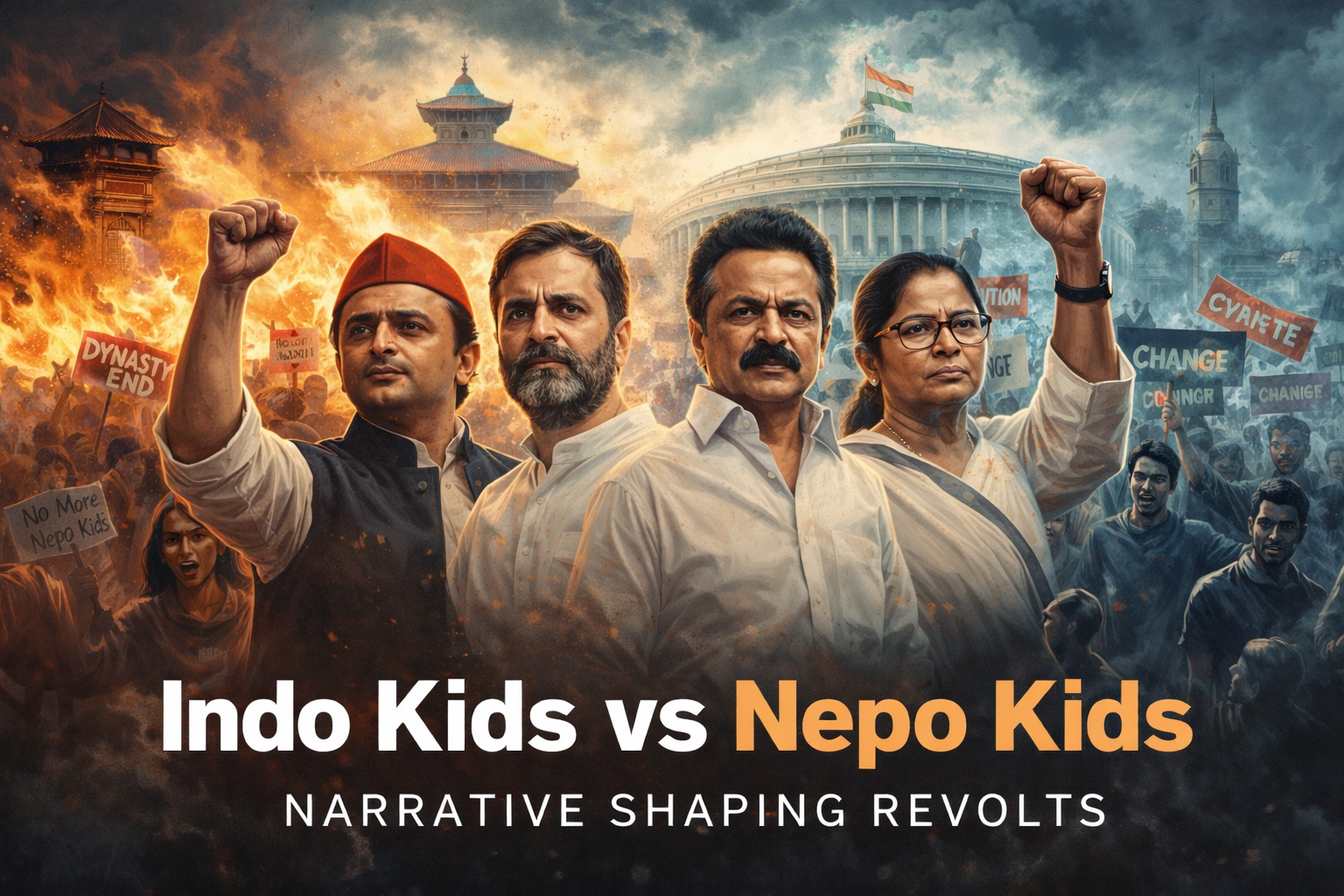
Indo Kids Narrative Shaping: Emulating Nepo Revolt
Part 1: Indo Kids Narrative Shaping
भारत/GB
Elite Rights Claimed — Indo Kids Narrative Shaping
The world watched as Nepal’s political landscape shifted, and the popular narrative was clear: this was a revolt against “Nepo Kids”—the entrenched children of political dynasties who had monopolized power for generations. Whatever the deeper geopolitical realities behind Nepal’s transformation (which we have examined in our earlier analyses of the so-called “Repair Revolution” and in other blogs of the series), the surface label stuck: the public had had enough of dynastic privilege. This brought about a chain reaction in Bharat by the kids of the elite politicians claiming to be Gen Z at 52, 55 or more.
Unlike in Nepal, what follows is a distinct pattern. This is Indo Kids Narrative Shaping—where elite political heirs are not swept away by dissent but step into it as its presumed leaders of Gen Z. While remaining beneficiaries of entrenched power structures, they recast themselves as outsiders, rebels, and moral authorities challenging the very system that protects them. The resulting paradox is central to understanding Indo Kids: a form of performed revolution in which the language and posture of dissent are adopted, even as risk, consequence, and displacement are carefully avoided.

narrative control, institutional pressure, and mass mobilization techniques.
Nepo Kids Model: When Revolt Targets Dynasties
To understand Indo Kids Narrative Shaping, we must first understand what they are not. Nepal’s story—at least as it was publicly framed—represents the traditional South Asian pattern of elite backlash. When political families overstay their welcome, when corruption becomes unbearable, when the children of rulers display too much entitlement, public anger crystallizes. We’ve seen this pattern repeat across the region:
- Sri Lanka’s Rajapaksas faced massive protests
- Pakistan’s dynastic politics have faced recurring challenges
- Bangladesh has grappled with generational political monopolies
In Nepal, the Nepo Kids—children of entrenched political elites—became the visible face of a broken system. Inherited privilege, closed political networks, and perceived entitlement among leaders’ wards created a perfect storm. The public narrative labeled it an anti-dynasty uprising, and regardless of the international dimensions and geopolitical wiring that may have been at play, this surface explanation resonated because it reflected genuine frustration.
This is the classic pattern: when elite families overstay → public anger crystallizes → system resets. Nepo Kids are honest about what they are—beneficiaries of inherited power. When people revolt, they revolt against them.
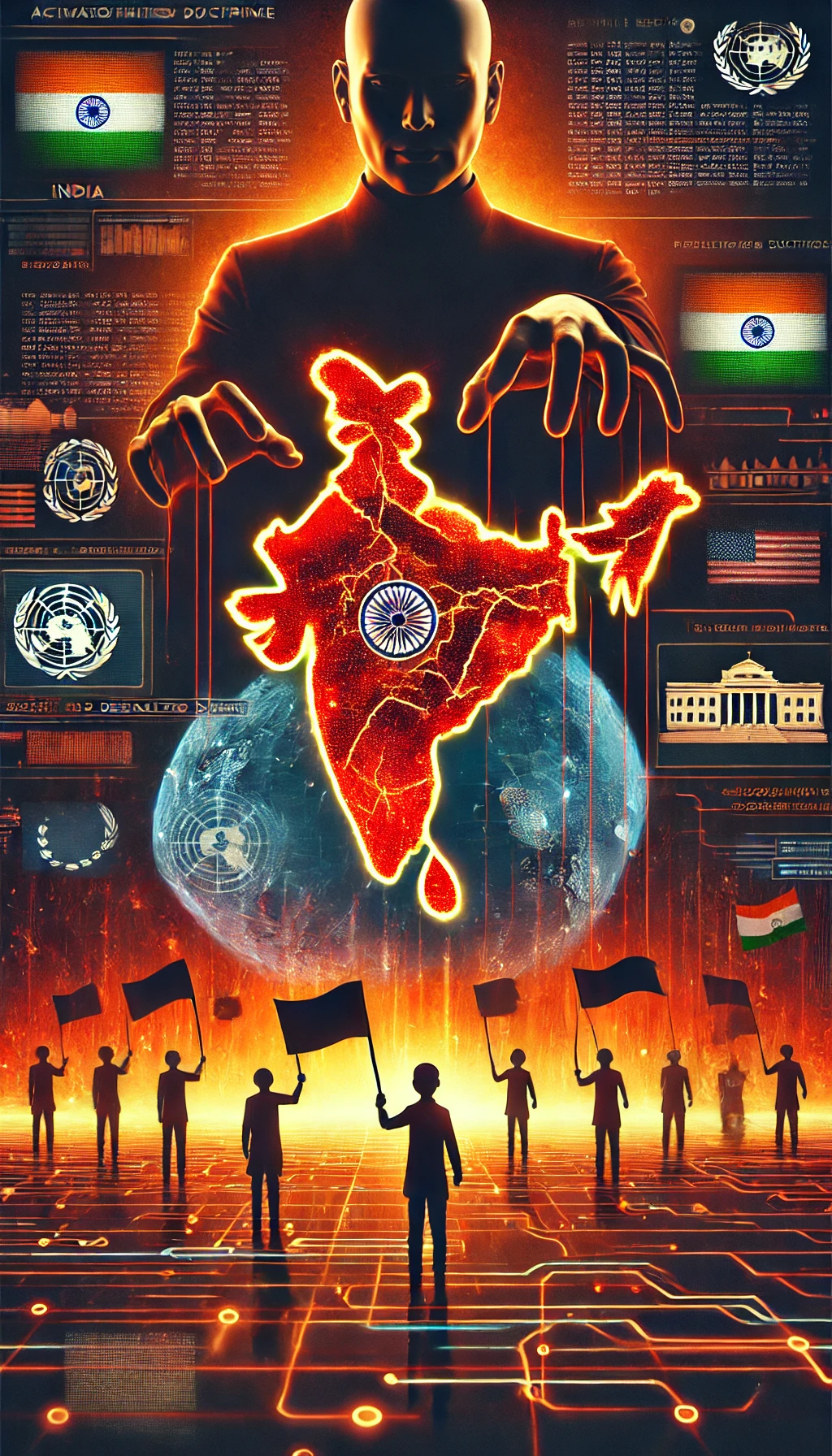
with Bharat representing a distinct and evolving case study.
The Indo Kids Model: When Elites Lead the Revolution
Indo Kids operate under an entirely different logic. In Bharat, we’re watching a remarkable phenomenon: the children of powerful political families are not being overthrown—they’re positioning themselves as revolutionary leaders. They’ve adopted the language of dissent, the aesthetics of activism, and the moral authority of outsiders, all while maintaining their elite privileges intact. This is dissent presented as generational revolt—Gen Z at 50+, a manufactured generational class. [Learn how the methodology functions]
The core features of Indo Kids Narrative Shaping include:
Zero-Risk Activism: They promote civil disobedience and system critique, but face no real legal, financial, or social consequences. Their family networks protect them from the very consequences ordinary activists face when challenging power.
Victim Narratives: Despite coming from privilege, Indo Kids present themselves as persecuted voices. They weaponize victimhood terminology while living in wealth and safety—a perfect inversion of actual marginalization.
Media Amplification: Unlike genuine grassroots movements that struggle for visibility, Indo Kids receive immediate and sustained media coverage. Their statements trend, their protests make headlines, their causes receive international attention—not because of merit, but because of institutional backing.
Designer Revolutions: These are carefully curated performances of dissent. The revolutionary imagery is there—the slogans, the protests, the righteous anger—but the actual risk is zero. It’s revolution as personal branding, not as existential commitment.
Moral Authority Without Sacrifice: True revolutionaries risk everything. Indo Kids risk nothing. Yet they claim—and often receive—the moral credibility that should only come from genuine sacrifice.
This creates a unique paradox: how can those born into political power structures genuinely lead a revolt against the same structures? The answer is simple—they can’t. But they can perform revolt in ways that actually preserve and even strengthen elite power.

convert elite-led dissent into perceived grassroots revolt.
The Civilizational Distinction
The contrast between Nepal and Bharat reveals two fundamentally different models of how elite power operates in South Asia:
Nepal’s Path: Neo-Feudal Collapse
- Dynasts face revolt
- Public anger targets elite families directly
- System resets (at least in public narrative)
- Nepo Kids are honest about their privilege
Bharat’s Path: Institutionalized Populism
- Dynasts lead revolt
- Elite children adopt revolutionary aesthetics
- System appears to change while preserving elite influence
- Indo Kids disguise privilege as persecution
This distinction matters because it reveals how political elites have evolved their survival strategies. In Nepal, the old model failed—the Nepo Kids were too visible, too entitled, too obviously benefiting from closed networks. In Bharat, the new model succeeds—Indo Kids present themselves as victims of the system they actually control.
The result? In Nepal, revolt targets the children of elites. In Bharat, the children of elites capture the revolt itself.

and normalized—laying the foundations of Bharat’s contemporary political culture.
Why This Matters
Understanding Indo Kids Narrative Shaping isn’t just an academic exercise. It’s essential for citizens to distinguish between genuine movements for change and elite-manufactured dissent. When revolution comes pre-packaged with media backing, international fellowships, and zero personal risk, it’s not revolution—it’s performance art subsidized by the powerful.
Genuine movements emerge from real grievances, face real opposition, and involve real sacrifice. They don’t arrive with glossy media profiles and NGO endorsements. They don’t position their leaders as simultaneously oppressed victims and moral authorities. They don’t guarantee safety for their participants.

living as alternative civilizational frameworks for nation-building.
Indo Kids offer none of these authenticity markers. Instead, they offer designer rebellion: all the aesthetics of revolution with none of the risk, all the moral authority with none of the sacrifice, all the visibility with none of the genuine challenge to power.
The challenge for citizens is learning to see this pattern. To recognize when “revolution” serves to restore elite influence rather than challenge it. To distinguish between those who risk everything to create change and those who risk nothing while claiming to lead it.
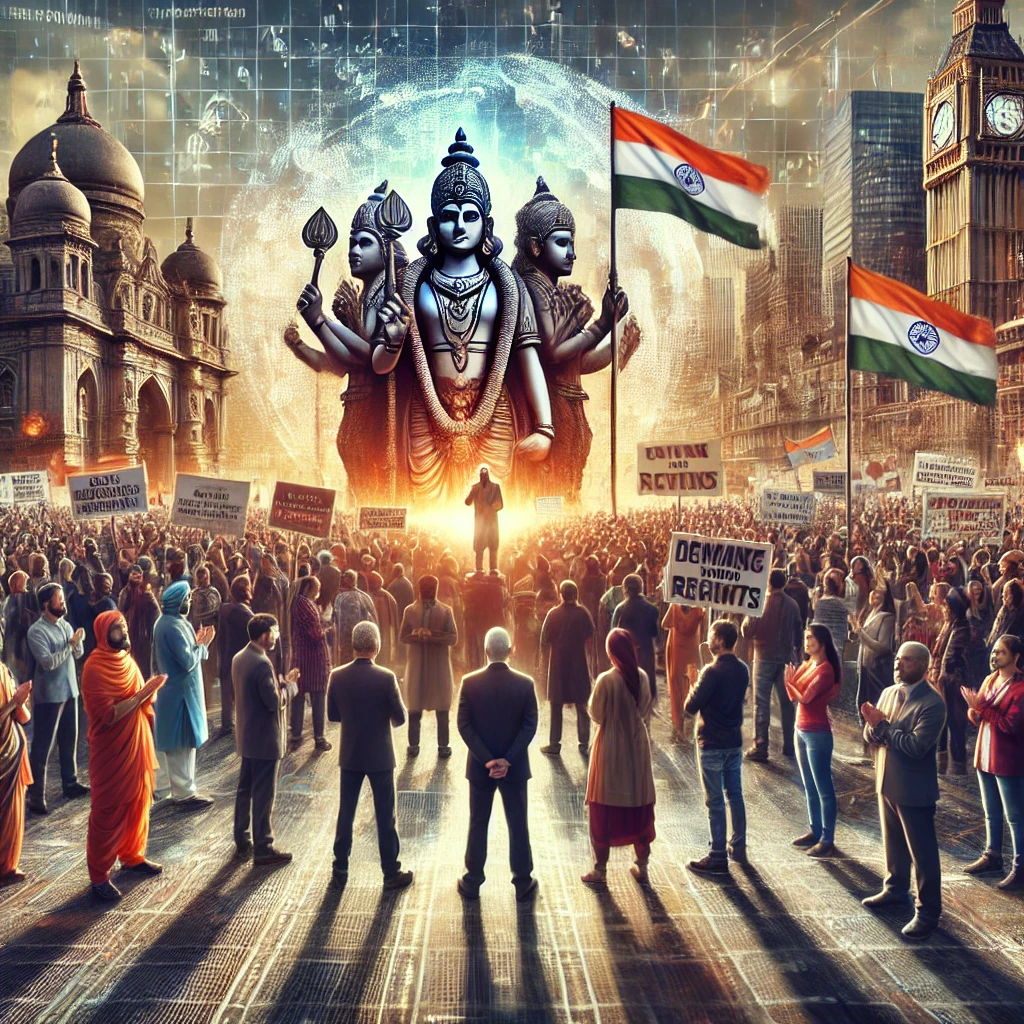
and the long-term cost of civilizational tolerance without safeguards.
Because in the end, the question isn’t whether Indo Kids are more effective than Nepo Kids at maintaining elite power. The question is whether citizens can learn to see through the performance before the next generation of designer rebels arrives to capture the next wave of genuine discontent.
Coming Next: “Indo Kids Are Made, Not Born — The Machinery of Elite Rebranding” — We examine exactly how the Indo Kids phenomenon emerged, the role of the NDA disruption, and the promotional playbook that manufactures designer rebels.
Feature Image: Click here to view the image.
Videos
Glossary of Terms
- Indo Kids: Political heirs in India who emerge from entrenched elite families yet position themselves as representatives of dissent and generational change.
- Nepo Kids: Beneficiaries of dynastic politics who inherit power, influence, and access through family lineage rather than public mandate.
- Indo Kids Narrative Shaping: The process by which elite political heirs adopt the language, imagery, and posture of rebellion to present themselves as leaders of dissent.
- Dynastic Politics: A political system where power and leadership circulate within a limited number of families across generations.
- Designer Rebellion: A curated form of dissent that adopts revolutionary aesthetics without incurring real risk, sacrifice, or displacement.
- Zero-Risk Activism: System-critical rhetoric conducted under conditions of legal, financial, and social protection.
- Media Amplification: Selective visibility and reinforcement provided by media institutions that elevate certain narratives while marginalizing others.
- Civilizational Distinction: The difference in how societies structurally process dissent, power transfer, and elite accountability.
- Institutionalized Populism: A form of populism where elite power is preserved while appearing to align with public sentiment.
- Generational Inversion: A contradiction in which age and privilege are masked behind claims of youthful or generational representation.
#IndoKids #NepoKids #DynasticPolitics #PoliticalNarrative #HinduinfoPedia#इंडोकिड्सकथानिर्माण #IndoKidsNarrativeShaping
Related Reading:
- Destabilization Doctrine: How America’s Foreign Policy Boomerang Is Striking Home
- Understanding the Abrahamic Alliance Targeting India
- Media Manipulation: The False Causality Matrix
- How Global Media Manipulation Works
- The Human Rights Paradox
- Rights-Based Solutions as Strategic Deception
Follow us:
- English YouTube: https://www.youtube.com/@Hinduofficialstation
- Hindi YouTube: https://www.youtube.com/@HinduinfopediaIn
- X: https://x.com/HinduInfopedia
- Instagram: https://www.instagram.com/hinduinfopedia/
- Facebook: https://www.facebook.com/Hinduinfopediaofficial
- Threads: https://www.threads.com/@hinduinfopedia
[…] भारत/GB […]
[…] Give me names.” But before we name names, we need to understand something more fundamental: Indo Kids are made, not born. They don’t emerge organically from genuine movements. They are products […]
[…] हमें एक अधिक मौलिक बात समझनी होगी: इंडो किड्स जन्म से नहीं होते, उन्हें बनाया जाता […]
[…] with the analysis started in our previous blog — where we documented how India’s political heirs rebranded themselves after NDA’s […]
[…] is the deeper pattern that the Indo Kids series has been building toward. Blog 1 documented the narrative shaping. Blog 2 dissected the elite rebel mechanism. This blog has traced the political trigger — the […]