

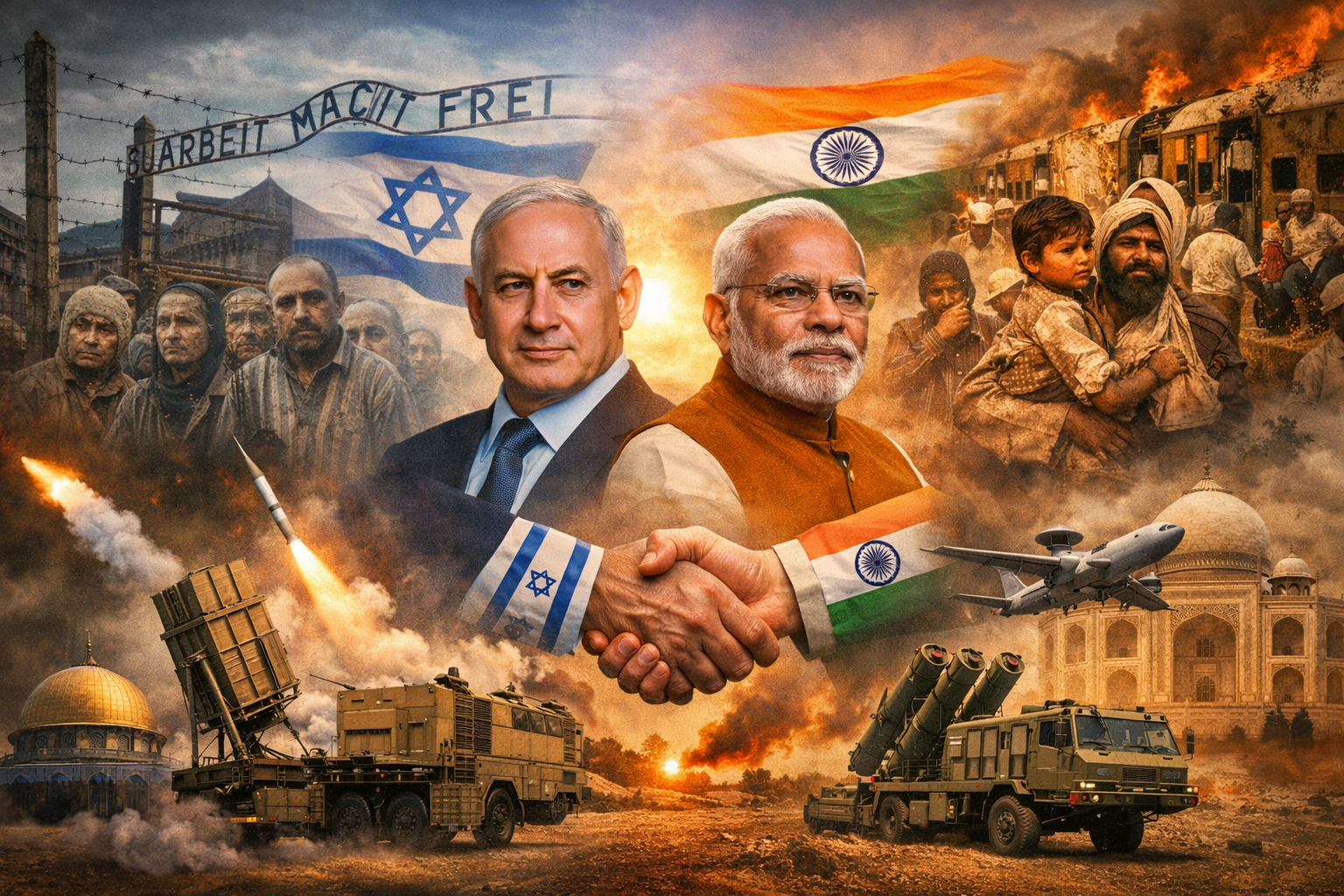
Netanyahu’s India Pivot: Union of Holocaust and Partition Survivors
भारत/GB
Netanyahu’s India Pivot: Union of Two Genocide Survivor Communities
A social media post prompted us to study and present the pitch of Benjamin Netanyahu to work jointly with India. When the Israeli Prime Minister announced his intention to pursue joint defense production with countries like India, Western analysts focused on the obvious—seemingly strategic autonomy, technology transfer, and reducing the $3.8 billion annual aid dependency. It looked as if this was intended to end dependence on American military aid. They missed the deeper story that Netanyahu’s India pivot represents.
This isn’t merely a transactional defense partnership between two middle powers seeking independence from superpower patronage. This represents a strategic convergence between two ancient civilizations that share a unique and catastrophic historical experience: both suffered the largest religiously-motivated genocides of the modern era—the Holocaust eliminating 6 million Jews, Partition eliminating 15 million Hindus and Sikhs—precisely because their core religious teachings emphasized tolerance, universal ethics, and non-aggression.
Judaism taught “Love thy neighbor as thyself.” Hinduism proclaimed “Vasudhaiva Kutumbakam“—the world is one family. Both civilizations paid devastating prices for these beautiful ideals when confronted by aggressive monotheisms built on conquest and conversion. The tolerance that defined their civilizational greatness became their existential vulnerability, as documented in Judaism and Tolerance: Exploring Historical Vulnerabilities.
Understanding this shared trauma explains why Netanyahu’s India pivot transcends normal strategic calculations. These aren’t just convenient partners—they’re genocide survivors who learned identical lessons through civilizational near-extinction.
📖 Recommended Reading: Understanding Tolerance as Vulnerability
Explore how spiritual teachings of tolerance made both civilizations vulnerable to conquest:
Tolerance Under Fire: Vulnerabilities of Jewish Teachings of Love
– How Judaism’s ethical framework became an exploitable weakness
Principle of Sacred Exclusion: Dharma’s Right to Boundaries
– Why unlimited tolerance enables intolerance
The Tolerance Trap: When Civilizational Virtue Becomes Fatal Weakness
Both Judaism and Hinduism developed sophisticated ethical frameworks that made them civilizationally advanced—and catastrophically vulnerable to aggressive ideologies.
Judaism’s Tolerance Doctrine:
The Torah commands repeatedly: “Love your neighbor as yourself” (Leviticus 19:18) and “The stranger who resides with you shall be to you as the native among you, and you shall love him as yourself” (Leviticus 19:34). These weren’t platitudes—they shaped Jewish civilization fundamentally. Jews didn’t build empires through conquest. They didn’t forcibly convert populations. They didn’t establish religious hegemonies through military expansion.
This ethical sophistication became existential liability. When Islamic armies conquered the Levant in 637 CE, Jewish response was accommodation and dhimmi acceptance rather than perpetual warfare for reconquest. Rather than mount sustained military resistance, Jewish communities left their ancestral homeland seeking peace and prosperity in Christian Europe—a refuge that would prove tragically illusory. When Christian Europe persecuted them for two millennia, Jewish survival strategy emphasized adaptation and tolerance rather than crusading resistance. The civilization that taught ethical monotheism to humanity nearly disappeared because it lacked the conquering impulse that characterized successor religions.
Hinduism’s Parallel Vulnerability:
“Vasudhaiva Kutumbakam” wasn’t diplomatic rhetoric but foundational philosophy encoded in the Maha Upanishad. Hindu civilization accepted Buddhism, Jainism, Sikhism without religious war. When Zoroastrians fled Islamic Persia, Hindu kingdoms gave refuge. When Jews faced persecution, Kerala’s Hindu rulers protected them for centuries.
When Christians fled persecution, India sheltered them. St. Thomas arrived in Kerala around 52 CE, bringing Christianity before it reached much of Europe. The 4th century brought Syrian Christian refugees—400 families fleeing persecution near Babylon. The 7th-8th centuries drove more Christian communities from Persian and Arab lands to Kerala’s ports. Hindu rulers granted them land, privileges, and high social status alongside Brahmins—not through conquest but through tolerance requiring only peaceful coexistence.
When Muslims fled other Muslims, India sheltered them. Arab traders reached Kerala by the 7th century, establishing the Mappila community. More telling were sectarian refugees: Ismaili Shias fleeing Sunni persecution found sanctuary in Gujarat from the 11th century. The Dawoodi Bohra, persecuted by Yemen’s Zaydi rulers, permanently moved their religious center to India in the 16th century. Various Bohra sects found protection in Gujarat’s Hindu kingdoms when Muslim rulers threatened them. These weren’t merchants seeking profit—they were religious refugees finding in Hindu India what they couldn’t find in Muslim lands: freedom to worship differently. The theological splits producing violence elsewhere found peaceful resolution under Hindu sovereignty.
This pluralistic tolerance created sophisticated civilization—mathematics, astronomy, medicine, philosophy—but left India catastrophically vulnerable to ideologies premised on conquest and conversion. Islamic invasions from the 7th century onward weren’t merely military defeats—they were civilizational catastrophes, as detailed in Nehru’s Intentional Omissions: Mathura Massacre and Appreciation. The civilization teaching “Ahimsa” (non-violence) faced invaders who viewed such tolerance as proof of civilizational inferiority demanding correction through sword and subjugation.
📖 Understanding Historical Conquest Patterns
See how tolerance enabled penetration by aggressive civilizations:
Nehru’s Portrayal of Muhammad Ghori
– How conquest was reframed as “bringing new vitality
Nehru’s Historical Narrative: How He Shaped Indian Historiography
– The systematic erasure of civilizational trauma
The Fatal Pattern:
Both civilizations demonstrate identical vulnerability: spiritual teachings emphasizing universal ethics prevented the aggressive self-defense necessary for survival against civilizations lacking such restraints. Neither Judaism nor Hinduism developed conquest theology, forced conversion doctrines, or frameworks for total religious warfare. When confronted by ideologies built on these principles, both nearly disappeared.
Arab and Muslim penetration of Jewish lands and Islamic conquest of India succeeded precisely because Jews and Hindus lacked the religious-military frameworks their adversaries possessed. Tolerance became the exploitable weakness through which aggressive civilizations achieved domination.
The Census Evidence: Holocaust and Partition as Twin Genocides
Western discourse treats the Holocaust as humanity’s worst genocide while dismissing Partition as “unfortunate communal violence.” Census data reveals a different truth, challenging the narrative as systematically as The Great Deception series challenges international consensus on the two-state solution.
Holocaust (1941-1945):
- 6 million Jews systematically killed
- Time-bounded: 4 years of concentrated extermination
- Universally recognized, memorialized globally
- Perpetrators held accountable at Nuremberg
- Status: “Never forget,” worst genocide in human history
Partition Genocide (1946-Present):
The census evidence is irrefutable and devastating, validated through government records just as Chhangur Baba conversion racket investigations used financial records to prove systematic targeting.
1941 Census (Last British India Census):
- Hindu/Sikh population in areas that became Pakistan: 18.7 million
- West Pakistan: 6.8 million (20% of population)
- East Pakistan: 11.9 million (28% of population)
Expected 1951 Population (with 1.25% annual growth rate):
- 21.1 million Hindu/Sikhs should have been present
Actual 1951 Census:
- Hindu/Sikh population in Pakistan: 10.7 million
- West Pakistan: 1.5 million (4%)
- East Pakistan: 9.2 million (22%)
Census Gap: 10.4 million people eliminated in 5 years
Of these 10.4 million eliminated:
- Approximately 7-8 million fled to India as refugees under genocidal conditions
- 2-3 million died from direct violence, migration deaths, disease, starvation, forced conversion, abduction, and murder during Direct Action Day and Partition
The Ongoing Genocide (1951-2025):
The elimination didn’t end in 1951—it continues systematically, much like demographic warfare patterns documented across Western democracies.
West Pakistan/Pakistan:
- Expected 2025 population with natural growth: ~6-7 million
- Actual population: ~0.8 million (2%)
- Additional eliminated: 5-6 million
East Pakistan/Bangladesh:
- Expected 2025 population with natural growth: ~35-40 million
- Actual population: ~13 million (8%)
- Including 1971 genocide (2-3 million killed, significant Hindu portion)
- Additional eliminated: 7-10 million
Total Partition Genocide Death Toll: ~15 million Hindus and Sikhs eliminated
- Immediate deaths (1946-1951): 2-3 million
- Ongoing elimination (1951-2025): 12-13 million
- Time frame: 79 years and continuing
- Recognition: Zero. Called “communal violence” or “both sides suffered”
- Accountability: None. Pakistan never held responsible
- Status: Footnote in history books, ongoing genocide unacknowledged
The Comparison:
- Holocaust: 6 million in 4 years = 1.5 million/year elimination rate
- Partition: 15 million over 79 years = 2.5× Holocaust total deaths
- Partition represents the largest religiously-motivated genocide of the 20th century—yet remains unrecognized
Status: Footnote in history books, ongoing genocide unacknowledged. Meanwhile, India’s Muslim population grew 386% since Partition—demolishing “both sides suffered” narratives.
📖 Partition’s Hidden Scale
Explore the systematic elimination Western discourse ignores:
Radcliffe Line: Elusive Boundary That Crafted Chaos
– How hasty borders enabled genocide
The Double Standard:
Western discourse memorializes Holocaust with museums, education, “Never Again” declarations, and criminalized denial. The same Western discourse treats Partition—which eliminated 2.5 times more people—as unfortunate violence with “both sides” responsible. The census data doesn’t lie. The missing 10.4 million people by 1951, growing to 15 million eliminated by 2025, represents systematic religious genocide conducted by Islamic states—yet no accountability, no recognition, no memorialization.
This pattern of denial mirrors how Muslim Brotherhood operations in France receive minimal scrutiny despite documented intelligence findings, while Holocaust denial faces prosecution. The double standard itself reveals civilizational bias against Hindu victims.
Why India Is Israel’s Perfect Partner: Shared Civilizational DNA
Through this civilizational lens, Netanyahu’s India pivot isn’t just strategic calculation—it’s recognition of profound alignment between genocide survivors who learned identical lessons about tolerance without strength leading to extinction.
Common Existential Threats:
Both face the same ideological adversary that nearly destroyed their ancestors: aggressive Islamist ideology premised on religious supremacy and civilizational replacement, detailed in Palestinian Refugees: Why No Muslim Country Will Take Them.
The Leadership Factor: Religious Practitioners, Not Secular Politicians
Netanyahu’s India pivot gains profound significance from a rarely acknowledged factor: both leaders are genuine religious practitioners governing civilizations finally led by unapologetic defenders. Netanyahu practices traditional Judaism and governs informed by it. Modi represents something historically unprecedented: India’s first openly Hindu leader after 70 years of Nehruvian governance that treated Hindu identity as embarrassing and Hindu concerns as communal. Modi broke this pattern decisively, refusing to apologize for civilizational pride.
This alignment matters because both face parallel existential threats. Israel confronts Hamas (explicitly genocidal charter), Hezbollah, Iranian proxies, and Palestinian Islamic Jihad. India faces Pakistan-sponsored terrorism (Lashkar-e-Taiba, Jaish-e-Mohammed), Kashmir insurgency, and more insidiously, internal demographic warfare from 15% Muslim population enabled by political appeasement—both Muslim and non-Muslim parties pandering for vote banks while ignoring civilizational implications. For the first time, Israel partners with an India that recognizes these threats as connected, understands Hindu-Jewish civilizational affinity as legitimate, and won’t apologize for defending Hindu interests. Both leaders emerged from their civilizations’ darkest periods—Holocaust and Partition—but learned the right lesson: never again means nothing without strength to enforce it and leaders willing to use that strength unapologetically.
Israel confronts Hamas (explicitly genocidal charter), Hezbollah, Iranian proxies, and Palestinian Islamic Jihad. India faces Pakistan-sponsored terrorism (Lashkar-e-Taiba, Jaish-e-Mohammed), domestic radicalization networks, and Kashmir insurgency. The same theological frameworks that justified historic conquest justify contemporary terrorism.
Both nations understand viscerally what Western allies don’t: these aren’t isolated security threats but continuations of civilizational conflicts their ancestors faced. Western nations can afford theoretical debates about proportionality and conflict resolution. Israel and India know that tolerant civilizations that don’t defend vigorously face extinction—the lesson Egypt learned building its Gaza wall.
Complementary Capabilities Without Western Constraints:
The defense partnership leverages distinct advantages without Western political strings. Israeli advantages include combat-proven systems, miniaturization expertise, electronic warfare capabilities, rapid innovation cycles, and intelligence gathering sophistication. Indian advantages include large-scale manufacturing capacity, cost-effective production, vast domestic market, growing R&D infrastructure, skilled labor force and raw material access.
India’s skilled labor force offers Israel something strategically vital: freedom from dependence on Palestinian and Arab workers who constitute a significant portion of Israel’s construction and service sectors—labor forces that include individuals ideologically committed to Israel’s destruction.
Combined synergy enables Israeli technology at Indian scale to reduce costs dramatically. Iron Dome batteries costing $50 million could drop to $30 million through co-production, enabling comprehensive deployment both nations need but couldn’t afford separately—similar to how Barak 8 missile systems already demonstrate successful joint development.
Technology Trust Based on Shared Values:
Western suppliers impose end-user agreements, technology restrictions, and political conditions reflecting fundamental distrust. US provides advanced weapons but constrains what Israel can do with them, as detailed in analyses of Western double standards. European nations lecture India on human rights while selling arms with conditions.
Netanyahu’s India pivot operates differently because both understand weapons aren’t for conquest but survival. Both maintain pluralistic democracies—Israel has Arab citizens in parliament and judiciary, India has Muslim presidents and chief justices—yet both face adversaries explicitly rejecting pluralism. Neither needs lectures on tolerance from civilizations that produced Holocaust and colonized India.
When Israel shares missile defense algorithms with India or India provides manufacturing scale for Israeli designs, neither fears misuse. Both know the weapons defend tolerant civilizations against intolerant ideologies—the defense their ancestors failed to mount adequately.
📖 Understanding Strategic Autonomy
See how both nations learned from Western unreliability:
Abraham Accords and Peace Through Strength
–Why Arab states normalized with Israel after October 7th validated security concerns
Gulf States Refugee Policy: Why Wealthy Arabs Said No to Palestinians
– Muslim nations’ own threat assessments
No Lectures, Only Understanding:
Both nations understand the tolerance paradox experientially through near-extinction. They maintain their civilizations’ core values—Judaism’s ethical frameworks, Hinduism’s pluralistic philosophy—while learning the harsh lesson history taught through genocide: unlimited tolerance of intolerance leads to extinction, as explored in Yogi Adityanath’s civilizational context.
Netanyahu and Modi represent leadership willing to use necessary force despite international criticism because both know civilizations that fear using force eventually face elimination. This isn’t militarism—it’s historical realism born from catastrophic experience. Political alignment enables long-term defense cooperation requiring sustained investment and willingness to ignore Western disapproval when survival demands it.
The Leadership Factor: Religious Practitioners, Not Secular Politicians
Netanyahu’s India pivot gains profound significance from a rarely acknowledged factor: both leaders are genuine religious practitioners governing civilizations finally led by unapologetic defenders. Netanyahu practices traditional Judaism and understands Jewish texts—he doesn’t govern despite his faith but informed by it. Modi represents something historically unprecedented: India’s first openly Hindu leader after 70 years of Nehruvian governance that treated Hindu identity as embarrassing and Hindu concerns as communal. From 1947 to 2014, India was ruled by an elite that practiced what can only be called institutionalized Hinduphobia—constitutional “secularism” that meant state control of Hindu temples while granting autonomy to mosques, minority appeasement policies, and textbooks whitewashing Islamic invasions. Modi broke this pattern decisively, refusing to apologize for civilizational pride.
This alignment matters strategically. For perhaps the first time since independence, Israel partners with an India led by someone who understands Hindu-Jewish civilizational affinity as legitimate, who won’t apologize to Muslim-majority nations for defending Hindu interests, and who sees defense cooperation as civilizational necessity rather than Western client relationship. Both leaders emerged from their civilizations’ darkest periods—Holocaust and Partition—but rejected the elite consensus that learned the wrong lessons from genocide. Netanyahu and Modi learned the right lesson: never again means nothing without strength to enforce it and leaders willing to use that strength unapologetically. This isn’t two politicians making deals—it’s two ancient civilizations simultaneously producing leaders who understand that tolerance without strength is civilizational suicide.
What Netanyahu’s India Pivot Represents: Tolerant Civilizations Armed For Survival
Netanyahu’s India pivot announcement about ending US military aid dependence symbolizes more than strategic autonomy—it represents civilizational recovery from near-extinction through tolerance.
Practical Cooperation Already Exists:
Current collaboration demonstrates the foundation for deeper integration:
- Barak 8 missile system: Joint development for naval/ground-based air defense
- Heron TP UAVs: Israeli drones for Indian surveillance across borders
- Phalcon AWACS: Israeli radar systems on Indian platforms
- Spyder systems: Mobile air defense filling capability gaps
Expanding cooperation will include hypersonic weapons, cyber defense integration, space-based assets, submarine technology, and eventually joint fighter development. The goal isn’t just hardware—it’s integrated defense industrial base ensuring neither nation can be cut off from critical capabilities through sanctions or political pressure, similar to how both developed indigenous nuclear capabilities despite Western opposition.
Civilizational Symbolism:
But deeper than hardware, Netanyahu’s India pivot symbolizes two ancient civilizations rebuilding after near-destruction—Israel after 2000 years of diaspora culminating in Holocaust, India after 800 years of invasion and 200 years of colonialism culminating in Partition.
Both are reclaiming civilizational confidence while facing adversaries that never stopped seeking their elimination. Both must balance tolerance that defines their greatness with strength that ensures their survival. The partnership proves tolerant civilizations can be strategically strong, that pluralism doesn’t require weakness, and that ethical sophistication doesn’t mean vulnerability.
The Corrected Principle:
Judaism’s “love thy neighbor” remains valid—backed by IDF ensuring Jews never again face Holocaust defenseless.
Hinduism’s “Vasudhaiva Kutumbakam” remains true—backed by Indian military ensuring Hindus never again face Partition-scale genocide helpless, as demonstrated in India’s post-independence military evolution.
Both maintain pluralism, democracy, and religious freedom—but both learned the painful addendum tolerance must teach: families need protection from predators, and universal kinship doesn’t mean tolerating eliminationist ideologies. This wisdom parallels how Jewish ethical contributions evolved to include defensive capability.
📖 Civilizational Recovery Through Strength
Explore how both nations evolved beyond pure tolerance:
Chhatrapati Shivaji Maharaj: Rise of Nationalist Icon
– Hindu resistance to Mughal dominance
The Message to History:
When Israeli and Indian engineers collaborate on missile defense systems, they’re not just building weapons—they’re ensuring tolerant civilizations have tools to survive in a world where intolerant ideologies still seek domination, much like how Vedic defense systems protected ancient knowledge.
When Netanyahu speaks of ending US aid dependence and partnering with India, he’s not rejecting America—he’s asserting that tolerant civilizations that nearly died from excessive tolerance have learned to stand strong. Netanyahu’s India pivot challenges the narrative that produced their genocides: the idea that tolerant civilizations are weak, that pluralism means vulnerability, that ethical sophistication invites exploitation.
Israel and India prove otherwise—tolerance survives when defended by strength. The partnership represents recovered civilizations ensuring genocidal ideologies that killed 21 million people combined never succeed again.
Conclusion: Never Again Means Something When Backed By Partnership
Holocaust and Partition eliminated 21 million people combined from two of humanity’s oldest, most sophisticated civilizations—precisely because their religious principles emphasized tolerance over conquest, ethics over domination, pluralism over supremacy. Netanyahu’s India pivot represents these civilizations’ determination to ensure it never happens again.
Not by abandoning their values—Israel remains democratic with Arab citizens thriving, India remains pluralistic with Muslim citizens in highest offices—but by ensuring those values survive through military strength to defend them. This evolution mirrors how Holocaust remembrance transformed from passive memory to active defense commitment.
Western discourse memorializes Holocaust while ignoring Partition despite comparable scale, as documented through census evidence. Western analysts see Netanyahu’s India pivot as transactional defense cooperation. Both miss the deeper truth: this is civilizational recovery, genocide survivors cooperating to ensure survival, ancient wisdom combined with modern realism.
The census data proves what happened: 15 million Hindus and Sikhs eliminated, ongoing and unrecognized, paralleling patterns visible in demographic warfare across democracies. The partnership ensures it ends. Two civilizations that nearly died from tolerance, now ensuring tolerance survives by refusing to tolerate eliminationist ideologies.
Netanyahu’s India pivot isn’t just best strategic match—it’s historical necessity for civilizations that refuse to die. When both suffered because spiritual teachings prevented aggressive self-defense, their partnership represents the corrected wisdom: maintain beautiful principles, but arm them with strength to survive.
That’s not abandoning “love thy neighbor” or “world is family”—it’s ensuring those who taught these principles to humanity survive to teach them still. The 21 million who died deserve that their civilizations learned the lesson and will never repeat their ancestors’ fatal mistake of unlimited tolerance enabling intolerant conquest.
The partnership between Israel and India proves tolerance can coexist with strength, pluralism with security, and ethical sophistication with military capability. This is what genocide survivors building together look like—ensuring never again means never again.
📖 Continue Exploring Civilizational Analysis
Understand the broader context of civilizational survival:
Right of Return to Palestine: The Strategy Behind 75 Years of Refugees
–How demographic warfare operates across generations
Regime Change Playbook: Manual for Color Revolution Operations
– Understanding systematic destabilization tactics both nations face
Share this article if you believe the 15 million Hindu and Sikh victims of Partition genocide deserve the same recognition as Holocaust victims. The partnership between Israel and India isn’t just about weapons—it’s about ensuring civilizational extinction never happens again to those who taught tolerance to humanity.
Feature Image: Click here to view the image.
Videos
Glossary of Terms
- Netanyahu’s India Pivot: Israel’s strategic shift under Prime Minister Benjamin Netanyahu toward deep defense and civilizational alignment with India beyond transactional partnerships.
- Holocaust: The systematic, state-sponsored genocide of approximately six million Jews by Nazi Germany between 1941 and 1945.
- Partition Genocide: The mass killing, displacement, forced conversion, and demographic elimination of Hindus and Sikhs following the 1947 Partition of India.
- Vasudhaiva Kutumbakam: A Hindu philosophical principle meaning “the world is one family,” emphasizing universal ethics and tolerance.
- Dhimmi System: An Islamic legal framework granting limited rights to non-Muslims under Muslim rule in exchange for submission and special taxes.
- Civilizational Near-Extinction: A condition where a civilization faces demographic, cultural, or physical elimination due to sustained violence or suppression.
- Genocide Survivor Civilizations: Societies that have endured mass extermination events yet continue as coherent civilizational entities.
- Defense Industrial Integration: Joint development and production of military systems to ensure strategic autonomy and sanction resilience.
- Demographic Warfare: Long-term population manipulation through violence, displacement, or coercion to alter civilizational balance.
- Tolerance Paradox: The principle that unlimited tolerance of intolerant ideologies leads to the destruction of tolerant societies.
#Netanyahu #IndiaIsrael #Partition #Holocaust #Civilization #HinduinfoPedia
Follow us:
- English YouTube: https://www.youtube.com/@Hinduofficialstation
- Hindi YouTube: https://www.youtube.com/@HinduinfopediaIn
- X: https://x.com/HinduInfopedia
- Instagram: https://www.instagram.com/hinduinfopedia/
- Facebook: https://www.facebook.com/Hinduinfopediaofficial
- Threads: https://www.threads.com/@hinduinfopedia
[…] भारत/GB […]