

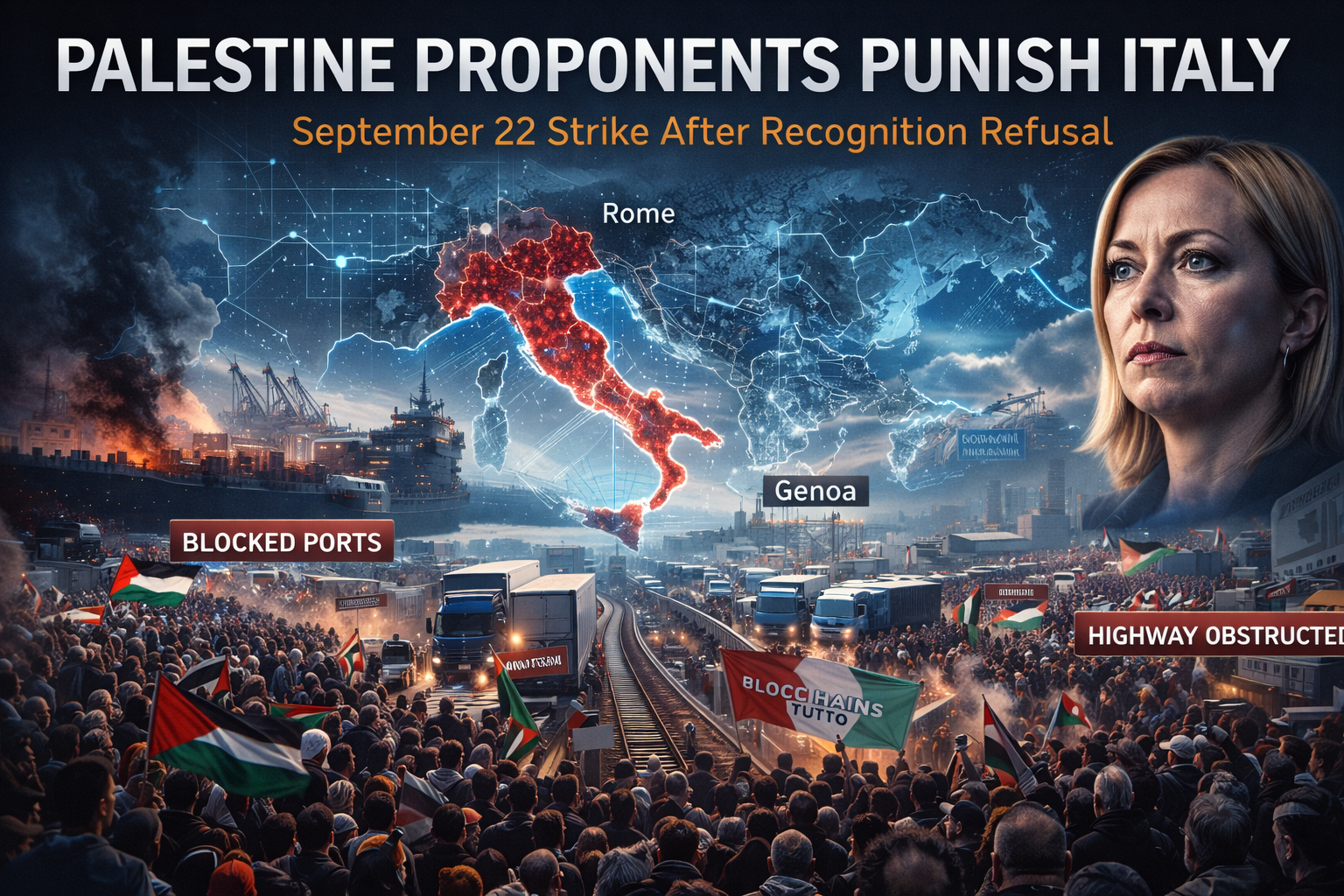
Palestine Proponents Punish Italy: September 22 Strike After Recognition Refusal
Part 6/#7 : European Palestine Recognition – Muslim Brotherhood
भारत / GB
Scrutinizing How Palestine Proponents Punish Italy
Palestine Proponents Punish Italy with coordinated infrastructure paralysis one day after nine European nations capitulated. While the United Kingdom, France, Belgium, and six other countries surrendered to recognition pressure on September 21-22, 2025, Italy’s Giorgia Meloni government held firm—and paid the price within 24 hours.
On September 22, 2025, approximately one million workers across Italy staged a general strike under the slogan “Blocchiamo tutto” (Let’s Block Everything). This wasn’t protest—this was economic warfare targeting a non-compliant European state, exactly like what they did to France a few weeks before to ensure France toes the line. The template was identical: coordinated infrastructure shutdown, port blockades, nationwide paralysis—until the government capitulated with Palestine recognition.

Muslim Brotherhood in France
The 24-Hour Punishment Timeline
September 21, 2025: The Recognition Cascade
Nine countries recognized Palestinian statehood in 48 hours: UK, Canada, Australia, Portugal, France, Belgium, Luxembourg, Malta, and Monaco. The coordination was undeniable—the statistical probability of nine independent democracies making identical foreign policy decisions in the same 48-hour window is approximately 1 in 512 million.
Italy didn’t join them.
Prime Minister Giorgia Meloni’s government maintained its “cautious stance” and would not recognize a Palestinian state. Italy’s position was consistently pro-Israel, continuing arms deliveries through the state-linked company Leonardo even as public pressure mounted.
September 22, 2025: Palestine Proponents Punish Italy
Within 24 hours of refusing recognition, Palestine Proponents Punish Italy with coordinated nationwide infrastructure shutdown:
Rome: 300,000 demonstrators occupied Termini railway station, Italy’s main railway hub, before marching through streets. The capital’s transportation network ground to a halt.
Genoa: Dockworkers blocked access roads to Italy’s busiest port. The call originated from Genoa’s dockworkers: “Let’s block everything.”
Milan, Turin, Florence, Naples, Bari, Palermo: Simultaneous strikes across over 80 cities. Roads, train stations, highways, and workplaces shut down in coordinated fashion.
The strikes weren’t about labor contracts or wages. USB union declared: “Workers have returned to center stage… not for a contract renewal but to demand justice for a distant and tormented people”.

Muslim Brotherhood in France: Intelligence Report Ignored
The Infrastructure Warfare Strategy
When Palestine Proponents Punish Italy, they didn’t organize spontaneous protests—they executed coordinated economic coercion:
Port Blockades = Trade Paralysis
Italy’s major ports in Genoa and Livorno were blocked. Dockworkers—the same profession that controls European arms shipments—simultaneously stopped work. Their stated goal: “Stop shipments to Israel” and force Italy to cut all political and economic ties.
Road Blockades = Supply Chain Disruption
Highways were obstructed in Turin, Florence, Bologna, and Rome. Major junctions were shut down. Milan’s ring road was occupied. Italy’s internal supply chains faced immediate disruption.
Workplace Blockades = Production Shutdown
The strike extended beyond transport. Schools closed, some prisoners “downed tools,” and over 100 cities saw demonstrations. This was comprehensive economic warfare against a government that refused compliance.
The pattern resembles the demographic strategy decoded in France’s September unrest—organized networks applying coordinated pressure on European democracies.

Egypt–Gaza Wall: The Hidden Truth
The Message to Europe: Capitulate or Face Economic Siege
The timing reveals the strategic calculation. Palestine Proponents Punish Italy exactly when the contrast would be most visible:
Countries that recognized Palestine on September 21-22: No infrastructure warfare.
Italy, which refused recognition on September 21-22: Million-person strike, nationwide port blockades, 24-hour economic paralysis.
The message was unmistakable: This is what happens when you don’t surrender.
The Pre-Emptive Capitulation Theory
Consider the reverse causality: Did UK, France, and other European nations recognize Palestine to avoid what happened to Italy?
France experienced massive September unrest four months after intelligence services documented 207+ Muslim Brotherhood entities creating “Islamist ecosystems”. France capitulated with recognition.
The UK recognized Palestine despite no prior diplomatic signals. UK avoided Italy-style infrastructure warfare.
Belgium, Luxembourg, Malta, Monaco, Portugal—all recognized Palestine in the same 48-hour window. None faced Italy’s punishment.
The pattern suggests preventive surrender: European governments recognized Palestine not from principle, but to prevent domestic economic warfare from organized networks capable of paralyzing their infrastructure.
This aligns with the broader demographic reality exposed in how high-fertility clusters reshape democracies.
The Hungary Exception: Why One Country Avoided Italy’s Fate
Hungary faced no infrastructure paralysis in September 2025. When Viktor Orbán’s government voted against the UN’s New York Declaration on Palestinian statehood—one of only 10 countries worldwide to do so—no ports shut down, no general strikes materialized, no million-person protests paralyzed Budapest.
The difference? Hungary spent a decade preventing the demographic and organizational infrastructure that France allowed to flourish. With approximately 5,000 Muslims among 10 million population, and with explicit 2015 policies banning pro-Palestinian rallies and preventing parallel society development, Hungary simply lacked the pressure mechanisms that brought Italy to its knees within 24 hours.

Black September: Jordan’s Forgotten War
Meloni’s Response: “Hooligans” and Defiance
Prime Minister Giorgia Meloni called the strikers “hooligans” and claimed that “clashing with the police and destroying private property would not help the people in Gaza”. Ministers Matteo Salvini and Matteo Piantedosi joined her condemnation.
Salvini, Italy’s Infrastructure Minister, became a particular target. In Venice, protesters sent “a special message to a special enemy,” insisting their loyalty was with Palestinians under attack.
But Meloni’s defiance had limits. Two days after the general strike, she declared herself “open to the recognition of a Palestinian state” pending conditions. The about-face was notable—though she added qualifiers (release of hostages, denial of Hamas role), the shift from “cautious stance will not recognize” to “open to recognition” occurred within 48 hours of Italy’s economic paralysis.
The pattern mirrors how destabilization doctrine operates when deployed domestically—targeted states face escalating pressure until compliance.

Lebanon Civil War: From Paris of the Middle East
The Coordination Question: Who Organized This?
When Palestine Proponents Punish Italy with million-person strikes across 80+ cities simultaneously, several organizational questions emerge:
How did protests in over 80 Italian cities coordinate identical actions on the same day?
The principal organizer was USB (Unione Sindacale di Base), a grassroots union. But USB coordinated with CGIL (Italy’s largest union), Palestinian associations in Italy, and the Global Movement for Gaza.
Political parties including Five Star Movement, Democratic Party, Greens and Left Alliance, Communist Refoundation Party, and Power to the People officially supported the strikes. Even neofascist party Forza Nuova participated, demonstrating the horseshoe theory where far-left and far-right converge against establishment governments.
Why did this happen exactly 24 hours after nine other European countries recognized Palestine?
The timing wasn’t coincidence. The September 22 strike coincided with France’s Palestine recognition at the UN General Assembly. Italy stood isolated as the only major European nation refusing to join the recognition wave—making it the perfect target for demonstration effect.
This aligns with patterns of regime change operations documented globally, where coordinated pressure isolates non-compliant governments.
The Funding Question: Beyond Official Organizations
While USB union and Palestinian associations provided official coordination, the “grapevine”—intelligence whispers and underground investigations—reveals a more troubling layer.
The Genoa dockworkers’ CALP collective, led by white Italians, allegedly received “solidarity funds” from the Association of Palestinians in Italy. December 2025 raids seized computers, with right-wing media claiming evidence of foreign funding channels. Student collectives faced accusations of cryptocurrency transfers from Iranian-affiliated wallets spiking before September strikes. Large legal defense funds appeared overnight after arrests.
No formal bribery charges have been proven—and that’s the point. The new model doesn’t pay Giovanni Rossi €10,000 to organize strikes. It provides “€50,000 solidarity fund for Gaza relief to maritime workers’ association.” Leaders can honestly deny personal bribes while the funding flows, the infrastructure paralyzes, and the government capitulates.

The Italy Example: Deterrence Through Demonstration
Palestine Proponents Punish Italy served multiple strategic purposes:
- Immediate Pressure: Force Meloni government toward Palestine recognition (achieved within 48 hours—she moved from “will not recognize” to “open to recognition”)
- European Deterrence: Show other holdout nations what happens if they resist recognition demands
- Capability Demonstration: Prove that organized networks can paralyze European infrastructure within 24 hours
- Precedent Setting: Establish that resistance to Palestine recognition triggers immediate economic warfare
The statistical impossibility of nine European countries simultaneously recognizing Palestine combined with Italy’s immediate punishment for non-compliance reveals coordination that transcends democratic decision-making.
When 142 countries voted for two-state solution at the UN, the vote represented coordinated pressure, not independent principle. When nine European democracies recognized Palestine in 48 hours, it represented coordinated surrender, not diplomatic momentum. When Italy refused and faced instant infrastructure paralysis, it represented the enforcement mechanism ensuring compliance. This same pattern appeared in India’s 2020-2021 farmers’ protests, where year-long highway blockades led by groups with documented Khalistani separatist connections eventually forced the Modi government to completely repeal contested farm laws—infrastructure warfare achieving political capitulation through coordinated economic coercion, regardless of geography.
This is civilizational warfare operating through demographic and organizational networks embedded in Western democracies—capable of economic coercion against governments that resist.
Italy wasn’t punished for its Israel policy. Palestine Proponents Punish Italy to send a message to all European governments: Recognize Palestine, or your infrastructure shuts down within 24 hours.
The question remaining: How many other European governments recognized Palestine not from conviction, but from fear of becoming the next Italy?
Feature Image: Click here to view the image.
Videos
Glossary of Terms
- September 2025 Italian General Strike: A nationwide strike across Italy on September 22, 2025, involving transport, ports, workplaces, and public services in response to Gaza-related political demands.
- Infrastructure Warfare: A strategy of political coercion using shutdowns of ports, railways, highways, and logistics to force government compliance without formal violence.
- Blocchiamo Tutto: Italian slogan meaning “Let’s block everything,” used by strike organizers to signal total economic paralysis.
- USB (Unione Sindacale di Base): A grassroots Italian trade union that played a central role in coordinating the September 2025 strike actions.
- CGIL: Italy’s largest trade union confederation, which supported and participated in the Gaza-linked general strike.
- Palestine Recognition Cascade: The coordinated recognition of Palestinian statehood by nine European countries within a 48-hour window in September 2025.
- Preventive Capitulation: The theory that governments concede politically in advance to avoid anticipated domestic unrest or economic disruption.
- Port Blockades: Organized stoppages at maritime ports—particularly Genoa and Livorno—to halt trade and arms shipments.
- Economic Coercion: Use of financial, trade, and production disruption to extract political concessions from a state.
- Demonstration Effect: A strategy where punishment of one state is used to deter resistance by others.
- Demographic Infrastructure: Long-term organizational, population, and network capacity enabling large-scale coordinated mobilization.
- Horseshoe Theory: The convergence of far-left and far-right political groups against centrist or establishment governments.
- Recognition Pressure Networks: Overlapping unions, activist groups, NGOs, and political actors applying synchronized pressure across states.
- Destabilization Doctrine: A framework describing how internal unrest is leveraged to alter state policy without direct regime change.
#ItalyStrike #EuropePolitics #GeneralStrike #Infrastructure #UKPolitics #Palestine #Europe #Demographics #FranceStrikes #FranceStrikes #PalestineRecognition #InfrastructureWarfare #LiberalDemocracy #HinduinfoPedia #FrancePolitics #GovernmentCollapse #ForeignInfluence #PalestineRecognition #MuslimBrotherhood #PoliticalIslam #EuropeCrisis #EuropeanPalestineRecognition
Series: Palestine Recognition 2025 — Europe’s Coordinated Surrender Explained (Complete)
- https://hinduinfopedia.com/palestine-recognition-2025-europes-48-hour-surrender-explained/
- https://hinduinfopedia.com/muslim-brotherhood-france-intelligence-report-media-ignored/
- https://hinduinfopedia.com/muslim-brotherhood-in-france-international-backers-and-leverages/
- https://hinduinfopedia.com/france-government-collapse-how-instability-enabled-foreign-pressure/ https://hinduinfopedia.org/?p=18697
- https://hinduinfopedia.com/france-strikes-september-2025/ https://hinduinfopedia.org/?p=18810
- https://hinduinfopedia.com/uks-palestine-support-template/ https://hinduinfopedia.in/?p=24770
- https://hinduinfopedia.com/palestine-proponents-punish-italy-september-22-strike/ https://hinduinfopedia.in/?p=25012
- https://hinduinfopedia.com/palestine-recognition-captures-france-the-unsc-veto-as-strategic-prize/ https://hinduinfopedia.in/?p=25379
- https://hinduinfopedia.com/palestine-pressure-strikes-three-fronts-france-uk-italy-september-2025/ https://hinduinfopedia.in/?p=25388
- https://hinduinfopedia.com/qatar-europe-influence-from-parliament-bribery-to-invisible-leverage/ https://hinduinfopedia.in/?p=25464
- https://hinduinfopedia.com/palestine-recognition-voting-patterns-hiss-versus-the-media-loudspeaker/ https://hinduinfopedia.in/?p=25514
Internal Links Referenced:
- Palestine Recognition 2025: Europe’s 48-Hour Surrender Explained
- Muslim Brotherhood In France: International Backers and Leverages
- Muslim Brotherhood France: Intelligence Report Media Ignored
- Demographic Strategy Decoded For France Unrest
- Demographic Continuity: France September 2025
- Demographic Reality Exposed: How High-Fertility Clusters Reshape Democracies
- Egypt Gaza Wall: The Hidden Truth 57 Muslim Nations
- Black September Jordan: The Forgotten War
- Lebanon Civil War: From Paris of the Middle East to Hezbollah State
- Destabilization Doctrine: How America’s Foreign Policy Boomerang Is Striking Home
- Regime Change Playbook: A Manual for Color Revolution Operations
- When Dictatorships Vote on Democracy: The UN Legitimacy Crisis
- Great Deception and Global Civilizational Warfare
Follow us:
- English YouTube: https://www.youtube.com/@Hinduofficialstation
- Hindi YouTube: https://www.youtube.com/@HinduinfopediaIn
- X: https://x.com/HinduInfopedia
- Instagram: https://www.instagram.com/hinduinfopedia/
- Facebook: https://www.facebook.com/Hinduinfopediaofficial
- Threads: https://www.threads.com/@hinduinfopedia
[…] भारत / GB […]
[…] […]
[…] 22, 2025: Within 24 hours, approximately one million workers stage general strike under slogan “Blocchiamo tutto” (Let’s Block […]
[…] […]