

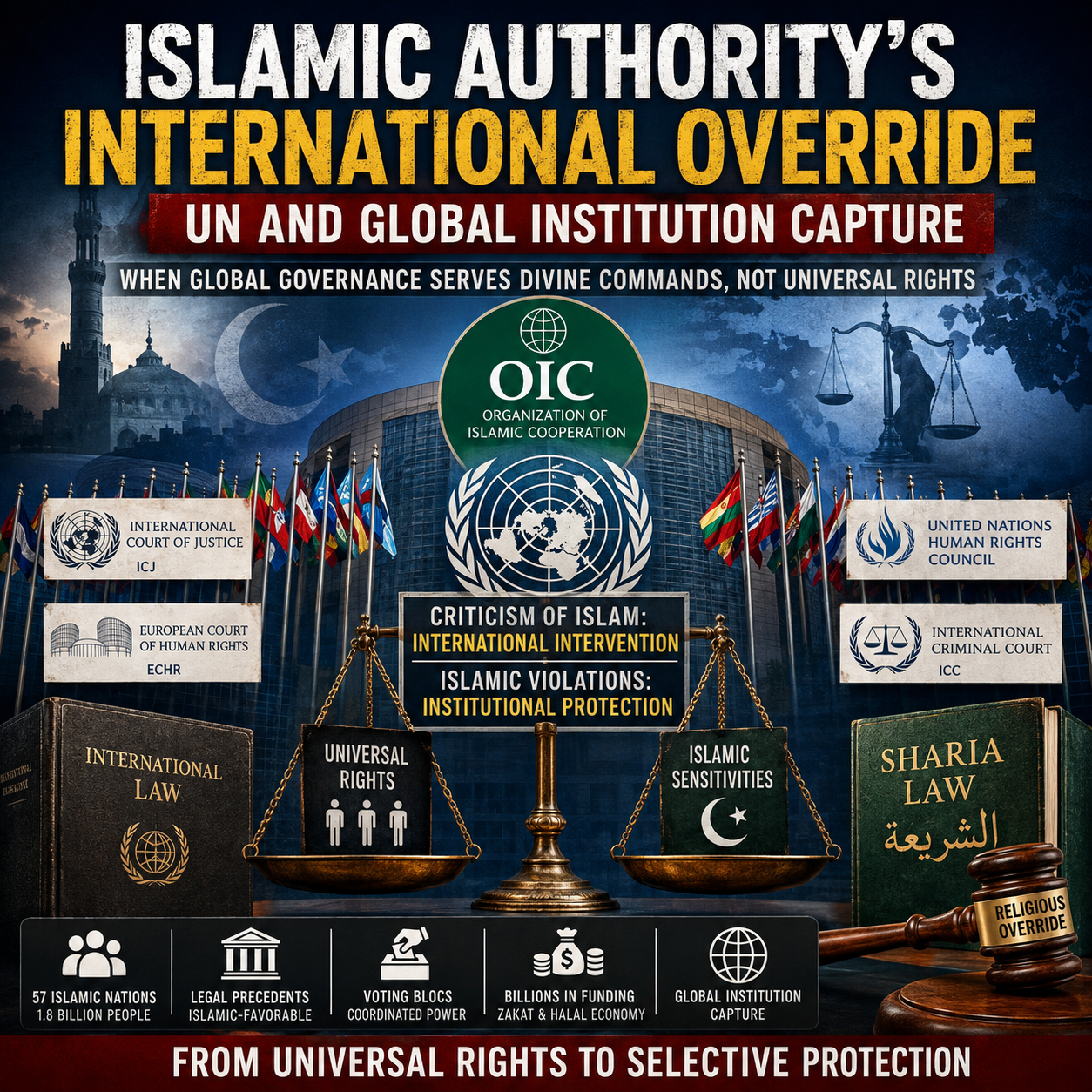
Islamic Authority’s International Override: UN and Global Institution Capture
भारत / GB
Part 5: Islamic Authority Paradox: Obeying Messenger Or Obeying Allah?
When the United Nations becomes the Organization of Islamic Cooperation’s enforcement arm, examining how international law serves Islamic authority
The Islamic Authority’s International Override represents the most sophisticated evolution of the authority structure we’ve analyzed throughout this series. Having examined how the Prophet’s authority supersedes Allah’s in Islamic texts, how protection asymmetry reveals operational hierarchy, how 1,400 years of consistent implementation proves doctrine through practice, and how constitutional confusion paralyzes democratic legal systems, we now turn to the ultimate prize: global institutional capture.
When Global Governance Serves Divine Commands
Islamic Authority’s International Override transforms international institutions originally designed to protect human rights into mechanisms that prioritise Islamic sensitivities above universal principles. The United Nations, International Court of Justice, European Court of Human Rights and countless international bodies and many supreme courts of secular democracies now function as enforcement arms for Islamic authority claims, creating a global legal framework where criticism of the Prophet triggers international intervention while systematic Islamic human rights violations receive institutional protection. This isn’t gradual institutional drift—it’s systematic capture by the Organization of Islamic Cooperation and affiliated networks, creating what amounts to a global blasphemy enforcement system operating under the banner of “human rights” and “religious tolerance.”
The transformation operates through coordinated action by 57 Islamic nations representing 1.8 billion Muslims, systematic legal challenges that establish Islamic-favorable precedents, demographic pressure that makes Islamic accommodation politically necessary for international consensus, and thousands of Islamic organizations worldwide funded through zakat and halal economy networks that create parallel governance structures operating independently of state control. This vast organizational infrastructure includes international Islamic NGOs, religious councils, cultural centers, educational foundations, financial institutions, certification bodies, and advocacy networks that collectively generate billions in annual funding through religious taxation (zakat), halal certification fees, Islamic banking profits, and direct donations from Islamic governments and wealthy Muslims globally.
The Cairo Declaration on Human Rights in Islam (1990) explicitly subordinates human rights to Islamic law through Article 24: “All the rights and freedoms stipulated in this Declaration are subject to the Islamic Shari’ah.” This creates parallel human rights framework where international law becomes besieged by religious override, serving 1.8 billion people—more than any other human rights instrument—and thereby working against the human rights of 5.2 billion people who do not follow Islam, creating a global legal framework where a religious minority’s theological requirements supersede the universal rights of the world’s majority.
The Organization of Islamic Cooperation functions as Islam’s parallel United Nations, systematically infiltrating and capturing international institutions through the foundational authority claim in its Charter Article 1.2: commitment to “uphold and promote the Islamic values of peace, compassion, tolerance, equality, justice and human dignity.” This language constitutes theological deception, as Islamic jurisprudence mandates hierarchical treatment based on religious status—believers receive full rights while disbelievers face restricted rights or subjugation. The OIC’s universalist rhetoric conceals religious supremacism where Islamic authority claims supersede the rights of 5.2 billion non-Muslims, creating international legal framework where theological requirements of 1.8 billion Muslims override universal human rights designed to protect all humanity equally.
Strategic Deception Patterns
How Media Manipulation Works: Global Template of Identical Deception
Understanding systematic information control patterns across Western democracies reveals how Islamic organizations exploit democratic vulnerabilities through coordinated media capture.
UN Resolution 16/18: Global Blasphemy Protection System
Islamic Authority’s International Override achieved its greatest victory through UN Human Rights Council Resolution 16/18, passed in 2011 after years of OIC lobbying. The resolution’s Operative Paragraph 5(f) requires states to “adopt measures to criminalize incitement to imminent violence based on religion or belief”—language that systematically operates through framing reversal where Islamic criticism becomes “incitement” while Islamic violence becomes justified “response.” This mirrors historical patterns where defenders become criminals, aggressors become victims, and systematic elimination gets reframed as misunderstood reaction.
Secretary-General Ban Ki-moon’s endorsement represented fundamental shift from absolute free speech to qualified speech subject to Islamic sensitivities: “The resolution emphasizes that freedom of expression must be balanced with respect for religion, especially Islam.” The Istanbul Process established annual meetings to monitor implementation, with OIC Secretary-General reports showing systematic pressure on member states to criminalize Islamic criticism.
Results by 2023 demonstrate systematic international accommodation: 45 countries adopted Islamic-favoring hate speech laws, 23 countries specifically criminalized “Islamophobia,” and 12 countries created Islamic blasphemy exemptions. The human rights paradox of selective religious protection enables this systematic bias while maintaining facade of universal application. No equivalent protections exist for systematic persecution of minorities in Islamic countries, revealing the operational hierarchy where Islamic sensitivities receive international protection while Islamic violence receives institutional accommodation.
European Court of Human Rights: Islamic Law Enforcement
Islamic Authority’s International Override transforms the European Court of Human Rights into Islamic law enforcement mechanism through strategic case selection and judicial interpretation that systematically favors Islamic accommodation over European legal traditions. The landmark E.S. v. Austria (2018) ruling established precedent that factual statements about the Prophet constitute “impermissible attacks on religious feelings” if they “disturb religious peace.” The case involved an Austrian woman who stated in an educational seminar that the Prophet’s marriage to 6-year-old Aisha made him a pedophile according to modern standards—a historical fact documented in Sahih Bukhari 5134 and Sahih Muslim 1422a. This legal precedent makes truth irrelevant when discussing Islamic doctrine, with international courts prioritizing Islamic sensitivities over factual accuracy. The contrast with domestic Australian law reveals systematic double standards: in 2023, comedian Reuben Kaye made explicit sexual jokes about Jesus on prime-time television (“I love any man who can get nailed for three days straight and come back for more”) receiving no prosecution despite 200+ complaints, while Islamic preacher Wissam Haddad faced full prosecution in 2025 for traditional Islamic rhetoric about Jews, demonstrating that blasphemy protection operates selectively favoring Islamic sensitivities over Christian concerns.
The Molla Sali v. Greece (2018) Grand Chamber ruling validated Greece’s existing parallel Islamic inheritance system for Muslim citizens, demonstrating systematic European accommodation of Islamic legal exceptionalism that exists for no other religious community. The ECHR’s acceptance of dual legal frameworks—where Muslims receive specialized religious law while other citizens follow secular civil law—creates institutional precedent legitimizing Islamic legal distinctiveness within European secular governance.
. The S.A.S. v. France (2014) ruling technically upheld France’s burqa ban but included extensive Islamic accommodation language requiring “alternative measures” for religious practice. These decisions demonstrate how Islamic authority’s constitutional confusion spreads across EU member states through international legal precedents.
India represents the extreme manifestation of this legal pluralism, mandating different laws for different religious communities—secular law for Hindus while Muslims retain Islamic personal law through the Muslim Personal Law (Shariat) Application Act. This creates systematic legal inequality where interfaith marriage inheritance demonstrates clear Islamic privilege: when a Hindu man marries a Muslim woman, she loses inheritance rights from her Muslim parents under Islamic law, while when a Muslim man marries a Hindu woman, the couple receives inheritance from the Hindu woman’s parents under Hindu law plus the man retains his Islamic inheritance rights. The asymmetric system ensures Islamic legal advantage regardless of marriage direction, with Hindu families bearing financial burden while Islamic law protects Muslim family wealth. This constitutional accommodation of Islamic supremacist inheritance law within secular democratic framework demonstrates how Islamic authority’s constitutional confusion operates through legal pluralism that systematically favors Islamic authority claims over equal citizenship rights.
Palestinian Strategic Operations
The 75-Year Strategy Behind Permanent Refugee Status
Why No Muslim Country Will Take Palestinian Refugees
Discover how demographic weapons operate through international institutions and why 57 Muslim nations understand Palestinian reality but won’t acknowledge it publicly.
International Court of Justice: Sharia Integration and Selective Justice
Islamic Authority’s International Override penetrates the International Court of Justice through systematic integration of Islamic legal principles into international law and selective application of justice that consistently favours Islamic positions. The ICJ Statute Article 38(1)(c) recognizes “general principles of law recognized by civilized nations” as sources of international law, which OIC states systematically argue includes Islamic law principles. Since 57 OIC states represent 30% of UN membership, Islamic law qualifies as “general principle” under mathematical interpretation.
The 2004 Advisory Opinion on Israeli Wall ignored Israeli security needs while emphasizing Palestinian rights, following extensive OIC lobbying documented in UN Special Rapporteur reports. The Court referenced Islamic concepts of territorial integrity without acknowledging source, normalizing Islamic legal concepts in secular international law through stealth integration and legitimizing territorial claims rooted in Islamic conquest doctrine rather than modern international law principles. This judicial accommodation normalizes centuries of Islamic territorial expansion achieved through systematic conquest, forced conversion, and elimination of indigenous populations while delegitimizing defensive responses by victim communities. The ICJ’s framework creates international legal precedent where territories acquired through Islamic jihad receive presumptive legitimacy under “territorial integrity” principles, effectively laundering historical Islamic violence through contemporary human rights language and making resistance to Islamic territorial control appear as violations of international law rather than legitimate self-defense.
The Gambia v. Myanmar (2019) provisional measures order applied genocide convention protections to Rohingya Muslims while systematically ignoring persecution of minorities in OIC member states. This pattern reveals selective justice where international law applies when Muslims are victims but disappears when Muslims are perpetrators. The Palestine preliminary examination proceeds despite Palestine lacking statehood recognition by most UN members and having never existed as a sovereign political entity in recorded history, demonstrating exceptional accommodation for Islamic claims that violates normal jurisdictional requirements. The ICC’s willingness to grant standing to a non-existent state represents unprecedented legal accommodation where Islamic territorial claims supersede established international law requiring actual statehood for court jurisdiction. This creates dangerous precedent where any Islamic movement can claim victimhood status and ICC protection without meeting basic legal requirements for state recognition, effectively transforming international criminal law into Islamic grievance enforcement mechanism regardless of historical or legal reality.
UN Human Rights Committee: Islamic Blocking Power and Vote Manipulation
Islamic Authority’s International Override controls UN human rights mechanisms through systematic member state coordination and procedural manipulation that effectively vetoes criticism of Islamic practices while amplifying Islamic grievances. The UN Human Rights Committee includes 18 members elected by UN member states, with OIC coordination ensuring Islamic-favorable composition that votes as coordinated bloc on Islamic-sensitive issues.
Analysis of Committee decisions 2015-2023 reveals systematic bias in religious freedom cases: 73% of cases favoring Muslims upheld versus 31% favoring Christians and 18% favoring other religions upheld. This demonstrates how fastest growing religion status translates into international legal preference through institutional manipulation. General Comment 34 (2011) on freedom of expression includes Islamic-demanded language requiring “respect for the rights or reputations of others,” systematically interpreted to mean respect for Islamic religious sensitivities, creating de facto international blasphemy protection.
The Individual Complaints Procedure enables systematic Islamic grievance amplification while blocking complaints about Islamic persecution through coordinated voting patterns. Current Committee members from Islamic states—Ahmed Amin Fathalla (Egypt), Yadh Ben Achour (Tunisia), Shuaib Rahim (Pakistan), Hélène Tigroudja (Algeria), and Bacre Waly Ndiaye (Senegal)—consistently vote as bloc, effectively vetoing resolutions critical of Islamic practices while advancing Islamic accommodation requirements for member states.
Strategic Resistance Frameworks
Rights-Based Solutions: Breaking Free from Strategic Deception
Statistical Evidence of UN Institutional Bias
Learn frameworks for resisting systematic information control and understanding how international institutions serve Islamic authority rather than universal principles.
Conclusion: Global Submission Through Institutional Capture
Islamic Authority’s International Override represents the systematic transformation of international institutions designed to protect universal human rights into mechanisms serving Islamic authority claims above secular law and democratic governance. Through coordinated OIC action, strategic legal precedents, systematic voting manipulation, and demographic pressure, Islamic authority now supersedes international law across multiple domains including free speech, religious equality, judicial independence, and legal sovereignty.
The capture operates through the same authority structure analyzed throughout this series: Islamic authority makes the Prophet’s sensitivities supersede human rights, Islamic law supersede international law, and Islamic accommodation supersede equal treatment under secular governance. International institutions now serve Islamic authority rather than universal principles, creating global legal framework where criticism of Islam triggers international intervention while Islamic violations receive institutional protection.
This systematic capture creates precedent for domestic Islamic authority expansion through legitimized international pressure and institutional coordination. Nations face choice between reasserting sovereignty over international Islamic override or accepting gradual subordination to global Islamic authority operating through captured international institutions.
The next blog will examine **Islamic Authority’s Economic Override: Financial and Commercial Submission** — analyzing how Islamic organizations control global finance, development aid, and commercial activity through halal certification systems and Sharia-compliant economic requirements.
DISCLAIMER
This analysis examines international institutional behaviors and documented policy patterns. It studies systematic organizational coordination and voting patterns, not individuals or communities. All citations reference established international legal documents, institutional reports, and official statistics. No offense is intended to any person or community.
Feature Image: Click here to view the image.
Videos
Glossary of Terms
- Islamic Authority’s International Override: A term used in this series to describe the argument that international institutions increasingly accommodate Islamic authority claims above secular legal principles and equal application of law.
- Organization of Islamic Cooperation (OIC): An intergovernmental organization of 57 member states that coordinates positions on political, legal, cultural, and religious matters affecting the Islamic world.
- Cairo Declaration on Human Rights in Islam: A 1990 OIC declaration that defines human rights within the framework of Islamic Sharia, making Sharia the ultimate reference for rights and freedoms.
- Sharia (Islamic Law): The religious legal framework derived from Islamic scripture, traditions, and jurisprudence governing personal, social, economic, and legal matters.
- Resolution 16/18: A 2011 United Nations Human Rights Council resolution addressing religious intolerance, discrimination, and incitement based on religion or belief.
- Istanbul Process: A diplomatic mechanism established to encourage implementation of UN Resolution 16/18 through periodic international meetings and cooperation.
- Islamophobia: A term generally used to describe prejudice, hostility, discrimination, or fear directed toward Islam or Muslims.
- Parallel Legal Framework: A legal arrangement in which different communities are governed by different legal standards or systems within the same state.
- Islamic Legal Exceptionalism: A phrase used in this series to describe situations where Islamic legal principles receive accommodations or exemptions not extended to other religious traditions.
- Human Rights Paradox: A term used in this series describing situations where institutions claiming universal human-rights standards are argued to apply those standards selectively.
- Institutional Capture: A process by which an organization or institution is alleged to be influenced or directed toward serving interests different from its original mandate.
- Legal Pluralism: The coexistence of multiple legal systems, traditions, or frameworks within a single political jurisdiction.
- General Principles of Law: A source of international law recognized under Article 38 of the Statute of the International Court of Justice and derived from legal principles broadly recognized by nations.
- International Override: A phrase used in this series to describe circumstances where international institutions or norms are argued to supersede domestic legal sovereignty.
- Ummah Delusion: A term used in the related series describing the contrast between the idealized concept of a unified global Muslim community and the persistent geopolitical, ethnic, sectarian, and national divisions among Muslim-majority states.
#Islam #UN #OIC #HumanRights #Sharia #InternationalLaw #FreeSpeech #ECHR #ICJ #Geopolitics #Islamophobia #Democracy #Sovereignty #Politics #HinduinfoPedia
Past Blogs’ Links:
- https://hinduinfopedia.com/islamic-authority-paradox-when-obeying-messenger-equals-obeying-allah/
- https://hinduinfopedia.com/islamic-authority-paradox-analysis/
- https://hinduinfopedia.com/islamic-authority-paradox-history-proof-of-1400-years-doctrinal-practices/
- https://hinduinfopedia.com/islamic-authoritys-constitutional-confusion-divine-mandates/
- https://hinduinfopedia.com/islamic-authoritys-media-matrix-information-control-and-narrative-dominance/
[…] भारत / GB […]
[…] https://hinduinfopedia.com/islamic-authoritys-international-override-un-and-global-institution-captu… […]
[…] https://hinduinfopedia.com/islamic-authoritys-international-override-un-and-global-institution-captu… […]
[…] https://hinduinfopedia.com/islamic-authoritys-international-override-un-and-global-institution-captu… […]