

America Day of Independence: The Birth of a Global Enforcer
America Day of Independence Analyzed
On America Day of Independence, July 4th, 1776, the thirteen colonies declared their separation from the British Crown—a revolutionary act inspired by Enlightenment ideals such as liberty, self-rule, and popular sovereignty. It was hailed as freedom from monarchy and colonial oppression. Yet, history reveals a troubling irony: the new state born that day would go on to display forms of dominance and control more far-reaching than the very empire it broke from.
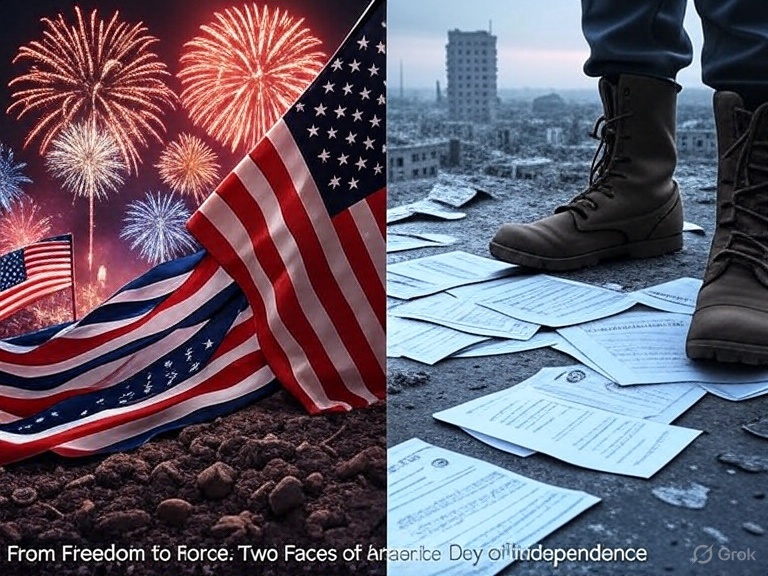
America Day of Independence has long been portrayed as a triumph of liberty. But beneath the fireworks lies a different legacy—one of selective freedom and future dominance.
The Declaration of Independence, authored by Thomas Jefferson, proclaimed that “all men are created equal,” and it marked the birth of what would become one of the most powerful nations in world history.
Yet this declaration of equality coexisted with glaring exclusions: women could not vote, Native Americans were labeled as “merciless savages,” and enslaved Africans were treated as property. The new republic’s promise of liberty was limited—reserved for a select class of white, landowning men.
While the ideals were lofty, the reality was far more complex—and far more brutal. The American Revolution was not simply a break from colonial rule; it became the foundation for a new kind of empire. Independence, it turned out, was not just about escaping foreign domination—it also enabled the consolidation of power through conquest, displacement, and control.
The Dispossession of Native Peoples
In the years following independence, the United States rapidly expanded westward. The doctrine of Manifest Destiny justified the seizure of indigenous lands as a divine right. From the Indian Removal Act of 1830 to the Trail of Tears and countless broken treaties, the new republic replicated—and intensified—the colonial logic of domination. Native populations were decimated through forced relocations, warfare, and deliberate cultural erasure. The very freedom America celebrated was built atop the loss of freedom for others.
What began as a revolution by a few thousand white men to free themselves from the British Crown soon evolved into something far more brutal. In liberating themselves, they assumed the role of the new crown—wielding power over others with a force that often exceeded the very oppression they had once resisted. For Native Americans, African slaves, and countless other communities, the birth of the republic marked not freedom, but a more systematic and enduring domination than that of the British Empire.
The Paradox of Slavery and Liberty
While America declared liberty as a founding principle, it simultaneously upheld and expanded the institution of slavery. Enslaved Africans were not only excluded from the promises of 1776, but their bondage was legally reinforced in the Constitution and economically embedded in the rise of American capitalism. Even after abolition, systemic racism persisted through Jim Crow laws, segregation, and mass incarceration.
Technological Power and Global Supremacy
The 19th and 20th centuries saw America leverage European technological advances—and develop its own technologies, fueling both industrial growth and military might. The invention of the cotton gin, the telegraph, and later, nuclear weapons, enabled the U.S. to extend its influence globally. The post-WWII era cemented the United States as a global superpower, but not without cost: its involvement in proxy wars, covert operations, and economic sanctions often destabilized nations across Latin America, the Middle East, and Southeast Asia.
From the overthrow of Iran’s Mossadegh in 1953 to the Vietnam War, and later U.S. interventions in Iraq and Afghanistan, America’s role as “global policeman” has been marked by both humanitarian rhetoric and strategic interests. The pursuit of power often came at the expense of local autonomy and democratic movements abroad.
Beyond military might, the U.S. has also wielded economic dominance as a tool of control—using sanctions, IMF structural adjustments, and the global reliance on the U.S. dollar to pressure or punish dissenting nations without firing a shot.
Invasions Without Provocation
While often framing its military actions as defensive or humanitarian, the United States has launched several unprovoked invasions that raised global concern over sovereignty, legality, and ethical standards. These interventions, though framed in humanitarian or security terms, frequently caused destabilization, civilian casualties, and decades of long-term regional instability.
Iraq (2003)
Perhaps the most infamous modern example, the U.S.-led invasion of Iraq in 2003 was based on the false claim that Saddam Hussein possessed weapons of mass destruction (WMDs). Despite lacking UN authorization and concrete evidence, the U.S. proceeded with military action. The result: hundreds of thousands of Iraqi civilians killed, a fractured region, and the rise of extremist groups like ISIS—ironically, the very threat the invasion purported to prevent.
Today, Iraq remains politically unstable, plagued by corruption, foreign influence, sectarian divisions, and recurring extremist violence that continues to threaten its fragile sovereignty.
Panama (1989)
These invasions—Iraq, Grenada, and Libya—highlight America’s willingness to bypass international norms to project power, control vital resources, and redraw global boundaries—not with maps, but with missiles and markets—often leaving chaos and civilian suffering in their wake.
More than three decades later, Panama remains overshadowed by American influence, with economic inequality, weak institutions, and political corruption persisting under the veneer of democratic governance.
Grenada (1983)
The U.S. invaded the small Caribbean island of Grenada in what it claimed was a rescue mission for American medical students and a move to curb a Marxist threat. However, the action was taken without consulting allies or international bodies. The United Nations called it a “flagrant violation of international law.”
Today, Grenada is a quiet tourist destination, but its political independence and development path remain shaped by external dependency and strategic alignment with U.S. interests.
Libya (2011)
Although initiated under NATO and justified as a humanitarian mission to prevent mass killings, the U.S.-backed intervention in Libya led to the collapse of the Gaddafi regime in 2011—and plunged the country into civil war. Even after NATO officially ended its mission later that year, Libya continued to spiral into chaos, with the rise of armed militias, slave markets, and persistent instability that endures to this day.
As of now, Libya is still a fractured state, divided between rival governments, foreign mercenaries, and militia rule—with no functioning democracy and humanitarian conditions in steep decline.
These modern invasions, marked by unilateral action, reflect a broader pattern of America prioritizing its geopolitical goals over international cooperation and sovereignty.
America’s Unilateral Ambitions
America’s pursuit of global dominance often sidelined multilateralism, prioritizing its own interests over international consensus. Allies and adversaries alike condemned the U.S. for bypassing global norms, revealing a pattern of unilateral action that disregarded sovereignty and cooperation. The 2003 Iraq invasion, launched despite opposition from allies like France and Germany and without UN authorization, exemplified this arrogance—fracturing NATO unity and fueling distrust over fabricated WMD claims. Adversaries like Russia and China seized on this, denouncing U.S. unilateralism to rally Global South nations against Western hegemony. In affected regions, initial support from some Iraqi exiles quickly turned to resentment as civilian casualties mounted, sparking anti-American protests and insurgencies. Similarly, the 2011 Libya intervention, though cloaked in NATO’s multilateral veneer, ignored African Union pleas for restraint, leaving chaos and slave markets in its wake. The UN General Assembly’s condemnation of the 1983 Grenada invasion as a “flagrant violation of international law” underscored global outrage at America’s cavalier disregard for sovereign rights. These episodes reveal a nation that, while projecting power, often acted as if it cared for none—undermining the very international order it claimed to uphold.
Imperial Durability in the Early 20th Century
Long before its Cold War dominance, the United States crafted an imperial framework through military occupations, annexations, and economic interventions in the early 20th century. This strategy, distinct from European-style colonization, relied on controlling governments, economies, and strategic assets across the Western Hemisphere and Pacific, setting the stage for modern unilateralism.
The Philippines (1898–1946)
Following victory in the Spanish-American War, the U.S. took control of the Philippines, despite Filipino aspirations for independence. What followed was the brutal Philippine-American War (1899–1902), in which U.S. forces suppressed Filipino resistance using scorched-earth tactics and concentration camps. Hundreds of thousands of Filipinos died. The U.S. maintained colonial control until 1946.
Haiti (1915–1934)
Citing political instability and the need to protect American business interests, the U.S. invaded Haiti in 1915 and stayed for nearly two decades. During this occupation, the U.S. rewrote Haiti’s constitution to allow foreign land ownership, controlled its finances, and violently suppressed dissent, leaving deep scars on Haitian sovereignty and political development.
Cuba & the Platt Amendment (1901)
The U.S. refined a model of “soft” imperialism in the Americas—one that exerted control without direct colonization. In Cuba, after aiding its nominal independence from Spain, the United States imposed the Platt Amendment in 1901. This provision granted Washington the unilateral right to intervene in Cuban affairs and secured a perpetual lease on Guantánamo Bay—a military presence that endures to this day. Though Cuba was technically sovereign, its political future remained tethered to American interests until the amendment’s repeal in 1934. This marked a broader pattern: influence without annexation, enforced not by flags, but by treaties, military bases, and economic leverage.
Panama and the Canal (1903)
The U.S. supported a separatist movement in Colombia’s province of Panama in exchange for rights to build and control the Panama Canal. Once Panama declared independence—with U.S. naval support—Washington quickly secured the Canal Zone, exercising extraterritorial authority for nearly a century.
From orchestrating coups in Guatemala (1954) and Chile (1973) to escalating the Vietnam War, the U.S. shaped the Cold War not through balance but through dominance—often suppressing nationalist or democratic movements in the name of anti-communism.
But America did not act alone. It cultivated a network of like-minded, technologically advanced allies—through NATO, the IMF, the World Bank, the G7, and the intelligence-sharing “Five Eyes” alliance (comprising the U.S., U.K., Canada, Australia, and New Zealand). Together, these powers formed a transnational cartel that set the rules of trade, finance, surveillance, and security. Though presented as guardians of democracy, this bloc often functioned like a corporate empire—extracting resources, enforcing compliance, and preserving a lopsided global order that kept the Global South structurally dependent and politically vulnerable.
These early 20th-century interventions follow a consistent logic: protecting American commercial and strategic interests, often at the expense of local autonomy. They also laid the groundwork for a durable imperial infrastructure, with military bases, puppet governments, and economic dependencies that would echo through the Cold War and into the present.
US Modern Echoes: Overt and Covert Influence
Even in the 21st century, America continues to assert its dominance—sometimes overtly, sometimes behind the scenes.
The Ukraine Front and NATO’s Edge
The U.S. has armed Ukraine and pushed for its inclusion in NATO—effectively bringing American-led missions to Russia’s doorstep. This strategy, despite prior assurances, has been widely cited as a key factor prompting Russia’s invasion—a conflict now entering its fourth year. Observers now characterize Ukraine’s fight as a prolonged U.S.-backed war, driven more by geopolitical aims than Ukrainian autonomy.
Covert Regime Change: Bangladesh & Pakistan
Former leaders and investigative journalists allege Washington has directly interfered in South Asian democracies.
-
In Bangladesh, the ouster of Prime Minister Sheikh Hasina and the rise of an allegedly U.S.-aligned successor—who had made sizable donations to U.S. political actors—raised serious questions of hidden intervention.
-
In Pakistan, former PM Imran Khan claims U.S. pressure—allegedly via diplomatic channels—helped orchestrate a no-confidence vote in 2022.
Syria: Installing Extremists as Allies
In Syria, U.S. covert assistance helped install and support extremist factions once designated terrorist. Programs like Timber Sycamore channeled CIA weapons to rebel groups, some of which later merged with extremist militias. These actions transformed the Syrian theater into a proxy war, destabilizing local governance to serve strategic interests.
Through direct aid, military support, intelligence coordination, and alleged regime changes, the U.S. continues to shape geopolitical outcomes far from its borders. Whether through overt armaments or shadowy maneuvers, these modern strategies echo the same imperial impulses that defined earlier eras—asserting American influence often at the expense of sovereignty and self-determination.
Continuing Legacy
Today, American cultural, economic, and military power continues to shape the world. Silicon Valley, Wall Street, Hollywood, and the Pentagon are not just symbols of U.S. strength—they are tools of soft power, shaping global minds, tastes, and markets alongside its policies. Yet behind the celebrations of freedom lie stories of erasure, control, and contradiction.
On this America Day of Independence, reflection must replace celebration—especially when the ideals proclaimed in 1776 served as a launchpad for global control.
American independence undoubtedly changed the world—but not merely by spreading democracy. It also taught the modern world how to consolidate power through a mix of ideology, technology, and force. As we commemorate this day, we must ask: what kind of freedom are we really celebrating?
Feature Image: Click here to view the image.
Glossary of Terms
-
America Day of Independence: July 4th, 1776, the day the thirteen American colonies declared independence from British rule, marking the formation of the United States.
-
Manifest Destiny: A 19th-century belief that the United States was destined to expand across the North American continent, often used to justify the displacement of Native Americans.
-
Trail of Tears: The forced relocation of Native American tribes in the 1830s, especially the Cherokee, resulting in thousands of deaths during their march to designated territories.
-
Jim Crow Laws: A set of state and local laws in the U.S. (late 19th to mid-20th century) enforcing racial segregation, particularly in the South.
-
IMF Structural Adjustments: Economic policy reforms imposed by the International Monetary Fund on countries receiving loans, often criticized for deepening inequality and reducing local autonomy.
-
Five Eyes Alliance: An intelligence-sharing network comprising the U.S., U.K., Canada, Australia, and New Zealand, formed during World War II and still operational today.
-
Operation Just Cause: The 1989 U.S. military invasion of Panama to remove leader Manuel Noriega, criticized internationally for violating sovereignty and causing civilian casualties.
-
Platt Amendment (1901): A clause inserted by the U.S. into the Cuban constitution, allowing American intervention in Cuban affairs and establishing a lease for Guantánamo Bay.
-
Guantánamo Bay: A U.S. naval base in southeastern Cuba, originally leased under the Platt Amendment; now internationally controversial for detaining terrorism suspects.
-
Proxy Wars: Conflicts where two opposing powers use third parties as substitutes for fighting each other directly, common during the Cold War era.
-
Soft Imperialism: A form of indirect control through economic pressure, diplomacy, or cultural influence, rather than formal colonization or direct military rule.
-
Unilateralism: A policy or action undertaken by a country independently, without regard for the views or cooperation of other nations or international institutions.
-
Destabilization: The process of causing a government, economy, or society to become less stable—often as a result of foreign intervention or covert operations.
-
Corporate Empire: A term used to describe a powerful entity or coalition (like the U.S. and allies) that exerts influence globally through economic, political, and military means without traditional colonization.
-
Global South: A term referring broadly to countries in Africa, Latin America, Asia, and Oceania that are economically developing or historically marginalized in global politics.
📚 References and Further Reading
-
Five Eyes Intelligence Alliance Explained – Council on Foreign Relations
- politico.com
- https://peoplesworld.org
- https://sundayguardianlive.com.
- commondreams.org
- en.wikipedia.org
Related Blogs
Iranian Revolution: A Turning Point for Oil, India, and the World
World War 2: Reflecting on V-J Day and Use of Atomic Power K
[…] America Day of Independence: The Birth of a Global Enforcer […]
[…] https://hinduinfopedia.com/america-day-of-independence/ […]