

Bangladesh Hindu Displacement: From 1947 Partition to the Marichjhapi Tragedy
A Journey Through Decades of Bangladesh Hindu Displacement
We have covered the broad contours of the 1979 Marichjhapi incident in the previous analysis titled “Bangladesh Hindu Killings Marichjhapi: The Untold Story Part-I.” This examination, “Bangladesh Hindu Displacement: From Partition to Marichjhapi Part-II,” explores what forced Bangladesh Hindus to become targets of Buddhadeb Bhattacharjee’s government violence, tracing the trajectory of Bangladesh Hindu displacement across decades.
As we turn to the next chapter in this tragic saga that culminated on January 31, 1979, we trace the journey that led thousands of Bangladesh Hindu refugees experiencing Bangladesh Hindu displacement to Marichjhapi island. Fleeing relentless persecution, these populations endured multiple waves of Bangladesh Hindu displacement, broken governmental promises, and harsh resettlement conditions, only to face ultimate betrayal in a land they hoped would offer refuge. This analysis uncovers decades of systematic neglect and shifting political priorities characteristic of Displacement of Bangladesh Hindu that culminated in their violent suppression, exposing the forces that transformed them from victims of persecution into targets of state brutality.
The Fallout of Partition: A Fractured Homeland and Bangladesh Hindu Displacement
When British colonial administrators partitioned India into two nations in 1947, the division didn’t merely draw lines on maps—it shattered millions of lives, initiating the first major wave of Bangladesh Hindu displacement. East Pakistan (now Bangladesh) became hostile territory for millions of Hindus caught in communal violence during this Displacement of Bangladesh Hindu . Overnight, families fled across the newly drawn border to West Bengal, clutching whatever possessions they could carry during this massive Displacement of Bangladesh Hindu . The initial wave—consisting of upper- and middle-class Bangladesh Hindus experiencing displacement—found ways to rebuild, leveraging education and professional networks in Kolkata and beyond. But for poorer, rural Bangladesh Hindus experiencing displacement, especially Dalit communities like the Namashudras, the story proved starkly different.
The Namashudras, once a thriving agricultural community in East Bengal, faced relentless persecution post-Partition, driving Bangladesh Hindu displacement. Their homes were systematically torched, agricultural lands seized, and lives threatened by neighbors transformed into adversaries in a newly Muslim-majority region during Displacement of Bangladesh Hindu . Worse still, extremist elements, remembering their actions in Noakhali and adjoining areas during 1946, resumed brutal tactics during Displacement of Bangladesh Hindu —Hindu women were abducted, sexually assaulted, and forcibly converted in a continuation of the terror that had driven so many out initially. By 1951, East Pakistan’s Hindu population had plummeted from 22% to approximately 18%, with an estimated 5 million crossing into India over the subsequent decade in waves of Displacement of Bangladesh Hindu .
West Bengal, their cultural and linguistic homeland, seemed a natural refuge for those experiencing Bangladesh Hindu displacement. Yet, the state—already strained by population density and poverty—offered minimal welcome. For these lower-caste refugees experiencing Displacement of Bangladesh Hindu , the promise of safety morphed into a desperate struggle for survival, establishing patterns for decades of continued Displacement of Bangladesh Hindu .
Dandakaranya: Failed Resettlement Deepening Bangladesh Hindu Displacement
By the 1950s and 1960s, India’s government faced a refugee crisis it couldn’t ignore stemming from ongoing Bangladesh Hindu displacement. West Bengal’s resources buckled under the influx, and political pressure mounted to decongest the state from Bangladesh Hindu displacement populations.
The governmental solution? Relocate the “excess” refugees experiencing Displacement of Bangladesh Hindu —mostly Dalits and rural poor—to Dandakaranya, a sprawling, arid region across modern-day Chhattisgarh, Odisha, and Andhra Pradesh. Launched in 1958, the Dandakaranya Development Authority promised populations experiencing Displacement of Bangladesh Hindu a fresh start: agricultural land, permanent homes, and opportunities to thrive.
Reality, however, proved cruelly different for those experiencing Displacement of Bangladesh Hindu . Dandakaranya’s rocky soil and scarce water resources mocked the Namashudras’ farming heritage cultivated during generations before Displacement of Bangladesh Hindu . Unlike Bengal’s fertile deltas, this alien landscape resisted cultivation, yielding little beyond frustration for populations experiencing Displacement of Bangladesh Hindu . Families were deposited in isolated camps, handed meager rations, and abandoned to fend for themselves in a landscape completely alien to their skills and culture developed before Bangladesh Hindu displacement. Promises of infrastructure—schools, wells, roads—faded into bureaucratic neglect of Displacement of Bangladesh Hindu populations. By the 1970s, after the Bangladesh Liberation War swelled refugee numbers again through renewed Displacement of Bangladesh Hindu , the camps became sites of disease, hunger, and despair. The camps became purgatory of suffering for Displacement of Bangladesh Hindu populations, worsened by the Pakistan Army’s greater brutality toward Bangladesh Hindus than Muslims during the 1971 conflict.
Survivors of Bangladesh Hindu displacement recall the hopelessness. “We were fishermen and farmers,” one refugee later told journalist Deep Halder. “They gave us stones and told us to grow rice.” Over 20 years, approximately 40,000 families experiencing Displacement of Bangladesh Hindu were sent to Dandakaranya, but nearly half abandoned it, trickling back to West Bengal or clinging to rumors of better prospects. The scheme’s failure wasn’t merely logistical—it represented governmental betrayal of trust, a state apparatus shrugging off its most vulnerable populations experiencing Displacement of Bangladesh Hindu . Yet, amid this desolation, a flicker of hope emerged in 1977, igniting the path to Marichjhapi for populations experiencing Displacement of Bangladesh Hindu .
From One Exodus to Another: The Shift from Dandakaranya to Marichjhapi
For the Bangladesh Hindu refugees experiencing displacement while trapped in Dandakaranya’s unforgiving terrain, West Bengal remained the only place they could truly call home despite decades of Bangladesh Hindu displacement. Their hopes were reignited in 1977 when the Left Front, led by the Communist Party of India (Marxist) (CPI(M)), came to power, vocally criticizing the previous government’s neglect of refugees experiencing Displacement of Bangladesh Hindu . Left leaders, particularly from the Revolutionary Socialist Party (RSP), assured those stranded in Dandakaranya experiencing Displacement of Bangladesh Hindu that they would be welcomed back and rehabilitated in Bengal. Encouraged by these promises, thousands sold whatever meager possessions they had and embarked on yet another exodus characteristic of Displacement of Bangladesh Hindu —this time toward Marichjhapi. With no resources for proper transport, many walked or traveled over a thousand kilometers, enduring hunger, exhaustion, and uncertainty during this Displacement of Bangladesh Hindu , clinging to the hope that Bengal would finally offer them refuge.
However, once in power, the Left Front faced immense pressure from its settled voter base, environmental regulations, and political calculations regarding populations experiencing Bangladesh Hindu displacement. The very refugees they had invited back were soon labeled “illegal encroachers” and a “burden” on the state despite their Displacement of Bangladesh Hindu history. The party’s reversal was swift and brutal, culminating in the events of January 31, 1979, when the very government that had given populations experiencing Displacement of Bangladesh Hindu hope turned its police forces on them. What had begun as a journey of return became yet another betrayal in the long history of Displacement of Bangladesh Hindu , marking Marichjhapi as the site of one of independent India’s most tragic episodes of state violence against populations experiencing displacement.
The Left Front’s Broken Promises: Hope Extinguished for Bangladesh Hindu Displacement
In June 1977, the Left Front, led by the Communist Party of India (Marxist) (CPI(M)), swept to power in West Bengal, ending decades of Congress rule. For the refugees experiencing Bangladesh Hindu displacement while languishing in Dandakaranya, the victory represented a lifeline. The Left had long championed the downtrodden, railing against the central government’s neglect of Bangladesh refugees experiencing displacement. Leaders like Ram Chatterjee of the Revolutionary Socialist Party (RSP), a Left Front ally, explicitly urged the Dandakaranya settlers experiencing Displacement of Bangladesh Hindu to return to Bengal, promising rehabilitation in their cultural homeland.
The rhetoric proved intoxicating for populations experiencing Bangladesh Hindu displacement. “Come back to Bengal,” the Left proclaimed, tapping into the refugees’ longing for familiar soil and language after years of Displacement of Bangladesh Hindu . By late 1977, thousands experiencing Displacement of Bangladesh Hindu heeded the call, selling scraps of belongings to fund the trek back. Among them were the Namashudras and other Dalits, who saw the Left Front as saviors after years of abandonment during Displacement of Bangladesh Hindu . Estimates suggest 15,000 to 40,000 made the journey, converging on the Sundarbans—an untamed delta of rivers and mangroves—where they claimed Marichjhapi, an uninhabited island, seeking to end their Displacement of Bangladesh Hindu .
For a fleeting moment, Marichjhapi shimmered with possibility for populations experiencing Bangladesh Hindu displacement. The refugees renamed it “Netaji Nagar” after Subhas Chandra Bose, a freedom struggle icon, and set to work ending their Displacement of Bangladesh Hindu . They built homes from mud and thatch, dug fisheries, and opened schools, crafting a community from resilience alone despite decades of Displacement of Bangladesh Hindu . By early 1978, markets buzzed, and children studied under makeshift roofs—a testament to their defiance of the odds following Displacement of Bangladesh Hindu . “We thought we’d finally found our place,” a survivor recalled. But this dream of ending Displacement of Bangladesh Hindu was a mirage, soon to be crushed by the very government that had beckoned them.
The Left Front’s promise unraveled rapidly for populations experiencing Displacement of Bangladesh Hindu . Once in power, the CPI(M) faced pressure from local voters and ecological concerns—the Sundarbans was a protected tiger reserve. By mid-1978, the narrative shifted: the refugees experiencing Displacement of Bangladesh Hindu were “illegal encroachers,” a burden West Bengal couldn’t bear. The same leaders who’d invited them now declared them a “national problem” to be dispersed, denying their Displacement of Bangladesh Hindu history.
This betrayal was not just a practical decision but a calculated political maneuver, possibly to appease settled constituencies at the expense of refugee rights—an issue deeply intertwined with the broader context of Bangladesh Hindu displacement. What began as a beacon of hope for ending Displacement of Bangladesh Hindu dimmed into a prelude to horror, setting the stage for one of the darkest chapters in post-Partition history. The subsequent analysis, “Politics of the Massacre,” will examine whether this was to appease settled constituencies over refugee rights experiencing Displacement of Bangladesh Hindu . What began as hope for ending displacement became preparation for violence.
Reflections on Displacement of Bangladesh Hindu and Unfolding Tragedy
From the chaos of 1947 Partition through the broken dreams of Dandakaranya, the refugees’ journey to Marichjhapi was one of relentless struggle for belonging during decades of Bangladesh Hindu displacement—only to be met with ultimate betrayal. The Left Front, once their beacon of hope for ending Displacement of Bangladesh Hindu , turned into the architect of their downfall, paving the way for the violent crackdown of 1979 against populations experiencing displacement.
This was not merely a failed policy but a stark reflection of systemic neglect, political opportunism, and the shifting tides of power affecting populations experiencing Displacement of Bangladesh Hindu . Marichjhapi was never just an island; it was the embodiment of decades of persecution and the ongoing Bangladesh Hindu displacement crisis.
As we examine its tragic end, we must ask—was this massacre inevitable, or was it orchestrated against populations experiencing Displacement of Bangladesh Hindu ? The next analysis, “Politics of the Massacre,” dissects the political forces that sealed the fate of refugees experiencing Displacement of Bangladesh Hindu and turned their struggle into one of the most chilling betrayals in independent India’s history.
The Bangladesh Hindu displacement, from 1947 Partition through Dandakaranya’s failed resettlement to Marichjhapi’s violent suppression, represents an unbroken thread of governmental failure, broken promises, and ultimate betrayal of vulnerable refugee populations seeking nothing more than a place to call home after fleeing systematic persecution across borders.
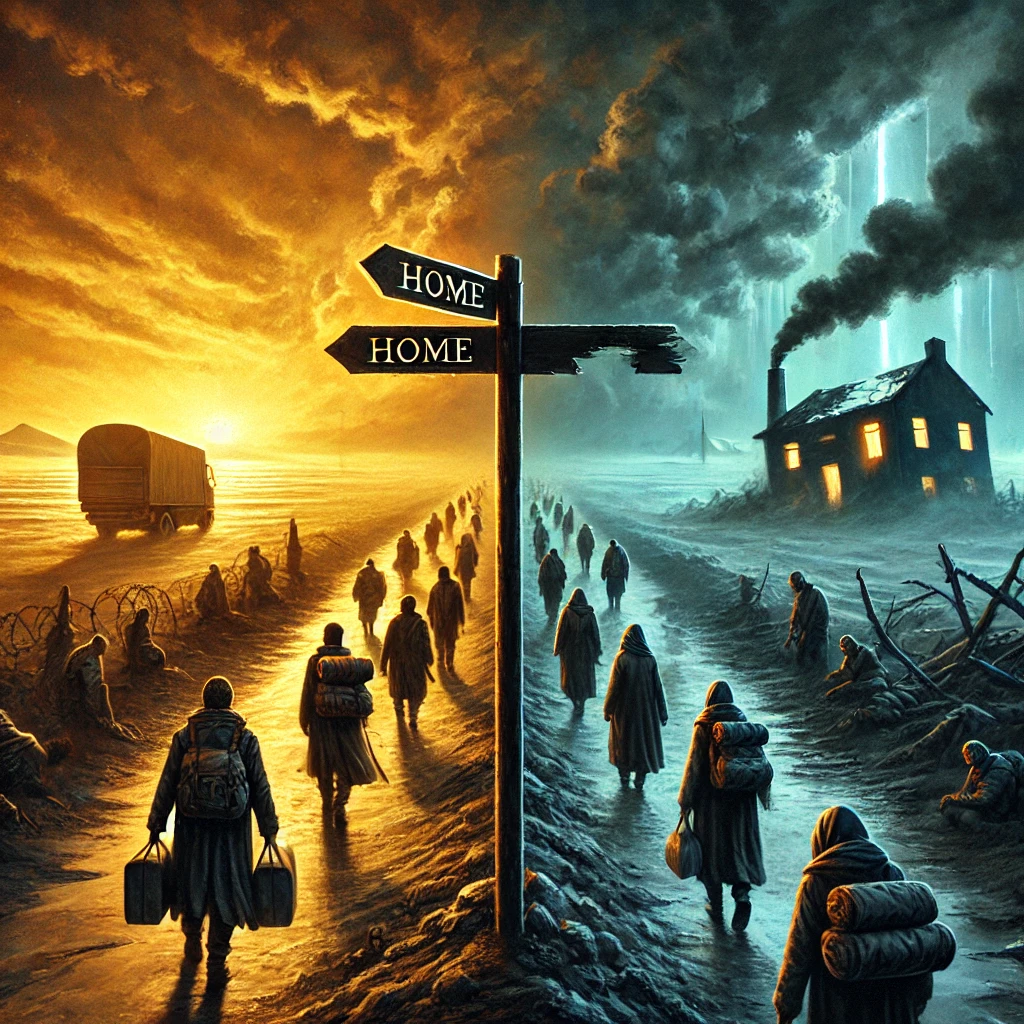
Feature Image: Click here to view the image.
Glossary of Terms:
- Bangladesh Hindu Killings: Refers to the persecution and violence faced by Hindus in Bangladesh, particularly during and after the 1971 Bangladesh Liberation War.
- Marichjhapi massacre: A violent incident that occurred on January 31, 1979, in which thousands of Bengali Hindu refugees were killed or displaced by the West Bengal government.
- Partition of India: The division of British India into India and Pakistan in 1947, resulting in one of the largest mass migrations in history.
- Dalits: A term referring to the lowest castes in the traditional Indian caste system, often facing social and economic discrimination.
- Namashudras: A Dalit community from East Bengal (now Bangladesh), who faced significant persecution and displacement during and after the Partition.
- Dandakaranya: A region in central India where the Indian government resettled thousands of Bengali Hindu refugees from East Pakistan (now Bangladesh) in the 1950s and 1960s.
- Left Front: A political alliance in West Bengal, led by the Communist Party of India (Marxist) (CPI(M)), which came to power in 1977.
- CPI(M): The Communist Party of India (Marxist), a left-wing political party in India.
- RSP: The Revolutionary Socialist Party, a left-wing political party in India and an ally of the CPI(M) in the Left Front.
- Sundarbans: A mangrove forest in the Ganges River Delta, spanning across West Bengal and Bangladesh.
- Netaji Nagar: The name given to Marichjhapi island by the Bengali Hindu refugees, after Subhas Chandra Bose, a freedom struggle icon.
#MarichjhapiMassacre #BengaliHinduRefugees #PartitionSurvivors #ForcedMigration
Related Posts
-
- https://hinduinfopedia.com/unrest-from-bangladesh-to-nepal-is-india-the-real-target/
- https://hinduinfopedia.com/bangladesh-hindu-persecution-the-historical-cost-of-tolerance/
- https://hinduinfopedia.com/bangladesh-hindu-killings-at-marichjhapi-1979/
- https://hinduinfopedia.com/bangladesh-hindu-rights-abuse-the-2024-crisis-and-the-loss-of-sanctuary/
Other related posts
- https://hinduinfopedia.org/bangladesh-hindu-killings-marichjhapi-the-untold-story-part-i/
- https://hinduinfopedia.org/bangladesh-hindu-killings-politics-of-massacre-part-iii/
- https://hinduinfopedia.org/bangladesh-hindu-massacre-persecution-past-and-present-part-iv/
- https://hinduinfopedia.org/bangladesh-hindu-killings-kumirmari-a-sky-of-hope-lost-part-v/
- https://hinduinfopedia.org/bangladesh-hindu-persecution-cost-of-tolerance-and-unity-call-part-vi/
- https://hinduinfopedia.org/hindu-persecution-in-west-bengal-the-struggles-of-the-minority/
- https://hinduinfopedia.org/attacks-on-hindus-a-threat-to-identity/
Follow us:
- English YouTube: https://www.youtube.com/@Hinduofficialstation
- Hindi YouTube: https://www.youtube.com/@HinduinfopediaIn
- X: https://x.com/HinduInfopedia
- Instagram: https://www.instagram.com/hinduinfopedia/
- Facebook: https://www.facebook.com/Hinduinfopediaofficial
- Threads: https://www.threads.com/@hinduinfopedia
[…] most instructive living example is Bangladesh. The Hindu population of what is now Bangladesh stood at roughly 28 percent at Partition in 1947. By 1971 it had fallen to approximately 18 percent through displacement, massacre, and forced […]