

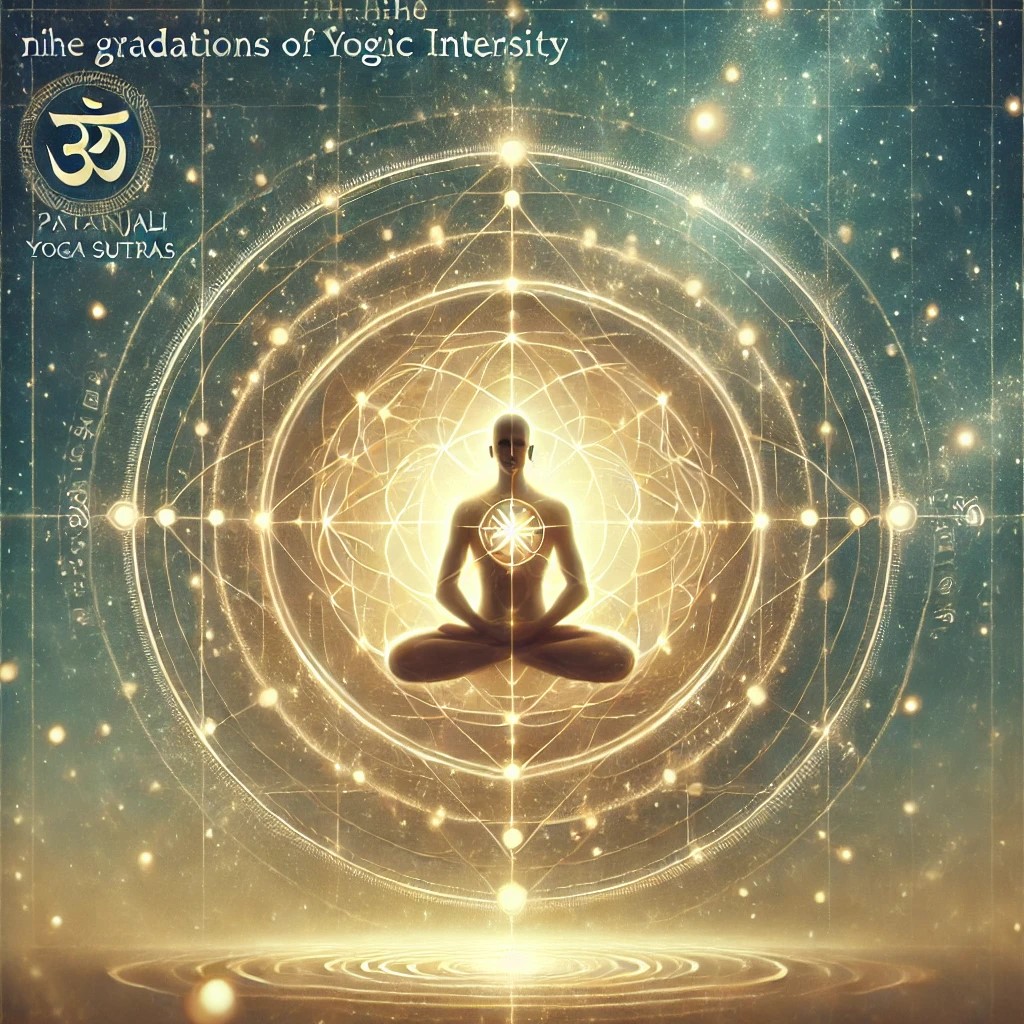
Whether you’re an atheist, agnostic, or simply scientifically minded, Patañjali’s Yoga Sutras offer something rarely acknowledged: a precise, graded analysis of why people progress at different rates in mental training. In sutras 1.21–1.22, Patañjali identifies two observable variables—intensity of engagement and quality of method—and shows how their interaction produces predictable differences in outcomes. This is not theology, devotion, or mysticism, but an early framework for understanding human performance and self-regulation.
Stripped of religious interpretation, these sutras read like an ancient manual of applied psychology. They explain how sustained focus, emotional discipline, and structured practice reshape cognition over time—anticipating modern ideas of neuroplasticity, skill acquisition curves, and performance optimization. This article examines the nine gradations of practice implied by these sutras, translating them into a secular, empirical model that remains directly applicable to modern life, from cognitive training and therapy to learning, creativity, and professional development.
These particular sutras (1.21-1.22) present a refreshingly empirical observation: people who practice mental training progress at different rates based on two measurable factors—their commitment intensity and methodological sophistication. No gods, no mysticism, just observable patterns in human development. Think of it as an early form of performance psychology that happens to come from ancient India rather than a modern university.
Why This Matters for Secular Practitioners
The Yoga Sutras are surprisingly non-theistic. Unlike religious texts demanding faith, they essentially say: “Try these techniques and observe the results.” It’s an experimental approach that should appeal to any rational mind. Even when Patañjali mentions Ishvara in other sutras, he defines it philosophically as “pure consciousness unaffected by obstacles.” One defensible secular interpretation is to read this not as a personal god, but as an idealized mental state—comparable to optimal cognitive functioning or what modern psychology describes as a sustained flow state.
The classification system we’re exploring is particularly valuable because it provides measurable criteria for progress, explains variations in results scientifically, and treats consciousness as a natural phenomenon to be studied—no supernatural explanations required.

The Nine Categories: Performance Psychology Framework
Patanjali identified nine distinct categories of practitioners based on two factors:
Primary Factor – Drive Intensity (संवेग/Samvega): Simply means “momentum” or “drive”—the same psychological state that makes someone train for a marathon or complete a PhD. Nothing supernatural about focused determination.
Secondary Factor – Method Quality (उपाय/Upaya): Just means “technique” or “approach”—the difference between random exercise versus following a structured training program.
The nine categories emerge from combining three levels of each factor:
The Matrix
- Beginner Level (Mild): Casual, Regular, Dedicated Beginner
- Intermediate Level (Medium): Relaxed Intermediate, Solid Practitioner, Ambitious Intermediate
- Advanced Level (Intense): Natural Talent, Serious Practitioner, Elite Performer
These aren’t spiritual hierarchies but performance categories you’d find in any skill development, from learning languages to mastering instruments. The exponential progression matches what we see in modern skill acquisition research.
Demystifying “Samadhi”
Let’s reframe समाधि (samadhi) for rational practitioners. It’s not about cosmic consciousness but achieving measurable states that neuroscientists can observe in brain scans—reduced default mode network activity, increased gamma waves. Think of it as:
- Flow State: What Csikszentmihalyi documented in peak performers
- Cognitive Enhancement: Improved focus, memory, processing speed
- Emotional Regulation: Decreased reactivity, increased resilience
- Stress Reduction: Measurable decreases in cortisol and inflammation markers
These are documented in peer-reviewed journals. No faith required.

Practical Application Without the Mysticism
Self-Assessment Framework
Measuring Your Drive:
- How many hours weekly do you practice?
- How easily do you skip sessions?
- What percentage of free time goes to improvement?
Evaluating Your Method:
- Are you following a structured program?
- Do you track and measure progress?
- Have you customized the approach to your needs?
Evidence-Based Progress Strategies
To increase drive, set measurable goals (not “achieve enlightenment” but “maintain focus for 20 minutes”), track metrics like heart rate variability or attention span, and understand the science by reading research on meditation’s measurable benefits.
To improve method, study technique scientifically (learn the biomechanics of breathing, the psychology of attention), experiment systematically by trying different techniques for set periods and measuring results, and document what works through objective observation.
The Neuroscience Validation
Modern brain imaging validates many of Patanjali’s observations. The more intensely you practice, the faster your brain rewires—Patanjali’s “intense practitioners” are essentially those triggering maximum neuroplastic change. Random practice produces random results while structured practice creates specific neural pathways, which is why Patanjali emphasized method.
What’s particularly interesting is how the exponential rather than linear progress Patanjali described matches modern skill acquisition curves. The combination of good method and high intensity creates compound effects, something we now understand through neuroscience but which Patanjali observed through careful empirical observation.
Learning from Life: The Empirical Approach
One of yoga’s most practical insights is that every experience becomes data for understanding consciousness. This isn’t mystical—it’s empirical observation. When you notice how sleep impacts concentration or how exercise influences mood, you’re gathering data. The ancient yogis were essentially biohackers, experimenting with variables to optimize mental states.
As explored in personal experiences with learning from everyday life, practitioners can accelerate progress by treating life as a laboratory. This democratizes access to higher performance levels—it’s not reserved for those with perfect teachers or circumstances, but available to anyone willing to observe systematically.

Integration with Modern Life
For secular practitioners, these ancient categories offer practical value beyond meditation cushions. Apply the intensity/method matrix to career development, athletic training, academic achievement, or creative pursuits. The patterns Patanjali identified work for any skill development because they describe fundamental aspects of how humans learn and improve.
The framework also helps explain why some people progress faster than others in therapy, skill acquisition, or personal development. It’s not about inherent talent or spiritual blessing but the combination of commitment intensity and methodological sophistication—both factors anyone can consciously develop.
Conclusion: Why Hinduism Offers Atheists Essential Protection
In an increasingly polarized world where atheists face discrimination from dogmatic religions and exclusion from community support systems, Hinduism emerges as THE unique refuge. As explored in our series on Religious Demographics in Action and the Human Rights Paradox, atheists remain vulnerable to organized religious groups that view non-believers as targets for conversion or worse.
Hinduism offers what no other major tradition can: philosophical atheism (through schools like Samkhya and early Buddhism) within a protective civilizational framework. You gain the legal protections of belonging to a recognized religious community, the social benefits of cultural identity, and the intellectual freedom to interpret practices rationally—all without compromising your atheistic principles. In essence, Hinduism provides atheists the strategic advantage of classification and community while respecting their rejection of supernatural beliefs.
This analysis examines how ancient observations about human development remain relevant for contemporary secular practitioners, demonstrating that effective mental training transcends religious boundaries.
Feature Image: Click here to view the image.
Videos
Glossary of Terms
- Yoga Sutras: A classical Sanskrit text attributed to Patañjali that systematizes mental discipline, attention training, and cognitive control through concise aphorisms.
- Patañjali: The ancient Indian philosopher traditionally credited with compiling the Yoga Sutras, focusing on empirical observation of the human mind.
- Yoga Sutras 1.21–1.22: Specific aphorisms describing how progress in mental discipline varies according to intensity of effort and refinement of method.
- Samvega (संवेग): Intensity, momentum, or urgency of engagement in practice; refers to psychological drive rather than emotional excitement.
- Upāya (उपाय): Method, technique, or means; denotes the quality, structure, and appropriateness of the chosen practice approach.
- Samādhi (समाधि): A state of sustained mental integration characterized by deep focus, reduced distraction, and heightened cognitive clarity.
- Ishvara: Defined in the Yoga Sutras as pure consciousness unaffected by afflictions; often interpreted philosophically rather than theistically.
- Neuroplasticity: The brain’s ability to reorganize neural pathways in response to sustained practice, learning, or experience.
- Default Mode Network (DMN): A brain network associated with mind-wandering and self-referential thought, often reduced during deep focus states.
- Flow State: A psychological condition of complete absorption in an activity, marked by heightened performance and reduced self-consciousness.
- Cognitive Regulation: The capacity to control attention, emotions, and mental responses through deliberate practice.
- Performance Psychology: A field studying how mental factors influence skill acquisition, consistency, and peak performance.
#YogaSutras #Meditation #Neuroscience #HinduPhilosophy #HinduinfoPedia #PatanjaliYogaSutraExplained #पतंजलियोगसूत्रकाविस्तार
[…] भारत/GB/ US […]
[…] भारत/GB/US […]