

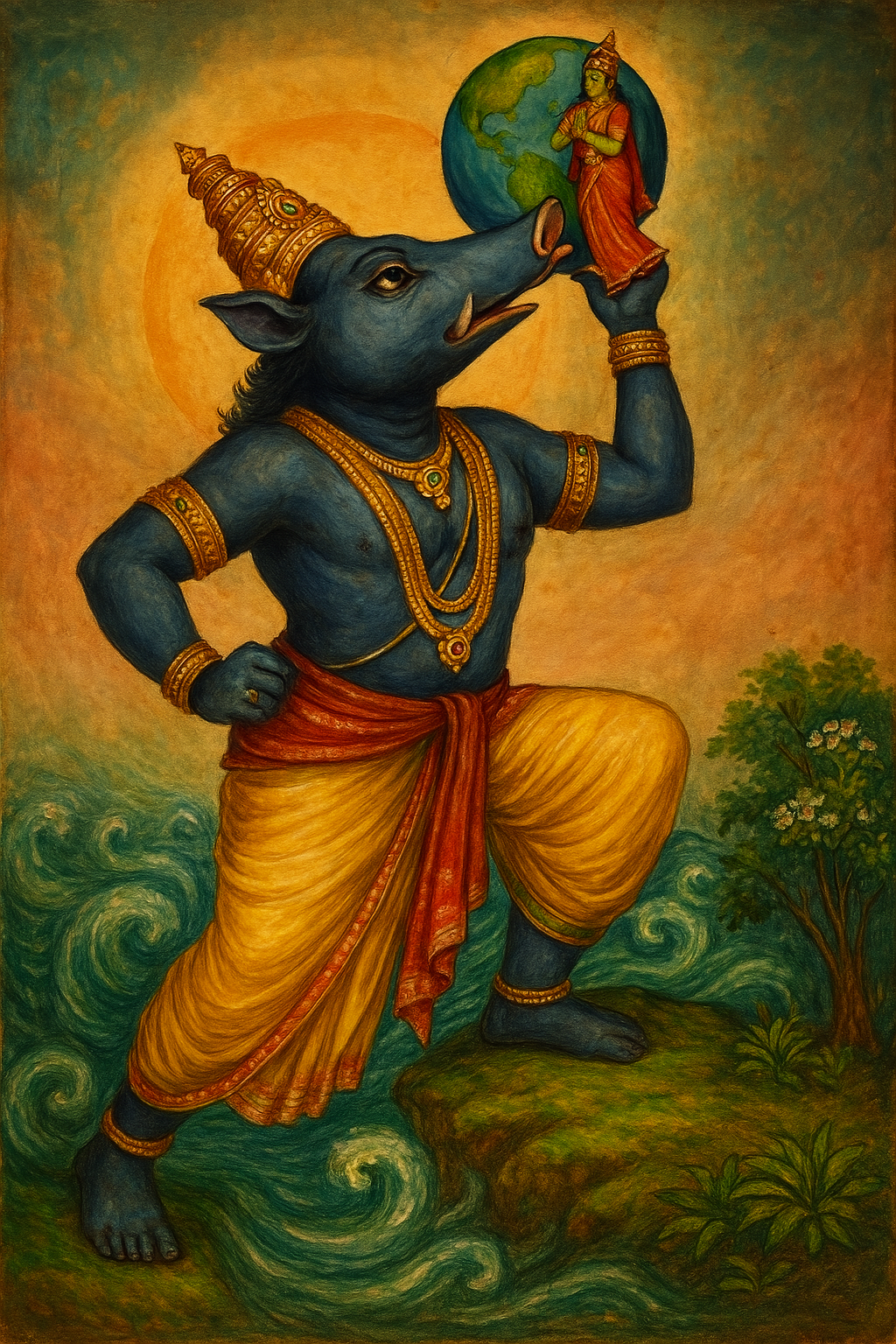
Bhagwan Varaha and His Tusks: Real, Not Myth
Introduction
Western narratives often mislabel Hindu texts as ‘mythology,’ overlooking the profound scientific insights embedded within these ancient scriptures. This blog is part of a multi-part series that challenges the erroneous views held by some Western scholars, media outlets, and other entities regarding Hindu texts. Our exploration begins with the scientific wisdom in the Nasadiya Sukta of the Rig Veda, which remarkably aligns with modern scientific understandings of the universe’s creation.
Our exploration will show how these scientific principles were skillfully distilled and woven into rituals and practices, simplifying complex concepts for broader comprehension and integrating them into daily life as foundational ways of living. The Nasadiya Sukta serves as a prime example, showing how ancient sages communicated complex scientific concepts through narrative, making them accessible and relevant to daily life. Our aim is to reveal the scientific underpinnings of these narratives, confirming that what is often dismissed as ‘myth’ is, in fact, ancient scientific knowledge.
The Vedic Narrative of Bhagwan Varaha
Hindu wisdom doesn’t crowd pews—it chants through life. The Vishnu Purana (Book 1, Chapter 4) paints a crisis: Hiranyaksha, golden-eyed and arrogant, drags Bhudevi into the Garbhodaka ocean’s abyss—a swirling void. Bhagwan Varaha dives in, battles a thousand mythic years, and hoists her on his tusks, restoring order. The Nilamata Purana ties this to Kashmir— Bhagwan Varaha pierces mountains, draining Satisaras Lake, unveiling fertile land at Baramulla [Ref 2]. No Sunday sermon here—priests chant this at pujas, most Hindus oblivious to its source, yet steeped in its echo.
Bridging Vedic Narrative and Science
“In the story of Bhagwan Varaha, the earth is described as being lifted from a cosmic ocean, a vivid depiction that parallels the geological process of landmass formation through tectonic activities. Just as Bhagwan Varaha lifts Bhudevi from the ocean, the earth’s crust rises from the sea due to tectonic forces:
- Tectonic Uplift: Varaha’s act of lifting Bhudevi can be likened to the tectonic uplift, a process where earth’s crust rises due to movements of the tectonic plates. For example, the formation of the Himalayas is a result of the Indian plate colliding with the Eurasian plate, pushing the land upwards in a manner similar to Bhagwan Varaha lifting the earth.
- Volcanic Activity: The battle between Bhagwan Varaha and the demon Hiranyaksha can be metaphorically seen in the volcanic activities that create new landforms. Volcanoes, spewing lava, create new land as the lava solidifies, much like Varaha’s struggle leading to the emergence of new stable ground.
- Sedimentation and Erosion: Following the uplift, processes such as erosion and sedimentation redistribute materials, shaping the landscape over millennia, akin to the ‘settling’ of the earth on Varaha’s tusks, stabilizing into the land we inhabit today.
By integrating these geological insights directly with elements of the Bhagwan Varaha myth, we see not just a story, but a prescient metaphor for the dynamic and ever-changing nature of our planet.
Detailed Scientific Analysis: Unveiling Geological Truths
Science nods. Earth, born 4.54 billion years ago, was a molten ball, cooling into a water world by 4.4 billion—zircons from Australia whisper oceans, scant land peeking through [Ref 3]. Tectonics churned—plates clashed, continents rose—Canada’s cratons (3.5 billion years), India’s Himalayas (55 million years)—land swelling to 150 million square kilometers today. A comet, like Chicxulub 66 million years ago, darkened skies, drowned plains in chaos—Hiranyaksha’s shadow [Ref 4]. Varaha’s lift? Tectonic might—sages saw land emerge, not guess it.
Detailed Scientific Analysis:
Varah Mool’s tale sharpens this. Kashmir’s valley, once a lake bed, drained as plates buckled—geology dates this shift, mirroring Satisaras’ myth [Ref 5]. The Himalayas, stirring 50-55 million years ago, crowned Earth’s tallest by 10-5 million—8.2-ton stones atop Tirumala prove it wasn’t fancy [Ref 6]. Sages didn’t have seismographs; they watched floods recede, peaks rise—Varaha’s tusks, a “rule of thumb” for eons of upheaval. Rigveda’s Shanti Mantras, chanted at such sites, weave peace into this science—sound and stone entwined.
Contrast with Other Cultural Myths:
While the Hindu narrative of Bhagwan Varaha delves deep into geological phenomena, Western interpretations like the biblical account in Genesis describe the Earth’s creation in just six days, perceived by some to depict the Earth as relatively young, around 6000 years old [Ref 7]. Similarly, Greek mythology introduces the concept of Chaos—a primal void from which Gaia, the Earth, emerges, though poetically described and less defined scientifically.
In contrast, the Sukta of the Rigveda contemplates a cosmic void, which Bhagwan Varaha transcends by transforming chaotic waters into orderly land. This narrative aligns closely with geological principles of tectonic movements and sediment formations—processes observed and confirmed by modern science without the aid of sophisticated labs or mathematical models [Ref 8].
The British, during their colonial rule, attempted to overshadow these indigenous understandings by enforcing the 1835 Education Act, which replaced Sanskrit with English, relegating such narratives to mere myth [Ref 7]. Yet, contemporary geological science continues to validate the insights of these ancient sages, recognizing tectonics and meteoric impacts as real, not mythical [Ref 9].
Reflection Through Real Impact of Hindu Texts
This wasn’t idle song. India’s 25% global GDP (Maddison, 2001) rode this land—Shudras hauled stones, Brahmins planned, a Varna system (Blog 10) science built [Ref 8]. Where Egypt’s pyramids crumbled, Rome’s forums fell, Hindus endured—Varaha’s Earth bore them, resilient, not by sword, but wisdom. Today, geology maps it—sages chanted it first.
Conclusion
Bhagwan Varaha’s tusks aren’t myth—they’re science, a boar lifting land from chaos sages saw, not spun. From 4 billion years of water to 150 million square kilometers, Hiranyaksha’s dark echoes a comet, Varaha’s rise tectonics—truths in slokas, not scrolls. The West’s “mythology” stumbles—Hindus knew Earth’s tale before plates were named. Next: Rahu bites the sky. Share your view—how does this ground Hindu worth?
Also Read: Bhagwan Mahavir Jayanti
Feature Image: Click here to view the image.
References:
- Vishnu Purana, Book 1, Chapter 4. Sacred-Texts.com.
- Nilamata Purana, Verses 22-28. Kashmir Shaivism Archives.
- Wilde, S. A., et al. (2001). “Evidence from detrital zircons…” Nature. Nature.com.
- Alvarez, L. W., et al. (1980). “Extraterrestrial cause…” Science. Science.org.
- Burbank, D. W., & Johnson, G. D. (1983). “Kashmir basin…” Palaeogeography. ScienceDirect.com.
- Kapp, P., et al. (2023). “Gangdese Arc…” Nature Geoscience. Stanford Earth News.
- Macaulay, T. B. (1835). Minute on Education. Columbia.edu.
- Maddison, A. (2001). The World Economy. OECD.org.
Glossary of Terms
- Bhagwan: A Sanskrit term for “Lord” or “God,” commonly used in Hinduism to refer to deities.
- Bhudevi: A Sanskrit term meaning “Earth Goddess,” often personified as the consort of Lord Vishnu and symbolizing the earth.
- Chicxulub Impact: Refers to the asteroid impact that occurred approximately 66 million years ago, believed to have caused the mass extinction of the dinosaurs. It is often cited in scientific discussions about catastrophic events that have shaped Earth’s history.
- Craton: Geologically stable regions of continental crust that have survived the splitting and merging of continents and supercontinents for hundreds of millions of years. Examples include parts of North America, Africa, and Australia.
- Garbhodaka Ocean: In Hindu cosmology, a celestial ocean that exists beneath the earthly realm, often mentioned in Puranic texts.
- Himalayas: A mountain range in South Asia, formed from tectonic plate movements that began around 50 million years ago. The Himalayas are often mentioned in Hindu texts as sacred.
- Hiranyaksha: A demon in Hindu mythology who is said to have taken the Earth to the bottom of the cosmic ocean, from where Lord Varaha rescues it.
- Plate Tectonics: A scientific theory explaining the structure of the Earth’s crust and many associated phenomena as resulting from the interaction of rigid lithospheric plates that move slowly over the underlying mantle.
- Pujas: Hindu religious rituals involving prayers, offerings, and the invocation of gods, performed by individuals or priests.
- Rigveda: An ancient Indian collection of Vedic Sanskrit hymns. It is one of the four sacred canonical texts (śruti) of Hinduism known as the Vedas.
- Satisaras: Another name for the ancient lake in the Kashmir Valley, associated with the legend of Bhagwan Varaha in Hindu mythology. According to the lore, Bhagwan Varaha drained this lake to create habitable land.
- Shanti Mantras: A set of mantras in Hinduism aimed at invoking peace and calm. Often recited at the beginning or end of religious rituals and teachings.
- Tectonics: The study of the Earth’s structure, involving the earth’s crust and large-scale processes such as earthquakes, volcanic activity, and mountain-building.
- Varaha: The boar avatar of the Hindu god Vishnu, known for rescuing the Earth from the demon Hiranyaksha according to Hindu mythology.
- Varna System: A traditional Hindu social classification system that divides society into groups based on karma (work) and dharma (duty).
- Vishnu Purana: An ancient Hindu text dedicated to the god Vishnu, one of the major Puranas in the Hindu religious literature.
- Zircon: A mineral that serves as a crucial tool for dating geological processes due to its ability to survive geologic events while encapsulating radioactive isotopes used in radiometric dating.
#HinduMythology #ScientificMyths #VedicScience #VarahaAvatar #GeologicalInsights
Previous Related Post
Next Related Posts
- https://hinduinfopedia.com/surya-siddhanta-astronomical-truth-of-rahus-bite/
- https://hinduinfopedia.com/vedic-astronomy-and-basic-concepts/
- https://hinduinfopedia.com/solar-eclipse-insights-from-hindu-texts/
- https://hinduinfopedia.com/astronomy-in-surya-siddhanta/
- https://hinduinfopedia.com/science-of-vedic-astronomy/
- https://hinduinfopedia.com/hindu-wisdom-in-yagna-fire-real-not-myth/
- https://hinduinfopedia.com/hindu-wisdom-in-ritual-and-food/
- https://hinduinfopedia.com/hindu-wisdom-in-surgery-sushruta-blades-are-rea/
- https://hinduinfopedia.com/surgeon-sushrutas-pioneering-procedures/
- https://hinduinfopedia.com/surgeon-sushrutas-scalpel-unveiled/
- https://hinduinfopedia.com/metal-mastery-hindu-zinc-science-not-myth/
- https://hinduinfopedia.com/hygiene-in-hindu-texts/
- https://hinduinfopedia.com/vegetarian-diet-of-hindu-wisdom/
Awesome
Very good
Good
I like this weblog very much, Its a very nice place to read and obtain info .