

Surgeon Sushruta’s Pioneering Procedures in Ancient India
Delving Deeper into Surgeon Sushruta’s Surgical Legacy
Our previous exploration of the Hindu Wisdom in Surgery revealed how Surgeon Sushruta, an ancient Indian sage-surgeon, defied the West’s ‘mythology’ label with his scientific precision around 600 BCE. We showed how the Sushruta Samhita, his seminal work, documented over 300 procedures, from rhinoplasty to cesareans, showcasing a medical tradition rooted in Vedic knowledge. Building on this foundation, we now dive into the specifics of Surgeon Sushruta’s surgical techniques, his innovative practices, and the cultural context that enabled such advancements. This Hindu Wisdom in Surgery not only healed bodies but also forged a resilient society, leaving a legacy that modern medicine still honors — a legacy rooted in the power of Vedic knowledge, meditation, and the discipline of yagna.
Background: The Vedic Framework of Surgeon Sushruta’s Surgery
Sushruta’s work is a testament to the Hindu Wisdom in Surgery, deeply embedded in Vedic traditions of observation and practice. As explored in our series, Vedic knowledge spans cosmic origins, herbal wisdom, and the psychological focus of yagnas. The Sushruta Samhita begins with prayers to Agni, the Fire God, symbolizing clarity and transformation, reflecting the Vedic ethos of aligning human intent with cosmic order [Ref 1]. Surgeon Sushruta’s emphasis on purity—seen in his production and sterilization of 121 instruments—echoes the yagna’s focus on ritual cleanliness. This integration of spiritual discipline and empirical science underscores how the Hindu Wisdom in Surgery thrived in ancient India, challenging colonial dismissals of Hindu texts as mere myths.
Surgeon Sushruta’s Surgical Procedures: A Closer Look
The Hindu Wisdom in Surgery shines through Surgeon Sushruta’s detailed procedures, which were groundbreaking for their time. The Sushruta Samhita describes over 300 operations, showcasing his mastery:
- Rhinoplasty: Surgeon Sushruta’s most famous procedure involved reconstructing noses using a forehead or cheek flap. This technique, often necessitated by punitive nose amputations in ancient India, involved measuring the defect, cutting a flap, and suturing it with ant heads—a natural clamp method modern surgeons can’t replicate due to sterility concerns [Ref 8].
- Cataract Surgery (Couching): Surgeon Sushruta used a curved needle to displace clouded lenses, restoring vision. This predates Europe’s 1700s attempts by 2,000 years, aligning with modern phacoemulsification’s goal [Ref 2].
- Cesarean Sections: Surgeon Sushruta performed cesareans, a high-risk procedure in his era, to save mothers and babies, detailing careful incisions and post-operative care using herbal poultices.
- Lithotomy: He removed bladder stones through perineal incision, a precise operation that required deep anatomical knowledge of the pelvic region.
- Fracture Management: Surgeon Sushruta treated fractures by aligning bones and using bamboo splints, a method still conceptually relevant in orthopedics.
- Hernia Repairs and Tumor Excisions: He addressed hernias and tumors with surgical precision, mapping muscles, nerves, and 700 vessels to minimize damage [Ref 3].
Surgeon Sushruta’s toolkit included 121 instruments—scalpels, forceps, hooks—sterilized by boiling, an early infection control measure [Ref 1]. He also used wine and herbs like henbane for anesthesia, a practice Hippocrates overlooked [Ref 5], showcasing the Hindu Wisdom in Surgery’s advanced approach.
Training and Preparation: Surgeon Sushruta’s Methods for Mastery
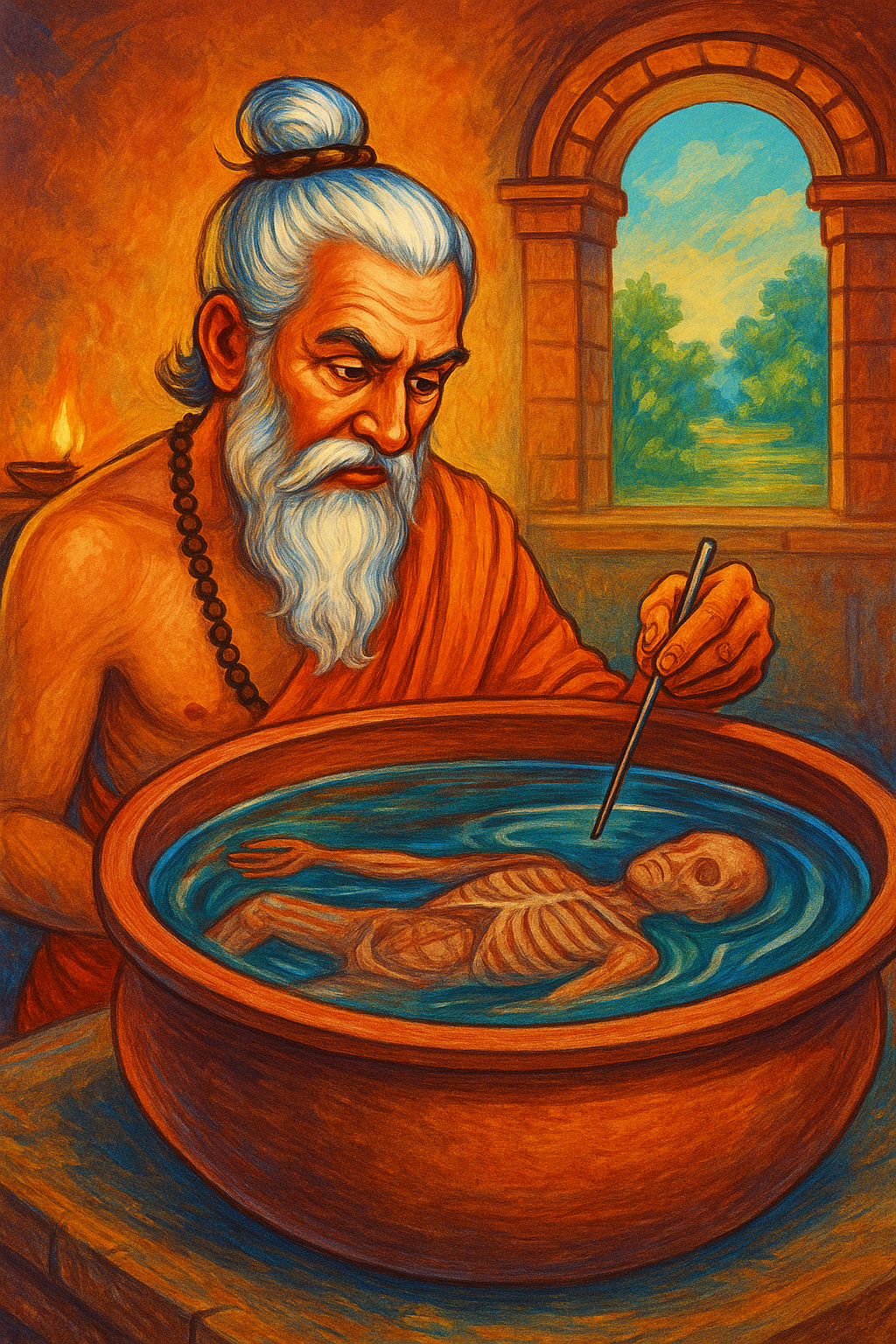
Mastery over these complex procedures demanded rigorous training, a need that Surgeon Sushruta addressed with innovative methods rarely seen elsewhere in the ancient world. Beyond procedures, the Hindu Wisdom in Surgery emphasized rigorous training. Surgeon Sushruta trained students using innovative methods that modern ethics wouldn’t permit. He had them practice incisions on gourds, lotus stems, and animal hides to master precision. For suturing, students worked on cloth or leather, while probing techniques were honed on bamboo. Sushruta’s anatomical studies were equally unique—he submerged cadavers in water to decompose, examining layers without cutting, a method that allowed detailed study in a time when dissection was taboo [Ref 1]. This hands-on, empirical approach ensured surgeons were skilled before touching patients, reflecting the Hindu Wisdom in Surgery’s commitment to competence. These rigorous training practices flourished within a society that deeply valued knowledge, health, and holistic living.
Cultural and Societal Context of Sushruta’s Era
The Hindu Wisdom in Surgery flourished in a society that valued knowledge and health. Around 600 BCE, India was a hub of learning, with universities like Takshashila attracting scholars. Surgeon Sushruta likely trained there, absorbing Vedic teachings alongside practical skills. His era witnessed robust societal systems that mastered the art of preserving human life — Shudras cultivated medicinal herbs, Brahmins advanced surgical practices, and the Varna system sustained this specialized division of labor, ensuring a continuous supply of vital resources for healing. The gotra system fostered genetic diversity, reducing congenital diseases and creating healthier communities for Surgeon Sushruta to serve. Large gatherings like Kumbh Mela, where neem and Tulasi prevented outbreaks, highlight how communal health practices complemented Sushruta’s surgical expertise, embedding the Hindu Wisdom in Surgery in daily life.
Unique Practices and Their Modern Relevance
Some of Surgeon Sushruta’s methods, while revolutionary for his time, are uniquely distinct from modern practices due to ethical and technological evolutions. Some of Surgeon Sushruta’s practices, though effective in his era, are considered unconventional or unfeasible today due to modern ethical and hygiene standards. For instance, he used ant heads as natural clamps for suturing—an ingenious method that cannot be replicated in sterile surgical environments. His anatomical understanding, gained through observing natural decomposition of submerged cadavers, offered insights into internal systems that modern medicine now explores using tools like ultrasound and MRI. Additionally, his use of haldi (turmeric) salves in post-operative care, which reportedly boosted survival rates by up to 70% (Aggarwal et al., 2007) [Ref 4], aligns closely with contemporary findings on curcumin’s anti-inflammatory and healing properties—underscoring the foresight of the Hindu Wisdom in Surgery.
Surgeon Sushruta’s Pioneering Procedures and Global Medicine
The Hindu Wisdom in Surgery left a global mark. Rhinoplasty’s “Indian method,” still used today, is credited to Sushruta by the American Society of Plastic Surgeons [Ref 8]. His sterilization practices foreshadowed germ theory, and his anatomical knowledge influenced later traditions, including Arabic medicine, which preserved and transmitted Indian texts to Europe. Surgeon Sushruta’s legacy endured, defying British attempts to dismiss ancient Indian medicine as ‘primitive’, and affirming the enduring power of the Hindu Wisdom in Surgery.
Comparative Glimpse: Surgeon Sushruta’s Training vs. Other Ancient Civilizations
Surgeon Sushruta’s rigorous training methods—practicing incisions on gourds, probing bamboo stems, and studying submerged cadavers—stand far ahead of other ancient civilizations. In Egypt, while mummification advanced embalming techniques, dissection for medical study remained rare and ritualistic. Ancient Greece allowed only limited anatomical exploration, with systematic human dissection beginning much later during the Hellenistic period (c. 300 BCE at Alexandria). Even Rome, famed for military surgery, emphasized battlefield improvisation over structured surgical education. In contrast, the Hindu Wisdom in Surgery, as exemplified by Sushruta, prioritized hands-on precision, anatomical mastery, and ethical surgical preparation centuries before Western systems institutionalized medical training. His model reflected a culture where surgery was both a scientific and a sacred duty, meticulously cultivated through disciplined practice rather than superstition or sporadic need.
Conclusion: A Timeless Surgical Legacy
Surgeon Sushruta’s pioneering work stands as a testament to the Hindu Wisdom in Surgery — a tradition that blended scientific precision, rigorous training, and deep societal integration long before modern medicine emerged. His detailed procedures, from rhinoplasty and cataract surgery to cesarean sections and fracture management, reflected a profound mastery rooted in Vedic principles. His innovative training methods, commitment to empirical learning, and the supportive cultural frameworks of ancient India enabled a flourishing of surgical science unparalleled in much of the ancient world. Even as colonial narratives attempted to dismiss this legacy, Sushruta’s influence endured, shaping global surgical practices and affirming the scientific depth of Hindu knowledge systems. His model — where surgery was both a sacred duty and a scientific discipline — continues to inspire, reminding us that true wisdom transcends time and adversity.
Call to Action:
Join us in rediscovering and honoring the authentic scientific heritage embedded in Hindu traditions. Share your thoughts — how does Sushruta’s work reshape your view of ancient science? Stay tuned as we continue our journey into Vedic innovations, next exploring the remarkable Patal Yantra — an ancient metallurgical marvel that further challenges the “myth” label placed on Hindu wisdom. Feature Image: Click here to view the image.
Glossary of Terms
- Sushruta: An ancient Indian sage and physician, regarded as the “Father of Surgery,” who authored the Sushruta Samhita around 600 BCE, detailing over 300 surgical procedures.
- Sushruta Samhita: A foundational Sanskrit text on surgery and medicine attributed to Sushruta, covering detailed procedures, instruments, anatomical studies, and post-operative care.
- Hindu Wisdom in Surgery: A term used in this blog series to describe the scientific and empirical surgical knowledge embedded in Hindu/Vedic traditions, particularly as practiced by Sushruta.
- Rhinoplasty: A surgical procedure for reconstructing or reshaping the nose; in Sushruta’s time, it involved cheek or forehead skin flaps and suturing with ant heads.
- Couching: An ancient surgical method used to treat cataracts by dislodging the cloudy lens in the eye with a sharp instrument.
- Lithotomy: A surgical procedure to remove stones (usually bladder stones) through an incision in the perineum, requiring deep anatomical knowledge.
- Henbane: A toxic plant (Hyoscyamus niger) used in ancient medicine for its sedative and anesthetic properties. Sushruta reportedly used it mixed with wine as early anesthesia.
- Haldi: The Hindi name for turmeric (Curcuma longa), used in Ayurvedic medicine for its antiseptic and anti-inflammatory properties, and applied by Sushruta in post-operative care.
- Gotra System: A Vedic lineage system used to ensure genetic diversity and trace paternal ancestry, considered important in maintaining community health in ancient Hindu society.
- Varna System: A traditional social classification system in Hindu society based on occupational roles, which structured collaborative efforts in healing—e.g., Brahmins as surgeons, Shudras as herb cultivators.
- Kumbh Mela: A major Hindu pilgrimage held every 12 years, known for gathering millions; referenced here for its use of neem and Tulasi to prevent disease spread.
- Agni: The Vedic fire god invoked in rituals and symbolic of purification, transformation, and clarity—central to both yagna and Sushruta’s surgical ethos.
- Yagna: A Vedic fire ritual involving offerings into a sacred flame, representing focused intent and purification; its precision and discipline are compared to surgical practices.
- Takshashila: An ancient Indian university (located in present-day Pakistan) that was a renowned center of learning in medicine, philosophy, and science around Sushruta’s time.
- Ant Heads: Used by Sushruta for natural suturing, the heads of large ants were allowed to bite and hold a wound closed, then their bodies were removed, leaving the jaws as natural clamps.
- Phacoemulsification: A modern cataract surgery method using ultrasonic waves to emulsify the lens, conceptually aligning with Sushruta’s ancient couching technique.
#Sushruta #AncientSurgery #VedicScience #HinduWisdom #HinduinfoPedia
References
- Singhal, G. D. (Trans.). (1976). Sushruta Samhita. National Center for Biotechnology Information.
- Bhishagratna, K. L. (1907). Sushruta Samhita: An English Translation. Archive.org.
- Gillies, H. D. (1920). Plastic Surgery of the Face. https://Archive.org.
- Aggarwal, B. B., et al. (2007). Curcumin: The Indian Solid Gold. Advances in Experimental Medicine and Biology, 595, 1–75.
- National Institutes of Health (NIH). (2020). Postoperative Care Standards.
- Macaulay, T. B. (1835). Minute on Education. https://Columbia.edu.
- Maddison, A. (2001). The World Economy: A Millennial Perspective. OECD.
- American Society of Plastic Surgeons. (2023). History of Rhinoplasty.
Visit Related Previous Blogs:
- Creation of Universe as described in Nasadiya Sukta of Rigveda
- Bhagwan Varaha Pulling Out Landmass out of Ocean.
- Surya Siddhanta Astronomical Truth of Rahu’s Bite
- Vedic Astronomy And Basic Concepts
- Solar Eclipse Insights from Hindu Texts
- Astronomy in Surya Siddhanta
- Science of Vedic Astronomy: Cultural Impacts
- Hindu Wisdom in Yagna Fire is Real not Myth/
- Hindu Wisdom in Ritual and Food
- https://hinduinfopedia.com/hindu-wisdom-in-surgery-sushruta-blades-are-rea/
Link for Next Related Blog
- https://hinduinfopedia.com/surgeon-sushrutas-scalpel-unveiled/
- https://hinduinfopedia.com/metal-mastery-hindu-zinc-science-not-myth/
- https://hinduinfopedia.com/hygiene-in-hindu-texts/
- https://hinduinfopedia.com/vegetarian-diet-of-hindu-wisdom/
[…] Surgeon Sushruta’s Pioneering Procedures in Ancient India […]
Awesome
Good
Awesome
Very good
Very good
Good
Very good
Awesome
Good
Very good
Awesome
Good
[…] Surgeon Sushruta’s Pioneering Procedures […]
[…] […]
[…] Class 6-10 history books, the Gupta Empire — which produced Aryabhata’s astronomy, Sushruta’s surgery and surgical methods, the decimal system — receives approximately one chapter. The Mughal Empire […]
[…] — जिसने आर्यभट्ट की खगोलशास्त्र, सुश्रुत की शल्य चिकित्सा और शल्य विधियाँ, दशमलव प्रणाली […]
[…] https://hinduinfopedia.com/surgeon-sushrutas-pioneering-procedures/ […]
[…] टिक ही नहीं पाती। यह वही ज्ञान है जिसे महर्षि सुश्रुत ने अपनी सर्जरी की पुस्तकों में दर्ज […]