

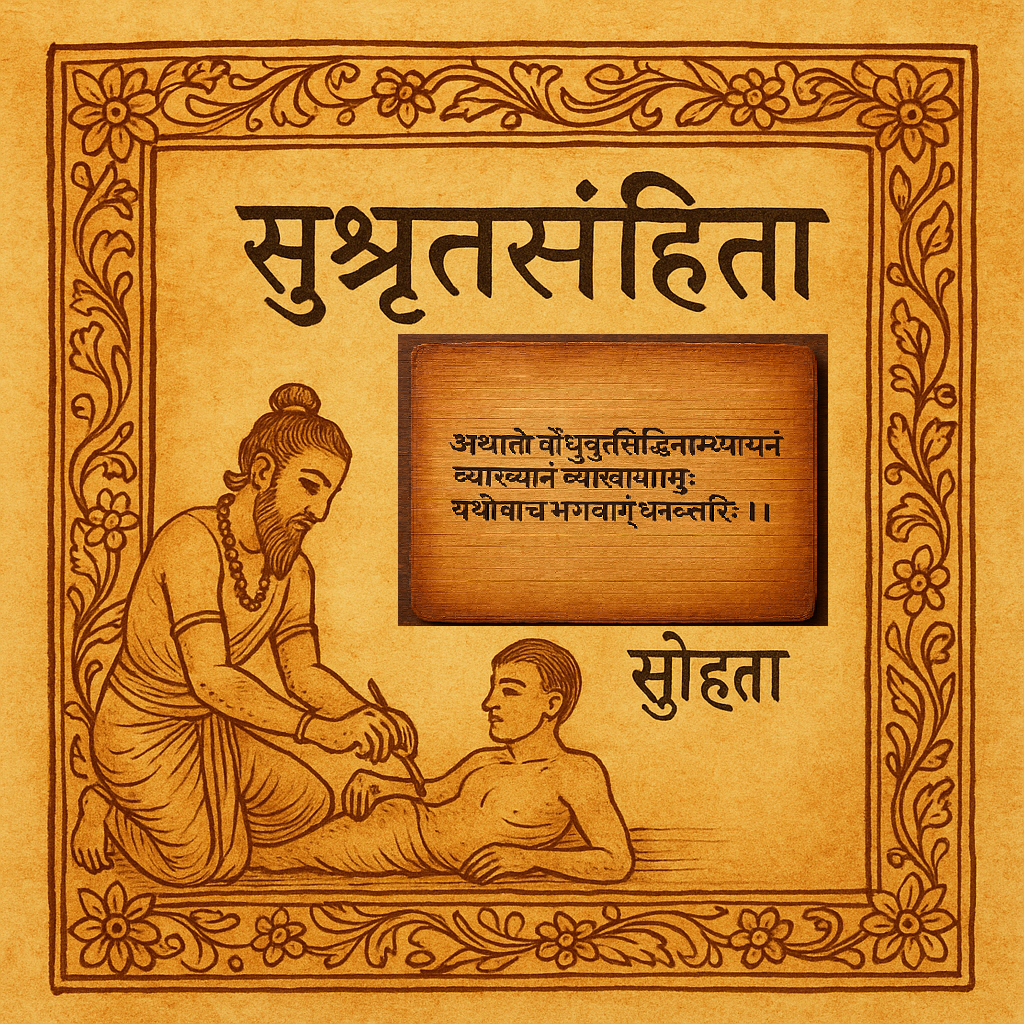
Surgeon Sushruta’s Scalpel: Unveiling Undiscovered Medical Marvels
Surgeon Sushruta’s Scalpel as a Symbol of Living Science
More than a mere surgical blade, Surgeon Sushruta’s Scalpel represents a multidimensional system of medicine rooted in ancient India’s Vedic tradition. His 600 BCE surgical treatise, Sushruta Samhita, documents over 300 intricate procedures—yet many facets of his legacy remain neglected. Beyond technical brilliance, Sushruta’s work incorporated preventive care, natural therapeutics, surgical ethics, and compassionate healing. This blog uncovers those lesser-known aspects of Surgeon Sushruta’s Scalpel that offer promising solutions to modern healthcare challenges.
The Underexplored Power of Surgeon Sushruta’s Scalpel
In today’s global healthcare crisis—marked by inequity in access and rising treatment costs—Surgeon Sushruta’s Scalpel stands out as a model of technical ingenuity grounded in simplicity. His use of natural antiseptics, reusable tools, and anatomical precision enabled life-saving interventions in resource-scarce settings. This low-tech, high-impact legacy offers a blueprint for rural clinics, mobile units, and disaster-response systems, where high-end tools are unavailable but lives must still be saved. For underserved populations, his methods remain not only relevant—but revolutionary.
· Natural Pain Management: Healing Without Harm
Sushruta’s approach to anesthesia demonstrates an early understanding of pharmacology and neurobiology. He administered wine mixed with sedative herbs like henbane and cannabis to dull pain during surgeries. These methods were designed not to completely knock out consciousness—as modern general anesthesia does—but to relieve pain while preserving cognitive function, minimizing risk. In today’s context, where synthetic opioids are leading to widespread addiction and serious side effects, Sushruta’s gentle and plant-based analgesics offer a safer, more sustainable alternative worth investigating. His formulations suggest that natural compounds can manage pain without the toxicity of industrial drugs, a concept that modern integrative medicine is just beginning to explore.
· Agnikarma and Raktamokshana: Ancient Therapies, Modern Potential
Sushruta employed Agnikarma (therapeutic cauterization) to treat musculoskeletal pain, abscesses, and even complex neuralgia. Using heated metallic instruments or specific herbs, he controlled bleeding, sterilized wounds, and reduced inflammation. Far from superstition, this method is akin to today’s laser therapy or radiofrequency ablation—minimally invasive procedures used to treat chronic pain and varicose veins. Similarly, his practice of Raktamokshana (bloodletting), particularly through leech therapy, is now recognized in Western medicine for conditions like venous congestion, arthritis, and skin diseases. The medicinal leech secretes enzymes that enhance circulation, prevent clotting, and reduce inflammation—a therapeutic rationale that Sushruta intuitively understood. These ancient therapies embody the core principle of the Hindu Wisdom in Surgery: treat the system, not just the symptom, and work with the body’s natural flow rather than against it.
· Embryological Insights: Precursor to Genetics and Epigenetics
In his observations on fetal development, Sushruta documented stages of intrauterine growth, linking the mother’s diet, emotional state, and daily routines to the health and constitution (prakriti) of the unborn child. He noted how disturbances during gestation could lead to deformities or diseases—an understanding that mirrors today’s insights into epigenetics, where environmental and psychological factors impact gene expression. He also emphasized hereditary influence on disease, outlining how certain conditions could be passed through familial lines. Though framed in Sanskritic language and metaphysical terminology, the foundation of genetic predisposition was already taking shape in his surgical worldview. In this, Surgeon Sushruta’s Scalpel also served as a diagnostic lens into life’s earliest formation stages.
· Low-Tech, High-Impact Protocols for Marginalized Communities
Perhaps the most timely aspect of Surgeon Sushruta’s Scalpel is its relevance to modern low-resource settings. His surgical practices relied on minimal tools but maximal knowledge—precision in incision, deep anatomical understanding, sterilization by boiling, and reliance on herbal antiseptics like turmeric. Procedures like fracture alignment using bamboo splints, lithotomy (stone removal), and even craniotomy, performed without modern anesthesia or imaging, demonstrate how life-saving care can still be delivered with basic means—if the knowledge and skill exist. For rural clinics, mobile medical units, or disaster-relief operations, revisiting these low-tech surgical frameworks can expand access to essential healthcare where infrastructure is lacking. In doing so, modern practitioners could tap into a tradition that has always favored accessibility, affordability, and adaptability. As proponents of Sushruta’s legacy assert: true technology isn’t measured by complexity or capital, but by how wisely available resources are used to solve real problems. In that light, Surgeon Sushruta’s Scalpel remains one of humanity’s most efficient, ethical, and empowering tools—especially for those the modern system too often leaves behind.
Surgical Ethics and Patient Dignity: A Dharma-Driven Model
The ethical code associated with Surgeon Sushruta’s Scalpel is one of the most striking features of his medical philosophy. Long before Hippocratic oaths were standardized in the West, Sushruta laid down moral requirements for every surgeon. According to him, a good surgeon must be:
- Calm and mentally stable
- Detached from greed or ego
- Dedicated to the patient’s total welfare
- Transparent about risks and procedures
- Committed to emotional support and post-operative care
He emphasized that the surgeon should treat patients as one would treat a friend or family member. This human-centered approach contrasts with today’s often mechanical and depersonalized healthcare systems, where efficiency and profit override empathy and individual attention. In an age where patients are reduced to cases and recovery is reduced to metrics, Surgeon Sushruta’s Scalpel reminds us that the emotional healing of the patient is as vital as the physical one.
Dharma Over Commerce: The Ethical Contrast of Surgeon Sushruta’s Scalpel
In an age where parts of the modern healthcare industry are increasingly criticized for prioritizing profit over patient welfare, Surgeon Sushruta’s Scalpel stands in stark moral contrast. Today’s medical systems are often likened in scale and ethical compromise to the arms and narcotics trade—not by hyperbole, but by documented crises. The opioid epidemic, driven by corporate greed and regulatory complicity, has claimed over 500,000 lives in the U.S. alone, with companies like Purdue Pharma earning billions by downplaying addiction risks. Life-saving drugs like insulin, once intended to be universally accessible, are now priced exorbitantly—making medical bankruptcy the leading cause of financial ruin in the U.S. Meanwhile, private hospitals in India and abroad routinely deny emergency care without upfront payment, reducing healing to a transaction. This profit-first model, described by organizations like Transparency International and the World Health Organization as among the most corrupt sectors globally, exposes a systemic rot where commerce triumphs over compassion. In stark contrast, Surgeon Sushruta’s medical philosophy was not for commerce, but for service. Surgery, to him, was a sacred dharma—an act of duty grounded in purity, skill, and empathy. There were no hospital bills, no gatekeeping based on wealth, no hierarchy of care. The patient was treated as a soul in distress, not a customer with a balance sheet. His scalpel was an instrument of ethics, not enterprise. Today, amid rising distrust in medical institutions and pharmaceutical monopolies, revisiting Sushruta’s model offers not merely an ancient alternative—but a much-needed moral compass. It reminds us that healing is a duty, not a business, and that science without dharma becomes soulless.
Sushruta Samhita in Global Perspective: A Comparative View
While Surgeon Sushruta’s Scalpel is often celebrated within the Indian tradition, a broader view reveals its global significance. Across time and civilizations, medical systems evolved—yet few rival the depth, ethical grounding, and surgical sophistication found in the Sushruta Samhita.
Egypt (2600–1000 BCE): Ritual over Reason
Ancient Egyptian medicine was heavily ritualistic. Though embalming practices offered some anatomical insights, human dissection was taboo, and healing was intertwined with magic and religious incantations. In contrast, Sushruta practiced empirical dissection, advocated cleanliness, and documented functional surgical procedures, placing him far ahead in scientific methodology.
Greece (~400 BCE): Theory over Application
Greek medicine, shaped by Hippocrates, emphasized the humoral theory (balance of bodily fluids) rather than surgical intervention. While the Hippocratic Oath is well known, Sushruta predates it with an even more detailed ethical model for surgeons. Moreover, Sushruta’s use of natural anesthesia and surgical training via cadaver immersion and practice on organic materials had no parallel in Greek tradition.
Islamic Golden Age (8th–13th CE): Preservation Before Plunder
Islamic scholars like Al-Zahrawi and Avicenna played a key role in preserving and transmitting ancient medical knowledge, including Indian contributions. Texts like the Sushruta Samhita were accessed through early scholarly exchanges and translated into Arabic, influencing later developments in surgery, particularly rhinoplasty and cataract procedures. Ironically, while early Islamic academia honored Hindu science, later invasions into India by Islamic rulers led to the destruction of many medical institutions and Vedic universities, severing the continuity of that native knowledge within India itself.
Medieval Europe (500–1500 CE): Stagnation and Suppression
European medicine stagnated during the Dark Ages. Surgery was performed by barbers, and dissection was restricted by Church doctrines. During this time, Sushruta’s structured training methods and rational therapies stood unmatched, though they were largely unknown in the West due to colonial and cultural suppression.
Modern Medicine (18th–20th CE): Finally Catching Up
Sterilization, anatomical precision, anesthesia, and holistic health—all central to Sushruta’s practice—became standard only in recent centuries. His prenatal care insights even mirror epigenetic theories, revealing an understanding of heredity long before genetics became a field.
Restoring Recognition
Today, there’s a slow but steady revival of interest in ancient Indian medical systems. Institutions like the Ministry of AYUSH, WHO’s acknowledgment of Ayurveda, and UNESCO’s recognition of Yoga as Intangible Cultural Heritage are small but symbolic steps in restoring what colonialism, conquest, and ignorance had buried. Surgeon Sushruta’s Scalpel was not a regional relic—it was a global benchmark in surgical science. Compared to his contemporaries and even later successors, Sushruta combined empirical knowledge, compassionate ethics, and social accessibility with unmatched foresight. His contributions were not just early; they were foundational. It is time the world not only studies him—but credits him.
Pull-Quote:
“When surgery becomes commerce, the scalpel cuts the soul before the skin. Sushruta taught us the reverse—heal with dharma, not for profit.”
Surgeon Sushruta’s Scalpel—A Blade that Still Heals
Surgeon Sushruta’s Scalpel stands as a timeless emblem of medical wisdom that combined precision with compassion, and innovation with ethics. Far from myth, it remains a guiding light for holistic healthcare systems of the future. From preventive protocols to natural anesthesia, from rural applicability to ethical surgery, his legacy calls for rediscovery—not just to honor the past, but to transform the present.
Call to Action
Which ancient practice from Surgeon Sushruta’s Scalpel deserves re-integration into modern medicine? Comment your thoughts, share this insight, and help bridge the gap between lost knowledge and present-day healing. Let’s restore the scientific dignity of Hindu traditions—because they were never myth to begin with.
Feature Image: Click here to view the image.
Glossary of Terms
- Sushruta: An ancient Indian physician, often referred to as the “Father of Surgery,” known for authoring the Sushruta Samhita.
- Sushruta Samhita: A foundational Sanskrit text in Ayurvedic medicine detailing over 300 surgical procedures, instruments, diagnostics, and ethical guidelines.
- Agnikarma: A therapeutic Ayurvedic procedure involving cauterization using heated instruments or herbal compounds to treat musculoskeletal pain, abscesses, and nerve conditions.
- Raktamokshana: A traditional Ayurvedic technique of bloodletting used to eliminate impure blood, often through leeches or venesection, believed to restore balance in the body.
- Henbane: A plant with natural sedative and analgesic properties, historically used as an anesthetic agent in ancient surgeries, including those by Sushruta.
- Cannabis: Used in ancient India as part of fumigation or anesthetic preparation to reduce pain and induce mild sedation during surgical procedures.
- Yagna: A Vedic ritual involving sacred fire offerings, representing transformation, purification, and alignment of human will with cosmic order.
- Takshashila: One of the world’s earliest known universities, located in ancient India, which served as a prominent center for learning in medicine, logic, and arts.
- Nalanda: A renowned ancient Indian university and monastery, destroyed during Islamic invasions, once known for advanced studies in medicine, philosophy, and Buddhist teachings.
- Varna System: The traditional Hindu occupational and social classification system dividing society into four main roles—Brahmins (priests), Kshatriyas (warriors), Vaishyas (traders), and Shudras (servants).
- Gotra System: A lineage-based classification in Hinduism used to avoid close genetic pairings in marriage and maintain genetic diversity.
- Integrative Medicine: A modern holistic healthcare model combining conventional medical treatments with alternative systems like Ayurveda, acupuncture, and naturopathy.
- Epigenetics: The scientific study of how external or environmental factors can influence gene expression without altering the DNA sequence—conceptually echoed in Sushruta’s prenatal teachings.
- Leech Therapy: A modern biomedical application of Raktamokshana using medicinal leeches to improve blood flow, reduce inflammation, and prevent clotting in surgical recovery.
- Dharma: In the Vedic context, it refers to righteous duty or moral law; for Sushruta, practicing medicine was not a profession, but a dharmic obligation to heal with integrity and compassion.
#SushrutaScalpel #AncientSurgery #VedicMedicine #IntegrativeHealing #HinduinfoPedia
Reference
Visit Related Previous Blogs:
- Creation of Universe as described in Nasadiya Sukta of Rigveda
- Bhagwan Varaha Pulling Out Landmass out of Ocean.
- Surya Siddhanta Astronomical Truth of Rahu’s Bite
- Vedic Astronomy And Basic Concepts
- Solar Eclipse Insights from Hindu Texts
- Astronomy in Surya Siddhanta
- Science of Vedic Astronomy: Cultural Impacts
- Hindu Wisdom in Yagna Fire is Real not Myth
- Hindu Wisdom in Ritual and Food
- Hindu Wisdom in Surgery Sushruta Blades
- https://hinduinfopedia.com/surgeon-sushrutas-pioneering-procedures/
Link for Next Related Blog
- https://hinduinfopedia.com/metal-mastery-hindu-zinc-science-not-myth/
- https://hinduinfopedia.com/hygiene-in-hindu-texts/
- https://hinduinfopedia.com/vegetarian-diet-of-hindu-wisdom/
Good
Very good
Good
Very good
Good
Very good
Awesome
Good
Awesome
Good
Very good
Good
[…] Surgeon Sushruta’s Scalpel Unveiled […]
[…] […]
[…] सुश्रुत की शल्य चिकित्सा और शल्य विधियाँ, दशमलव प्रणाली उत्पन्न की — लगभग एक […]
[…] the Gupta Empire — which produced Aryabhata’s astronomy, Sushruta’s surgery and surgical methods, the decimal system — receives approximately one chapter. The Mughal Empire receives dedicated […]