

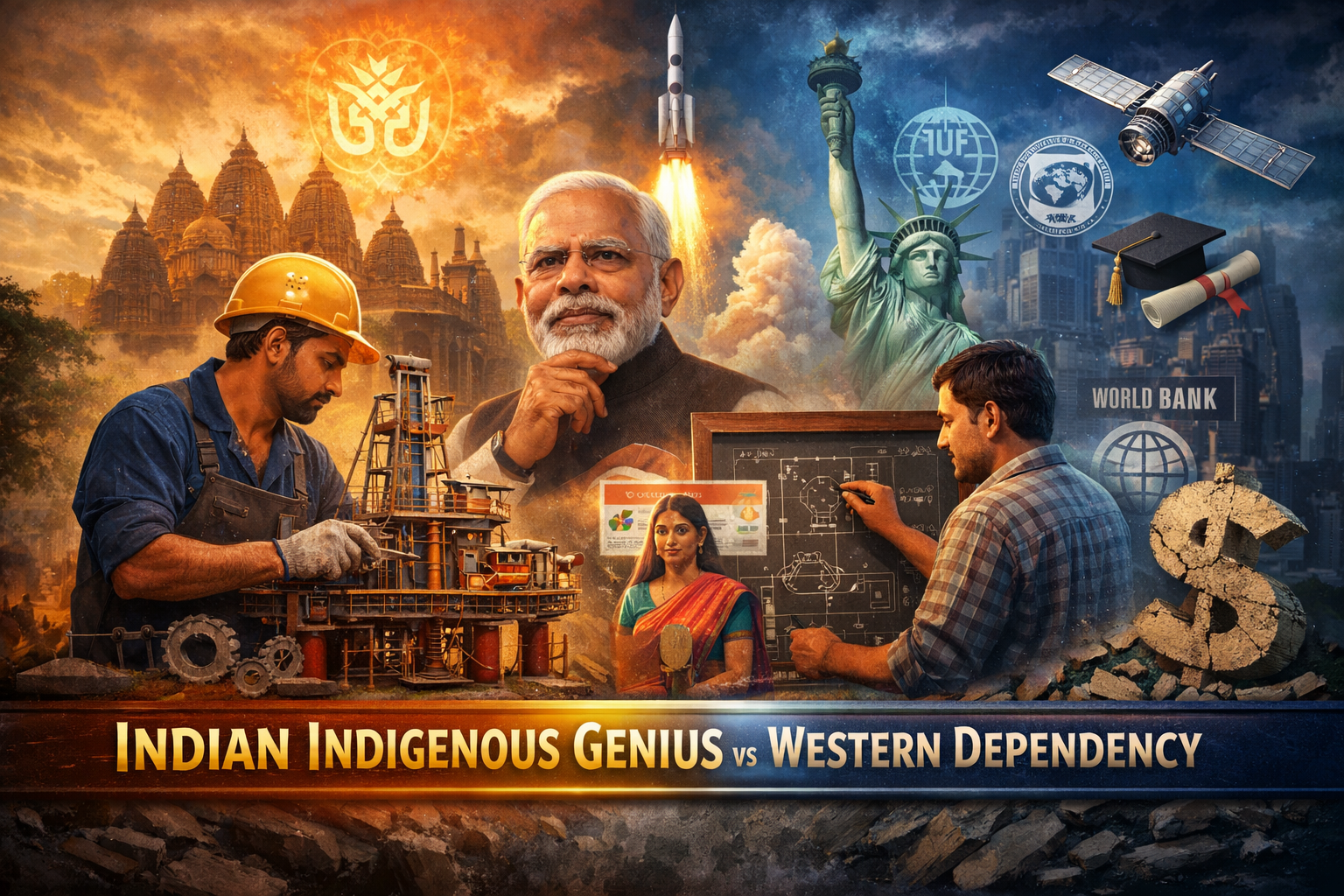
Indian Indigenous genius: Does Soft Power Terrify the West?
Part 1: Breaking Western Monopolies: Beating The Deceit
भारत/GB
Explore The Indian Indigenous genius And Beating The Deceit
For nearly six and a half decades after independence, India remained governed by a class that inherited colonial assumptions rather than dismantled them. Political power changed hands, but intellectual and institutional authority continued to mirror Western frameworks—a phenomenon often described as the “Brown British” phase of Indian governance. Only in the last decade has India begun to visibly assert both soft and hard power rooted in Indian Indigenous genius rather than external validation. This article sets the context for what India is now positioned to display: Indian Indigenous genius grounded in Vedic, scientific, and Dharmic principles that together express India’s integrated civilizational capability.
This simple example explains what the series contains. On a night shift aboard an offshore oil rig somewhere in Indian waters, a Gujarati electrician with no engineering degree used his break time to create something extraordinary. With scrap materials, discarded parts, and zero budget, he built a scaled, functional model of an entire jack-up drilling rig—complete with working rotary rotation and hook-block movement—using measurements taken from the vessel’s onboard safety display drawings at his workplace. This wasn’t a static display piece but a mechanically functional demonstration of complete systems understanding. Indian Indigenous genius of this caliber, operating in isolation with minimal resources, represents India’s most potent—and most threatening—form of soft power.
He needed no World Bank loans, no consultants, no degrees. Just knowledge and scrap materials.
This is the soft power that Prime Minister Narendra Modi recognized from day one in 2014 would fundamentally threaten what the Western world calls “international order”—their monopoly on development expertise, technological gatekeeping, and economic hegemony, now increasingly challenged by India’s surge in startups, unicorns, and technology platforms built without Western patronage. And unlike military power or economic competition, Indian Indigenous genius cannot be sanctioned, bombed, or contained.
The Pattern of Indian Indigenous genius
The Gujarati electrician’s achievement wasn’t an isolated incident. It reveals a pattern of capability scattered across India that challenges every assumption about what “development” requires.
The 5S Workshop Transformation
The same electrician transformed a 12 ft x 6 ft electrical workshop—barely larger than a walk-in closet—into a display-worthy example of 5S methodology, the Japanese manufacturing discipline that corporations pay consultants hundreds of thousands of dollars to implement. He did this without any formal degree, without certification courses, without Japanese experts flying in to guide the process. The 72-square-foot space became so meticulously organized that it could serve as a training example.
Companies like Toyota developed 5S over decades. Western consultants charge hundreds of thousands to implement it. He did it in 72 square feet with zero budget.
The Chalk Drawing Machinist
In Punjab, a machinist who never saw computer-aided design software or engineering blueprints recreates complex high-tech machines by drawing rough sketches with chalk on workshop walls. No precise measurements in CAD files, no specifications in standardized formats—just chalk outlines capturing the essential mechanical principles. Then he builds functional replicas from these wall sketches, often on the first attempt.
This isn’t approximation or guesswork. The machines work. The tolerances hold. The reverse engineering is complete. Western manufacturing assumes you need expensive design software, precise documentation, and iterative testing. Punjab’s Indian Indigenous genius proves you need understanding—everything else is optional infrastructure.
In Ahmedabad, locksmith Saiyyad Shaukat Hussain creates puzzle-locks of remarkable complexity using ancient Indian knowledge—one with 21 keys for 20 keyholes, another with dual locks in one keyhole. Hand-crafted from sheet metal with hammer, drill, and files, these mechanisms confound even fellow locksmiths. Understanding the principle matters; expensive tools and formal training are optional.
The 1000-Kilowatt Alignment
On another offshore rig, a colleague with matriculation-level education aligned a 1000-kilowatt machine using only an Allen key. No high-tech gauges. No magnetic catchers. No laser measurement systems. Just practical knowledge, tactile feedback, and experience-based precision. The alignment held. The machine operated within specifications.
In Western technical environments, such work requires certified technicians with specialized tools worth thousands of dollars. Equipment manufacturers specify exact procedures and proprietary instruments. Yet this matriculation-educated Gujarati accomplished the task with a tool that costs less than a cup of coffee, demonstrating Indian Indigenous genius in practical engineering that makes expensive certification requirements look like artificial gatekeeping.
The Sivasagar Productivity Multiplication
At the Sivasagar heavy electrical repair shop in Assam, productivity didn’t increase incrementally—it multiplied—through two simple interventions that required no capital investment. First, printed registers, in stead of hand writing, for work order tracking under ISO 9001:2000 standards created accountability and workflow visibility. Second, outsourcing bamboo cutting and splitting for electrical motor winding freed skilled electricians from manual labor to focus on electrical work.
The word choice matters: not “improved” or “increased” but multiplied. Small process changes created exponential impacts because Indian Indigenous genius doesn’t require complex solutions—just the right environment to apply practical wisdom. No McKinsey consultants diagnosed the problem. No expensive software tracked the workflow. Just printed paper registers and common-sense labor allocation.
Why This Threatens the Western Development Model
The Western development model, institutionalized through the World Bank, IMF, and OECD frameworks, rests on three pillars of enforced dependency.
The Three Pillars of Dependency: Capital Dependency: Development requires World Bank loans with ‘structural adjustment’ conditions – decades of debt servicing while accepting Washington’s policy dictates.
Worse: cross-default clauses ensure that if any single international obligation fails, all loans become immediately due—guaranteed economic collapse(IMF Sovereign Default Chapter).
Expertise Dependency: Only Western consultants possess development know-how. The McKinsey scandal in South Africa, where the consulting firm profited from state capture at Eskom, exemplifies how consulting firms profit from the assumption that local knowledge is insufficient. The revenue model depends on maintaining the perception that indigenous capability doesn’t exist.
This was best demonstrated during COVID-19, when US pharmaceutical companies demanded sovereign assets as collateral for vaccine purchases—countries had to pledge national reserves and waive legal rights to access life-saving medicines. The message: your people’s lives depend on accepting our terms.
Education Dependency: Development requires degrees from Western universities. The credential gatekeeping ensures that expertise flows one direction—from “developed” to “developing” nations—maintaining intellectual hierarchies. Global university rankings methodologies reinforce Western institutional dominance through metrics that privilege English-language research and Western academic structures.
The Nobel Prize pattern reveals the depth: non-Western scientists require Western institutional affiliation to receive recognition. Indian laureates were British nationals when awarded; South African winners were exclusively White; zero Black scientists have won in 120 years. Genius itself needs Western credentials to be acknowledged. [https://pmc.ncbi.nlm.nih.gov https://www.nature.com/]
Each pillar creates revenue streams: interest on loans, consulting fees, tuition payments. More importantly, they create psychological dependency—the internalized belief that development requires external validation. This is the “Brown British” mindset that pervades educated Indian society—the internalization that Western equals superior, that indigenous equals inferior.
How Indian Indigenous genius Destroys Each Pillar
The electrician building a rig from scrap destroys the capital dependency pillar. If functional engineering models emerge from discarded materials and intuitive knowledge, the assumption that development requires billions in World Bank loans becomes obviously false. The constraint isn’t capital—it’s environment.
The 5S workshop without consultants destroys the expertise dependency pillar. If a self-taught electrician can implement sophisticated Japanese manufacturing methodology in 72 square feet, the McKinsey business model collapses. The expertise exists locally—it’s being suppressed, not absent.
The machinist recreating machines with chalk drawings destroys the education dependency pillar. If complex reverse engineering happens without CAD software or engineering degrees, the credential gatekeeping is exposed as artificial. Western universities aren’t creating capability—they’re certifying what already exists and charging premium fees for validation.
Indian Indigenous genius proves the dependency is constructed, not natural. This threatens the entire post-World War II development architecture that generates trillions in revenue and maintains geopolitical control through economic subordination.
The Demonstration Effect
If India succeeds through Indian Indigenous genius rather than Western frameworks, every developing nation will ask:
“Why do we need World Bank loans?” India built infrastructure through domestic capability and minimal foreign borrowing.
“Why do we need Western consultants?” Indians figured it out themselves—machinists, electricians, engineers applying practical knowledge.
“Why do we follow your development model?” The Indian path worked better, faster, and without debt dependency.
This is the demonstration effect that terrifies Western institutions more than Chinese military modernization or Russian resource nationalism. Military power can be countered with alliances. Economic competition can be managed through trade agreements. But a successful alternative development model destroys the ideological foundation of Western hegemony.
When the Soviet Union existed, it offered an alternative model—but it failed, validating capitalism triumphalism. China offers an alternative—but it’s authoritarian, allowing the West to claim democratic capitalism remains superior.
India potentially offers something more dangerous: democratic development without Western dependency, proving their model was never universal or necessary. The Washington Consensus that dominated development economics for decades is being quietly dismantled by proof of alternative possibility.
The IMF’s declining relevance as countries pursue alternative arrangements through BRICS and bilateral agreements shows this process already underway. If Indian Indigenous genius becomes the basis for a scalable development model, the entire architecture of Western influence—built over 75 years since Bretton Woods—collapses.
Modi’s Strategic Recognition
Modi’s RSS background gave him unique insight: he understood systems, logistics, and grassroots capability. Reports suggest he even created organizational monitoring software.
Modi recognized what Western analysts missed: Indian Indigenous genius wasn’t potential but proven capability scattered across millions.
What didn’t exist was the environment to organize this genius. Not capital—environment. Give these individuals space, infrastructure, basic freedom from bureaucratic harassment, and they would build competitive manufacturing capability without foreign loans or expertise.
But Modi also knew this posed an existential threat to Western development monopoly. Therefore, opposition was inevitable—not just from the United States, but from every institution profiting from the dependency model: World Bank, IMF, consulting firms, Western universities, and multinational corporations extracting rent from developing nations.
Why Silence is Strategic
Modi cannot openly declare: “India’s Indian Indigenous genius makes Western expertise obsolete.” Such rhetoric would unite opposition before India builds sufficient alternatives, sound arrogant triggering cultural backlash internationally, and force Western institutions to actively undermine India rather than passively accept its rise.
So Modi deploys strategic ambiguity. He praises Gandhi publicly (political necessity), welcomes foreign investment (economic pragmatism), maintains QUAD partnership membership (strategic balancing), while quietly building alternatives:
- RuPay payment system (challenging Visa/Mastercard dominance)
- NavIC satellite navigation (operational since 2018, independent of GPS)
- ONDC e-commerce network (challenging Amazon’s monopoly)
- Bharat Taxi (100,000+ downloads, alternative to Uber)
The pattern is consistent: build alternatives while appearing non-threatening. Never announce confrontation. When alternatives achieve scale, negotiate from strength. This is the strategic patience that frustrates supporters who demand immediate action but ensures long-term success.
The Environment Creation Strategy
Modi’s role isn’t to fund Indian alternatives—it’s to create the environment where Indian Indigenous genius can organize itself. The Ease of Doing Business reforms that improved India’s ranking from 142nd in 2014 to 63rd by 2020 didn’t add capability to Indians. It removed barriers to existing capability.
Consider the puzzle: Indians establish successful furniture businesses in Ohio but struggle with identical enterprises in Gujarat. Same people, same skill, same business model—different environment. In America: register business in one day, minimal inspection harassment, predictable legal framework. In India historically: months of permits, constant bribery demands, inspector raj paralysis.
The capability was always present. The Indian Indigenous genius existed in both locations. What differed was friction. Modi’s strategy isn’t to become America but to reduce friction enough that Gujarati entrepreneurs, Sikh farmers-turned-industrialists, and South Indian manufacturers can deploy their proven capability domestically.
Hypothesis: Give Punjab’s machinists 2 square kilometers of covered industrial space with basic infrastructure—power, water, roads, freedom from harassment—and the hypothesis is testable: within three years, significant Chinese toy market share shifts to India. Not through subsidy but through unleashed Indian Indigenous genius.
The Infrastructure Sabotage Response
The clustering of major infrastructure failures between July 2024 and January 2025 reveals Western recognition of India’s sovereignty trajectory and their capacity to demonstrate technological dependency:
Between July-December 2024, four major infrastructure failures exposed dependency vulnerabilities: CrowdStrike crashed 8.5 million Windows systems globally. AWS US-EAST-1 outage lasted 14 hours. Azure CDN failed from ‘configuration change.’ Cloudflare, handling 20% of global internet traffic, experienced two major outages
Each incident serves dual purposes: testing kill-switch capabilities and reminding nations pursuing sovereignty that infrastructure dependency still exists. You may have Indian Indigenous genius in manufacturing and engineering, but if your hospital systems run on Windows, your communications flow through Cloudflare, and your e-commerce depends on AWS, that genius can be neutralized remotely.
The GPS Blackout Example
Recent GPS blackout incidents demonstrated this vulnerability catastrophically. Between 2021 and 2024, GPS signal loss events affecting commercial aircraft increased 220%, with thousands of instances documented. In 2024, Finnair suspended flights to Tartu, Estonia after repeated GPS outages made landings impossible—Air Traffic Control unable to safely guide aircraft without satellite positioning. International carriers suspended Venezuelan routes when 10% of flights operated with compromised navigation systems. Even European Commission President Ursula von der Leyen’s aircraft was forced to revert to paper charts when GPS failed during landing approach. NavIC, operational since 2018, means India can navigate when others cannot.
This is where India’s NavIC satellite constellation, operational since 2018, provides strategic backup. Independent of American GPS control, NavIC ensures that navigation capability cannot be remotely disabled during conflict or coercion. During Operation Sindoor in May 2025, NavIC proved decisive—providing 10-20 cm accuracy for missile guidance, drone navigation, and battle damage assessment when Pakistan-based targets were struck with precision. While Western media focuses on India’s military modernization, the quiet sovereignty wins like NavIC represent more fundamental independence—the infrastructure to function when foreign systems are denied.
The Race Against Lock-In
Modi is running a race between building sufficient alternatives and the completion of technological dependency lock-in. Every year that passes with foreign infrastructure dominance makes transition harder. But every year also brings progress:
RuPay has achieved over 60% market share in India’s payment card market, while UPI processes more than 100 billion transactions annually—exceeding all other global digital payment systems combined. ONDC continues expanding merchant adoption despite Amazon’s entrenched network effects, and Bharat Taxi’s user base grows steadily from its initial 100,000 downloads. Each percentage point gained represents territory reclaimed from foreign dependency.
The infrastructure sabotage attempts reveal Western recognition of this timeline.
Are they testing capabilities and demonstrating continued dependency precisely because they see the alternatives emerging? The timing suggests these incidents might serve dual purposes: both warning and assessment—”You’re not independent yet, and we can prove it.”
Irreversibility and Consciousness Transformation
Indigenous genius as soft power is permanent. Once Indians recognize their capability doesn’t require Western validation, that consciousness cannot be reversed. The electrician knows his competence doesn’t need certification. The machinist knows credentials are artificial gatekeeping.
This is happening at the individual level across millions. The “Brown British” educated class—those who internalized colonial consciousness that Western equals superior—are revealing their actual understanding. Research on preference falsification shows that when constraints are removed, hidden opposition becomes visible through cascading revelations. Initial studies suggest thresholds around 15-25% can trigger such cascades, with full irreversibility occurring at higher levels around 35-40% as social costs fully reverse.
The trajectory is exponential, not linear, because each decolonized individual influences their network. Indian Indigenous genius, once recognized collectively, creates civilizational confidence that policy changes cannot undo.
Why the Race Will Succeed
India doesn’t need to match Western capital investment dollar-for-dollar or Chinese manufacturing scale unit-for-unit. Indian Indigenous genius creates asymmetric advantage: the ability to achieve equivalent outcomes with minimal resources.
If an electrician can build functional engineering models from scrap, imagine 10,000 such minds organized with basic infrastructure. If productivity multiplies from printed registers and smart outsourcing, imagine systematic application across Indian manufacturing. If machinists reverse-engineer from chalk drawings, imagine organized industrial parks where this capability scales.
The West assumes development requires their capital, expertise, and institutions because that’s how they developed. But they didn’t have Indian Indigenous genius already present—they built capability over centuries. India isn’t starting from zero; it’s starting from scattered brilliance requiring only organization.
This is why Modi’s “doing nothing” strategy—frustrating to Hindu supporters demanding immediate action—is actually brilliant strategic patience. You cannot ban systems you depend on. You must build alternatives first, scale them gradually, then transition from strength. The apparent slowness isn’t hesitation; it’s foundation-building before confrontation.
The Silent Revolution
The Indian Indigenous genius exists. It built oil rigs from scrap, recreated machines from chalk sketches, multiplied productivity with paper registers. Modi is creating the environment for it to organize—slowly, systematically, strategically. The whole world that profits from dependency will oppose, because they recognize what Modi knew from day one: this soft power threatens their order more than any weapons system could.
The indigenous genius wasn’t theoretical potential awaiting creation—it was proven capability awaiting conditions. Aadhaar, developed before Modi took office, revolutionized social security for 1.4 billion people at a scale no Western system has matched. When French President François Hollande visited the Aadhaar office in Connaught Place during his 2016 visit, it signaled Western recognition: India had built what they couldn’t. Earlier governments knew this capability existed but lacked the strategic vision to systematize it across domains. Modi’s insight was recognizing that scattered brilliance needed only environment and organization, not foreign assistance.
Disclosure: This analysis is grounded in real-life experiences, observed cases, and field-level examples. Where precise quantitative data is unavailable, the article uses reasonable estimates, extrapolations, and pattern-based inference to illustrate systemic trends. These extrapolations are intended to explain mechanisms and directionality, not to claim laboratory-grade precision.
Feature Image: Click here to view the image.
Glossary of Terms
- Indian Indigenous Genius: India’s native, experience-driven technical, organizational, and civilizational capability that operates independently of Western validation or institutions.
- Brown British Mindset: A post-colonial elite orientation that internalizes Western superiority and governs using inherited colonial assumptions.
- Soft Power: Influence exercised through cultural confidence, intellectual capability, and systems performance rather than coercion or force.
- Hard Power: Power exercised through military, economic pressure, or coercive instruments.
- Dependency Architecture: The global development system that binds developing nations to Western capital, expertise, and institutions.
- Capital Dependency: The belief that development requires external loans, primarily from institutions like the World Bank and IMF.
- Structural Adjustment: Policy conditions imposed on borrowing nations as part of World Bank or IMF lending programs.
- Cross-Default Clause: A debt provision where failure on one obligation triggers immediate repayment of all outstanding loans.
- Expertise Dependency: The assumption that legitimate development knowledge exists only with Western consultants and institutions.
- Credential Gatekeeping: Restricting recognition of expertise through formal degrees and Western academic certification.
- 5S Methodology: A Japanese workplace organization system focused on order, efficiency, and discipline.
- Reverse Engineering: Recreating systems or machines by understanding principles rather than relying on original designs.
- Demonstration Effect: When one nation’s success encourages others to adopt the same alternative model.
- Preference Falsification: Concealing true beliefs due to social pressure until constraints are removed.
- Technological Lock-In: Long-term dependency created by entrenched foreign infrastructure and platforms.
- NavIC: India’s indigenous satellite navigation system, independent of US-controlled GPS.
- Aadhaar: India’s biometric digital identity system enabling large-scale welfare and governance delivery.
#IndianGenius #SoftPower #Bharat #Sovereignty #SelfReliance #HinduinfoPedia
Follow us:
- English YouTube: https://www.youtube.com/@Hinduofficialstation
- Hindi YouTube: https://www.youtube.com/@HinduinfopediaIn
- X: https://x.com/HinduInfopedia
- Instagram: https://www.instagram.com/hinduinfopedia/
- Facebook: https://www.facebook.com/Hinduinfopediaofficial
- Threads: https://www.threads.com/@hinduinfopedia
[…] भारत/GB […]