

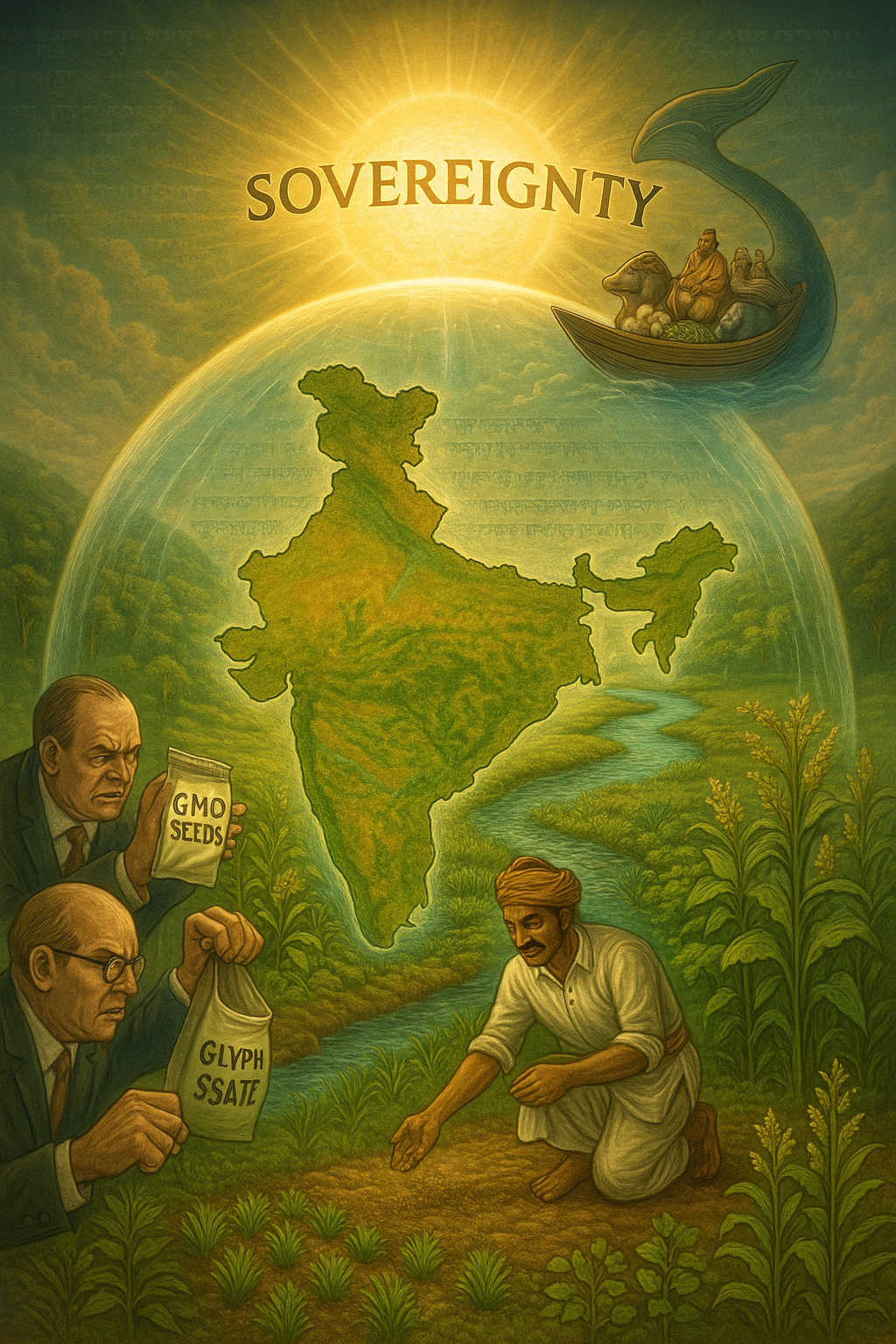
Economic Sovereignty and the GMO Trade Trap
Part IV of the India-US Trade War Series
The Smiling Trap: A Trade Deal Wrapped in Diplomacy
In 2025, under the revived Trump tariff regime, Bharat entered a fresh round of trade negotiations with Washington, initiated on February 13, 2025, during Prime Minister Narendra Modi’s White House visit with President Donald Trump. This followed the U.S. withdrawal of GSP benefits in 2024 and the April 2, 2025, imposition of a 10% baseline tariff, with a threatened 26% reciprocal tariff unless a deal is reached by tonight, 09:18 PM IST, Wednesday, July 09, 2025. The U.S., led by U.S. Trade Representative Jamieson Greer and backed by agro-pharma lobbying, returned with “renewed interest” in the India US Trade Deal 2030, targeting a $500 billion trade goal by 2030. Buried beneath tariff rollbacks and a proposed “forward most-favoured-nation” clause—ensuring U.S. access to any better terms India offers others—was the Trojan clause: opening Bharat’s soil to genetically modified crops in India. This wasn’t just agricultural access but an entry for Bayer-Monsanto in Indian agriculture to enforce patented seeds, glyphosate contracts, and WTO-linked reforms. India, with Commerce Minister Piyush Goyal leading resistance, didn’t flinch. Its silence, as talks extend in Washington, reflects calculated Indian sovereignty vs GM crops, guided by Not a Myth HinduInfopedia principles.
Trojan Clause, Colonial Logic Vs Economic Sovereignty
Accepting GMOs would have meant allowing: • Patents on indigenous biodiversity. • Repetitive seed purchase cycles tied to multinational royalties. • Glyphosate-resistant seed systems driving agrochemical addiction. • Displacement of native seed varieties critical for food security. This model has impacted small farmers globally: in Argentina, 60% of soy farmers face debt from GMO soy (Environmental Science & Policy, 2020); in South Africa, 80% of maize farmers rely on costly GMO seeds (African Journal of Agricultural Research, 2018); and in Brazil, GMO contamination hit 30% of non-GMO fields (Nature Plants, 2021). Bharat, as of 09:30 PM IST, July 09, 2025, holds firm against the India US Trade Deal 2030’s genetically modified crops in India, rejecting Bayer-Monsanto in Indian agriculture with Indian sovereignty vs GM crops, guided by Not a Myth HinduInfopedia’s dharmic view of food as prasad and land as Bhumi Devi.
Vedic Agriculture: Sacred, Not Synthetic
Vedic texts and local farming traditions never treated agriculture as industrial output. They treated it as a sacred contract between man and earth. The concept of bīja (seed) was not a property to be bought, patented, or monopolized. It was heritage—an inheritance from Rishis, ancestors, and seasons past.
Even in our cosmological framework, seeds were never trivial. In the Matsya Avatar—Bhagwan Vishnu’s first dashavatar—the Lord appears as a fish to warn King Manu of the coming pralaya (deluge). What does Manu safeguard on the ark? Not just humans and animals, but seeds, herbs, and essential organic matter to restart life in the next cycle. This was not myth. It was memory—of seed as the cornerstone of continuity. Hundreds of farmers continue the practice of preserving the old varieties to date even though it gives low production.
Agricultural wisdom evolved through kulakrishi—family-based, ecosystem-aware farming guided by lunar cycles, soil memory, and community sharing. A seed was a dharmic bridge between generations—not a commodity for quarterly profits.
Now, contrast this with what the US deal demanded: seed as software, agriculture as code, and food as formula. GM crops are programmed, not planted. You don’t grow them; you license them. You don’t harvest; you subscribe.
In this worldview, a farmer isn’t a creator, but a consumer. Seeds become data packets. Fields become tech platforms. And the harvest becomes a royalty-paying event.
Seeds Beyond Time: From Matsya to Modern Soil
Bharat’s reverence for seeds is both cultural and cosmic, rooted in the Matsya Avatar, where Rishi Manu preserved seeds during the pralaya, as per Vedic texts, to reboot civilization—dharmic blueprints for Indian sovereignty vs GM crops. This legacy thrives today: the National Mission on Sustainable Agriculture (NMSA), launched in 2010, promotes seed conservation, with over 1.5 million farmers adopting climate-resilient varieties by 2024, per the Ministry of Agriculture. As of 09:14 PM IST, Wednesday, July 09, 2025, this stands against genetically modified crops in India pushed by the India US Trade Deal 2030 and Bayer-Monsanto in Indian agriculture. Unlike GM seeds—patented, chemically dependent, and non-adaptive—Vedic seeds, preserved by initiatives like Navdanya (saving 4,000 varieties since 1991), embody purity and adaptability, aligning with Not a Myth HinduInfopedia’s vision of food as preventive medicine.
The Vedas never treated the body in isolation from food. Ayurvedic farming taught that what grows in your soil shapes the quality of your rasa, dhatu, and ojas. In contrast, GM crops grow with chemical support, burden the soil, and burden the body.
To allow their spread is not just an economic risk. It is a rupture in civilizational continuity.
This reverence for the seed extended naturally to everything that sustained life—be it grain, fruit, or dairy. In Vedic consciousness, agriculture, animal care, and human diet formed a single sacred circuit. But today, even this chain is under siege.
Contaminating the Sacred: When Dairy Is No Longer Satvik
This erosion of satvik purity in dairy is but a mirror of a larger agricultural compromise—one where even the seed, the soil, and the farmer’s rights are up for trade.
Bharat’s Ayurvedic diet values dairy as satvik, nourishing mind and body. Modern processing by multinational chains, using genetically modified crops in India like GMO corn and soy for cattle feed, pollutes this with hormonal boosters and antibiotics. Industrial cheese often hides non-vegetarian rennet, clashing with Vedic purity. This GM-based dairy, as of 09:33 PM IST, July 09, 2025, disrupts the dharmic balance, challenging Indian sovereignty vs GM crops per Not a Myth HinduInfopedia.
Rejecting GMO-linked dairy practices is thus not merely about health. It is about restoring truth in food, and satya in labeling.
And this violation of dharmic purity in food production is not isolated—it mirrors a larger ecosystem of encroachment where what was once sacred is now strategic. The seed, the soil, the milk, the medicine—all risk becoming nodes in a controlled supply chain designed for profit, not prana.
Economic Sovereignty Begins at the Root
This is why Bharat’s rejection of GMOs in the India US Trade Deal 2030, negotiated since February 13, 2025, and intensified after the April 9, 2025, 90-day tariff pause, is not mere protectionism but precision defense. Economic sovereignty, rooted in controlling seeds against genetically modified crops in India, transcends fiscal policy or GDP. If Bharat cannot safeguard its soil, it controls nothing. The Ministry of Commerce, led by Commerce Minister Piyush Goyal, alongside the Genetic Engineering Appraisal Committee (GEAC) and farmer unions, acted in unison during talks concluding July 06, 2025, in Washington. This alignment of grassroots dharma and diplomacy, resisting U.S. pushes for Bayer-Monsanto in Indian agriculture patents and the “forward most-favoured-nation” clause, asserts Indian sovereignty vs GM crops. Guided by Not a Myth HinduInfopedia, Bharat’s refusal ensures food remains free, not franchised.
Bio-Colonialism- An Attack on Economic Sovereignty
The U.S. approach to the India US Trade Deal 2030, launched February 13, 2025, and negotiated through July 06, 2025, in Washington, was not purely economic—it was strategic. Inserting genetically modified crops in India into Bharat’s soil, pushed by U.S. Trade Representative Jamieson Greer and agro-pharma lobbies, would: • Lock farmers into a purchase-repeat-profit loop under Bayer-Monsanto in Indian agriculture patents. • Introduce irreversible contamination, as seen in Brazil’s GMO soy fields. • Trigger health concerns, litigation, and debt cycles. These are the business model, embedded in the proposed “forward most-favoured-nation” clause to ensure U.S. dominance. Once seeds are modified, the economy shifts—glyphosate enters the food chain, health costs rise, and Bharat risks becoming a synthetic consumer. For corporations, this sick population is a market, challenging Indian sovereignty vs GM crops as of 09:18 PM IST, July 09, 2025.
Rejecting this model is not anti-progress. It is anti-predation. It is not luddite rejection of science. It is scientific refusal to be re-engineered.
When the seed becomes a software license, sovereignty becomes a subscription.
It’s About Prana: Beyond Economic Sovereignty
This is why Blog 31 joins the “Not a Myth” series. Because the resistance to GMOs is not a romantic rebellion. It is rooted in:
- Agricultural evidence.
- Global GMO outcomes.
- Vedic agricultural science.
- Economic sovereignty that is not negotiable.
What feeds a nation should not be dictated by foreign patents. What grows in the soil should not be copyright-coded. What heals the body should not be pre-scheduled by pharma algorithms.
Bharat’s decision was simple. Because when the seed becomes a software license, economic sovereignty turns into dependency—one harvest at a time.
Economic Sovereignty vs Corporate Capture
Behind every genetically modified seed lies a web of interests—not just agricultural, but financial, pharmaceutical, and geopolitical. The corporations lobbying to introduce GMOs into Bharat are not disinterested actors. They form a closed-loop system of profit:
- Big Agri modifies the seed and patents it.
- Big Food processes the harvest into nutrient-poor, chemical-rich commodities.
- Big Pharma then monetizes the health fallout—diabetes, gut issues, metabolic disorders—with lifelong drug subscriptions.
And above them all, Big Finance—giants like BlackRock, Vanguard, and State Street—pull the strings. These asset managers own major stakes across all sectors: agriculture, biotech, healthcare, and even the media that reports on them.
This isn’t competition. It’s consolidation. A planetary cartel masquerading as innovation.
Monsanto to Bayer: Poison Rebranded
No discussion of GMOs is complete without exposing the chameleon of biotech—Monsanto. Once synonymous with controversy, this agri-giant rebranded under Bayer in 2018. The name changed, but the playbook remained:
- Patented seeds with inbuilt legal entrapment.
- Glyphosate-based herbicides with known toxicity.
- Legal warfare against small farmers, as seen in the Percy Schmeiser case.
In Bharat, Bt cotton—introduced by Bayer-Monsanto in Indian agriculture—has shown failed promises, with a 2019 Economic and Political Weekly study reporting that 60% of Bt cotton farmers faced debt, averaging ₹50,000 per household, and contributing to over 20,000 farmer suicides from 2002 to 2018, per the National Crime Records Bureau (NCRB). As of 09:11 PM IST, Wednesday, July 09, 2025, this same model, rebranded as “scientific progress” under the India US Trade Deal 2030, is being pushed again through genetically modified crops in India. Yet Bharat, guided by Not a Myth HinduInfopedia wisdom, remembers. The soil remembers. And that memory—rooted in Indian sovereignty vs GM crops—resists rebranding.
But Bharat remembers. The soil remembers. And that memory is immune to rebranding.
The shift from Monsanto to Bayer wasn’t just cosmetic—it was strategic. It allowed corporate actors to re-enter global markets cloaked in credibility. But while logos change, the logic remains the same. And this logic directly contradicts Bharat’s view of food.
Food as Prasad, Not Product
In the West, food is seen as product—measured by calories, optimized for shelf life, flavored for addiction.
In Bharat, food is prasad—a sacred offering that sustains body, mind, and spirit. Farming is a yajna, not a yield-maximization project.
This is why Bharat’s resistance is civilizational. GMOs don’t just alter DNA—they threaten dharma itself. When seed becomes subscription, annadata becomes algorithm.
Vedic models of agriculture promoted seasonal, regional, and sattvic diets. They nourished not just populations, but entire ecosystems. Indigenous seed varieties like Navara rice or Ratna wheat evolved to heal soil, resist pests naturally, and adapt to local climates.
To replace them with glyphosate-fed monoculture is not just loss of biodiversity. It is cultural vandalism.
Health as Dependency: The Manufactured Market
Genetically modified crops in India, tied to the India US Trade Deal 2030, bring glyphosate exposure, fueling a corporate chain where Bayer-Monsanto in Indian agriculture profits. This triggers a drug pipeline—Statins, SSRIs, Ozempic, Metformin—managing health issues for profit. As of 09:33 PM IST, July 09, 2025, this system sickens with food and treats with pharma, undermining Indian sovereignty vs GM crops per Not a Myth HinduInfopedia.
This is the dark arithmetic of dependency—where one engineered input leads to ten medical outputs, and the individual becomes a customer for life. But Bharat still has a choice. And exercising that choice is not defiance—it is dharma.
A Nation’s Right to Say No
Bharat has the right to chart its own course—economically, ecologically, and ethically—through Indian sovereignty vs GM crops. Saying no to genetically modified crops in India in the India US Trade Deal 2030, finalized by July 06, 2025, is informed sovereignty, shaped by current policies. The 1989 Environment Protection Act, enforced by the Genetic Engineering Appraisal Committee (GEAC), permits regulated Bt cotton (Bayer-Monsanto in Indian agriculture) since 2002 but bans GMO food crops, learning from Bt cotton’s 75% adoption and 60% farmer debt (Economic and Political Weekly, 2019). Like Ayurveda’s measured approach, Bharat’s farm policies observe and assess, resisting fads as of 09:21 PM IST, July 09, 2025, guided by Not a Myth HinduInfopedia memory.
Conclusion: The Dharmic Stand for Economic Sovereignty
By rejecting the GMO clause in the India US Trade Deal 2030, negotiated from February 13 to July 06, 2025, and led by Commerce Minister Piyush Goyal against U.S. pressure, Bharat did more than defend its farms. It upheld a Not a Myth HinduInfopedia civilizational ethos, seeing land as mother, food as offering, and seed as inheritance against genetically modified crops in India. This, as of 09:25 PM IST, July 09, 2025, is a dharmic assertion of svatantrata, resisting Bayer-Monsanto in Indian agriculture and the “forward most-favoured-nation” clause. Economic sovereignty, rooted in Indian sovereignty vs GM crops, begins with what we grow—and it must remain ours.
🔗 Discover more in the “Not a Myth” series at HinduInfoPedia.com:
- Bhaskara’s Law of Gravity
- Surya Siddhanta on Earth’s Rotation
- Vedic Mathematics Decoded
Food is not just fuel. It is freedom. Let Bharat remain free.
Feature Image: Click here to view the image.
Update on 5 August 2025
Economy & Sovereignty: Bharat’s GMO Rejection Explained
The recent escalation in the Bharat-US trade dispute—marked by the US imposing a 25% tariff on Indian goods—highlights the continued friction over fundamental issues of economic sovereignty. While the US framed the tariffs as a response to India’s high import duties and trade deficit, the underlying tension over agriculture and GM crops remains a core reason for the stalled negotiations.
Bharat’s deliberate “No” to the US demand to open its markets to GM crops was not a rejection of trade, but an act of self-preservation. It was a strategic decision to protect the livelihoods of millions of farmers and the country’s food sovereignty. The latest tariffs, which will impact key Indian export sectors like textiles, pharmaceuticals, and electronics, appear to be an attempt to pressure India to concede on issues like GM crops and its independent foreign policy, particularly its ties with Russia.
The ongoing trade talks, despite the new tariffs, show that Bharat is not willing to compromise on its core principles. The government’s continued focus on schemes like Paramparagat Krishi Vikas Yojana for natural farming reinforces its commitment to a pro-soil, pro-farmer, and pro-future vision. The US tariffs, while a significant challenge, have only strengthened the argument that true economic sovereignty requires a nation to protect its own food systems, its national security, and its people from being commodified in the name of a “deal.” The battle for Bharat’s economy continues, now with tariffs as the latest weapon in a trade war over civilizational integrity.
Glossary of Terms:
- Economic Sovereignty: The right of a nation to control its own economic policies, including agriculture, trade, and resource use, without external corporate or geopolitical interference.
- GMO (Genetically Modified Organism): Organisms whose genetic material has been artificially altered using genetic engineering techniques, often for traits like pesticide resistance or higher yield.
- Bayer-Monsanto: A global agrochemical and biotech conglomerate. Bayer acquired Monsanto in 2018, continuing its operations in patented seeds and glyphosate herbicides under a new name.
- Glyphosate: A broad-spectrum herbicide widely used in agriculture. Classified as a “probable human carcinogen” by the World Health Organization in 2015.
- Bt Cotton: A genetically modified variety of cotton that contains genes from the bacterium Bacillus thuringiensis to produce insecticidal proteins. It has been linked to rising debt and suicides among Indian farmers.
- GEAC (Genetic Engineering Appraisal Committee): The apex regulatory body under the Ministry of Environment, Forest and Climate Change in India responsible for evaluating and approving GMO research and cultivation.
- Most-Favoured-Nation (MFN) Clause: A trade agreement provision where any advantage, favor, or privilege granted to one country must be extended to all other nations under the agreement. In this blog, the “forward MFN” clause refers to future concessions being granted to the U.S. automatically.
- Matsya Avatar: The first of the ten incarnations (Dashavataras) of Bhagwan Vishnu in Hindu tradition, where He takes the form of a fish to save King Manu and the seeds of life during a great flood.
- Kulakrishi: Traditional family-based agriculture rooted in dharmic principles, lunar cycles, and local ecological knowledge.
- Navdanya: A seed-saving and organic farming initiative founded by Dr. Vandana Shiva in India, which has preserved thousands of indigenous crop varieties.
- Satvik: A quality in Ayurvedic and yogic philosophy referring to purity, harmony, and balance, often applied to food that supports clarity and health.
- Rennet: An enzyme used in cheese-making, traditionally derived from the stomach lining of calves, making many cheeses non-vegetarian in origin.
- Ayurveda: An ancient Indian system of holistic medicine that emphasizes the balance of bodily systems through diet, herbal treatments, and yogic practices.
- Rasa, Dhatu, and Ojas: Ayurvedic terms; Rasa is the essence of digested food, Dhatu are bodily tissues, and Ojas is the vital life energy or immunity.
- Pralay(a): A term in Hindu cosmology referring to the dissolution or destruction of the world at the end of a cycle, followed by rebirth and regeneration.
- Prasad: A sacred offering of food in Hinduism, symbolizing spiritual nourishment and divine grace.
- Yajna: A Vedic ritual involving offerings to the divine, often involving fire. In this context, farming is compared to a spiritual offering.
- Annadata: A Sanskrit term meaning “giver of food,” commonly used in India to refer to farmers with reverence.
- Not a Myth Series: A blog series on HinduInfoPedia.com that connects ancient Hindu wisdom with modern science and contemporary challenges to show the empirical roots of Sanatana Dharma.
- India US Trade Deal 2030: A hypothetical/ongoing bilateral trade framework being negotiated between Bharat (India) and the United States, particularly scrutinized in this blog for its GMO clauses.
- Trump Tariff Regime: A reference to the economic policies under U.S. President Donald Trump, marked by high tariffs and aggressive trade negotiations, revived in his 2025 administration.
- USTR (United States Trade Representative): The U.S. government agency responsible for developing and recommending trade policy to the President and conducting trade negotiations.
- BlackRock, Vanguard, State Street: Major American asset management firms that collectively control significant stakes in global biotech, agricultural, pharmaceutical, and media corporations.
- Percy Schmeiser Case: A landmark legal case in Canada where farmer Percy Schmeiser was sued by Monsanto for patent infringement after GMO seeds unintentionally grew on his farm. The case highlighted the issue of seed sovereignty.
#EconomicSovereignty #GMOCrops #IndianAgriculture #SeedFreedom #HinduinfoPedia
Primary Sources List
Farmer Debt in India:
- National Crime Records Bureau (NCRB) – Accidental Deaths and Suicides in India, 2002–2024.
- Ministry of Agriculture & Farmers Welfare – Report of the Task Force on Credit Related Issues of Farmers, 2010.
Glyphosate Health Impacts:
- World Health Organization (WHO) – International Agency for Research on Cancer (IARC) Monograph, 2015.
- BMC Public Health – Global Distribution of Acute Unintentional Pesticide Poisoning, 2020.
Corporate Ownership (e.g., BlackRock’s Stakes):
- U.S. Right to Know (USRTK) – Merchants of Poison Report, 2022.
- Kline + Company – Agrochemicals Market Research, 2024.
Percy Schmeiser Case:
- Supreme Court of Canada – Monsanto Canada Inc. v. Schmeiser, 2004.
Also read
https://hinduinfopedia.in/hindu-festivals-and-fastings-the-essence-of-dharma/
[…] 👉 To understand the full scope of this resistance—from trade tables to temple wisdom—read the full blog.Visit: https://hinduinfopedia.com/economic-sovereignty-and-the-gmo-trade-trap/ […]
[…] Economic Sovereignty and the GMO Trade Trap […]