


Solar Eclipse Insights from Hindu Texts
Solar Eclipse and Eclipse Mechanics In Hindu texts
Welcome back to our enlightening series on the “Surya Siddhanta”, where we dive into the sophisticated world of Vedic astronomy. Having explored the foundational concepts and basic celestial mechanics in our previous picturesque blog, we now shift our focus to the dynamic movements of planets and the precise mechanics behind predicting eclipses. This installment unveils the intricate dance of celestial bodies as understood by ancient Indian astronomers and how these movements are meticulously calculated to predict solar and lunar eclipses.
Deep Dive into Solar Eclipse and The Mechanics
The “Surya Siddhanta” offers an exceptional insight into the orbits of planets, detailing their speeds, trajectories, and the influence they exert over each other. It describes the celestial sphere where these planets operate, revealing the complexities involved in their periodic cycles. Each planet’s movement is not merely a path traced across the sky but a carefully calculated dance that influences life on Earth. We present these scientific facts through images captured from the book by Rev. Ebenezer Burgess, formerly a missionary of the A.B.C.F.M. in India, reprinted from 1860 and edited by Phanindralal Gangooly, M.A., B.L., Lecturer at Calcutta University, published by the University of Calcutta in 1935.
Eclipse Predictions: A Testament to Vedic Precision
Eclipses hold a special place in Vedic astronomy, serving as both mystical phenomena and critical celestial events for timing religious and agricultural activities. The text meticulously outlines methods to predict solar and lunar eclipses, demonstrating an understanding of the intersections of the moon’s orbit with the sun’s path—known as Rahu and Ketu, the lunar nodes responsible for eclipses.
Lunar Phases in the ‘Surya Siddhanta’
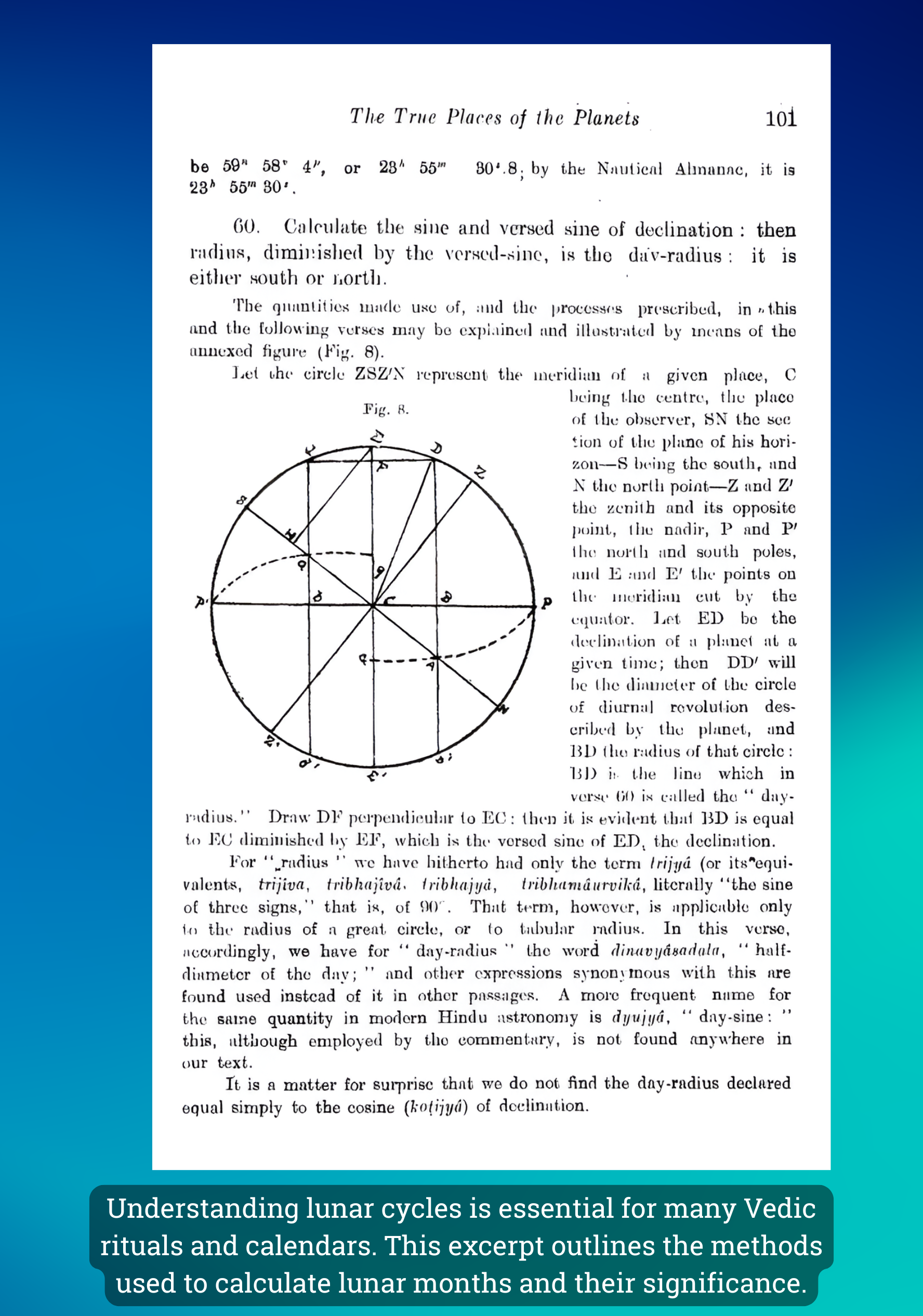
A detailed illustration from the ‘Surya Siddhanta’ showing various lunar phases and their calculations, with annotated Sanskrit text explaining the cycle of the moon.
Eclipse Calculations Explained
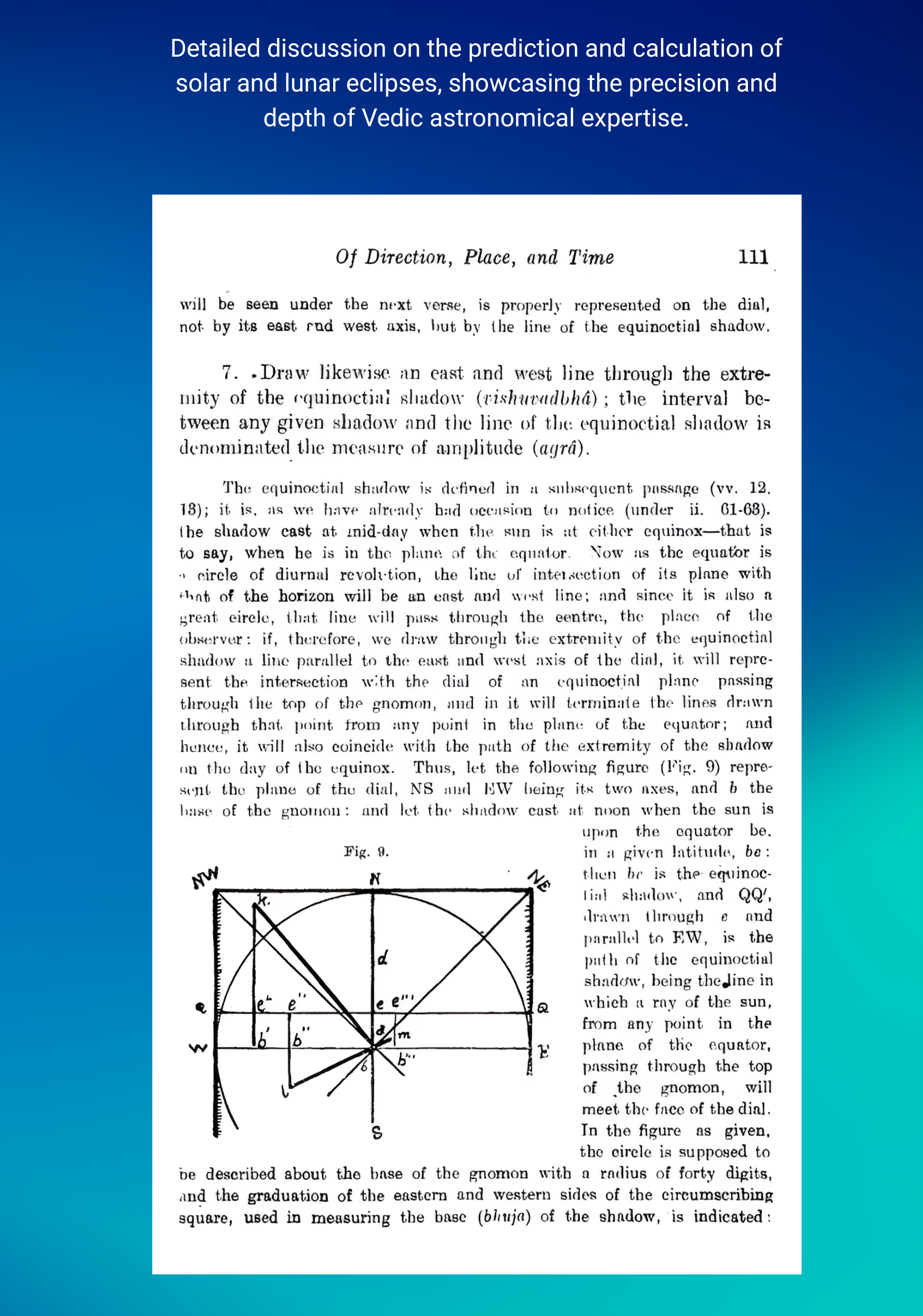
Page from the ‘Surya Siddhanta’ depicting the method to calculate solar and lunar eclipses, featuring complex diagrams and detailed descriptions in Sanskrit.
Planetary Orbits and Alignments
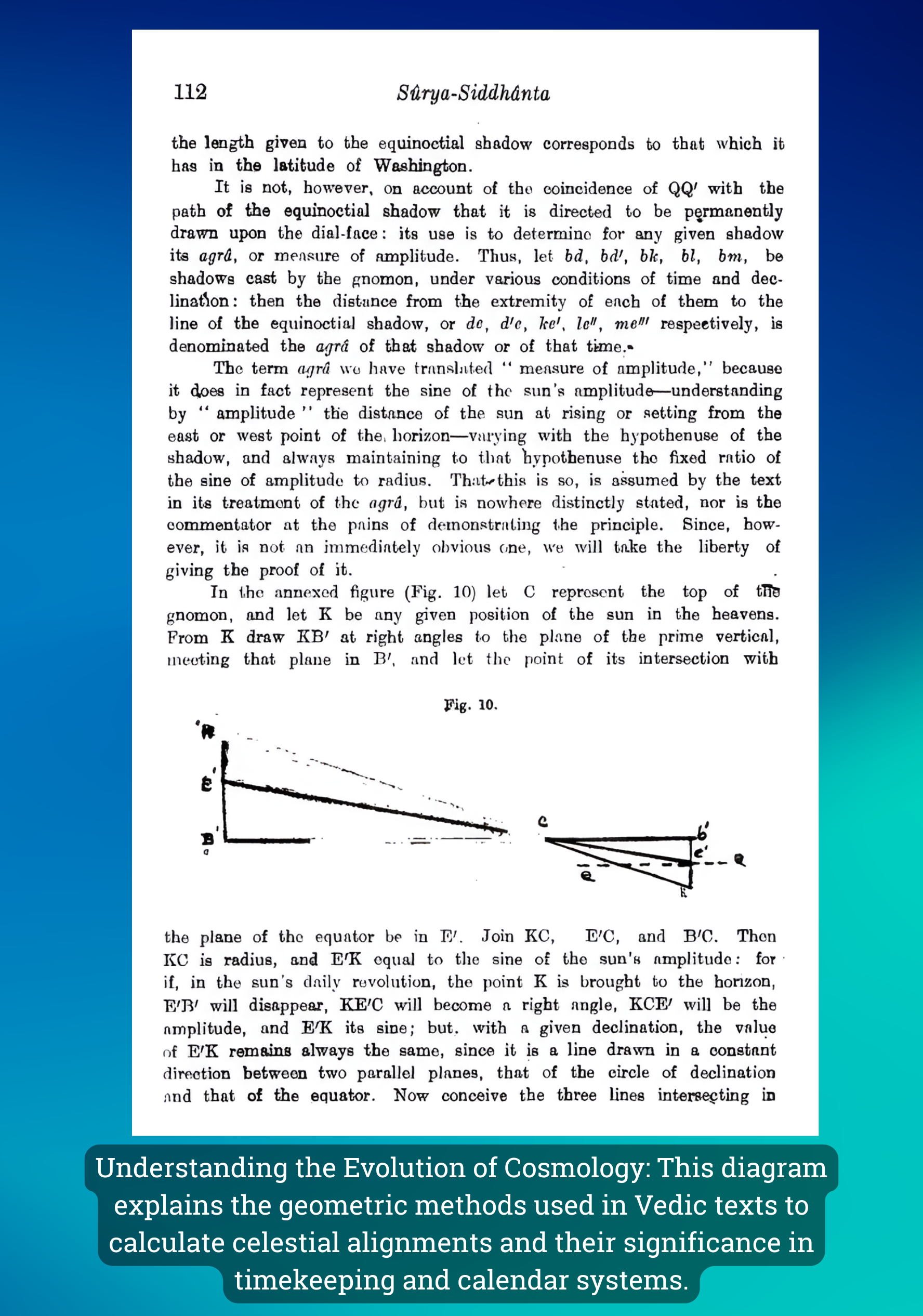
Excerpt from the ‘Surya Siddhanta’ showing a celestial diagram used to explain the orbits of planets and their alignment, accompanied by descriptive Sanskrit scripts.
Stellar and Planetary Positioning
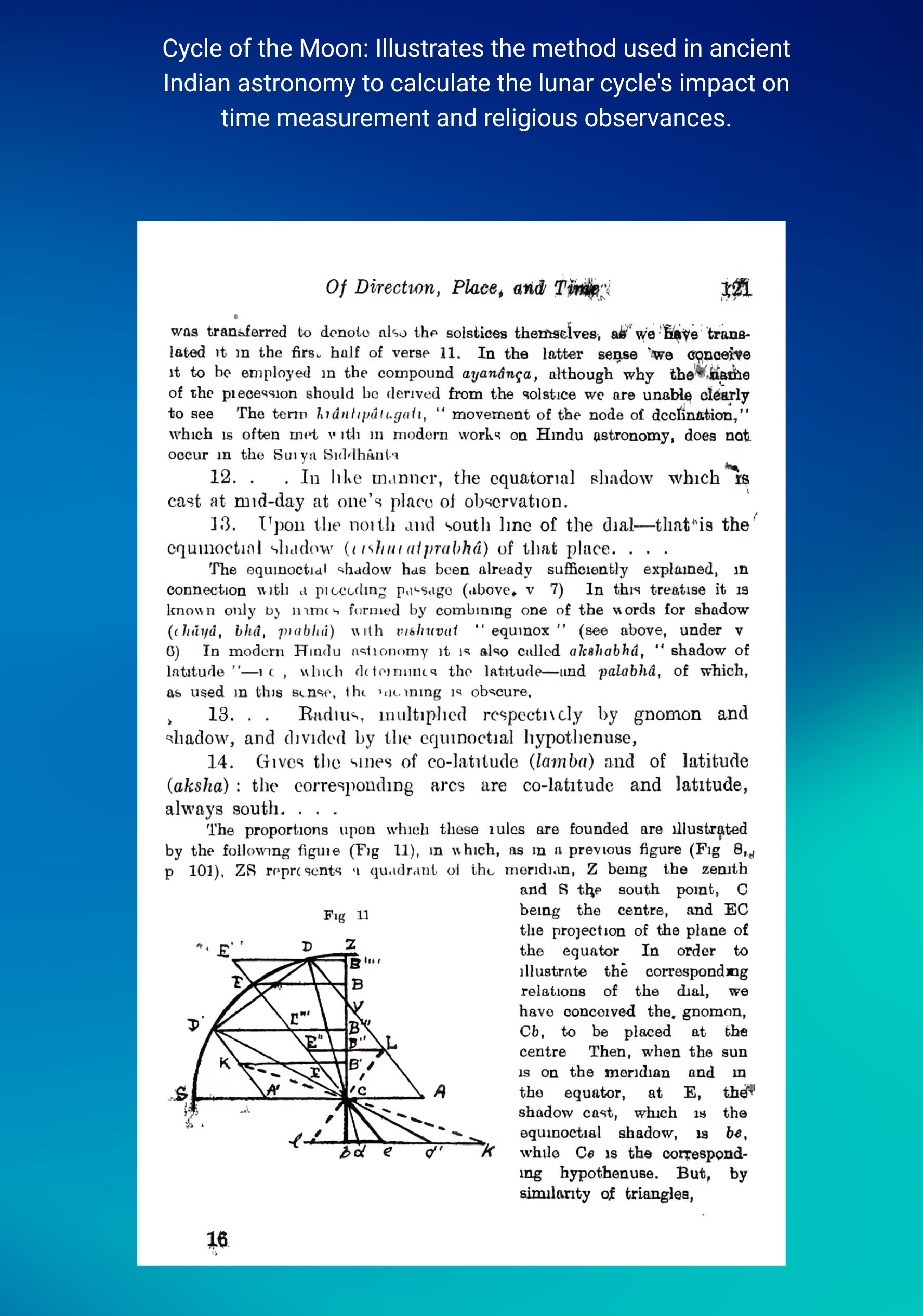
Text and diagrams from the ‘Surya Siddhanta’ outlining the calculations for determining the positions of stars and planets, with detailed annotations in Sanskrit.
Astronomical Charting and Mapping
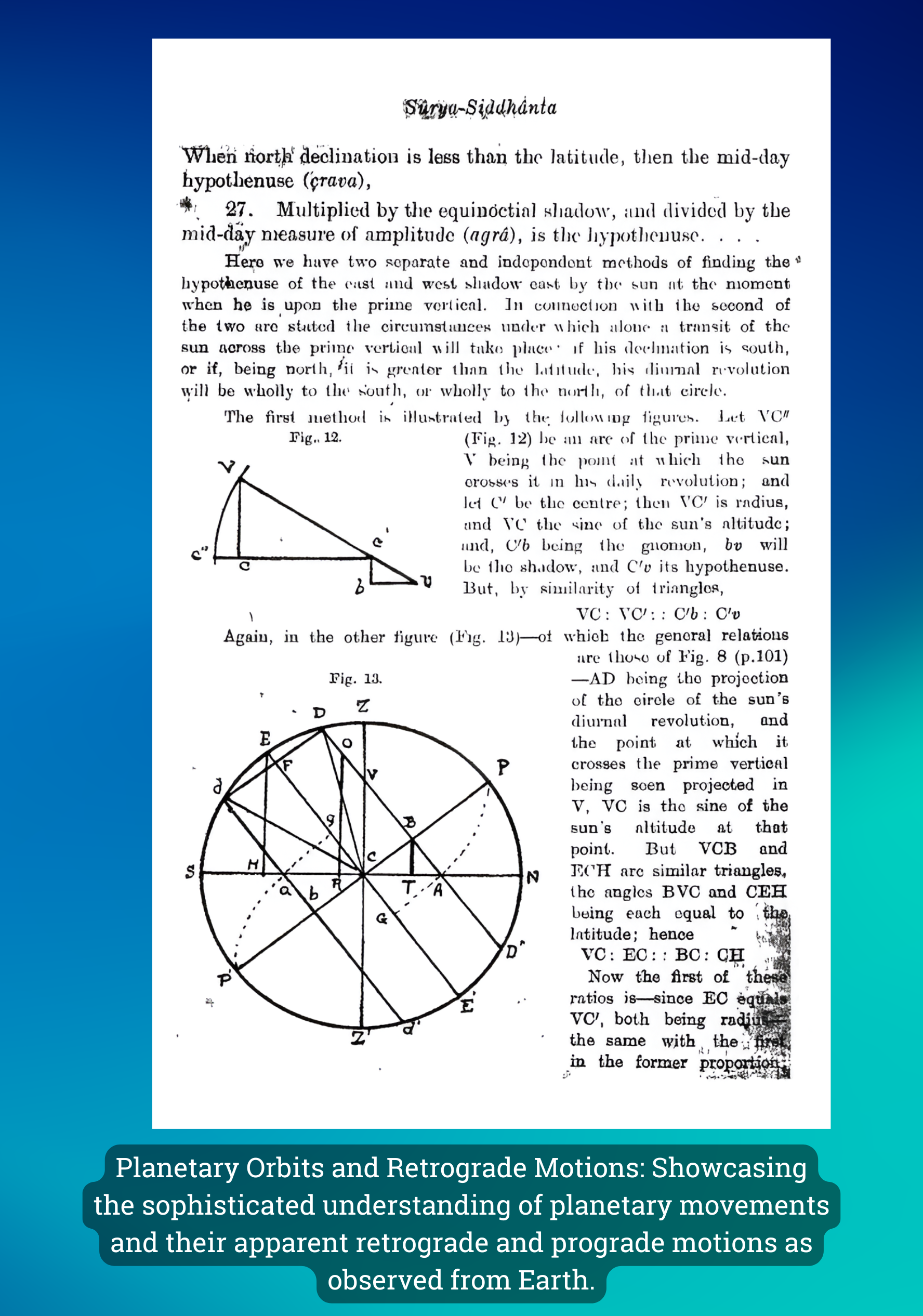
A complex astronomical chart from the ‘Surya Siddhanta’, filled with geometric calculations and celestial mappings, annotated in traditional Sanskrit.
Modeling Celestial Orbits and Eclipses
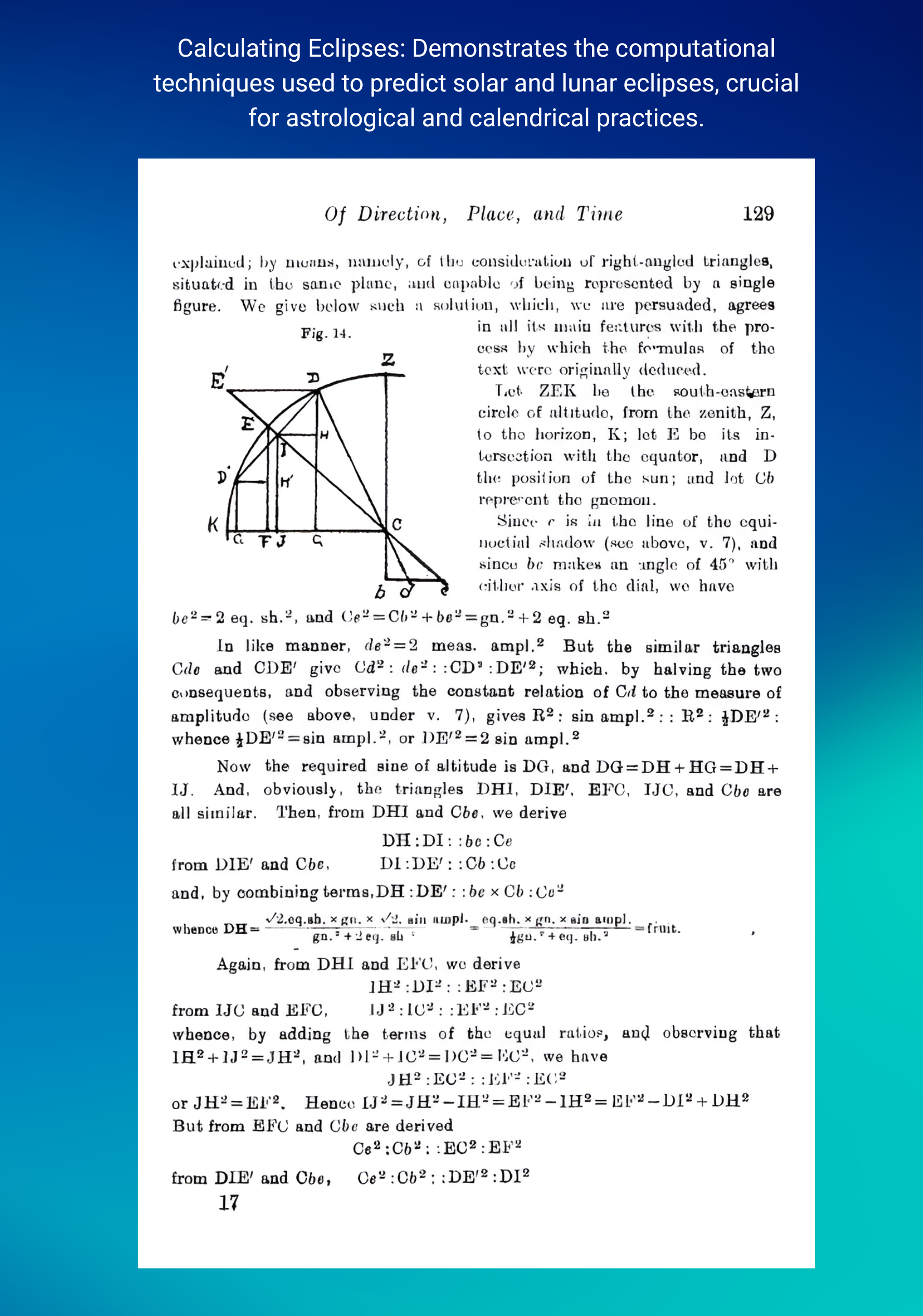
A page from the ‘Surya Siddhanta’ featuring detailed Sanskrit text and diagrams related to the mathematical modeling of celestial orbits and eclipse predictions.
Geometric Celestial Arrangements
Illustration from the ‘Surya Siddhanta’ showing the geometric arrangement of celestial bodies, annotated with detailed calculations and descriptions in Sanskrit script.
The visual journey through the ‘Surya Siddhanta’ not only illuminates the ancient methods but also connects them with contemporary astronomical understanding. The detailed diagrams and precise calculations present in these images underscore how ahead of their time Vedic astronomers were. By comparing these ancient techniques with today’s methods, we gain a deeper appreciation for the scientific acumen possessed by scholars centuries ago. This synthesis of historical knowledge continues to inspire current astronomical research, demonstrating the timeless relevance of the ‘Surya Siddhanta’.
Lunar and Solar Eclipse
As we have seen, the “Surya Siddhanta” is not just a text but a profound scientific treatise that bridges the observable with the calculable, bringing the heavens a bit closer to human understanding. In our next blog, we will delve into the astronomical tools and mathematical techniques that made these calculations possible. Join us as we uncover the instruments and methods that ancient astronomers used to enhance their understanding of the universe, demonstrating the sophistication and ingenuity of Vedic scientific thought.
Call to Action
Stay tuned to our blog as we explore the subject further. Interact and comment on the contents. In the next installment, where we will explore the range of astronomical tools and advanced mathematical techniques described in the “Surya Siddhanta”. For related topics explore more on our blogs Hinduinfopedia.com and Hinduinfopedia.org.
Feature Image: Click here to view the image.
Glossary of Terms
- Celestial Sphere: An imaginary sphere of arbitrary radius with the Earth at its center and the objects in the sky projected onto its inner surface.
- Eclipse: A celestial event that occurs when one celestial body moves into the shadow of another celestial body, blocking all or part of the light from reaching the observer.
- Lunar Nodes (Rahu and Ketu): The points where the moon’s orbit intersects the ecliptic (the sun’s apparent path across the sky). Rahu and Ketu are considered significant in Vedic astrology for calculating eclipses.
- Planetary Orbits: The path that planets follow around the sun, shaped by gravitational forces.
- Surya Siddhanta: An ancient Indian astronomical treatise that provides systematic directions on calculating the motions of heavenly bodies with respect to the Earth.
- Vedic Astronomy: The study of astronomy based on the principles and observations detailed in the Vedas, ancient Hindu scriptures.
- Ecliptic: The apparent path of the Sun across the celestial sphere over the course of a year.
- Geometric Calculations: Mathematical computations related to the shapes, sizes, and positions of celestial bodies.
- Celestial Mechanics: The branch of astronomy that deals with the motions and gravitational forces of celestial objects.
- Mathematical Modeling: The process of creating a mathematical representation of a real-world situation or system to predict future behavior.
Credit for Images: https://archive.org/details/surya-siddhanta-english-translation-ebenezer-burgess/page/76/mode/1up
#VedicAstronomy #EclipsePrediction #SuryaSiddhanta #PlanetaryMechanics #AncientAstronomy
Visit Related Previous Blogs:
- Creation of Universe as described in Nasadiya Sukta of Rigveda
- Bhagwan Varaha Pulling Out Landmass out of Ocean.
- Surya Siddhanta Astronomical Truth of Rahu’s Bite
- Vedic Astronomy And Basic Concepts
Link for Next Related Blog
- https://hinduinfopedia.com/astronomy-in-surya-siddhanta/
- https://hinduinfopedia.com/science-of-vedic-astronomy/
- https://hinduinfopedia.com/hindu-wisdom-in-yagna-fire-real-not-myth/
- https://hinduinfopedia.com/hindu-wisdom-in-ritual-and-food/
- https://hinduinfopedia.com/hindu-wisdom-in-surgery-sushruta-blades-are-rea/
- https://hinduinfopedia.com/surgeon-sushrutas-pioneering-procedures/
- https://hinduinfopedia.com/surgeon-sushrutas-scalpel-unveiled/
- https://hinduinfopedia.com/metal-mastery-hindu-zinc-science-not-myth/
- https://hinduinfopedia.com/hygiene-in-hindu-texts/
- https://hinduinfopedia.com/vegetarian-diet-of-hindu-wisdom/
Very good
Awesome
Very good
Very good
Very good
Good
Very good
Fantastic website. Plenty of useful information here. I’m sending it to a few friends ans also sharing in delicious. And of course, thanks for your sweat!