


Astronomy in Surya Siddhanta: Ancient Indian Mathematical Tools and Techniques
Understanding Astronomy in Surya Siddhanta
Continuing our journey through the profound astronomical insights of the “Surya Siddhanta”, this third blog focuses on the sophisticated tools and advanced mathematical techniques employed by ancient Indian astronomers. Building on our understanding of planetary dynamics and eclipse mechanics from the previous blog, we now explore the actual instruments and computational methods that facilitated these intricate calculations.
The Ingenuity of Ancient Astronomical Instruments
Ancient Indian astronomers utilized a variety of tools to observe the heavens and make their calculations more precise. These included the gnomon, armillary spheres, and water clocks, among others. Each instrument played a crucial role in tracking celestial movements, determining equinoxes, solstices, and the passage of celestial bodies across the sky. The precision of these tools reflects a deep understanding of engineering and geometry, characteristics that highlight the advanced state of Vedic science.
Delving into Mathematical Mastery
The “Surya Siddhanta” is not just a text of astronomical theories but also a manual of mathematical genius. It introduces trigonometry and spherical geometry as means to solve problems related to celestial phenomena. The text’s use of sine tables, quadratic equations, and geometric models allowed astronomers to predict celestial events with remarkable accuracy long before such mathematical tools were known in the Western world.
Images Gallery
Celestial Sphere Dynamics

Exploring the interaction of celestial spheres through ancient Vedic diagrams.
Temporal Cosmology
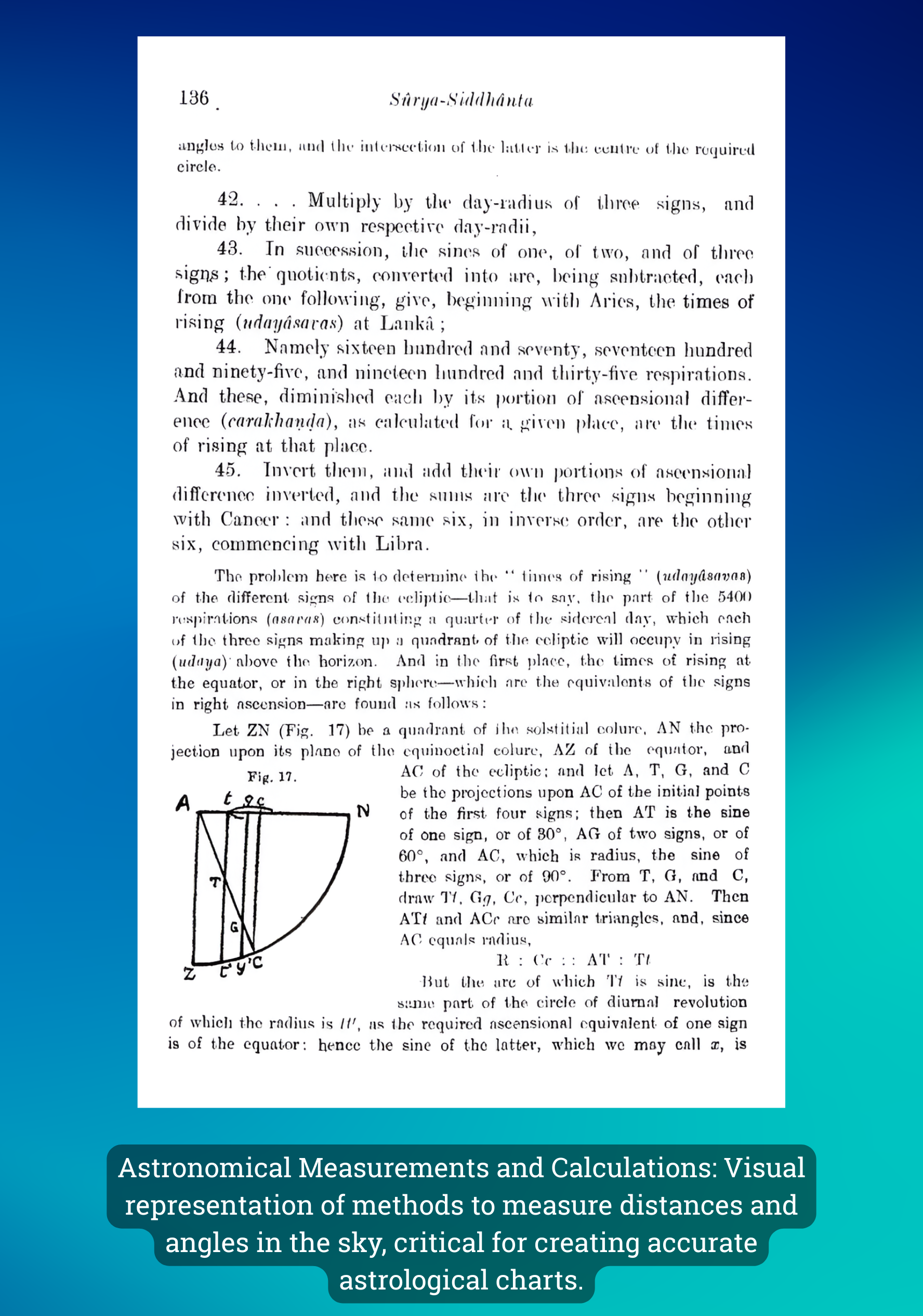
Visualizing time measurement and celestial movements in Vedic astronomy.
Planetary Positioning and Astrology
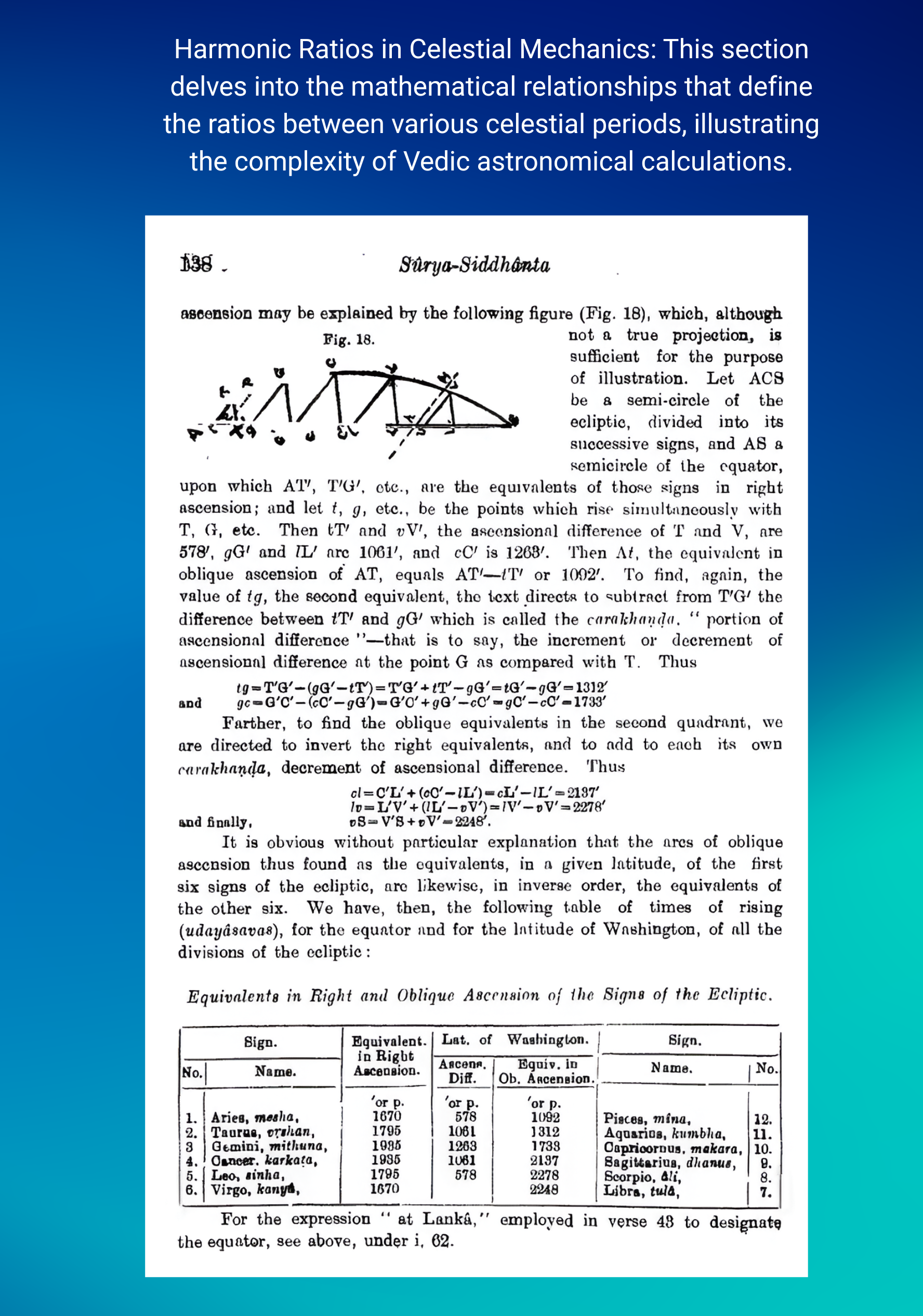
Detailed astrological calculations from the ‘Surya Siddhanta’.
Planetary Alignments and Earthly Influences
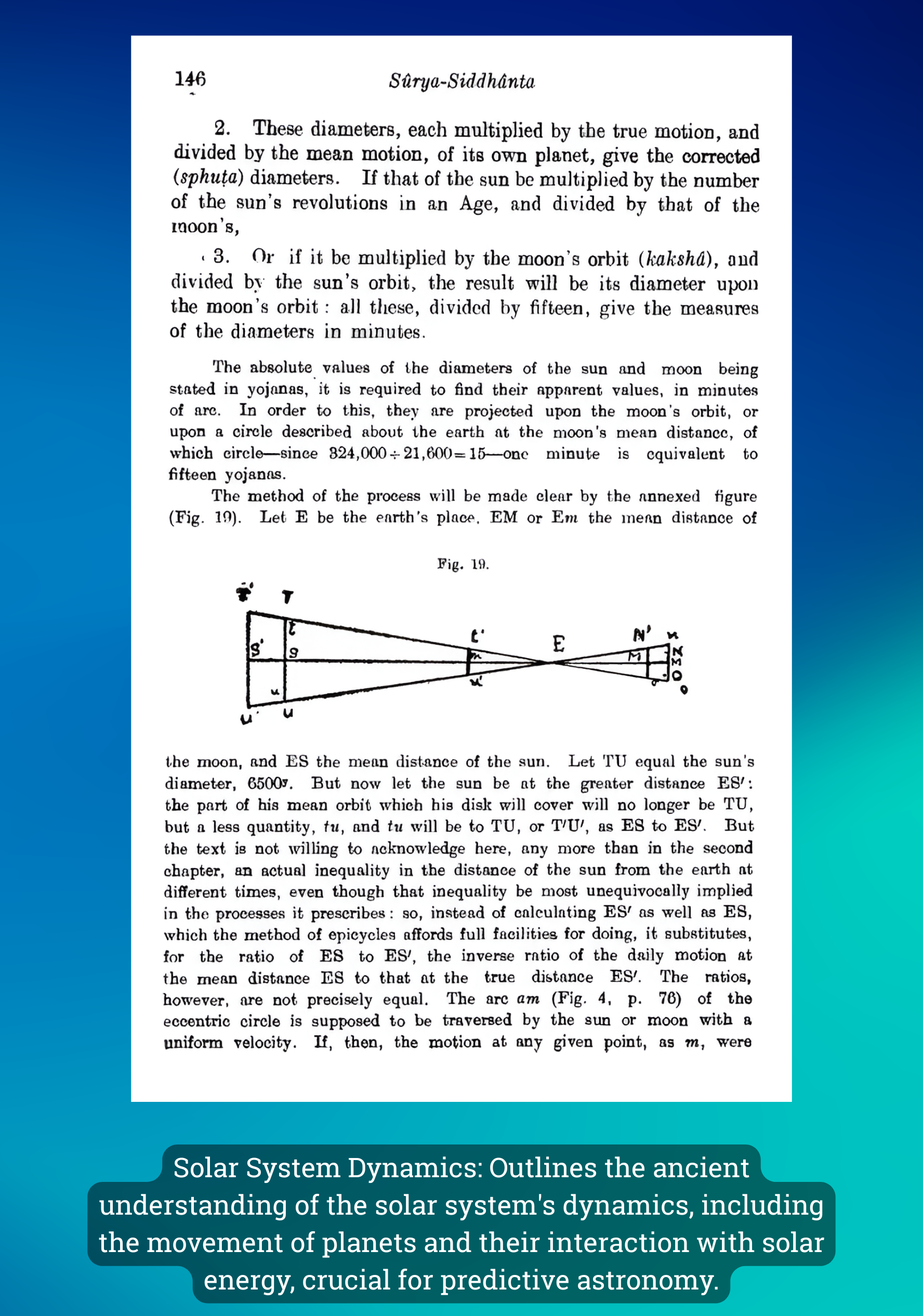
How ancient calculations linked planetary alignments to terrestrial phenomena.
Eclipse Path Geometry
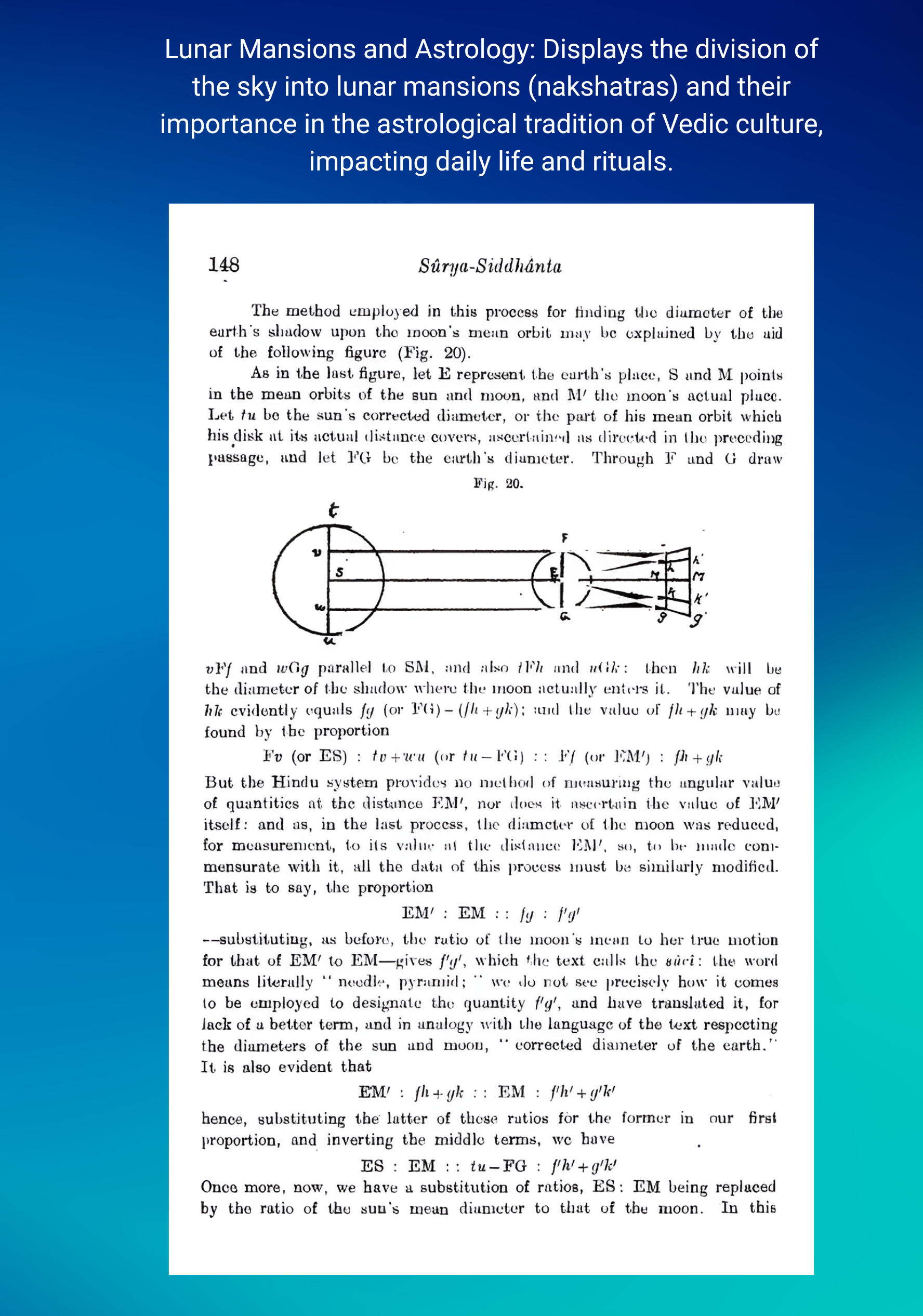
Schematic insights into the paths of solar and lunar eclipses.
Calculating Solstices and Equinoxes
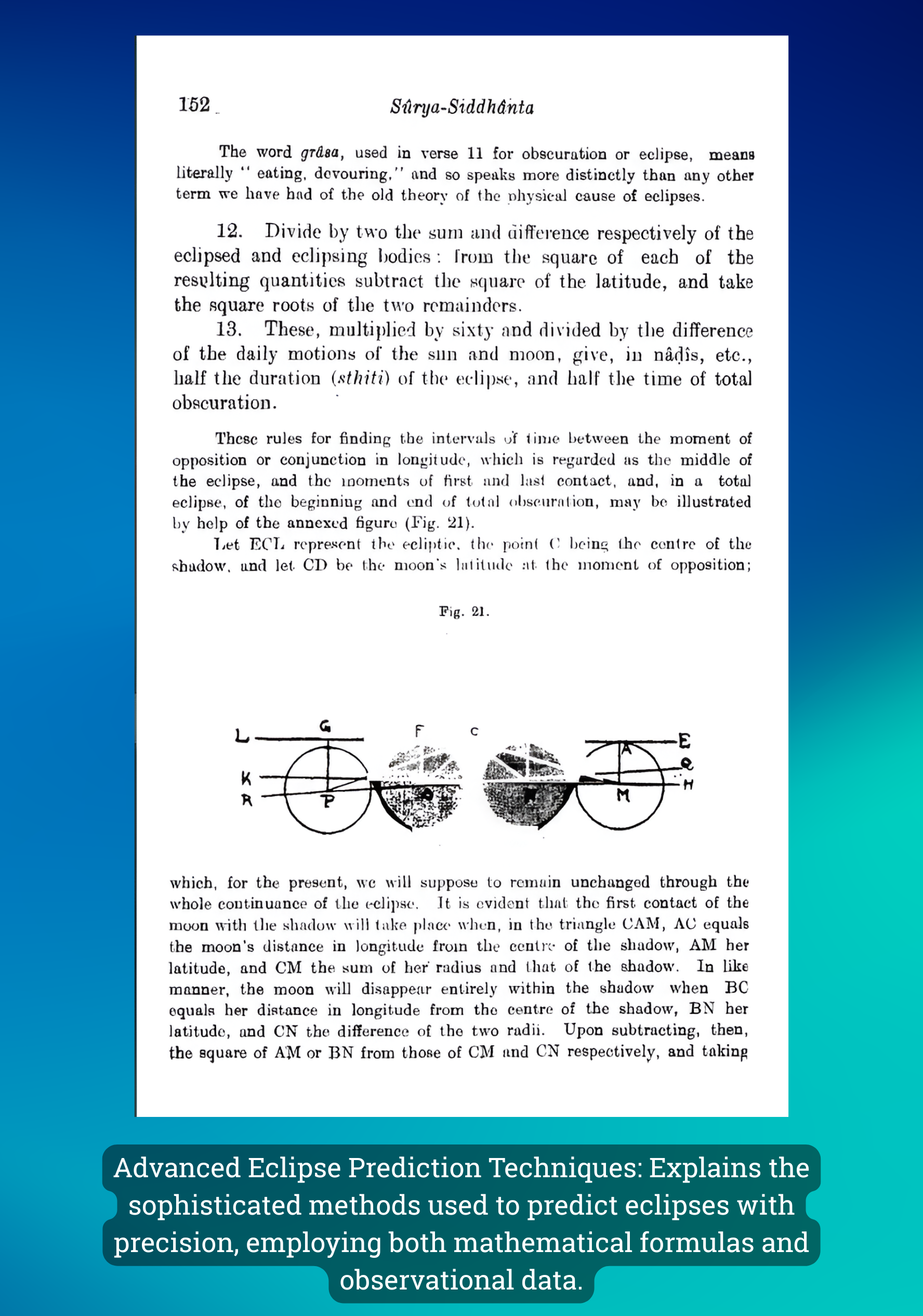
Mathematical approaches to determining critical celestial events.
Mechanics of Celestial Motion
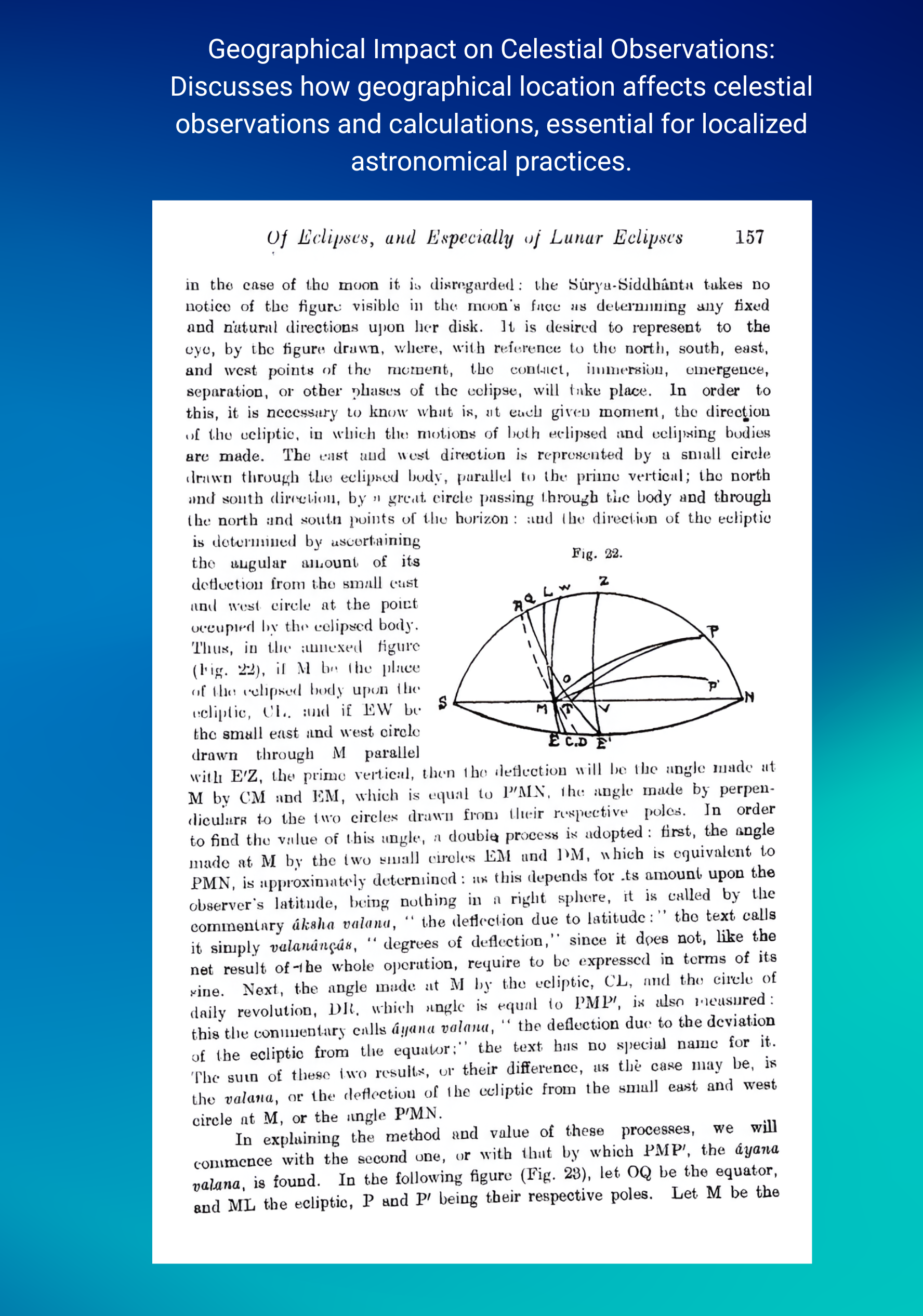
Detailed diagrams showing the movement of the sun and moon.
Lunar Month Calculations
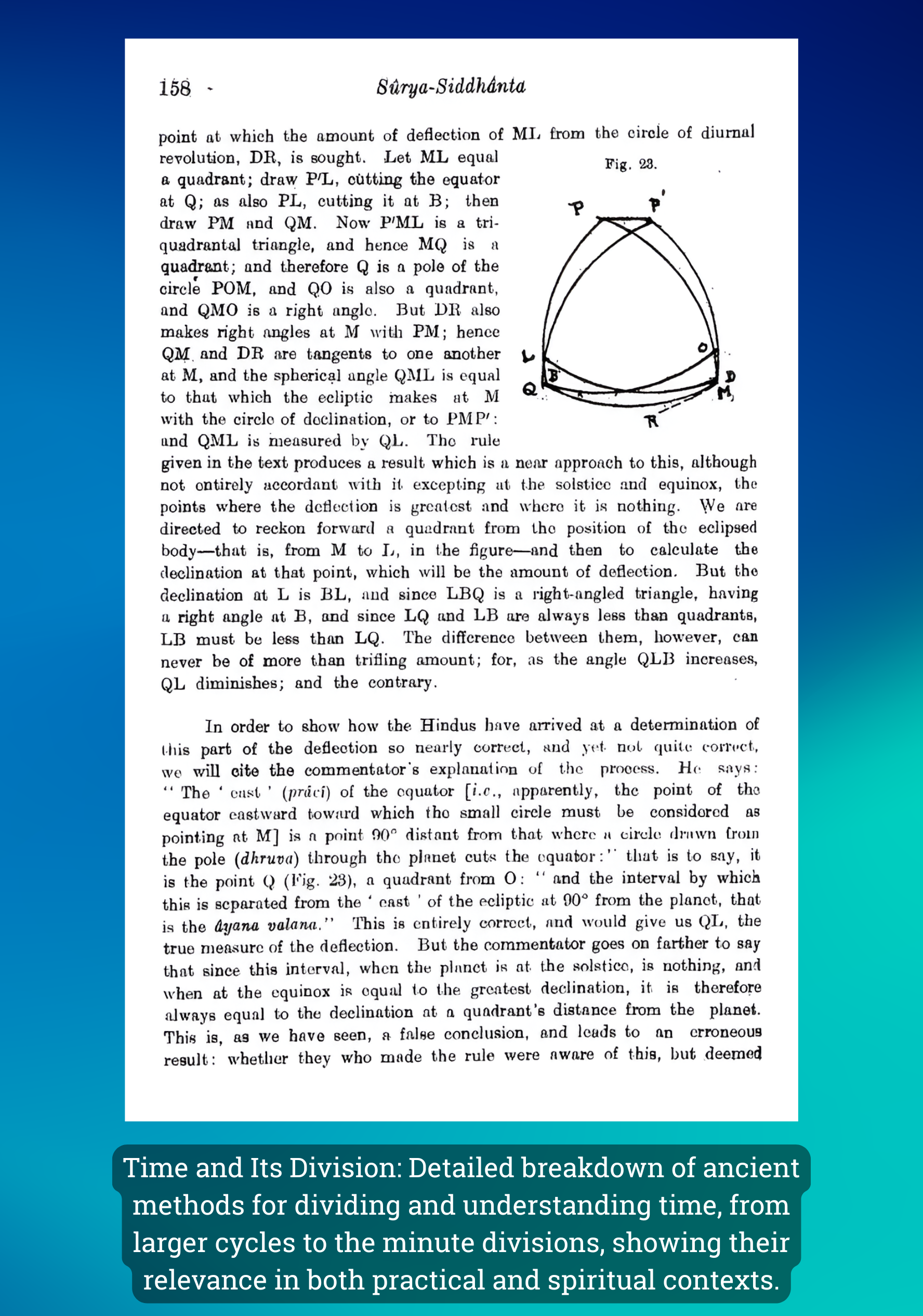
Methods for determining the duration of lunar cycles in Vedic traditions.
Astrological Charting
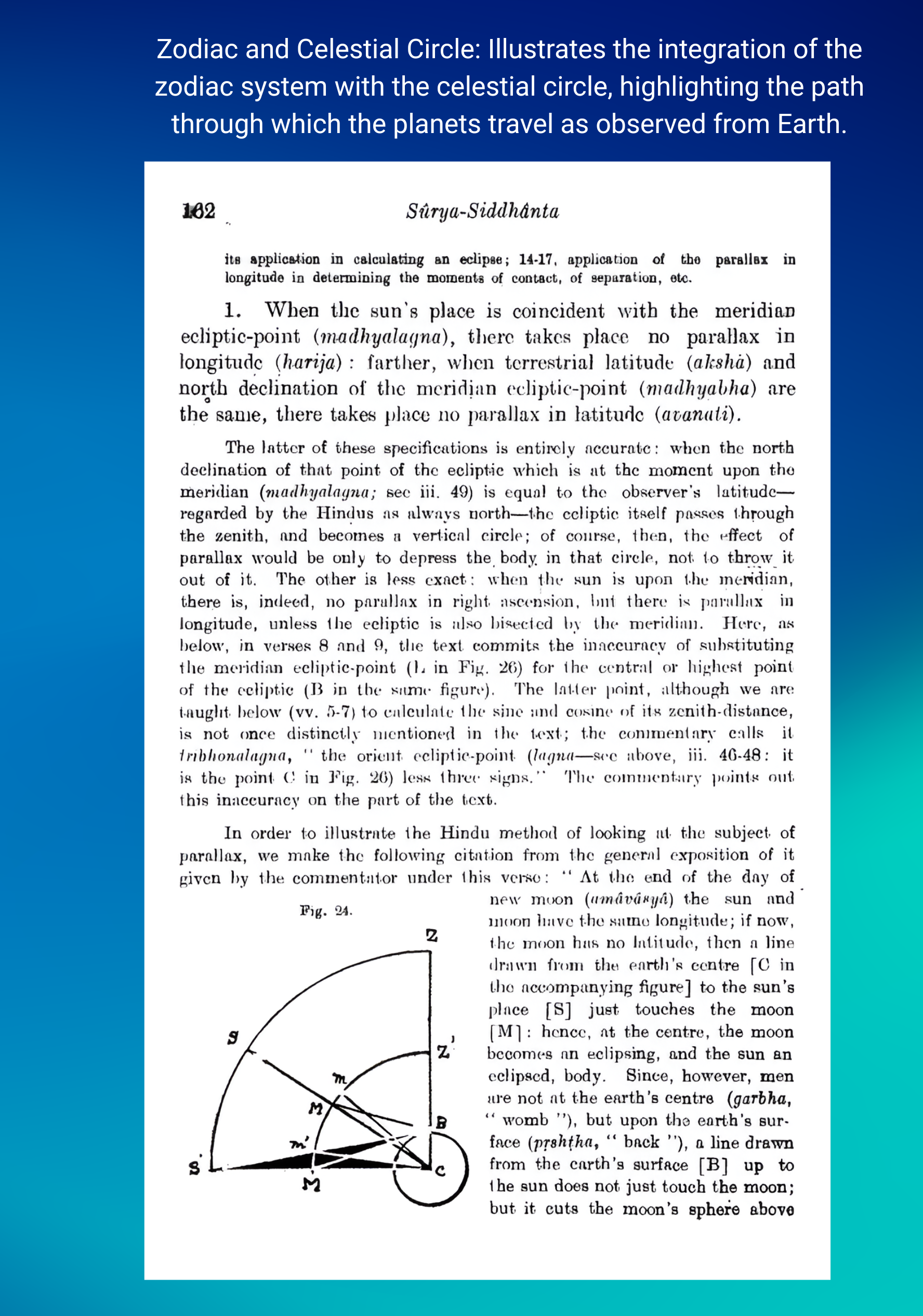
Mapping the celestial sphere with precision in ancient India.
Conclusion
Through the “Surya Siddhanta”, we gain not only insights into the celestial mechanics but also an appreciation for the mathematical and technological advancements of ancient Indian culture. The tools and techniques described in this sacred text underscore a legacy of innovation that continues to influence astronomy and mathematics today
Call to Action
Share your thoughts and engage for more. Join us as we conclude our journey through this monumental text, reflecting on its enduring legacy and its significance in both historical and contemporary contexts only to take another topic for analyzation and revelation. Feature Image: Click here to view the image.
Update 19 March 2026
The Surya Siddhanta is a Calculative Masterpiece, providing the mathematical tools for spherical astronomy and sine tables that were centuries ahead of equivalent Western developments.
A — Add festival-context paragraph with specific Surya Siddhanta–Ugadi connection
After the section discussing the Surya Siddhanta’s accuracy or planetary calculation methods. Insert as a connecting paragraph between the technical analysis and any concluding section.
Ugadi: The Surya Siddhanta’s Most Public Annual Test
Every year on Ugadi — Chaitra Shukla Pratipada — the Surya Siddhanta’s mathematical tools described in this post are put to their most publicly visible test. The tithi calculation, the Mesha Sankramana (solar ingress into Aries) timing, and the Nakshatra position of the Moon are all computed using the precise sine tables and planetary longitude algorithms this text established. Shaka 1948 begins today, and its Panchanga data — broadcast through the Panchanga Sravanam in temples across South India — is downstream of exactly the astronomical mathematics this post examines. For the specific precision figures behind today’s Ugadi calculation, including how the Surya Siddhanta’s sidereal year value compares to modern atomic-clock measurements, see Ugadi Panchanga Precision: The Science of the Hindu New Year.
Glossary of Terms
-
Surya Siddhanta: An ancient Indian astronomical treatise that explains the theoretical and mathematical foundations of astronomy. It includes calculations for planetary motions, eclipses, and other celestial phenomena.
-
Gnomon: A device used in ancient astronomy, essentially a stick or a pillar, that casts a shadow used to determine the altitude of the sun and thereby calculate time of day and solstices.
-
Armillary Sphere: A model of objects in the sky, consisting of a spherical framework of rings that represent lines of celestial longitude and latitude and other astronomically important features such as the ecliptic.
-
Water Clocks: Ancient time-measuring instruments that use the flow of water to measure time. Used extensively in various ancient cultures, including India, to time various astronomical and religious events.
-
Trigonometry: A branch of mathematics that studies the relationships between the sides and angles of triangles. The Surya Siddhanta makes significant use of trigonometric functions like sine.
-
Spherical Geometry: A branch of geometry that deals with figures on the surface of a sphere, used in astronomy to describe the celestial sphere where the planets, stars, and other celestial bodies exist.
-
Sine Tables: Tables of trigonometric values used for calculating angles and distances in astronomy and navigation. These were used extensively in the Surya Siddhanta for precise astronomical calculations.
-
Quadratic Equations: Mathematical equations where the highest exponent of the variable is a square. Such equations in the Surya Siddhanta are used to solve problems related to celestial mechanics and eclipse predictions.
-
Celestial Sphere: An imaginary sphere of arbitrarily large radius, concentric with the observer. All objects in the observer’s sky can be conceived as projected upon the inner surface of the sphere.
-
Celestial Mechanics: The branch of astronomy that deals with the motions and gravitational effects of celestial objects.
-
Rahu and Ketu: According to Vedic astrology, they represent the points of intersection of the paths of the Sun and the Moon as they move on the celestial sphere. Therefore, they are associated with eclipses.
-
Ecliptic: The path that the Sun appears to trace through the stars each year as the Earth orbits around it.
Credit for Images: https://archive.org/details/surya-siddhanta-english-translation-ebenezer-burgess/page/76/mode/1up
Visit Related Previous Blogs:
- https://hinduinfopedia.com/cosmic-seed-of-universe/
- https://hinduinfopedia.com/bhagwan-varaha-and-his-tusks/
- https://hinduinfopedia.com/surya-siddhanta-astronomical-truth-of-rahus-bite/
- https://hinduinfopedia.com/vedic-astronomy-and-basic-concepts/
Link for Next Related Blog
- https://hinduinfopedia.com/astronomy-in-surya-siddhanta/
- https://hinduinfopedia.com/science-of-vedic-astronomy/
- https://hinduinfopedia.com/hindu-wisdom-in-yagna-fire-real-not-myth/
- https://hinduinfopedia.com/hindu-wisdom-in-ritual-and-food/
- https://hinduinfopedia.com/hindu-wisdom-in-surgery-sushruta-blades-are-rea/
- https://hinduinfopedia.com/surgeon-sushrutas-pioneering-procedures/
- https://hinduinfopedia.com/surgeon-sushrutas-scalpel-unveiled/
- https://hinduinfopedia.com/metal-mastery-hindu-zinc-science-not-myth/
- https://hinduinfopedia.com/hygiene-in-hindu-texts/
- https://hinduinfopedia.com/hygiene-in-hindu-texts/
- https://hinduinfopedia.com/vegetarian-diet-of-hindu-wisdom/
Very good
Awesome
Very good
Very good
Awesome
Awesome
Very good
Good
Very good
Wonderful ssite you have here but I was curious about if you knew of any
discussuon boards that cver the same topics discussed in this article?
I’d really lofe to be a part off online community where I can get comments from other knowledgeable people thatt
share the same interest. If you have any recommendations, plase let me know.
Thanks a lot!
[…] cycle are deeply rooted in the Hindu calendar system. Ancient Indian texts, especially the Surya Siddhanta, codified this cycle through the Hora system—an algorithmic model where planetary hours, not […]