

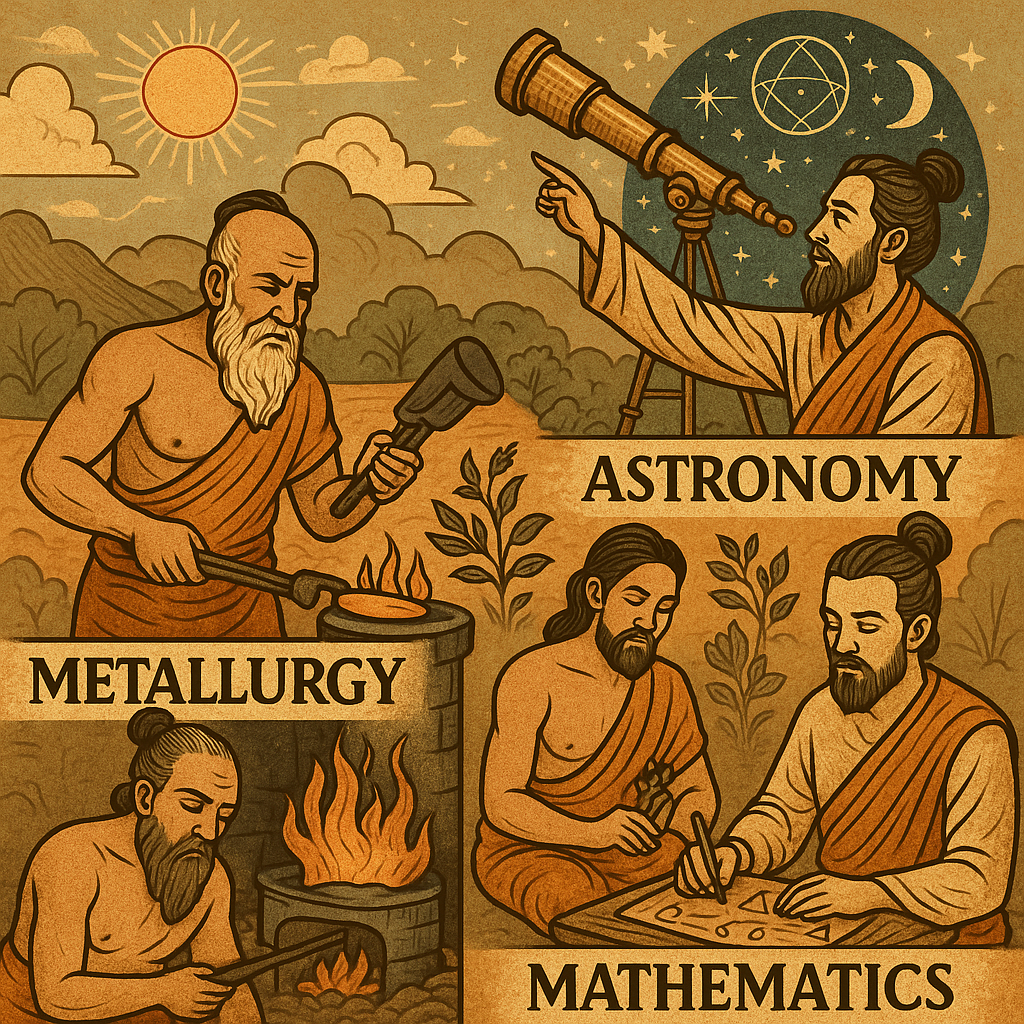
Metal Mastery: Hindu Zinc Science Not Myth
Revealing the Metal Mastery
The Hindu wisdom in metallurgy, far from Western “mythology” labels, forged scientific truths in fire and ore. Ancient texts like the Rasaratnakara (~2nd century CE or earlier) detail zinc extraction with a level of precision unseen in the West until millennia later [Ref 1]. This isn’t folklore—it’s empirical science. Just as the Nasadiya Sukta probed cosmic origins and Sushruta’s scalpel carved surgical reality ( and associated blogs), Hindu metallurgists distilled elements and tempered metals with knowledge, not superstition. This post uncovers how India’s metal mastery in zinc, steel, and rust-free iron redefines ancient science.
Background: Mythology or Methodology?
Colonial dismissals often painted Hindu achievements as mythic abstractions.
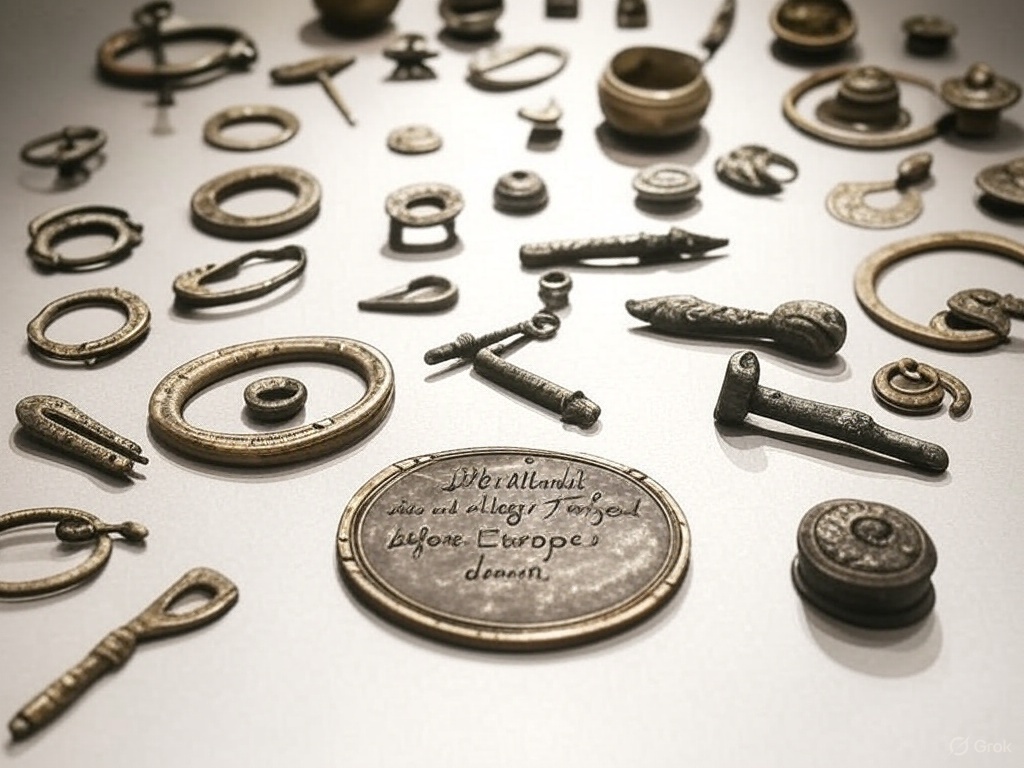
Across disciplines—from astronomy and surgery to metallurgy and medicine—ancient Hindu texts reflect a consistent tradition of observation, experimentation, and refinement. One of the most striking examples lies in early metal extraction techniques, particularly zinc smelting, practiced as early as 1000 BCE.
This sophisticated process wasn’t confined to metallurgy alone. The apparatus and underlying principles were later described in Rasa Shastra, where they were adapted for extracting medicinal compounds, essential oils, and active ingredients from herbs and minerals. These texts detail not only the substances but also the equipment—sealed retorts, condensers, and furnaces—demonstrating continuity of scientific thought across domains.
Rather than myth or metaphor, what we find is a legacy of applied science and metal mastery that adapted and extended across fields. Let us now explore the specific technology behind this remarkable process [Ref 4].
Let us get started with the technology behind the extraction.
Patal Yantra: Hindu Metallurgy’s Core
Before we appreciate the scale of Hindu zinc mastery, we must understand the apparatus at its heart—a tool both symbolic and scientific: the patal yantra.
Hindus don’t gather in pews—science thrives in labor. The patal yantra, meaning “device positioned in the netherworld” or “underground apparatus,” was a sealed, inverted furnace central to early Hindu metallurgy. Its principle of downward distillation, remarkably advanced for its time, is described in Rasaratnakara, attributed to Nagarjuna. By 1000 BCE, this device was used not only to extract zinc but later adapted for mercury distillation and Ayurvedic elixirs [Ref 1].
The process involved sealing zinc ore mixed with charcoal inside a clay retort. This was placed upside down in a heating furnace and subjected to temperatures exceeding 1000°C. As the ore vaporized, the zinc vapor was directed downward through a narrow clay tube and condensed—usually in a lower vessel cooled by air or shallow water. This produced solid zinc metal, collected without oxidation—a technique the West achieved only in 1738 CE.
This wasn’t theoretical. Excavations at Zawar in Rajasthan have uncovered hundreds of such clay retorts and distillation chambers [Ref 6]. Their placement, shape, and residue match the description in ancient Sanskrit texts—providing archaeological confirmation of this early metal mastery.
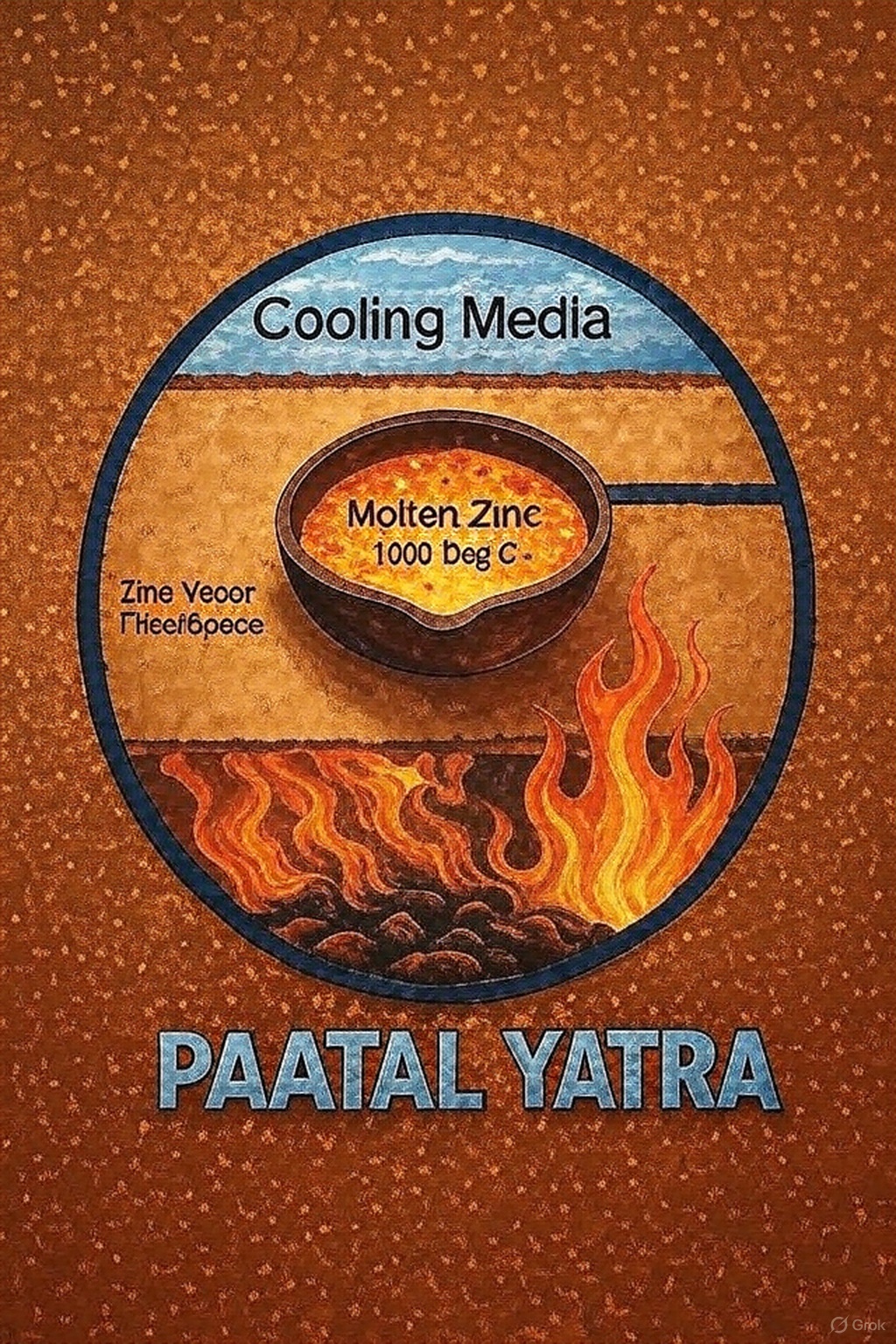
Unlike crude smelting in open-air forges elsewhere, this was sealed, repeatable, and precise—true to the Vedic spirit of measurable knowledge. Even as Rigveda’s Shanti Mantras were recited for focus, it was through fire, pressure, and geometry that Hindu sages forged science—not myth. Pull Quote: “Patal yantra isn’t myth—it’s metallurgy, distilled in clay and fire.” Internal Link: Learn how Vedic astronomy’s precision (and associated blogs) mirrors this metallurgical mastery.
Metal Mastery in Zinc Extraction: World’s First Distillation
Having grasped the technological foundation, we now turn to its extraordinary application—where ancient India transformed scientific knowledge into an organized metallurgical industry. While the patal yantra laid the scientific foundation, it was the scale and consistency of its application that truly set Hindu metallurgy apart. By 1000 BCE, entire clusters of furnaces operated across Zawar in Rajasthan, producing zinc at volumes that suggest not isolated experimentation but an early industrial ecosystem. Archaeologists have uncovered not just clay retorts but entire layouts of coordinated smelting pits, ash layers, and standardized vessels—evidence of mass production, specialization of labor, and repeatable results. These weren’t scattered alchemical trials—they were organized metallurgical zones rooted in practical knowledge. This system ran uninterrupted for centuries, establishing protocols for materials, furnace design, and controlled cooling—predating modern chemical engineering by millennia.

Pull Focus: India didn’t just discover zinc—it mastered its controlled, replicable extraction at scale.
Metal Mastery in Steel Production: The Wootz Legacy
Zinc wasn’t the only domain where Hindu metallurgists excelled. Around 300 BCE, a new metallurgical breakthrough—wootz steel—expanded the frontiers of material science from smelting to weaponry. By 300 BCE, Indian blacksmiths had pioneered wootz steel, a crucible-forged, high-carbon alloy that traveled to Arabia, Persia, and Rome. Its unique molecular composition—visible today under electron microscopes—revealed carbon nanotube structures, making it flexible yet strong [Ref 5, Ref 7]. Known in the West as Damascus steel, it cut cleaner than Roman blades and resisted brittleness. This wasn’t metallurgical luck—it was the result of generations of experimentation, observation, and documentation.
Display of Metal Mastery: Rust-Proof Pillar of Delhi
A few centuries later, another monument of metallurgical genius would rise—one not meant for war, but for wonder: the Iron Pillar of Delhi. Standing tall since the 4th century CE, the Iron Pillar near Qutub Minar resists corrosion despite Delhi’s humid climate. Its secret? A high phosphorus content, deliberate alloying, and slow slag cooling. Western metallurgists only began to replicate such rust resistance in the late 20th century [Ref 2]. This 6-ton artifact is not an anomaly—it’s a beacon of metallurgical consistency, possibly crafted by the same empirical minds that distilled zinc centuries earlier.

What do you think preserved the Iron Pillar for so long? Comment in the Comments box.
Science Silenced: Colonial Erasure of Hindu Metallurgy
Despite this legacy of scientific brilliance, much of it was sidelined during the colonial era—a time when native knowledge was dismissed and nearly erased from institutional memory.
The British replaced traditional Indian education with English instruction under Macaulay’s 1835 Minute [Ref 8], branding Sanskrit-based knowledge as superstition. Metallurgical achievements documented in texts like Rasaratnakara, and the tradition of Hindu metal mastery, were relegated to “myth.” But archaeological evidence—smelting sites, rust-free artifacts, and historical trade in steel—defy this erasure. Hindu metallurgists didn’t just preserve techniques—they passed them down orally, silently resisting colonial condescension.
Learn more on how Vedic astronomy too was miscast as “myth” and associated blogs.
Legacy in 2025: Rediscovering Hindu Innovation
This section is strong but could begin with more emotional or nationalistic resonance to connect the past and present. In today’s labs, the echoes of ancient forges return. IIT Kanpur’s studies on wootz steel’s nanostructure fuel modern superalloys for aerospace and biomedicine [Ref 9]. Environmental scientists study ancient smelting’s efficiency for greener mining techniques. As India reclaims its scientific soul—through projects like AYUSH and educational reform—these metal marvels become more than relics. They become roadmaps for sustainable innovation rooted in dharmic balance. Visual Suggestion: Table comparing metallurgy across civilizations (India vs. Europe). “Timeline of Innovation: Hindu metallurgy led the world.”
| Civilization | Milestone | Date | Feature |
| Hindu India | Zinc smelting | 1000 BCE | Downward distillation in closed vessels |
| Hindu India | Wootz steel | 300 BCE | Source of Damascus blades |
| Hindu India | Rasaratnakara | ~2nd century | Textual description of metal extraction |
| Hindu India | Iron Pillar | 4th century CE | Rust-proof with phosphorus alloy |
| Europe | Zinc production | 1738 CE | William Champion’s late discovery |

Reflections on Metal Mastery by Hindu Society
From the distillation of zinc in 1000 BCE to nanostructured blades and rust-free iron columns, Hindu metallurgy showcases science—not speculation. These weren’t divine gifts or fables—they were calculated triumphs of material science. As we continue this blog series—from cosmic hymns to surgical precision—we affirm that Hindu knowledge is Real, Not Myth. Next, we delve into Vedic hydrology and how water was revered and purified through ecological science. Pull Quote: “Hindu metallurgy forged facts in fire, not fables in pews.”
Call to Action
How does rediscovering Hindu metallurgy reshape your view of ancient science? Comment below and subscribe to HinduInfoPedia to explore the next post: Water’s Cleansing Wisdom in Vedic Science. Internal Link: Revisit Sushruta’s surgical legacy and trace the thread of empirical tradition across disciplines.
Feature Image: Click here to view the image.
Glossary of Terms
- Patal Yantra: An ancient inverted furnace apparatus used in Hindu metallurgy for extracting zinc and mercury via downward distillation, described in texts like Rasaratnakara.
- Rasaratnakara: An early Sanskrit treatise attributed to Nagarjuna, detailing metallurgical techniques such as distillation and purification of metals like zinc and mercury.
- Rasa Shastra: A branch of Ayurveda focused on alchemy and medical chemistry, using metals, minerals, and herbal extracts processed through specialized equipment.
- Zawar: A historical mining region in Rajasthan, India, known for its ancient zinc smelting complexes dating back to 1000 BCE.
- Wootz Steel: A high-carbon crucible steel produced in ancient India, known for its exceptional sharpness and durability; the precursor to Damascus steel.
- Iron Pillar of Delhi: A 4th-century CE rust-resistant iron structure in Delhi, celebrated for its corrosion-proof metallurgy and engineering sophistication.
- Rigveda: One of the oldest Vedic scriptures of Hinduism, comprising hymns that include philosophical, ritualistic, and cosmological knowledge.
- Shanti Mantras: Peace-invoking hymns from the Vedas traditionally chanted to promote focus, clarity, and spiritual discipline during learning and rituals.
- Nasadiya Sukta: A hymn from the Rigveda (10.129) that explores the origins of the universe, often cited as an example of Hindu cosmological inquiry.
- AYUSH: An acronym for Ayurveda, Yoga, Unani, Siddha, and Homeopathy—traditional systems of medicine promoted by the Government of India for holistic wellness.
- Macaulay’s Minute (1835): A document by British official Thomas Babington Macaulay advocating English education in India while dismissing traditional Sanskrit-based learning.
- Damascus Blades: Legendary swords known for their strength and wavy patterns, originally made using Indian wootz steel exported to the Middle East.
#HinduinfoPedia #VedicScience #AncientIndia #ZincSmelting #WootzSteel
References
[1] Nagarjuna. Rasaratnakara. Available at: Archive.org.
[2] Biswas, A.K. (1996). Minerals and Metals in Ancient India. Google Books.
[3] Craddock, P.T. (2003). “Zinc Production in Medieval India.” World Archaeology. TaylorFrancis.com.
[4] Prakash, B. (2007). “Metallurgy in Ancient India.” Indian Journal of History of Science. Springer.com.
[5] Srinivasan, S., & Ranganathan, S. (2004). India’s Legendary Wootz Steel. Google Books.
[6] Willies, L. (1987). “Ancient Zinc-Lead-Silver Mining in Rajasthan.” Mining Magazine. MiningJournal.com.
[7] Reade, J. (1996). “Indian Steel in the Persian World.” Journal of Asian History. JSTOR.org.
[8] Macaulay, T.B. (1835). Minute on Education. Columbia.edu.
[9] IIT Kanpur (2020). “Wootz Steel Research.” IITK.ac.in.
[10] Archaeometallurgy in India by Vibha Tripathi (1998).
Visit Related Previous Blogs:
- https://hinduinfopedia.com/cosmic-seed-of-universe/
- https://hinduinfopedia.com/bhagwan-varaha-and-his-tusks/
- https://hinduinfopedia.com/surya-siddhanta-astronomical-truth-of-rahus-bite/
- https://hinduinfopedia.com/vedic-astronomy-and-basic-concepts/
- https://hinduinfopedia.com/solar-eclipse-insights-from-hindu-texts/
- https://hinduinfopedia.com/astronomy-in-surya-siddhanta/
- https://hinduinfopedia.com/science-of-vedic-astronomy/
- https://hinduinfopedia.com/hindu-wisdom-in-yagna-fire-real-not-myth/
- https://hinduinfopedia.com/hindu-wisdom-in-ritual-and-food/
- https://hinduinfopedia.com/hindu-wisdom-in-surgery-sushruta-blades-are-rea/
- https://hinduinfopedia.com/surgeon-sushrutas-pioneering-procedures/
- https://hinduinfopedia.com/surgeon-sushrutas-scalpel-unveiled/
Link for Next Related Blog
- https://hinduinfopedia.com/hygiene-in-hindu-texts/
- https://hinduinfopedia.com/vegetarian-diet-of-hindu-wisdom/
- https://hinduinfopedia.com/vegan-food-and-hindu-wisdom/
[…] Metal Mastery: Hindu Zinc Science Not Myth […]