

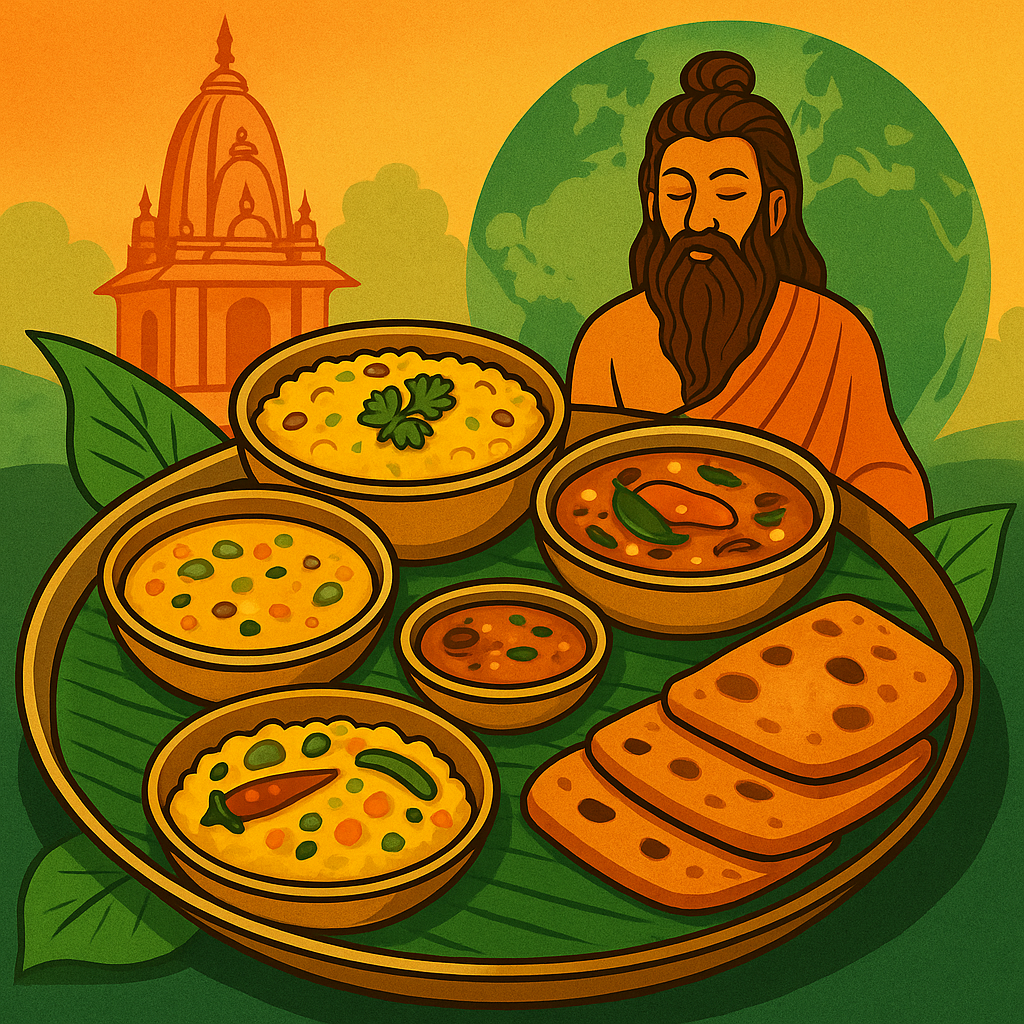
Vegan Food and Hindu Wisdom: A Meatless Legacy
Vegan Food and Hindu Wisdom: A Meatless Legacy
Vegan food, inspired by Hindu wisdom’s moderation, offers a sustainable path amid a warming world. Non-vegetarian diets—relying on cattle, poultry, and feed crops—drive global warming through methane, deforestation, and water overuse, with global meat consumption reaching 350 million metric tons in 2024 [Ref 10]. Hindu principles of mindfulness, backed by modern science, position vegan food as a climate solution grounded in logic and ecology—not myth. This blog explores the environmental toll of meat and dairy, the perils of overeating, and how vegan food aligns with ancient wisdom to foster a cooler, healthier planet.
Livestock’s Climate Toll: Methane and Manure
Non-vegetarian diets fuel 14.5% of global greenhouse gas emissions (7.6 GtCO2e), rivaling transportation [Ref 9]. From 1975 to 2024, meat animals’ emissions rose from 3,200 to 5,200 MtCO2e (+62.5%), while milk animals’ doubled from 1,200 to 2,400 MtCO2e (+100%) [Ref 13]. Cattle emit ~220 pounds of methane yearly, 28 times more potent than CO2, and manure releases nitrous oxide, 65% of agriculture’s N2O emissions (2.3 GtCO2e [Ref 6, 15]). Efficiency exposes dairy’s weakness: dairy yields 1.13 tons protein per MtCO2e, 4.9x less than meat’s 5.50 tons/MtCO2e [Ref 13]. Meat and milk’s overconsumption (31.3 MMT protein [Ref 8]) raises health risks like cardiovascular disease [Ref 9]. Vegan food, free of livestock, eliminates these impacts, embodying Hindu principles of planetary care.
Dairy’s Growth: Efficiency, Equity, and Earth’s Balance
Dairy production’s efficiency has declined—protein output per unit emissions dropped from 1.25 to 1.13 tons/MtCO2e (-9.6%) as emissions outpaced food value (+100% vs. +80%) [Ref 13]. Yet, dairy’s growth in smallholder systems (e.g., 2.7 million Bharatiya farmers [Ref 18]) fosters equitable income distribution, narrowing wealth gaps. Unequal income drives higher CO2 loads—the rich emit 50x more (5,000 vs. 100 tons CO2e/person [Ref 12]). Dairy’s model, while less efficient, mitigates broader societal emissions by reducing inequality, enhancing overall resource efficiency. Vegan food, with 25 tons protein/MtCO2e, remains the ultimate climate solution [Ref 9].
Feed Crops: A Resource Crisis
Non-vegetarian diets fuel 14.5% of global greenhouse gas emissions (7.6 GtCO2e), rivaling transportation [Ref 9]. Cattle emit ~220 pounds of methane yearly, a gas 28 times more potent than CO2, while cow/pig manure releases nitrous oxide, accounting for 65% of agriculture’s N2O emissions (2.3 GtCO2) [Ref 6, 15]). Producing meat demands vast feed crops—corn and soy total 650 MMT annually, consuming 36% of global cereals (2,848 MMT in 2024 [Ref 4]), yet this meets only ~4% of global caloric needs (10,950 trillion kcal [Ref 12]) and 14% of protein needs (350 MMT [Ref 1]) via livestock, diverting food from humans [Ref 9]. Feed crops guzzle 9% of U.S. freshwater (41 billion m³/year), straining rivers [Ref 6]. Vegan food, like pulses praised in the Rigveda, uses minimal resources—lentils require 50x less land (25 Mha) and emit 0.5 kg CO2e/kg protein [Ref 7, 11]. Vegan food eliminates these impacts, embodying Hindu principles of planetary care.
Meat vs. Milk vs. Vegan Food: Sustainable Alternatives
To distill the key climate and health differences among dietary choices, we now present a comparative summary. This section breaks down the environmental trade-offs between meat, milk, and vegan food, offering a clear guide for practical decision-making rooted in Hindu ecological values.
Vegan food offers a sustainable path to reduce meat and milk’s environmental toll, aligning with Hindu wisdom’s ahimsa. The information is very technical. Therefore we present the information in a bulleted format. Consider the trade-offs and benefits of these dietary choices:
Vegan food outperforms meat and milk in efficiency:
- Soy provides 10 MMT protein with 0.4 GtCO2e, a stark contrast to less efficient meat and milk production [Ref 9].
Vegan food offers nutritional benefits:
-
- Lentils provide 9 g protein/100g with 0 mg cholesterol [Ref 5].
- Milk contains 3.7 g saturated fat/100g, while beef has 85 mg cholesterol/100g [Ref 6].
Hindu diaspora in the US and UK adopt vegan food:
-
- Use soy milk in prasadam, balancing nutrition and ecology [Ref 9].
Counterarguments fail:
-
- Soil carbon sequestration doesn’t offset emissions; methane dominates [Ref 12].
Practical alternatives:
-
- Try moong dal khichdi (lentils, rice, coconut oil) or soy tofu stir-fry to replace meat/milk sustainably.
Some defend dairy for social benefits:
-
- Smallholder systems support 2.7 million Bharatiya farmers, fostering equitable income distribution [Ref 18].
- Greater income inequality increases CO2 loads—the rich emit 50x more than the poor (5,000 vs. 100 tons CO2e/person [Ref 12]).
- Dairy reduces inequality, mitigating societal emissions and improving resource efficiency holistically.
By choosing vegan food, we honor dharma, cut emissions, and protect health, proving this meatless legacy’s climate wisdom.
Meat’s Rising Demand, Earth’s Rising Heat
Rising meat demand threatens planetary boundaries, while vegan food offers a sustainable path rooted in Hindu wisdom. By 2050, soaring demand—especially for beef and poultry—could push food emissions beyond 1.5°C warming limits, potentially adding 10 GtCO2e annually if trends continue [Ref 1]. Poultry production, set to quadruple, exacerbates pressure on feed crops (650 MMT corn/soy), already strained by climate shifts like droughts and floods [Ref 9]. This demand drives deforestation (1,250 Mha for beef [Ref 16]) and water stress (41 billion m³/year in the U.S. [Ref 6]). Overconsumption worsens health—meat’s 31.3 MMT protein exceeds needs (25 MMT for 8 billion people [Ref 8]), raising cardiovascular risks (beef: 85 mg cholesterol/100g [Ref 5]).
In Bharat, vegan food gains mainstream traction, with 63% of urban youth reducing meat for sustainability due to excessive ads, Western culture, and media impact [Ref 6]. Vegan food cuts emissions by up to 50%, sparing land and aligning with Hindu ecology [Ref 13]. Hindu diaspora in the US and UK use vegan food like fortified almond milk in prasadam, matching meat’s protein (e.g., soy: 10 MMT protein [Ref 9]) without health risks [Ref 6]. Try lentil curry or soy-based chaat to replace meat sustainably, honoring dharma while cooling the planet.
The Perils of Overeating: A Lesson in Taste and Wisdom
Overeating, whether vegetarian or non-vegetarian, poses a universal challenge, driven by the allure of taste and exacerbating health and environmental crises. Meat and milk’s global protein output (31.3 MMT) exceeds needs (25 MMT for 8 billion people [Ref 8]), with taste—umami in beef, creaminess in milk—fueling excess consumption [Ref 0]. This overindulgence strains resources, driving emissions (7.6 GtCO2e [Ref 9]) and deforestation (1,250 Mha for beef [Ref 16]). Even vegetarian overeating burdens the planet through increased crop production [Ref 9].
Hindu wisdom, rooted in primary texts, urges detachment and mindfulness. The Bhagavad Gita (2:62-63) warns: “Attachment to sensory pleasures leads to delusion and loss of wisdom,” advocating disciplined consumption [Ref 1]. Likewise, as detailed in Shrimad Bhagavatam—Book 11, Chapter 8, Bhagwan Dattatreya, drawing wisdom from his 24 Gurus, noted the fish’s downfall: its craving for bait’s taste leads to death, symbolizing humanity’s bondage to sensory cravings [Ref 24]. While fish lose their lives, humans lose their health and money for maintaining it. Overeating, driven by taste, mirrors this folly, leading to health risks like cardiovascular disease (beef: 85 mg cholesterol/100g [Ref 5]) and environmental harm. Vegan food offers a balanced path, meeting needs (e.g., lentils: 9 g protein/100g [Ref 5]) without excess, reflecting Hindu principles of moderation, with ahimsa as a supportive value.
Vegan Recipe: a quick guide
Beyond the numbers and philosophy lies the daily plate. This section offers a curated selection of vegan dishes—traditional yet versatile—that mirror the satisfaction of popular meat-based meals. These recipes reflect not only sustainability but the cultural joy of sattvic dining.
This blog reveals that non-vegetarian diets, emitting 7.6 GtCO2e, drive deforestation and strain resources, while dairy’s inefficiency and rising meat demand threaten 1.5°C limits by 2050. Overeating, driven by taste, worsens health risks and emissions—a folly Hindu wisdom counters through detachment and Dattatreya’s fish Guru lessons. Vegan food, with higher protein efficiency, cuts emissions by 50%, offering sustainability. These vegan dishes rival Western meat-based dishes, each with numerous equivalents. For instance, Litti Chokha matches beef stew’s warmth, Thukpa mirrors chicken noodle soup’s comfort, Rotla surpasses meat-filled tacos’ rustic flavor, Avial of Kerala mimics chicken pot pie’s creaminess, and Puran Poli of Maharashtra contrasts ham-stuffed crepes’ sweetness, showcasing vegan food’s versatility. The “Vegan Recipe: A Quick Guide” highlights these eco-friendly alternatives, honoring Hindu moderation for a cooler planet.
A Legacy for a Cooler Planet
Vegan food is not a recent trend—it is the logical culmination of ancient Hindu wisdom. Rooted in balance, restraint, and ecological awareness, it answers today’s global crises with quiet clarity. While earlier sections examined emissions, efficiency, and health trade-offs in detail, the deeper takeaway is this: vegan food is a cultural philosophy in action.
From the Bhagavad Gita’s counsel on moderation to Dattatreya’s parable of the taste-bound fish, Hindu thought cautions against excess—whether in desire, diet, or exploitation of nature. In honoring those lessons, vegan food becomes more than a climate solution; it is a way to align daily choices with dharma. Not all may choose this path, but those who do carry forward a legacy—one that nourishes both the body and the planet.
Call-to-Action
How does vegan food from the “Vegan Recipe: A Quick Guide” inspire you? Share your take on dishes like Litti Chokha or Thukpa in the comments, supporting a greener planet!
Feature Image: Click here to view the image.
Glossary of Terms
- Ahimsa: Often translated as non-violence, it refers to a principle in certain Indian philosophies that advocates avoidance of harm to living beings. In this blog, it is referenced as a later interpretive value rather than a core Vedic principle.
- GtCO2e (Gigatonnes of Carbon Dioxide Equivalent): A metric used to compare emissions from various greenhouse gases based on their global warming potential.
- MtCO2e (Million Tonnes of Carbon Dioxide Equivalent): A smaller-scale unit than gigatonnes used to measure greenhouse gas emissions.
- MMT (Million Metric Tons): A standard unit of mass used globally in reporting large-scale production figures such as meat, milk, and crop yield.
- Dharma: A key concept in Hindu thought meaning righteous duty or the ethical path aligned with cosmic order and individual responsibility.
- Bhagavad Gita (2:62–63): A section of the revered Hindu scripture that discusses the consequences of sensory attachment and loss of discrimination.
- Shrimad Bhagavatam (Book 11, Chapter 8): A Puranic text that narrates philosophical teachings, including the symbolic lessons of Lord Dattatreya’s 24 Gurus.
- Sattvic, Rajasic, Tamasic Foods: Categories of food in Hindu dietary philosophy; sattvic promotes clarity and purity, rajasic incites activity and restlessness, tamasic induces lethargy and dullness.
- Moong Dal Khichdi: A traditional Indian vegan dish made from mung beans and rice, often cited for its digestibility and balance.
- Protein Efficiency (tons/MtCO2e): A climate-efficiency metric showing how much protein is produced per unit of greenhouse gas emissions.
- Prasadam: Food offered to a deity during worship in Hinduism and then distributed to devotees. Vegan adaptations include replacing dairy with plant-based alternatives.
- Deforestation (1,250 Mha): Refers to the clearing of forests, with 1,250 million hectares attributed globally to beef production and feed expansion.
- ICMR-NIN: Indian Council of Medical Research – National Institute of Nutrition, responsible for nutritional guidelines and research in India.
- Tamas/Tamasic: In Hindu philosophy, refers to qualities or substances inducing inertia, dullness, or darkness, often applied to certain foods like garlic or meat.
- Feed Crops: Crops such as corn and soy grown specifically for animal feed, which require large amounts of land, water, and fertilizer.
- Smallholder Dairy Systems: Farming systems operated by small-scale rural households. They are less emission-efficient but promote income equity and rural employment.
References
[Ref 1] Bhagavad Gita, 17.8–10. https://Sacred-Texts.com.
[Ref 2] Manusmriti, 5.48–56. https://Sacred-Texts.com.
[Ref 3] UNEP. (2021). Food System Impacts on Biodiversity Loss. https://www.unep.org
[Ref 4] Springmann, M. et al. (2018). Options for Keeping the Food System within Environmental Limits. Nature. https://www.nature.com/articles/s41586-018-0594-0
[Ref 5] USDA. (2023). Nutrient Database. https://USDA.gov.
[Ref 6] Statista. (2023). Vegetarianism in India. https://www.statista.com
[Ref 7] Shrimad Bhagavatam, 11.5.58–60. https://Sacred-Texts.com.
[Ref 8] FAO. (2013). Tackling Climate Change Through Livestock. https://www.fao.org
[Ref 9] WATTPoultry.com. (2024). Poultry Production to Top 141 Million Metric Tons in 2024. https://www.wattagnet.com
[Ref 10] Our World in Data. (2019). Environmental Impacts of Food Production. https://ourworldindata.org
[Ref 11] Discover Sustainability. (2024). Climate Change and Its Effects on Poultry Industry. https://link.springer.com
[Ref 12] UC Davis. (2019). Cows and Climate Change. https://www.ucdavis.edu
[Ref 13] IFCN Dairy Research Network. (2023). Global Milk Production Trends. https://www.ifcndairy.org
[Ref 14] FAO. (2020). Sustainable Agriculture in India. https://FAO.org
[Ref 15] UCLA Sustainability. The Case for Plant Based. https://sustain.ucla.edu
[Ref 16] World Resources Institute. (2022). 6 Pressing Questions About Beef and Climate Change, Answered. https://www.wri.org
Vegan Recipe Quick links
- https://www.worldofvegan.com/khichdi/
- https://www.myplantifulcooking.com/vegan-asian-broccoli-mushroom-tofu-stir-fry/
- https://holycowvegan.net/flattened-rice-with-onions-potatoes-and-peas-or-kande-pohe-an-Bharatiya-breakfast-classic/
- https://www.Bharatiyahealthyrecipes.com/cheela-recipe/
- https://nishamadhulika.com/en/44-chana_chole_recipe.html#google_vignette
- https://nishamadhulika.com/93-gobhi_aloo_sabzi_recipe.html
- https://nishamadhulika.com/727-vegetable-biryani-recipe.html
- https://nishamadhulika.com/48-palak_panir_recipe.html
- https://nishamadhulika.com/en/1312-moong-dal-tadka.html
- https://nishamadhulika.com/en/432-tofu-butter-masala-recipe.html
- https://nishamadhulika.com/en/298-sambar-recipe.html
- https://nishamadhulika.in/matar-pulao.
- https://nishamadhulika.com/en/1187-kaju-korma-recipe.html
Vegan Snacks and street foods worth trying out
- Pani Puri (Golgappa) (Naturally vegan, prasadam-friendly)
- Bhel Puri (Puffed rice chaat, ahimsa-friendly)
- Vada Pav (Potato fritter in bun, request no butter)
- Samosa (Spiced potato filling, confirm no ghee)
- Chole Bhature (Spicy chickpeas with fried bread, skip curd)
- Masala Makhana (Roasted lotus seeds, light and sattvic)
- Poha Chivda (Flattened rice snack mix, prasadam-friendly)
- Bhel Puri (Puffed rice chaat, naturally vegan)
- Aloo Tikki (Potato patties, use no yogurt)
- Kachori (Spiced lentil dumplings, confirm no ghee)
#VeganFood #ClimateWisdom #HinduEcology #MeatlessLegacy #HinduinfoPedia
Visit Related Previous Blogs:
- https://hinduinfopedia.com/cosmic-seed-of-universe/
- https://hinduinfopedia.com/bhagwan-varaha-and-his-tusks/
- https://hinduinfopedia.com/surya-siddhanta-astronomical-truth-of-rahus-bite/
- https://hinduinfopedia.com/vedic-astronomy-and-basic-concepts/
- https://hinduinfopedia.com/solar-eclipse-insights-from-hindu-texts/
- https://hinduinfopedia.com/astronomy-in-surya-siddhanta/
- https://hinduinfopedia.com/science-of-vedic-astronomy/
- https://hinduinfopedia.com/hindu-wisdom-in-yagna-fire-real-not-myth/
- https://hinduinfopedia.com/hindu-wisdom-in-ritual-and-food/
- https://hinduinfopedia.com/hindu-wisdom-in-surgery-sushruta-blades-are-rea/
- https://hinduinfopedia.com/surgeon-sushrutas-pioneering-procedures/
- https://hinduinfopedia.com/surgeon-sushrutas-scalpel-unveiled/
- https://hinduinfopedia.com/hygiene-in-hindu-texts/
- https://hinduinfopedia.com/hygiene-in-hindu-texts/
Link for Next Related Blog
Clear and easy to follow! This made my day a little easier….