

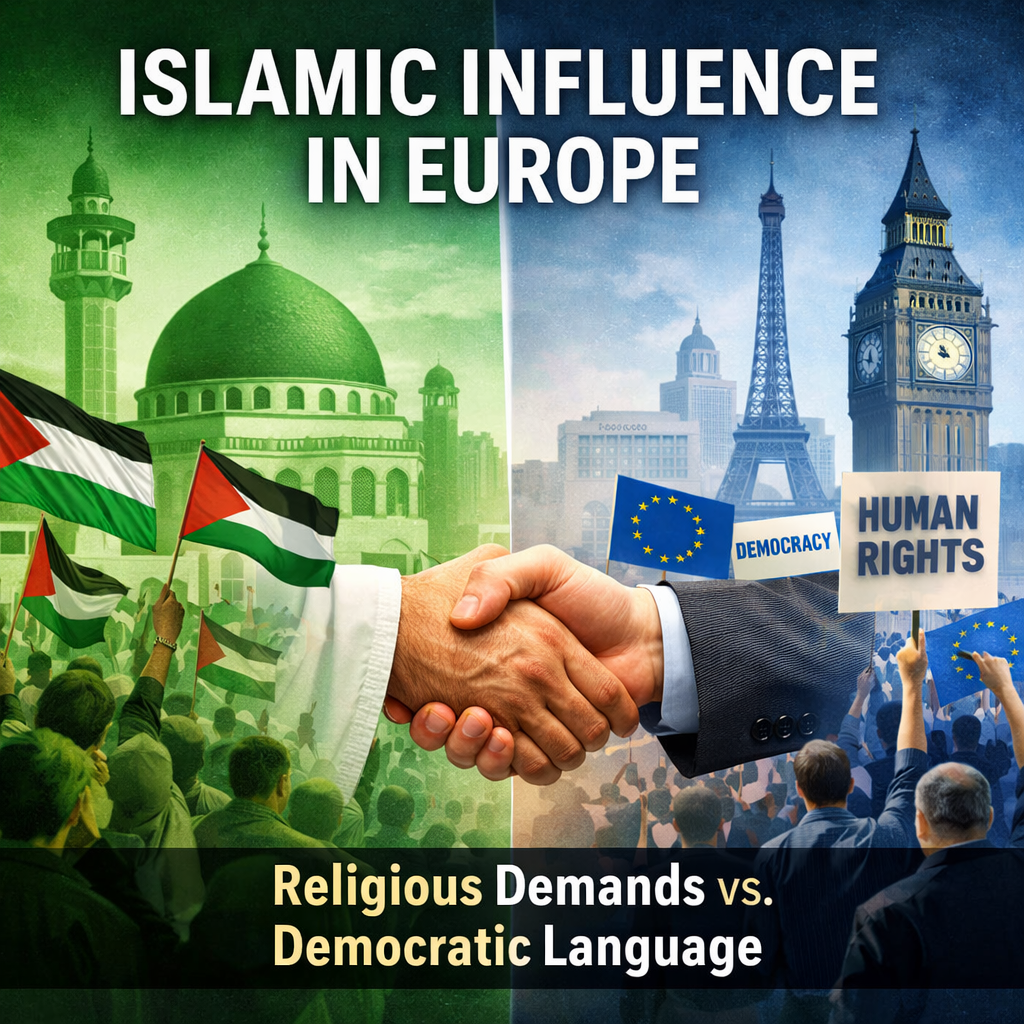
Islamic Influence in Europe: Religious Demands vs Democratic Language
Part 11/#12 : European Palestine Recognition – Muslim Brotherhood
भारत/GB
Vote on Palestine Statehood: Islamic Influence in Europe
The defining feature of Islamic Influence in Europe is not its scale — it is its bilingualism. Inside community mosques and OIC diplomatic channels, the vocabulary is religious obligation: ummah solidarity, the duty of every Muslim to support Palestine as a matter of faith. Outside — in parliamentary chambers, trade union halls, and protest banners — the same demands emerge in the language of secular democracy: human rights, international law, self-determination. Islamic Influence in Europe is the art of translating between these two vocabularies so seamlessly that Western institutions cannot tell which they are responding to. This article in our series on the September 2025 Palestine recognition cascade asks: what does this dual vocabulary mean for the democracies navigating it, and what does the cascade reveal about how far the translation has already succeeded?
The Two Vocabularies in Practice
The dual-vocabulary structure of Islamic Influence in Europe is not a deception in the ordinary sense. It is a rational adaptation to operating in two simultaneous institutional environments — the Islamic community framework and the Western democratic framework — that have fundamentally different legitimating languages. What the OIC calls “mobilising diaspora communities in solidarity with Palestine” and what a Bradford MP calls “representing my constituents’ concerns about international humanitarian law” are the same political act described in two different grammars.
In practice, this translation is performed by community organisations, advocacy groups, religious leaders, and political intermediaries who frame the same issue differently for internal religious audiences and external democratic institutions.
🕌 Internal Vocabulary (community / OIC)
“Palestine is an Islamic cause — every Muslim has an obligation to the ummah”
“Our doctrinal duty is to resist the occupation of Muslim lands”
“The division between Dar al-Islam and Dar al-Harb makes this a civilisational struggle”
“Every Muslim voter must hold their MP accountable on Palestine”
🏛️ External Vocabulary (parliament / media)
“We are calling on our government to uphold international law”
“This is about universal human rights and the protection of civilians”
“We support the two-state solution and a negotiated peace process”
“Our community expects elected representatives to reflect our values”
The translation between these columns is not merely rhetorical — it is structural. The French intelligence report of May 2025 documented that 207+ Muslim Brotherhood-linked entities operated with “dual registers” — one facing the state, one facing the community — identifying this bilingualism as a specific threat to “national cohesion,” because democratic institutions respond to demands in democratic language regardless of whether the underlying motivation is secular or theological.
The OIC’s Explicit Activation Strategy
What makes the September 2025 cascade analytically distinctive is that the OIC did not leave the activation of European diaspora communities to informal community networks. OIC Resolution 57/49-POL (2023) explicitly called on member states to “mobilise diaspora communities” in Western countries for Palestine advocacy — framing this mobilisation as a state-level foreign policy obligation, not merely a community preference. By September 2025, with Israel having struck Hamas leadership in Doha and Gulf states requiring a unified response, this resolution provided the institutional licence for direct OIC coordination of European community pressure.
The result was visible in the simultaneous nature of the pressure across France, the UK, and Italy. Each country’s Islamic community networks activated in the same two-week window, deploying the external democratic vocabulary — “humanitarian crisis,” “international law,” “principled foreign policy” — while the internal motivation and coordination was explicitly religious and geopolitical. Islamic Influence in Europe at this operational level is not grassroots activism. It is coordinated foreign policy by proxy, using resident populations as diplomatic instruments.
This is not a new phenomenon. What is new in 2025 is the scale of institutional penetration and the visible failure of democratic systems to uphold their own principles, making such mobilisation far more effective. Decades of mosque-building, school establishment, civil society funding, and political candidate cultivation — documented in the Qatar Papers and post-Qatargate investigations — created constituencies European politicians cannot ignore regardless of whether they understand the theological framework animating them.
When this mobilisation enters democratic institutions, it encounters a structural feature of liberal systems: they are designed to respond to the language of rights and representation, not to the motivations behind that language
🌍 The Walls of Truth Series
While Europe’s governments responded to Islamic pressure with Palestine recognition, the Muslim-majority world built actual walls against Palestinian refugees. This series documents what 57 Muslim nations know about Palestinian political culture — and why none of them will open their borders.
Explore now:
Section 3: Where Democratic Language Fails
The structural vulnerability that Islamic Influence in Europe exploits is a feature, not a bug, of liberal democracy. Democratic systems are designed to respond to demands expressed in the legitimating vocabulary of rights, representation, and accountability.
They have no institutional mechanism for distinguishing between a demand that is genuinely motivated by democratic values and a demand that uses democratic language to advance goals that are, in their internal framing, religious obligations incompatible with democratic pluralism.
France’s laïcité principle — constitutionally secular since the 1905 law — built its entire integration model on religion-neutral public space. The September 2025 strikes that produced France’s Palestine recognition were organised partly through mosque networks the French state formally treats as private religious bodies — because laïcité prevents engaging with them as political actors. The constitutional framework designed to limit religious influence on politics created a legal blind spot that amplified it.
The UK’s experience is symmetrical. Britain’s multicultural framework treats community religious identity as a legitimate political identity deserving institutional accommodation — giving Islamic networks the formal standing to make political demands that laïcité theoretically refused. Both frameworks — assimilationist and multicultural — proved equally unable to prevent the September 2025 outcome. Each expressed the demand in the vocabulary its system was designed to hear, and each system heard it.
The effectiveness of this dynamic is amplified by electoral geography: concentrated voting blocs can convert community mobilisation into decisive political leverage.
The Electoral Arithmetic — Bradford to Seine-Saint-Denis
Islamic Influence in Europe in its electoral dimension does not require majority Muslim populations to produce decisive political outcomes — only concentrated populations in marginal constituencies where a 5–10% cohesive swing determines results. Bradford West (UK), with a Muslim population of approximately 38%, is the textbook case: George Galloway’s 2024 by-election victory on an explicitly Gaza-focused platform showed that single-issue Islamic mobilisation can defeat a major party in a previously safe seat. Indian polity also offers a parallel illustration. Even a ten to twenty percent Muslim population, voting en-mass, has historically shaped electoral outcomes in states such as Uttar Pradesh and Bihar, a pattern now increasingly visible in West Bengal and in the emerging political contest in Assam.
The mobilisation infrastructure described earlier becomes politically decisive only when it intersects with this kind of electoral geography.
Seine-Saint-Denis in metropolitan Paris, with Muslim populations exceeding 60% in some communes, produces elected officials who routinely cite Gaza and OIC positions in local government sessions — matters formally outside municipal jurisdiction — because their electoral survival depends on it. This constituency pressure travels upward through the French political system from commune to department to national government, arriving at the Élysée as “public pressure on Gaza policy” rather than what it structurally is: organised religious constituency management.
The same arithmetic operates in Germany’s Berlin-Neukölln, Belgium’s Molenbeek, and Birmingham’s Sparkbrook. No country-level Muslim minority needs to be a majority to reshape national foreign policy. It needs only to be a decisive margin in enough marginal seats, and to vote cohesively enough on a small number of priority issues. In such circumstances, even a small but cohesive population can become a political kingmaker, effectively exercising veto power over major policy directions, as illustrated by parliamentary support in the United Kingdom for recognising Palestinian statehood.
The Destabilization Doctrine Series
Islamic Influence in Europe is one instance of a broader global pattern: coordinated external pressure on democratic institutions using resident populations as instruments. The Destabilization Doctrine series documents how this model operates — and how India is being targeted by the same architecture.
Explore now:
What This Means for the Non-Compliant Democracies — and for India
Italy and Germany did not recognise Palestine in September 2025. Italy paid the immediate cost — a 24-hour general strike with explicit recognition demands. Germany has not yet faced equivalent activation, but the infrastructure is present: an estimated 5.5 million Muslims, significant Muslim Brotherhood organisational presence including Germany’s Islamic Council (IGD, widely identified as the Brotherhood’s European headquarters), and a political system acutely sensitive to community-bloc pressure.
The India dimension is equally direct. Islamic Influence in Europe and the pressure architecture targeting India are not parallel phenomena — they are the same architecture deployed against different targets. The OIC’s engagement with Indian domestic affairs — its statements on Kashmir, the Citizenship Amendment Act, the Waqf Amendment Act, and the treatment of Indian Muslims — uses precisely the same dual vocabulary: internal Islamic obligation framing for Muslim-majority audiences, human rights and minority rights language for Western audiences and international institutions.
What Europe’s September 2025 capitulation demonstrates for India is a warning about the institutional endpoint of this architecture when it has had decades to embed: a point where governments with full intelligence awareness of the coercive mechanism nonetheless comply, and announce compliance as principled policy. India’s resistance on the Waqf Amendment Act, on Sharia court proposals, and on OIC interference reflects an institutional understanding that Europe has not fully developed: that the vocabulary of a demand is not the same as its motivation, and that responding to vocabulary without understanding motivation produces outcomes the responding institution did not intend and cannot reverse.
India has successfully amputated the limbs of the ‘Great Deception’ by choking FCRA funds and silencing rogue media mouthpieces like the BBC. But the Chhangur Baba case of 2025 serves as a chilling reminder that the heart of the beast is subterranean. With over ₹500 crore funneled through the Nepal border to bypass formal eyes and pan India presence, the ‘Internal Vocabulary’ of the Deobandi and madrasa networks continues to build a state-within-a-state. India’s institutional resistance to Waqf and Sharia is the correct ‘Macro’ response, but without a ‘Micro’ surgical strike on the underground financial and demographic nodes, the European fate—capitulation disguised as principle—remains a clear and present danger.
Will it be a rule that every protest against the immigrant population by white locals is cracked down, while every protest in favor of Palestine is respected—even if it results in attacks on state property and state forces, as was displayed in the UK in the last few months?
The Series Thesis, Restated
This series began with a question: why did eight governments recognise Palestine in 48 hours in September 2025, with no advance diplomatic signals, no parliamentary debates — the statistical likelihood of independent coordination would be extremely low? Eleven articles later, the answer is complete.
Islamic Influence in Europe produced this cascade through a four-decade investment in community infrastructure, funded by Gulf states and coordinated through Muslim Brotherhood-affiliated networks, that built electoral constituencies European politicians cannot defy at acceptable cost. The Israel strike on Hamas in Doha on September 9 activated this infrastructure. The pressure that followed — infrastructure paralysis in France, demographic threat in the UK, port blockades in Italy — was a pattern resembling coordinated foreign policy by proxy, expressed in the democratic vocabulary each European institution was designed to hear.
Governments that recognised Palestine were likely aware of the political pressures involved. Their intelligence services had documented it. They calculated that compliance costs less than resistance — and announced that calculation as “diplomatic leadership.” The Islamic Influence in Europe system had worked exactly as designed: not by deceiving European governments, but by making the cost of honest response higher than the cost of compliant performance.
Recognising this gap between democratic language and religious demand is the prerequisite for any honest analysis of how democratic foreign policy is made in twenty-first century Europe — and for any assessment of what needs to change if those democracies are to remain genuinely self-governing.
The Great Deception Series
The overarching civilisational warfare framework that places Islamic Influence in Europe in its global context — from the UN General Assembly to European parliaments to Indian streets.
Explore now:
Feature Image: Click here to view the image.
Videos
Glossary of Terms
- Islamic Influence in Europe: A term used in the article to describe how Islamic community networks, institutions, and political mobilisation interact with democratic systems in Europe through both religious and secular political language.
- OIC (Organisation of Islamic Cooperation): An international organisation of 57 Muslim-majority countries that coordinates political positions on issues affecting the Muslim world, including Palestine.
- Ummah: An Arabic term referring to the global community of Muslims united by shared religious identity.
- Palestine Recognition Cascade (September 2025): The rapid sequence in which several governments recognised Palestine within a short time window, raising questions about coordinated political pressure and diplomatic alignment.
- Diaspora Mobilisation: The organised political activation of immigrant or expatriate communities within host countries to influence policy decisions related to their regions of origin.
- Dual Vocabulary Framework: The article’s concept describing how the same political demand can be expressed internally using religious language and externally using democratic or human-rights language.
- Muslim Brotherhood: A transnational Islamist political movement founded in Egypt in 1928, with networks and affiliated organisations operating across many countries.
- Qatar Papers: Investigative materials that documented alleged funding networks connected to Islamic institutions and organisations in Europe.
- Qatargate: A corruption scandal involving alleged influence operations linked to Qatar and European political institutions.
- Laïcité: France’s constitutional principle of strict secularism that separates religion from public institutions and governance.
- Multicultural Framework (UK): A political model recognising and accommodating cultural and religious identities within the national political structure.
- Electoral Geography: The distribution of voter populations across constituencies that determines how demographic clusters influence election outcomes.
- Marginal Constituencies: Electoral districts where small shifts in voting blocs can determine the winning candidate.
- Seine-Saint-Denis: A department in metropolitan Paris known for high immigrant and Muslim population concentrations and their political influence in local elections.
- Bradford West: A parliamentary constituency in the United Kingdom noted in the article as an example of electoral outcomes shaped by concentrated community voting patterns.
- Dar al-Islam: In classical Islamic jurisprudence, territories governed under Islamic law.
- Dar al-Harb: A classical Islamic legal concept referring to territories not governed by Islamic law.
- Laïcité Blind Spot: The analytical idea that strict secularism may limit a state’s ability to treat religious organisations as political actors.
- Democratic Vocabulary: Political language centred on rights, representation, humanitarian law, and democratic legitimacy.
- Religious Obligation Framing: The internal framing of political causes within religious duty, doctrine, or community solidarity.
#OIC #IslamicInfluence #ForeignPolicy #GlobalPolitics #Palestine #Europe #Geopolitics #Media #Israel #Diplomacy #Protests #MiddleEast #Politics #Recognition #EU #Intelligence #Narrative #Pressure #Qatar #Qatargate #Influence #HinduinfoPedia #PalestineRecognition #MuslimBrotherhood #PoliticalIslam #EuropeCrisis #EuropeanPalestineRecognition
Recommended Reading Across the HinduInfopedia Network
- Two-State Delusion Exposed: Netanyahu’s 99-9 Vote
Israel’s domestic response to the recognition cascade — and what the 99-9 Knesset vote signals about the post-Oslo framework - The Genocide Inversion: How Hamas Weaponized Civilian Casualties
The information architecture that made European public opinion receptive to the Islamic Influence in Europe pressure campaign
- Domestic Blowback: US Destabilization Campaign Replays at Home
What happens when the pressure architecture exported to target democracies turns inward — the American dimension of the same pattern
- Bangladesh Hindu Killings: Politics of Massacre
The same dual-vocabulary model operating in South Asia — Islamic obligation internally, minority rights language externally — with lethal consequences for Hindus - Crisis Documented: Mathematical Evidence of Systematic Hindu Elimination
Demographic pattern analysis showing the long-term civilisational consequences of Islamic influence operating through democratic institutions
- Nazia’s Classification Crisis: Why Hindus Are Kafir
The internal theological vocabulary — kafir, kuffar, mushrikeen — that the external democratic language systematically translates and conceals - Safety, Sharia and Stark Realities
The Indian domestic dimension: how Sharia-derived social norms are advanced through the same democratic rights vocabulary documented in European context
- Waqf Amendment Act 2025: The Battle Over Accountability
India’s institutional resistance to Islamic civil society opacity — the domestic policy parallel to the European vulnerability documented in this series
Series: Palestine Recognition 2025 — Europe’s Coordinated Surrender Explained
- https://hinduinfopedia.com/palestine-recognition-2025-europes-48-hour-surrender-explained/
- https://hinduinfopedia.com/muslim-brotherhood-france-intelligence-report-media-ignored/
- https://hinduinfopedia.com/muslim-brotherhood-in-france-international-backers-and-leverages/
- https://hinduinfopedia.com/france-government-collapse-how-instability-enabled-foreign-pressure/ https://hinduinfopedia.org/?p=18697
- https://hinduinfopedia.com/france-strikes-september-2025/ https://hinduinfopedia.org/?p=18810
- https://hinduinfopedia.com/uks-palestine-support-template/ https://hinduinfopedia.in/?p=24770
- https://hinduinfopedia.com/palestine-proponents-punish-italy-september-22-strike/ https://hinduinfopedia.in/?p=25012
- https://hinduinfopedia.com/palestine-recognition-captures-france-the-unsc-veto-as-strategic-prize/ https://hinduinfopedia.in/?p=25379
- https://hinduinfopedia.com/palestine-pressure-strikes-three-fronts-france-uk-italy-september-2025/ https://hinduinfopedia.in/?p=25388
- https://hinduinfopedia.com/qatar-europe-influence-from-parliament-bribery-to-invisible-leverage/ https://hinduinfopedia.in/?p=25464
- https://hinduinfopedia.com/palestine-recognition-voting-patterns-hiss-versus-the-media-loudspeaker/ https://hinduinfopedia.in/?p=25514
Follow us:
- English YouTube: https://www.youtube.com/@Hinduofficialstation
- Hindi YouTube: https://www.youtube.com/@HinduinfopediaIn
- X: https://x.com/HinduInfopedia
- Instagram: https://www.instagram.com/hinduinfopedia/
- Facebook: https://www.facebook.com/Hinduinfopediaofficial
- Threads: https://www.threads.com/@hinduinfopedia
[…] भारत/GB […]