

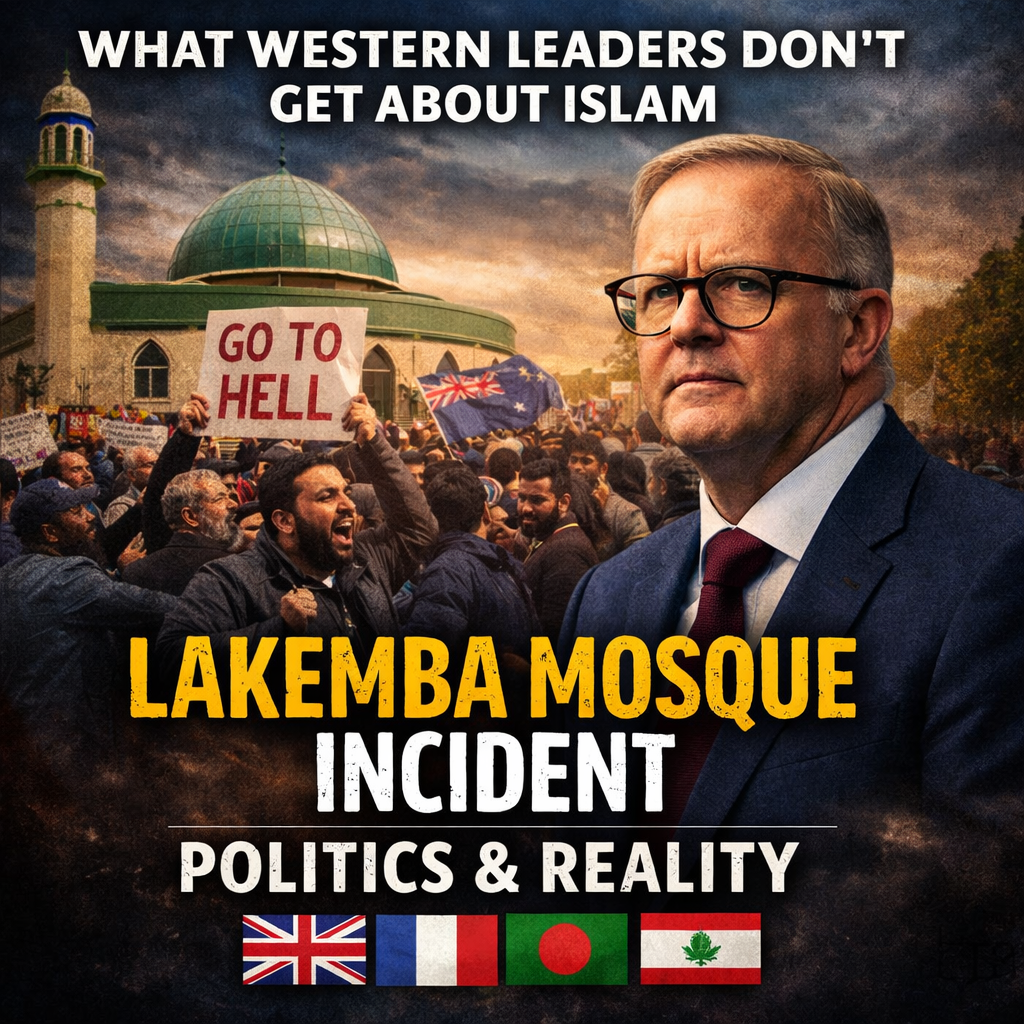
Western Leaders Islam: The Lakemba Lesson Albanese Did Not Learn
भारत / 🌍
Breaking News: The Demographic Reality that cannot be challenged
Western Leaders Islam — Sydney, March 20, 2026
The visit to Lakemba Mosque in western Sydney on March 20, 2026 — when the Australian Prime Minister was welcomed on the auspicious occasion of Eid — lasted less than fifteen minutes before it broke down. This incident demolishes — or at the very least should demolish — the “Western Leaders Islam tolerance” image. The question now is: to what extent has this lesson been learned?
Prime Minister Anthony Albanese and Home Affairs Minister Tony Burke had arrived to join worshippers for Eid al-Fitr prayers. Within a quarter-hour, protesters were on their feet. “Get out!” they chanted. “Genocide supporters!” A security guard tackled one heckler to the ground. As Albanese and Burke left, the crowd followed, shouting “Shame on you!” The entire episode was captured on video and circulated globally within hours.
The Spin and the Gap
What Albanese said afterward is the real story. The mosque visit was “incredibly positive,” he told reporters. “If you got a couple of people heckling in a crowd of 30,000, that should be put in that perspective.” The crowd was not a crowd of hecklers. It was a congregation. The hecklers were the ones who stood up. The ones who did not stand were restrained by organisers heard on video urging people to “keep calm a little bit” because “it is Eid, it is a joyful day.” The restraint was logistical, not doctrinal. Understanding this distinction is the entry point for everything that follows.
“If you got a couple of people heckling in a crowd of 30,000, that should be put in that perspective.” — Anthony Albanese, March 20, 2026, after being booed out of Lakemba Mosque.
The Ummah Doctrine Is Not a Metaphor
Every major civilisational tradition has a governing principle for how it relates to the rest of humanity. Hinduism has Vasudhaiva Kutumbakam — the world is one family — a philosophical position that defines the outsider as kin. Judaism carries a comparable formulation in the Torah’s obligation to love the stranger, grounded in the repeated reminder that the Israelites were themselves strangers in Egypt. Christianity codified the same instinct in the Golden Rule — do unto others as you would have them do unto you — a universalist ethical standard that makes no categorical distinction between believer and non-believer as a matter of doctrine.
Islam has the Ummah doctrine — the global community of Muslim believers. Its logic runs in precisely the opposite direction. It begins with a categorical distinction between the believer and the non-believer — the Muslim and the kafir — and every obligation of solidarity, loyalty, and political alliance flows within that boundary, not across it.
This is not fringe interpretation or radical theology. It is standard Islamic jurisprudence, present in the Quran, codified in classical fiqh, and operative in the political behaviour of Muslim communities wherever population reaches sufficient scale. As the French demographic case demonstrates, its political expression is consistent across geographies.
The Structural Consequence
A non-Muslim leader who visits a mosque or hosts an Iftar is not thereby admitted into the Ummah circle. He remains outside it by definition. His gestures are evaluated as policy — judged by whether they serve the Ummah’s interests.
Albanese’s government had backed Israel’s right to self-defence to a large extent, on the Gaza war issue. The crowd at Lakemba applied the Ummah standard to that position and delivered their verdict. The chant “Allahu Akbar” that rang through the mosque during the heckling was not incidental — it was doctrinal punctuation. Western leaders Islam confrontations always reach this moment, and the Western leader always looks surprised.
The Appeasement Ritual — From Windsor to Lakemba

King Charles at Windsor, March 2025
Twelve months before Albanese walked into Lakemba, King Charles III made history. In March 2025, the British monarch hosted the first Iftar dinner in Windsor Castle’s thousand-year history. Over 360 Muslim guests gathered in St George’s Hall — a room normally reserved for heads of state and royal banquets. The Adhan echoed through the Castle’s stone corridors — the first time in the building’s recorded history. King Charles, Defender of the Faith of the Church of England, was praised by Muslim scholars for the gesture. A 2018 biography noted he studies the Quran and believes Christianity can learn from Islam.
The Adhan is not simply a melodic call to prayer. It is a formal declaration of Islamic belief: that there is no god but Allah and that Muhammad is His messenger, followed by an invitation to prayer and success. When it echoed through Windsor Castle, it was not a neutral cultural sound but a clear articulation of faith within one of the central symbolic spaces of the British state.
Why the Gesture Cannot Work
There is no consistent, civilisational pattern of Muslim-majority state leaders hosting Christmas dinners, Diwali celebrations, or Passover seders as reciprocal interfaith gestures. Recent exceptions — most notably in the United Arab Emirates, where Diwali has been publicly marked and the BAPS Hindu Mandir Abu Dhabi permitted — are state-directed, top-down initiatives tied to economic strategy and international positioning, not doctrinal reciprocity embedded within the Ummah framework.
The reciprocal gesture, as a norm, does not exist because the Ummah framework does not require it. The King of England hosting an Iftar is read, within that framework, as recognition of Islam’s growing weight — tribute, not fellowship. Albanese’s Lakemba visit follows the same template: a political calculation driven by vote-bank politics Islam produces in concentrated constituencies, in the shadow of the Gaza conflict. The crowd’s response was not ingratitude. It was the application of a doctrinal standard that Western leaders Islam encounters never anticipate.
Western Leaders Islam and the Demographic Trajectory

The Western leaders Islam pattern does not stay at the level of embarrassing photo opportunities. It follows a demographic trajectory with documented stages. At low concentrations — under five percent — Muslim communities focus on infrastructure: mosques, schools, halal certification. Between five and fifteen percent, the community becomes a voting bloc and Iftar invitations begin. Beyond fifteen to thirty percent, the community asserts non-negotiable demands on foreign policy, blasphemy norms, and state accommodation — as the French case documents in detail. The appeasement ritual does not arrest this trajectory. It accelerates it.
The Bangladesh Record
The most instructive living example is Bangladesh. The Hindu population of what is now Bangladesh stood at roughly 28 percent at Partition in 1947. By 1971 it had fallen to approximately 18 percent through displacement, massacre, and forced conversion. By 2024, the documented figure is below eight percent. Each phase of decline correlates with a phase of political assertion — Partition itself, the 1971 genocide, the 1990 and 2001 communal riots, and the post-Hasina collapse of 2024 in which temples were burned. The Western leaders Islam problem is not merely embarrassing visits. It is the early-stage expression of a doctrine that, given sufficient demographic weight, does not remain ceremonial.
The Lebanon Example — Live Test
A closer structural parallel is Lebanon. Once known as the “Paris of the East,” Lebanon descended into a fifteen-year civil war (1975–1990) driven by shifting sectarian demographics and competing political claims. The post-war system did not resolve the underlying imbalance; it formalised it. Today, the Lebanese state coexists with a parallel sovereignty structure in Hezbollah — an armed organisation with independent military and foreign policy capacity. This “state within a state” dynamic has repeatedly drawn Lebanon into conflict, including direct confrontation with Israel. Lebanon demonstrates the endpoint of demographic politics when it evolves beyond electoral bargaining into parallel sovereignty.
Where Australia Sits
Australia’s Muslim population is currently estimated at around three to four percent nationally. Western Sydney constituencies including Lakemba, Bankstown, and Auburn carry concentrations significantly above that average. The political arithmetic Albanese was working from on March 20, 2026, is the arithmetic of a country in the early stages of this trajectory. He came to the mosque because the votes matter. He left because the Ummah doctrine — not the votes — governs what happens inside it.
The Albanese Calculation — And What It Costs
There is a layer to the Lakemba story that received less attention than the heckling. Albanese’s government, just weeks before the mosque visit, designated Hizb ut-Tahrir as a prohibited hate organisation — under legislation advanced after the Bondi Beach mass shooting on December 14, 2025, in which fourteen members of Sydney’s Jewish community were killed. Hizb ut-Tahrir is an international Islamist organisation that advocates for the re-establishment of the Caliphate and has been linked to the Lakemba Mosque congregation. Albanese banned the organisation and then, within weeks, walked into a mosque with reported connections to it.
A Doctrine Without an Answer
This is not hypocrisy in the ordinary political sense. It is the logical outcome of a framework with no coherent position on the Ummah doctrine. The government wanted to signal firmness to the Jewish community while simultaneously courting Muslim voters. The two signals are incompatible when the mosque being visited is connected to the organisation just banned. The crowd understood the contradiction. They chose to ignore the Australian Prime Minister’s support for the UN vote on Palestinian recognition and reacted only to what ran against them. Their response was the application of a clear doctrinal standard to a leader who had no coherent framework to answer it. As the New York Declaration analysis documents, Western leaders Islam encounters are, at their core, encounters between a doctrine and its absence.
The crowd at Lakemba did not heckle Albanese because he failed to support Palestine sufficiently. They heckled him because, within the Ummah framework, a non-Muslim leader’s support is always conditional, always suspect, and never enough — by definition.
The Pattern Across the West
The same dynamic explains every variant. France bans the veil; then hosts Iftar dinners to repair the relationship; the community accepts the dinners and continues to push. It then co-sponsors the New York Declaration in September 2025, seeking a two-state solution to the Israel–Palestine conflict. The British government criminalises Islamist organisations; the King hosts the Adhan at Windsor Castle; demands in Parliament intensify. The Western appeasement ritual does not reduce pressure. Within the Ummah framework, it signals weakness — and weakness invites escalation.
The Asymmetry Test
Consider the reverse scenario. If a Muslim leader were invited to a church and was shouted down as an “anti-Semitic supporter,” the international response would be immediate and unambiguous. Headlines would frame it as religious intolerance. Political leaders would issue swift condemnations. Church authorities would be expected to respond. The incident would not be reduced to “a few hecklers.” It would be elevated into a question of values, respect, and the sanctity of religious space.
Lakemba produced no comparable moment of internal clarity. There were chants, there was disruption, and there were calls for order — but no widely visible, unequivocal condemnation of the behaviour itself. That absence matters.
The contrast is not rhetorical; it is structural. In one direction, condemnation is expected and enforced. In the other, it is neither immediate nor assured. The Lakemba episode is therefore not only about what happened inside the mosque, but also about what did not follow after — and what that silence signifies.
Global Echoes of the Lakemba Lesson
The Lakemba confrontation is no isolated glitch; it is the latest pulse in a synchronised global rejection of Western “outreach” as the 2026 Iran War redraws loyalties.
In the United States, the Ramadan backlash has turned volatile. In Texas and Pennsylvania, mosque leaders have cancelled communal Iftars and boycotted politicians following federal crackdowns and the February 24 ambush of a prominent Imam in Utah. What was once “interfaith dialogue” has been replaced by a “state of war” stance against any leader supporting the Trump administration’s strikes on Tehran.
In London, thousands defied a historic government ban on the Al-Quds Day march on March 15, 2026. Despite the Home Secretary’s attempt to suppress “pro-regime” signalling, the streets echoed with chants for the “martyred” Ayatollah Khamenei. Meanwhile, in India, a Sambhal police officer sparked a national row on March 13 by warning worshippers that Friday prayers cannot be used for pro-Iran political mobilisation.
From Sydney to Texas, the message is identical: Western leaders may offer symbolic recognition, but the Ummah doctrine demands a total alignment that no secular state can provide.
The Lessons Taught, But Never Learned
The Ceiling of the Ritual
Albanese will not be the last Western leader to walk into a mosque, receive a hostile reception, and describe it as “incredibly positive.” The ritual will continue because the political incentive — courting concentrated voting blocs — is a more immediate pressure than civilisational reality. What Lakemba demonstrated is that the appeasement ritual has a hard ceiling. You can attend the prayers, but you cannot enter the Ummah. You can host the Iftar, but you cannot purchase a loyalty that is, by doctrinal definition, reserved for the believer.
In the words of Himanta Biswa Sarma, Chief Minister of Assam: A Muslim may offer a kidney out of personal gratitude, but they will not offer you their vote. Loyalty is a doctrinal obligation, not a transactional one — and the Ummah principle stands out under all circumstances.
The Civilisational Error
The error is not tactical; it is an act of profound, recurring ignorance. A leader who governs a society built on the Golden Rule, on Vasudhaiva Kutumbakam, or on Enlightenment universalism, is applying his own tradition’s logic to a tradition whose foundational premise is structurally exclusive.
Albanese left the mosque claiming a “positive” experience because to admit otherwise would be to admit his entire domestic strategy is built on a fallacy. The crowd at Lakemba was not confused about who Albanese was. Albanese was confused about what the crowd was and what it did. That asymmetry is the lesson Lakemba taught — and it is the lesson the Western political class seems determined to never learn.
Feature Image: Click here to view the image.
Videos
Glossary of Terms
- Ummah: The global community of Muslim believers — invoked as Islamic solidarity but examined in this series as a political claim contradicted by state behaviour.
- Hezbollah: The Lebanese Shia political and paramilitary organisation founded in 1982 with Iranian Revolutionary Guard Corps support following Israel’s invasion of Lebanon. Funded, trained, and armed by Iran. Designated a terrorist organisation by the US, EU, UK, and other states. Operates both as a political party with seats in the Lebanese parliament and as a military force. Has fought both Israel and Sunni factions in Syria on Iran’s behalf.
- Anthony Albanese (born 1963): Australian Labor Party politician and Prime Minister of Australia from May 2022. Attended Lakemba Mosque in western Sydney on March 20, 2026 for Eid al-Fitr prayers and was heckled, booed, and ordered to leave by a section of the congregation over his government’s position on the Gaza conflict and the Iran war. Subsequently described the visit as “incredibly positive.”
- Tony Burke (born 1969): Australian Labor politician serving as Home Affairs Minister under Prime Minister Albanese. Accompanied Albanese to the Lakemba Mosque visit on March 20, 2026. His portfolio responsibility covers immigration, border security, and domestic security — including the designation of Hizb ut-Tahrir as a prohibited organisation weeks before the mosque visit.
- King Charles III (born 1948): King of the United Kingdom and Head of the Commonwealth. Constitutional title: Defender of the Faith. Hosted the first Iftar dinner in Windsor Castle’s recorded history in March 2025 — over 360 Muslim guests in St George’s Hall, with the Adhan sounded publicly inside the castle for the first time. Studied the Quran and has publicly expressed admiration for Islam. Cited in this blog as the clearest example of the appeasement ritual operating at the symbolic level of state.
- Himanta Biswa Sarma (born 1968): Chief Minister of Assam, India, since 2021. Member of the Bharatiya Janata Party. Known for direct public commentary on Muslim political behaviour and demographic change in Assam. Quoted in this blog for the observation that a Muslim may offer a kidney out of personal gratitude but will not offer their vote — framing Muslim political loyalty as doctrinally structured rather than transactionally available.
- Hizb ut-Tahrir: A transnational Islamist political organisation founded in Jerusalem in 1953. Advocates for the re-establishment of a global Islamic Caliphate and rejects democratic governance as a Western imposition incompatible with Islamic law. Banned in multiple countries including Russia, Germany, Pakistan, and — as of early 2026 — Australia. The Australian ban was advanced under legislation following the Bondi Beach mass shooting of December 2025. The organisation has been linked to the Lakemba Mosque congregation.
- BAPS Hindu Mandir Abu Dhabi: The first traditional Hindu stone temple in the Arabian Peninsula, inaugurated in February 2024 in Abu Dhabi, UAE. Built by the Bochasanwasi Akshar Purushottam Sanstha (BAPS) organisation. Cited in this blog as a state-directed exception to the pattern of non-reciprocity in Muslim-majority states — a top-down initiative tied to the UAE’s economic and international positioning rather than doctrinal reciprocity within the Ummah framework.
- Vasudhaiva Kutumbakam: Sanskrit phrase from the Maha Upanishad meaning “the world is one family.” A foundational principle of Hindu philosophical universalism — the idea that all of humanity, regardless of religion, ethnicity, or nationality, constitutes a single extended family. Contrasted in this blog with the Ummah framework’s categorical distinction between believer and non-believer as the organising principle of political loyalty.
- Kafir: Arabic term meaning one who disbelieves or rejects — in Islamic theology, a non-Muslim. In classical Islamic jurisprudence, the distinction between Muslim and kafir structures obligations of solidarity, inheritance, marriage, and political loyalty. Cited in this blog as the foundational categorical distinction that makes the Ummah doctrine structurally exclusive — solidarity flows within the community of believers, not across the Muslim-kafir boundary.
- Fiqh: Islamic jurisprudence — the science of deriving legal rulings from the Quran, the Hadith (sayings and actions of the Prophet), scholarly consensus, and analogical reasoning. The four major Sunni schools of fiqh (Hanafi, Maliki, Shafi’i, Hanbali) and the major Shia school (Ja’fari) all address questions of political loyalty, relations with non-Muslims, and the obligations of the Ummah. Cited in this blog as the codified legal framework through which the Ummah doctrine operates in practice.
- Caliphate: The Islamic political-religious institution of governance under a Caliph — the successor to the Prophet Muhammad as leader of the global Muslim community. The Ottoman Caliphate was abolished by Mustafa Kemal Atatürk in 1924. Its re-establishment is the stated political objective of Hizb ut-Tahrir and was the territorial claim of ISIS (2014–2019). The Caliphate represents the Ummah’s political expression at its maximum institutional form — a single unified governance structure for all Muslims.
- Appeasement Ritual: The recurring pattern documented in this blog in which Western political leaders — driven by electoral calculations in constituencies with significant Muslim populations — make symbolic gestures of accommodation toward Muslim communities (mosque visits, Iftar invitations, recognition of Islamic festivals) without corresponding adjustments in policy on the issues the Ummah framework prioritises. The ritual does not reduce political pressure; within the Ummah framework it signals weakness and invites escalation.
- Vote-Bank Politics: The electoral strategy of targeting concentrated demographic groups — religious, ethnic, or linguistic — as a bloc to be courted through symbolic gestures, policy concessions, or direct patronage, rather than engaging them through universal policy platforms. Applied in this blog to Albanese’s mosque visit as the product of electoral arithmetic in western Sydney constituencies where Muslim voter concentration is politically significant.
- Parallel Sovereignty: A political condition in which a non-state actor — typically an armed organisation — exercises effective governmental functions (military force, taxation, welfare provision, foreign policy) within the territory of a recognised state, operating alongside but not subordinate to the state’s official institutions. Lebanon’s Hezbollah is the primary contemporary example. Cited as the endpoint of the demographic trajectory when electoral bargaining evolves into independent power structures.
- Demographic Trajectory: The staged model described in this blog for how Muslim political assertiveness scales with population concentration — infrastructure building (under 5%), voting bloc formation (5–15%), non-negotiable foreign policy and blasphemy demands (15–30%), and parallel sovereignty structures (above 30%). The model is grounded in documented cases: France, Lebanon, Bangladesh, and the trajectory visible in western Sydney.
- Lakemba Mosque Incident (20 March 2026): The event in which Australian Prime Minister Anthony Albanese and Home Affairs Minister Tony Burke visited Lakemba Mosque in western Sydney for Eid al-Fitr prayers and were heckled, booed, and ordered to leave by a section of the congregation over Australia’s position on the Gaza conflict and the Iran war. Albanese subsequently described the visit as “incredibly positive.” Widely circulated on video globally. The incident is the starting point of this blog’s analysis of what Western leaders structurally misunderstand about the Ummah doctrine.
- Windsor Castle Iftar (March 2025): The first Iftar dinner hosted in Windsor Castle’s recorded history, organised by King Charles III in March 2025. Over 360 Muslim guests attended in St George’s Hall. The Adhan was sounded inside the castle — the first time in the building’s history. Cited as the highest-profile example of the appeasement ritual operating at the symbolic level of the British state.
- Bondi Beach Mass Shooting (14 December 2025): An attack on Sydney’s Jewish community at Bondi Beach on December 14, 2025, in which fourteen members of the community were killed. The attack prompted the Australian government to advance legislation under which Hizb ut-Tahrir was subsequently designated a prohibited hate organisation — weeks before the Lakemba Mosque visit by the Prime Minister.
- Al-Quds Day March London (15 March 2026): The annual pro-Palestinian march in London, held on the last Friday of Ramadan. The March 2026 edition was subject to a government ban — the Home Secretary attempted to suppress what was characterised as “pro-regime” signalling in the context of the Iran war. Thousands defied the ban. Chants referenced “martyred” Ayatollah Khamenei.
- Lebanon Civil War (1975–1990): The fifteen-year armed conflict in Lebanon driven by intersecting Palestinian, Maronite Christian, Shia, Sunni, Druze, and Syrian and Israeli interventions. Rooted in demographic imbalance between religious communities whose political representation had been locked by the 1943 National Pact based on 1932 census data. Cited in this blog as the structural precedent for how demographic politics evolves beyond electoral bargaining into parallel sovereignty when not addressed at foundation.
- Adhan: The Islamic call to prayer, sounded five times daily from mosques. A formal declaration of Islamic faith — “Allahu Akbar” (God is greatest), the Shahada (there is no god but Allah and Muhammad is His messenger), and an invitation to prayer and success. Cited in this blog for its sounding inside Windsor Castle in March 2025 — characterised not as a neutral cultural gesture but as a formal articulation of Islamic faith within a central symbolic space of the British state.
#WesternLeadersIslam #LakembaMosqueIncident #UmmahDoctrine #AppeasementRitual #DemographicTrajectoryIslam #VoteBankPolitics #VasudhaivaKutumbakam #HizbutTahrir #WindsorCastleIftar #MuslimPoliticalHistory #GazaConflict #Hezbollah #IranWar2026 #Albanese #KingCharles #Islam #Australia #UmmahDelusion #HinduinfopediaGeopolitics #Demographics
Follow us:
- English YouTube: https://www.youtube.com/@Hinduofficialstation
- Hindi YouTube: https://www.youtube.com/@HinduinfopediaIn
- X: https://x.com/HinduInfopedia
- Instagram: https://www.instagram.com/hinduinfopedia/
- Facebook: https://www.facebook.com/Hinduinfopediaofficial
- Threads: https://www.threads.com/@hinduinfopedia
[…] भारत / 🌍 […]