

Govardhan Puja in a Broken Biosphere: Why Ancient Ecological Humanism Still Speaks to the World
Western scholarship has long tried to fit Hinduism into borrowed boxes: polytheism, pantheism, or a surviving “pagan” religion. Each label falls short because it assumes religion means a creed — a set of beliefs handed down from a single founder or a single book. As the ‘Not a Myth’ series on HinduinfoPedia documents, Sanatana Dharma works as a living, adaptive organism: a set of knowledge systems built on observation and continuity, which keeps renewing its forms while protecting what helps generations survive.
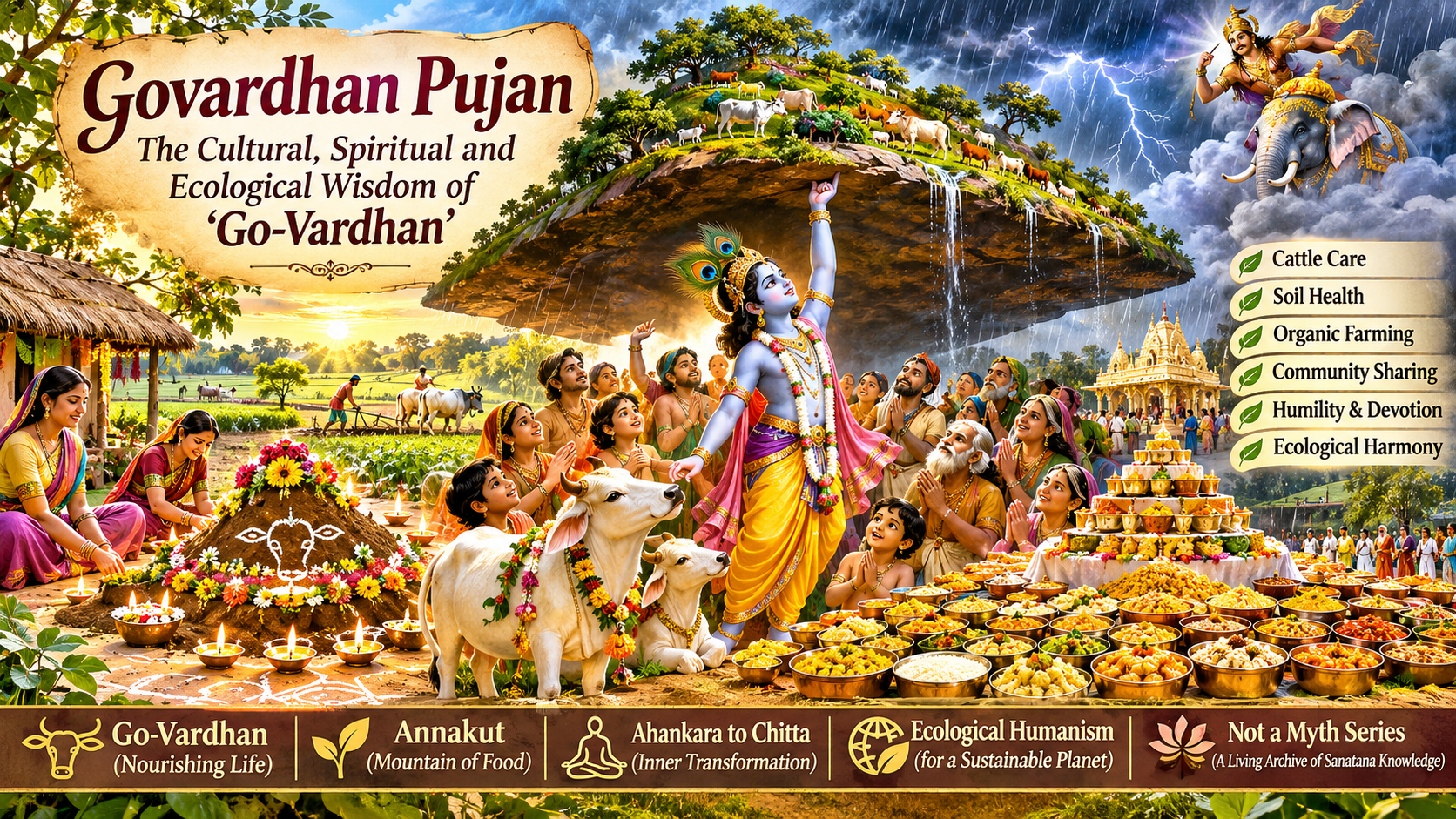
Few festivals show this better than Govardhan Puja, celebrated on Kartika Shukla Pratipada after Deepavali — in 2026, on 10 November in India and 9 November in the UK and USA. Its message reaches far beyond India, to a planet facing climate change, soil loss and collapsing biodiversity.
The Harvest Festivals of the World: Shared Gratitude
Almost every civilisation gives thanks after harvest. The Jewish festival of Sukkot has families living in temporary huts open to the sky, recalling their dependence on God and the land. North American Thanksgiving gathers families around the year’s bounty. Japan’s Shinto Niiname-sai offers the new rice to the kami. The Celtic Samhain marked the end of harvest and the turning toward winter. Christian harvest festivals fill churches with produce for the poor.
Govardhan shares this spirit of gratitude and sharing — its Annakut, a “mountain of food” of 56 or more dishes, is now displayed in Hindu temples from London and Leicester to New Jersey and Toronto. But it adds something distinctive.
What Makes Govardhan Different
- Nature as a form of the Divine: In the Bhagavata Purana (10.24.35), Krishna takes on a vast form and declares “śailo ’smi” — “I am the mountain.” The hill is not raw material or a stage for human history; it is worshipped as the Divine itself. Nature is not merely a resource; it is a relative to be revered.
- Animals within the moral circle: The festival honours the cow, the calf, the bull and the pasture. Krishna’s title earned here, Govinda, means protector of the cows. Society survives not despite other species but through partnership with them.
- Local over distant: By turning from the far-off rain-god Indra to the local hill, forest and herd, the story favours the bioregion — care for the land you actually live on, an idea modern ecological economics now champions.
Dominion, Stewardship and the Debate Over Ecology
In 1967 the historian Lynn White Jr. famously argued that a reading of the biblical command to “have dominion” over the earth, combined with Enlightenment thinking that treated nature as dead matter, helped create our ecological crisis. Many Christian and Jewish thinkers disagreed, pointing to a strong tradition of stewardship: humans as caretakers, not owners. Pope Francis’s 2015 encyclical Laudato Si’ calls the earth “our common home” and urges an “ecological conversion.” Indigenous traditions in the Americas, Africa and Australia also treat land as kin.
So the honest comparison is not “Hindu good, others bad.” It is this: where many traditions arrive at care for the earth through stewardship, Govardhan starts from the sacredness of the earth itself, and builds that into an annual community ritual practised by millions. That is its gift to the global conversation.
The ‘Not a Myth’ Verdict: A Blueprint Worth Sharing
Read through the ‘Not a Myth’ lens, Govardhan is not a tale invented to comfort herders. It encodes a durable model of living: trust the land you can see, care for the animals that sustain you, return organic matter to the soil, and share the harvest so no one goes hungry. With fertile soil degrading and wildlife declining worldwide, the principle of Vardhan — helping life increase rather than extracting it — is one of humanity’s most valuable survival models. It belongs not only to Hindus but to anyone who wants a liveable future.
Deepen the Perspective: Read the inner, spiritual reading of the Indra–Krishna episode on our spiritual portal:
The Spiritual Physics of Govardhan. From this series:
Nature in Hinduism: Sacred Elements, Not a Resource and
the complete Not a Myth archive.
Glossary of Terms
1. Broken Biosphere: A descriptive phrase used in this blog for the deteriorating ecological condition of the planet, marked by climate disruption, biodiversity decline, soil degradation and environmental instability.
2. Ecological Humanism: A philosophical approach that places human existence within the wider web of nature and recognises responsibility towards other living beings and the environment.
3. Anthropocene: A proposed geological epoch characterised by the extensive impact of human activities on Earth’s climate, ecosystems and natural processes.
4. Bioregion: A geographical area defined by its natural ecological characteristics, including climate, water systems, vegetation, wildlife and interconnected habitats.
5. Sukkot: A Jewish harvest festival commemorating the Israelites’ historical journey through the wilderness, traditionally celebrated by dwelling in temporary shelters.
6. Niiname-sai: A traditional Japanese Shinto harvest festival in which the newly harvested rice is offered to the kami, or sacred spiritual beings, in thanksgiving.
7. Samhain: An ancient Celtic seasonal festival marking the end of the harvest and the transition into winter.
8. Thanksgiving: A North American harvest-related celebration centred on gratitude, family gatherings and the sharing of food.
9. Dominion: The concept of human authority over the earth and its creatures, particularly associated with interpretations of the biblical creation narrative.
10. Stewardship: The principle that human beings have a responsibility to protect, manage and preserve the natural world rather than exploit it without restraint.
11. Laudato Si’: The 2015 papal encyclical issued by Pope Francis addressing environmental degradation, climate change, social responsibility and the protection of what it describes as our common home.
12. Ecological Conversion: A transformation in human attitudes and behaviour towards nature, encouraging environmental responsibility, restraint and care for the earth.
13. Lynn White Jr.: An American historian who published the influential 1967 essay The Historical Roots of Our Ecologic Crisis, examining the relationship between Western religious thought and environmental attitudes.
14. Vardhan: A central concept in this blog meaning nourishment, growth and flourishing. It represents an ecological principle of increasing and sustaining life rather than extracting resources without replenishment.
15. Not a Myth Series: A HinduinfoPedia research initiative documenting the historical, philosophical, scientific and ecological dimensions of Sanatana Dharma and its relevance to contemporary global challenges.
#Govardhan #Ecology #Environment #ClimateChange #Biodiversity #Sustainability #Nature #Hinduism #SanatanDharma #IndianCulture #Earth #Harvest #EcologicalWisdom #HinduinfoPedia