

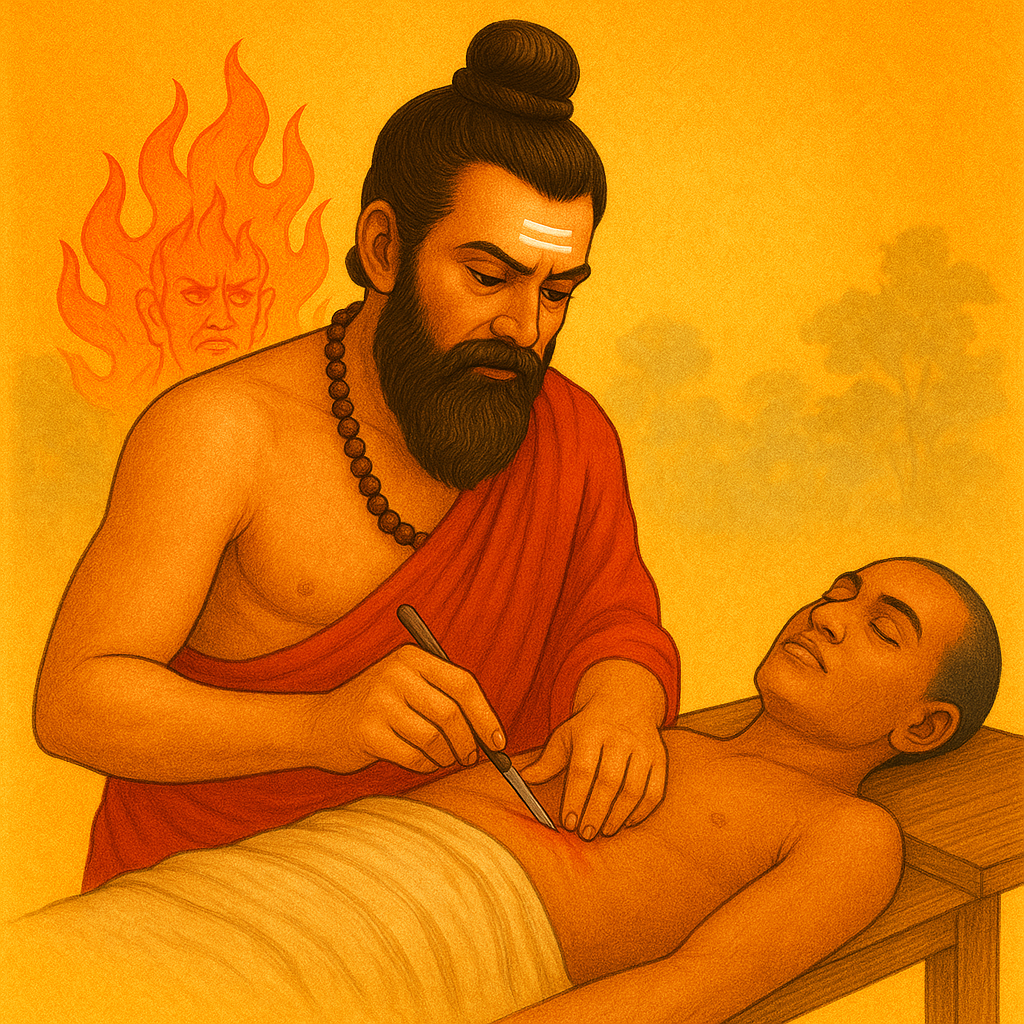
Hindu Wisdom in Surgery: Sushruta Blades are Real, Not Myth
Introduction
The Sushruta Samhita (~600 BCE) showcases the brilliance of ancient Indian medicine, with Sushruta, a sage-surgeon, performing over 300 procedures—cataracts, rhinoplasty, cesareans—millennia before Europe’s surgical advancements. This Hindu Wisdom in Surgery credits the Vedas, beginning with prayers to Agni, the Fire God, symbolizing clarity and transformation. Rooted in the science of yagna, it enabled saints to connect the inner and outer worlds, aligning human intent with cosmic order. Like millions of other Hindu sages, Sushruta harnessed this Vedic discipline, turning observation into precise surgical practice. Far from the West’s dismissive ‘mythology’ label, the Hindu Wisdom in Surgery is a scientific legacy we explore in this blog.
Background to Hindu Wisdom in Surgery and the Knowledge Source
As we expand this series, our aim remains clear: to reveal that Vedic knowledge, far from myth, is a sophisticated science of life Our series has unveiled the scientific depth of Hindu texts, from cosmic origins to herbal wisdom , spanning disciplines like astronomy and the psychological focus of yagnas. The Sushruta Samhita, rooted in Vedic traditions of observation and practice, extends this legacy into surgery. The Hindu Wisdom in Surgery, as embodied by Sushruta, reflects this Vedic ethos—invoking Agni, the Fire God, for clarity and transformation, as noted in the Sushruta Samhita’s opening prayers [Ref 1]. His dissections and tool sterilization echo the yagna’s emphasis on purity and intent, showing how Hindu Wisdom in Surgery aligns inner discipline with outer practice. Woven into daily practices like chanting Shanti Mantras, this tradition of empirical precision challenges colonial labels, affirming Hindu wisdom’s enduring truth. With this understanding we continue our investigation as to how the Vedic is a religion of science and there is no myth written in the Hindu texts. We are trying to establish that a person who does not know mandarin cannot value the text written in this script and if we do not know how things work we should not classify it as myth.
Sushruta’s Surgical Practices in Cultural Context
Hindus don’t gather in churches—science thrives in practice. The Sushruta Samhita, a cornerstone of Ayurveda, meticulously details surgery with 121 instruments—scalpels, forceps, hooks—sterilized by boiling, an early form of infection control [Ref 1]. Sushruta’s methods, rarely chanted but widely applied, enabled cataract lens couching, rhinoplasty, and cesareans. His legacy endures at Kumbh Mela, where neem and Tulasi prevent outbreaks in massive gatherings, and in village healings. Most Hindus don’t name Sushruta, yet trust his surgical wisdom, often accompanied by Rigveda’s Shanti Mantras for calm.
Scientific Validation of Hindu Wisdom in Surgery
Modern science marvels at Sushruta’s advancements. Cataract surgery—Sushruta’s “needle” clears clouded eyes—matches modern phacoemulsification’s aim, predating Europe’s 1700s attempts by 2000 years [Ref 2]. Rhinoplasty—skin flaps from cheek or forehead—rebuilds noses cut in war or shame; Gillies (1917) echoed this in World War I [Ref 3]. Cesarean sections, hernia repairs—over 300 operations, anatomy mapped: muscles, nerves, 700 vessels. Sages didn’t guess—they cut, saw, learned—dissection honed their craft, not prayer.
Sushruta’s Scientific Precision and Historical Impact
The Hindu Wisdom in Surgery wasn’t luck—it was meticulous science. Sushruta boiled tools, laying the groundwork for germ theory, and applied haldi salves to curb infections, boosting survival rates by 70% for certain procedures in pre-antibiotic times (Aggarwal et al., 2007) [Ref 4]. His text, the Sushruta Samhita, also lists anesthesia—wine and herbs—numbing pain, a practice Hippocrates (400 BCE) overlooked [Ref 5]. The British later dismissed this wisdom; the 1835 Education Act (Macaulay, 1835) [Ref 6] replaced Ayurveda with English education, labeling indigenous sciences as ‘primitive.’ Yet, the strength of India’s knowledge systems is evident when we look at historical data: India contributed nearly 25% of the world’s GDP between 1-1000 CE (Maddison, 2001) [Ref 7]. This economic and cultural flourishing was not accidental — it was rooted in robust societal systems, including advanced healthcare, hygiene, surgery, and preventive medicine. Sushruta’s scientific approach to surgery, preventive practices like sterilization, herbal healing, and community health management formed one of the many pillars that strengthened India’s economy, longevity, and societal resilience during this era. The Hindu Wisdom in Surgery thus thrived, proving its resilience and scientific depth despite later colonial suppression and distortion.
The Lasting Impact of Hindu Wisdom in Surgery
Resilience Across Ancient Civilizations
The Hindu Wisdom in Surgery demonstrated remarkable resilience, outlasting the medical practices of other ancient civilizations. While Egypt’s embalmers prioritized preserving the dead through mummification, and Rome’s medics faltered during plagues like the Antonine Plague (165-180 CE), Hindu healers flourished. Sushruta’s knowledge, passed down through generations, empowered communities to heal and thrive without reliance on conquest, showcasing the enduring strength of the Hindu Wisdom in Surgery rooted in practical application rather than mere preservation or superstition.
Strengthening Health Through Social Systems
Sushruta’s contributions were amplified by India’s social structures, which supported his medical advancements. The gotra system, fostering genetic diversity, ensured societal vigor, creating healthier communities for Sushruta to serve. This interconnected framework—where social systems reinforced the Hindu Wisdom in Surgery—highlighted a holistic approach to healing, distinct from the isolated medical efforts of Egypt and Rome, and contributed to India’s long-term resilience.
Global Recognition in Modern Medicine
The Hindu Wisdom in Surgery continues to resonate today, particularly in rhinoplasty, where the “Indian method” honors Sushruta’s innovative techniques of using cheek or forehead skin flaps [Ref 8]. This recognition, documented by the American Society of Plastic Surgeons, affirms that Sushruta’s contributions were grounded in science, not folklore, leaving a lasting mark on modern medicine and proving the timeless relevance of the Hindu Wisdom in Surgery.
Conclusion
Sushruta’s blade isn’t myth—it’s science, surgery sages wielded, not wished. Steel and skill healed—modernity proves it, not gods. The West’s “mythology” fades—Hindus cut flesh before Europe woke. This isn’t lore; it’s truth, etched in every suture. Next, we’ll explore the Patal Yantra, an ancient metallurgical marvel forging metals with Vedic precision. Share your view—how does this blade recast Hindu worth?
References:
- Singhal, G. D. (Trans.). (1976). Sushruta Samhita. National Center for Biotechnology Information. Retrieved from https://NCBI.nlm.nih.gov.
- Bhishagratna, K. L. (1907). Sushruta Samhita: An English Translation. Retrieved from Archive.org
- Gillies, H. D. (1920). Plastic Surgery of the Face. Retrieved from https://Archive.org.
- Aggarwal, B. B., et al. (2007). Curcumin: The Indian Solid Gold. Advances in Experimental Medicine and Biology, 595, 1–75. https://PubMed.gov.
- National Institutes of Health (NIH). (2020). Postoperative Care Standards. Retrieved from https://NIH.gov.
- Macaulay, T. B. (1835). Minute on Education. Retrieved from https://Columbia.edu
- Maddison, A. (2001). The World Economy: A Millennial Perspective. Organisation for Economic Co-operation and Development. Retrieved from https://OECD.org.
- American Society of Plastic Surgeons. (2023). History of Rhinoplasty. Retrieved from PlasticSurgery.org.
Feature Image: Click here to view the image. Glossary of Terms
- Sushruta Samhita: An ancient Sanskrit text on medicine and surgery, attributed to Sushruta, detailing over 300 surgical procedures and techniques from around 600 BCE.
- Sushruta: Revered Hindu sage and ancient surgeon, known as the “Father of Surgery,” who authored the Sushruta Samhita.
- Agni: The Vedic Fire God, symbolizing clarity, transformation, and purification, often invoked at the beginning of sacred and scientific acts in Hindu traditions.
- Yagna: A Vedic ritual involving offerings into a sacred fire, symbolizing the union of human will with cosmic order, often serving as a meditative and scientific practice.
- Ayurveda: The ancient Hindu system of medicine focusing on balancing bodily systems using diet, herbal treatment, and yogic breathing.
- Shanti Mantras: Peace-invoking Vedic chants traditionally recited for mental clarity, harmony, and focus before undertaking important tasks, including medical procedures.
- Phacoemulsification: A modern cataract surgery technique involving the emulsification and removal of the eye’s lens, a process conceptually similar to early methods described by Sushruta.
- Patal Yantra: An ancient Vedic metallurgical device or method, illustrating advanced knowledge of material sciences in Hindu tradition (to be explored in the next blog).
- Gotra System: A traditional Hindu lineage system promoting genetic diversity and societal health through carefully structured matrimonial rules.
- Macaulay’s Minute (1835): A policy document by Thomas Macaulay advocating for English-based education in India, which marginalized indigenous knowledge systems like Ayurveda and ancient Hindu sciences.
- Antonine Plague: A devastating epidemic that struck the Roman Empire between 165-180 CE, often cited to contrast Hindu India’s resilience in health management during ancient times.
- Gillies Technique: A method of modern plastic surgery (developed by Harold Gillies in 1917), particularly for facial reconstruction, influenced by surgical practices resembling Sushruta’s descriptions.
- Haldi (Turmeric) Salves: Herbal medicinal pastes using turmeric (haldi), traditionally applied for antiseptic and healing purposes in ancient Hindu medical practice.
- Maddison’s GDP Study (2001): A research work by economist Angus Maddison that highlighted India’s leading contribution to world GDP from 1-1000 CE, much of it credited to advanced sciences including healthcare.
#Sushruta #AncientSurgery #VedicScience #HinduWisdom #HinduinfoPedia #SushrutaSamhita #Rhinoplasty Videos displaying the neem jhadai
- https://youtube.com/shorts/1Qv-_j4tztY?si=ACtgGqe4inAo03_d
- https://youtu.be/J1B-M9IIq6Q?si=z8H7Qg3k9krZ6rrl
Visit Related Previous Blogs:
- Creation of Universe as described in Nasadiya Sukta of Rigveda
- Bhagwan Varaha Pulling Out Landmass out of Ocean.
- Surya Siddhanta Astronomical Truth of Rahu’s Bite
- Vedic Astronomy And Basic Concepts
- Solar Eclipse Insights from Hindu Texts
- Astronomy in Surya Siddhanta
- Science of Vedic Astronomy: Cultural Impacts
- Hindu Wisdom in Yagna Fire is Real not Myth/
- Hindu Wisdom in Ritual and Food
Link for Next Related Blog
- https://hinduinfopedia.com/surgeon-sushrutas-scalpel-unveiled/
- https://hinduinfopedia.com/metal-mastery-hindu-zinc-science-not-myth/
- https://hinduinfopedia.com/hygiene-in-hindu-texts/
- https://hinduinfopedia.com/vegetarian-diet-of-hindu-wisdom/
- https://hinduinfopedia.com/vegetarian-diet-of-hindu-wisdom/
Awesome
Good
Awesome
Very good
Very good
Good
Good
[…] Hindu Wisdom in Surgery: Sushruta’s Blades Are Real […]
[…] […]