


Bhaskara I – Refining Vedic Mathematics: Not Myth
In the Light of the Stars, A Thinker Emerged
In the heart of 7th-century Ujjain, one of the world’s oldest centers of astronomical learning, Bhāskara Āchārya I emerged as a brilliant mathematician-astronomer whose insights still resonate in modern computation and celestial modeling. Building upon the foundations laid by Āryabhaṭa, Bhaskara I expanded Vedic mathematics with unmatched precision and clarity.
In 629 CE, he authored the Mahābhāskarīya, a treatise that refined trigonometric calculations, solved complex algebraic equations, and brought mathematical astronomy into everyday Vedic life. The Mahābhāskarīya, written in Sanskrit verse, is divided into eight chapters. These cover a range of topics including mean and true planetary motion, solar and lunar eclipses, timekeeping, sine tables, conjunctions, and rising and setting of celestial bodies. Bhaskara I structured this work not just as a commentary on Āryabhaṭa but as an independent, instructional guide for scholars and practitioners alike. His sine approximations, algebraic solutions, and rational planetary models were far ahead of their time—predating Western calculus by nearly a thousand years [Ref 1: Datta, 1932].
Yet, in later centuries, this tradition of empirical brilliance was mischaracterized and obscured by colonial narratives that dismissed Hindu science as “mythology“. Thinkers like Bhaskara I were not mystics lost in speculation—they were scientific visionaries who calculated with rigor, taught with method, and embedded mathematics into the spiritual and agricultural rhythm of the land.
This blog uncovers how Bhaskara I refined not only equations—but the very framework through which we understand the cosmos, ensuring the continuity of India’s mathematical legacy from Āryabhaṭa to Bhāskara II.

Refining Cosmic Calculations: From Aryabhata to Approximation
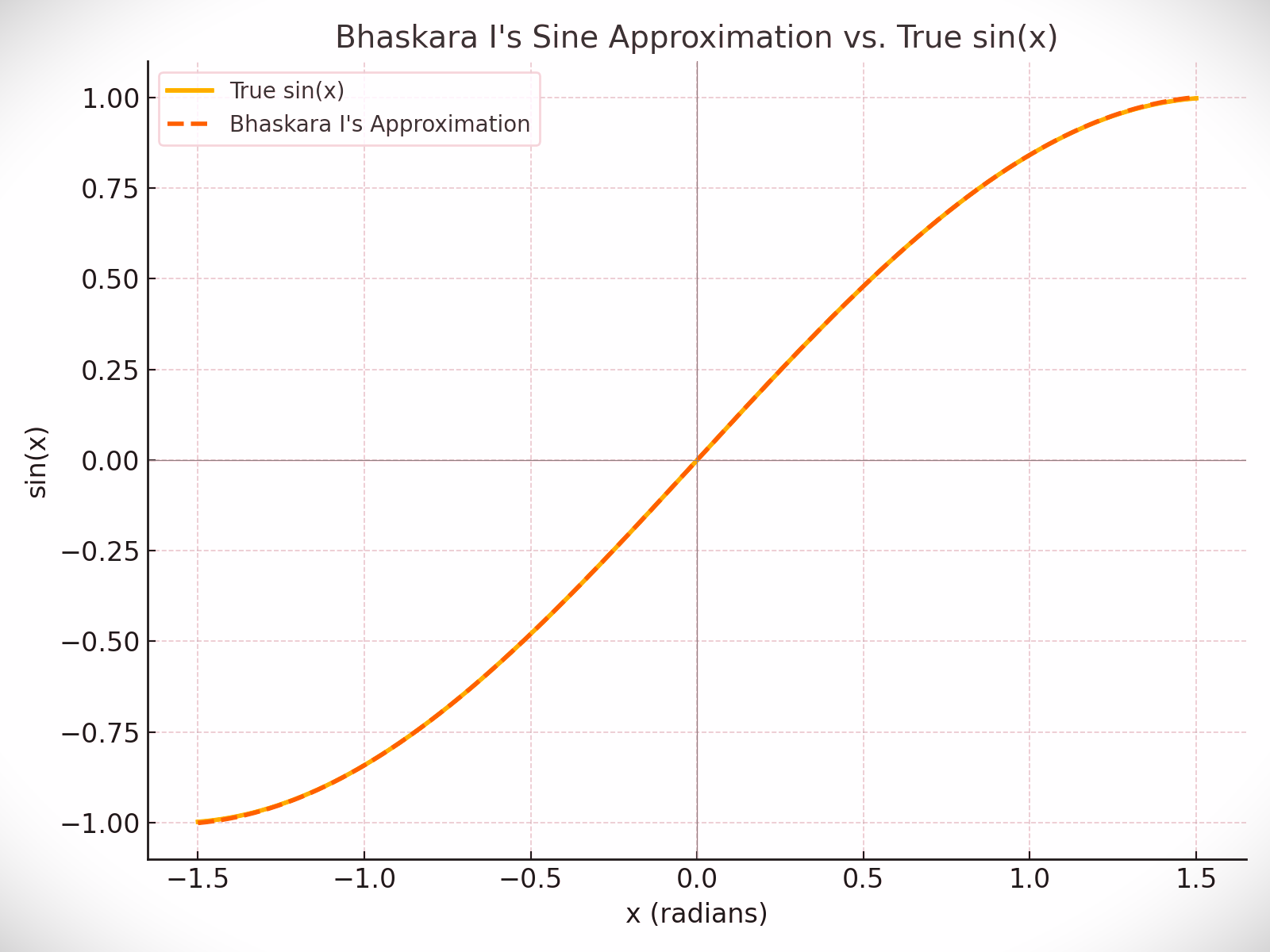
Bhaskara I’s brilliance lay not just in preserving Āryabhaṭa’s legacy, but in deepening its mathematical precision. Building on the trigonometric foundations of the Āryabhaṭīya, he introduced one of the earliest polynomial approximations for the sine function:
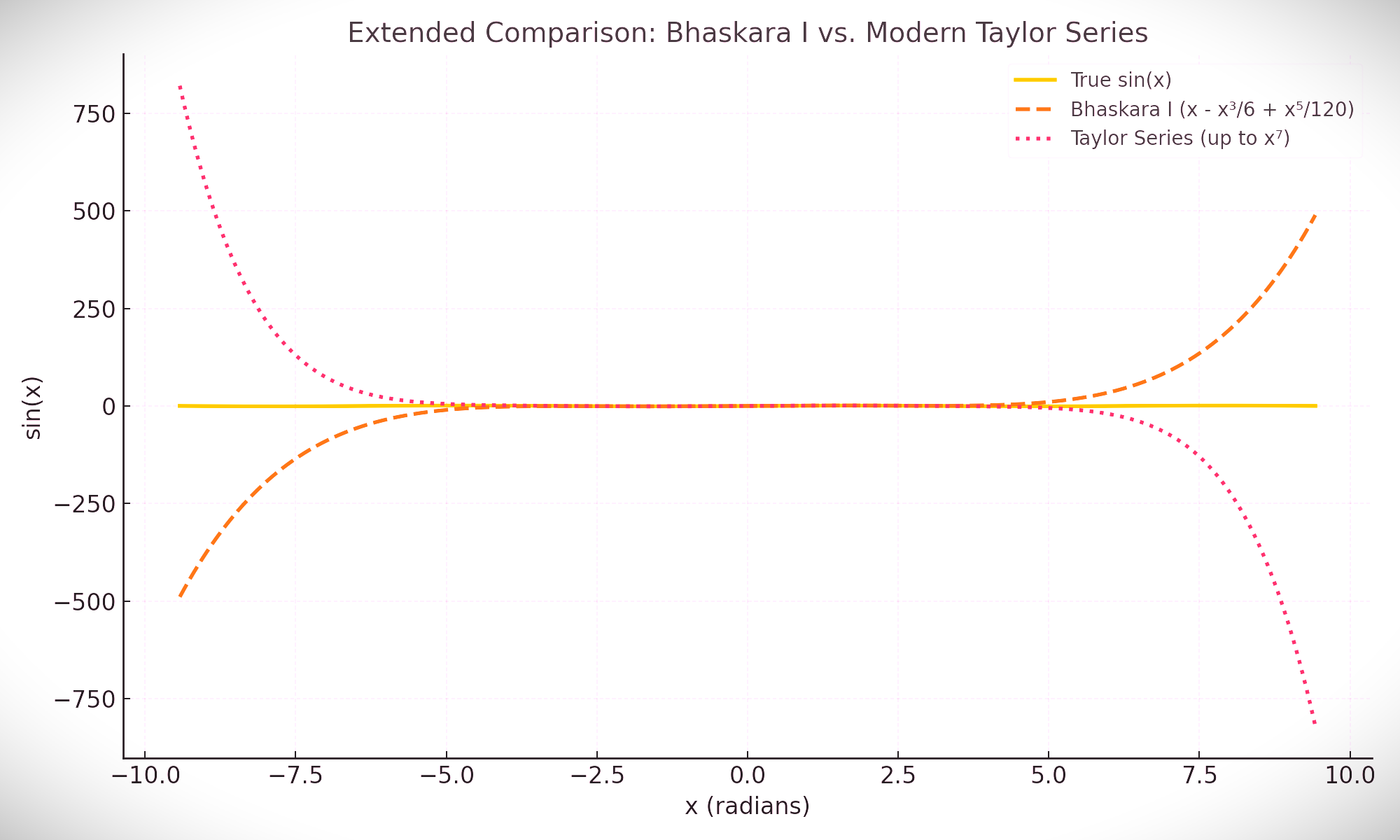
sin(x) ≈ x – x³/6 + x⁵/120
This formula, remarkably close to the modern Taylor series, enabled precise astronomical calculations—vital for Vedic calendrics, seasonal agriculture, and ritual alignment.
[Ref 1: Datta, 1932]
One of the notable themes in the Mahābhāskarīya is Bhaskara’s insistence on observation-calculation harmony. In one verse, he writes (translated):
“As the shadow shifts and the numbers align, so too must the sage trace time in motion divine.”
This poetic yet precise tone reflects his effort to combine empirical calculation with cosmic rhythm, a core ideal in Vedic science.
One such verse from the Mahābhāskarīya illustrates this blend of scientific clarity and metrical elegance:
सङ्ग्राह्यो लब्धवर्गो द्विघ्नो द्विघ्नगुणो लब्धवर्गात्।
नाम्ना त्रिसङ्गुणितेन व्यस्तं मूलं समं ज्ञेयम्॥
Translation:
“Take the square of the result, double it, double that again and subtract the square of the result from it;
Divide by thrice the name (i.e., the divisor), then the square root of that gives the equal quantity.”
This is a verse-form expression of an algebraic method—concise, metrical, and memorisable, yet algorithmically precise. Bhaskara I’s verse compositions were not just literary ornaments; they encoded computational logic in rhythm and sound.
More than a mathematical convenience, Bhaskara I’s work embodied the Vedic ideal of rita—cosmic order. His sine models were not only computationally robust, they harmonized with Sanātana Dharma’s vision of the universe as a mathematically knowable reality. This blend of spiritual order and scientific logic extended Āryabhaṭa’s cosmological philosophy explained through Gotra System and Peace in Sanatana.
Equally groundbreaking was his solution to a complex Diophantine equation:
61x² + 1 = y²
Now known as a special case of Pell’s Equation, Bhaskara I’s approach demonstrated advanced knowledge of modular arithmetic and integer solutions, which he used to calculate planetary periods essential for Vedic calendrical precision.
[Ref 2: Plofker, 2009]
In the Mahābhāskarīya, Bhaskara I uses technical Sanskrit terms that reflect a highly developed mathematical vocabulary. For example, he employs jyā (the sine of an arc), koti-jyā (cosine or the sine of the complementary angle), and manda-kendra (the point representing the apogee or slowest orbital point in a planet’s motion). These were not vague metaphysical labels but precise geometric and astronomical concepts used to calculate planetary positions and eclipses.
Terms like udayāsta-kāla (times of rise and set of celestial bodies) further demonstrate the integration of mathematics with observable phenomena, vital for both ritual timing and agricultural planning.
Alongside the Mahābhāskarīya, Bhaskara I also authored the Laghubhāskarīya—a shorter version that served as a practical manual for students, focusing on simplified astronomical methods and calculations. It was likely used in introductory instruction within gurukuls.
Science in Society: Ujjain as a Vedic Observatory
Bhaskara I lived and taught in Ujjain, a celebrated center for astronomical learning. From the time of the Surya Siddhanta, this city functioned as a real-world observatory.
Bhaskara I lived and taught in Ujjain, a celebrated center for astronomical learning. From the time of the Surya Siddhanta), this city functioned as a real-world observatory. Ujjain, a thriving trade hub contributing to India’s 25% global GDP, supported Bhaskara I’s work, as merchants relied on his calculations for precise trade and calendric planning. Bhaskara I’s methods were used to:
- Calculate auspicious timings (muhurtas) for Vedic rituals
- Align agricultural activities with solar-lunar cycles
- Structure temple festivals with celestial precision
He taught within gurukul systems, where students memorized verses of Mahābhāskarīya under open skies, reciting formulas like mantras but applying them as astronomers. Bhaskara’s Sanskrit verse was more than poetic—it was programmable logic.
Mathematics Without Borders: Influence Beyond India
The legacy of Bhaskara I did not stop at the Vindhyas. His mathematical precision crossed borders through Islamic scholars, particularly during the Abbasid translation movement. Figures like Al-Khwārizmī were influenced by Hindu treatises, many of which incorporated Bhaskara I’s refinements. In fact, the term “algebra” is derived from al-jabr, used by Al-Khwārizmī, who was deeply familiar with Indian methods.
[Ref 3: Al-Daffa, 1977]
In fact, the term “algebra” is derived from al-jabr, used by Al-Khwārizmī, who was deeply familiar with Indian methods. Al-Khwārizmī’s Kitab al-Mukhtasar incorporated Bhaskara I’s sine methods, aiding Islamic astronomy, which later influenced European trigonometry during the Renaissance [Ref 3].
Bhaskara’s sine tables and algebraic methods were absorbed into Islamic mathematical compendia and eventually reached Renaissance Europe, contributing to the revival of science after the Dark Ages.
[Ref 4: Plofker, 2009]
This transmission wasn’t through conquest, but through computation. A tradition Macaulay’s colonial curriculum tried to displace by branding such contributions as “pagan superstition”.
Modern Reverberations: Bhaskara I in the Digital Age
Though neglected by colonial systems, Bhaskara I’s insights endured in oral traditions and temple schools. Today, they’re seeing revival in surprising places. At IIT Kanpur, modern researchers reference Bhaskara’s sine approximations in computational models for satellite trajectory prediction and numerical simulations.
[Ref 5: Sharma, 2020]
He represents a forgotten lineage of indigenous STEM knowledge—one that predates and, in some aspects, rivals early European science.
Bhaskara I did not just preserve Aryabhata’s vision—he enhanced it, laying the intellectual groundwork upon which Bhaskara II would later develop calculus-like methods and gravitational concepts, as we will explore in the upcoming blog.
Hindu Texts- Not Myth, But Method
Bhaskara I was not a myth-maker. He was a method-builder. A scientist in the truest sense—translating cosmic rhythm into computable formulas. His Mahābhāskarīya stands as one of the most intellectually advanced works of its time, a testament to the empirical roots of Hindu scientific thought.
In a world too eager to forget, we remember—and reclaim—this legacy of knowledge.
Call to Action
How does Bhaskara I’s genius reshape your view of India’s scientific past?
🔍 Share your reflections in the comments below.
📚 Read the full series at: Hinduinfopedia.com
Let’s restore what was always fact—not fable—etched into every verse, every equation, and every star.
Feature Image: Click here to view the image.
Watch Education Video here:
Watch Hindi Video
Glossary of Terms
- Bhaskara I: A 7th-century Indian mathematician and astronomer from Ujjain, known for refining Aryabhata’s trigonometric methods and authoring the Mahābhāskarīya and Laghubhāskarīya.
- Mahābhāskarīya: A detailed Sanskrit astronomical treatise written by Bhaskara I in 629 CE, covering sine tables, planetary motion, eclipses, and timekeeping.
- Laghubhāskarīya: A shorter companion text to Mahābhāskarīya, designed as a practical manual for students learning astronomy and basic computations.
- Āryabhaṭa: An earlier Indian mathematician and astronomer (born 476 CE), whose Āryabhaṭīya laid the foundation for later Hindu astronomical models.
- Āryabhaṭīya: A pioneering 5th-century Sanskrit text by Āryabhaṭa that introduced trigonometry, planetary models, and the concept of Earth’s rotation.
- Sine approximation (sin x ≈ x – x³/6 + x⁵/120): A polynomial formula used by Bhaskara I that closely matches the modern Taylor series expansion for sin(x), centuries before calculus was formalized.
- Taylor Series: A method in modern calculus to express functions as infinite sums of derivatives. Bhaskara I’s sine formula mirrors its early terms.
- Diophantine equation: An algebraic equation with integer solutions. Bhaskara I solved a form of it: 61x² + 1 = y², now known as a special case of Pell’s Equation.
- Pell’s Equation: A classical number theory equation of the form x² – Ny² = 1. Bhaskara I’s work anticipated its methods nearly a millennium before European documentation.
- rita (ऋत): A Vedic concept denoting cosmic order, rhythm, and law—often mirrored in astronomical and ritual cycles in Hindu thought.
- Sanātana Dharma: The traditional term for Hinduism, emphasizing eternal truths, cosmic law, and moral duties aligned with the universe.
- jyā (ज्या): The Sanskrit term for the sine of an arc in Indian trigonometry.
- koti-jyā (कोटिज्या): The cosine function, or the sine of the complementary angle, used in Indian astronomical calculations.
- manda-kendra (मन्द केन्द्र): The apogee or the point in a planet’s orbit where it moves slowest, crucial in ancient Indian planetary models.
- udayāsta-kāla (उदयास्तकाल): The times of rising and setting of celestial bodies, used for ritual timing and agricultural scheduling.
- Al-Khwārizmī: A 9th-century Persian mathematician whose works on algebra and astronomy were influenced by Hindu treatises, including those of Bhaskara I.
- al-jabr: The Arabic term for “reunion of broken parts,” from which the word “algebra” is derived. It features in Al-Khwārizmī’s work that drew from Indian mathematics.
- Abbasid translation movement: A scholarly effort in 8th–9th century Baghdad where Hindu scientific texts were translated into Arabic, significantly influencing Islamic and European science.
- Ujjain: An ancient Indian city that served as a major astronomical observatory and educational hub during Bhaskara I’s time.
- gurukul: A traditional Hindu educational system where students lived with and learned from a teacher, often in natural settings under open skies.
#VedicMathematics #BhaskaraI #AncientIndianScience #MathematicsHistory #HinduinfoPedia
References:
- Datta, B. (1932). The Science of the Sulba.
- Plofker, K. (2009). Mathematics in India.
- Al-Daffa, B. (1977). The Muslim Contribution to Mathematics.
- Plofker, K. (2009). Mathematics in India.
- Sharma, R. (2020). Indian Mathematics in Modern Algorithms.
Visit Related Previous Blogs in the Series:
- https://hinduinfopedia.com/cosmic-seed-of-universe/
- https://hinduinfopedia.com/bhagwan-varaha-and-his-tusks/
- https://hinduinfopedia.com/surya-siddhanta-astronomical-truth-of-rahus-bite/
- https://hinduinfopedia.com/vedic-astronomy-and-basic-concepts/
- https://hinduinfopedia.com/solar-eclipse-insights-from-hindu-texts/
- https://hinduinfopedia.com/astronomy-in-surya-siddhanta/
- https://hinduinfopedia.com/science-of-vedic-astronomy/
- https://hinduinfopedia.com/hindu-wisdom-in-yagna-fire-real-not-myth/
- https://hinduinfopedia.com/hindu-wisdom-in-ritual-and-food/
- https://hinduinfopedia.com/hindu-wisdom-in-surgery-sushruta-blades-are-rea/
- https://hinduinfopedia.com/surgeon-sushrutas-pioneering-procedures/
- https://hinduinfopedia.com/surgeon-sushrutas-scalpel-unveiled/
- https://hinduinfopedia.com/metal-mastery-hindu-zinc-science-not-myth/
- https://hinduinfopedia.com/hygiene-in-hindu-texts/
- https://hinduinfopedia.com/vegetarian-diet-of-hindu-wisdom/
- https://hinduinfopedia.com/vegan-food-and-hindu-wisdom/
- https://hinduinfopedia.com/varna-system-hindu-merit-not-myth/
- https://hinduinfopedia.com/gurukul-truths-of-hindu-wisdom/
- https://hinduinfopedia.com/science-hub-rituals-vedic-truths-unveiled/
- https://hinduinfopedia.com/genetic-testing-in-ancient-gotra-system/
- https://hinduinfopedia.com/peace-in-sanatana/
- https://hinduinfopedia.com/aryabhata-and-mathematical-astronomy-not-myth/
Link for Next Related Blog
- https://hinduinfopedia.com/bhaskara-ii-algebra-to-gravity-not-myth/
- https://hinduinfopedia.com/shankaracharyas-vedic-mathematics-practical-applications/
- https://hinduinfopedia.com/raman-effect-unveiling-vedic-sciences-light/
[…] Originally published at: https://hinduinfopedia.com/bhaskara-i-refining-vedic-mathematics-not-myth/ […]