

Hindu Calendar: Scientific Timekeeping, Not a Myth
The Lost Origins of the Global Week
The seven-day week is now a global standard—but its true origins are often misunderstood. While many Western accounts credit Greco-Roman or Babylonian traditions, the mathematical and astronomical foundations of the seven-day cycle are deeply rooted in the Hindu calendar system. Ancient Indian texts, especially the Surya Siddhanta, codified this cycle through the Hora system—an algorithmic model where planetary hours, not mythology, determine the sequence of days.
The Hindu calendar is a system of time based on celestial mechanics, rooted in the precise movements of planets and observable cycles, as demonstrated by its mathematical foundations. In this blog, we decode the Vedic understanding of time, supported by Sanskrit texts and reinforced by modern science.
Background and Purpose
This blog is part of Hindu Infopedia’s series illuminating the scientific foundations of ancient Indian knowledge, countering Western narratives that often mislabel Hindu texts as mythological or attribute global scientific advancements to Greco-Roman or Babylonian cultures. Previous articles, such as Vedic Astronomy and Basic Concepts, Astronomy in Surya Siddhanta, and Solar Eclipse Insights from Hindu Texts, explored the precise astronomical calculations in texts like the Surya Siddhanta and Aryabhata’s Aryabhatiya, which accurately predicted eclipses using trigonometric methods [Ref 3]. Others, including Bhaskara II: Algebra to Gravity Not Myth and Raman Effect: Unveiling Vedic Science’s Light, connected ancient mathematical and optical insights to modern science [Ref 1, Ref 2]. This blog focuses on the Hindu calendar, demonstrating its mathematical and astronomical basis for the seven-day week and Hora system, as detailed in the Surya Siddhanta. By addressing critiques, such as the calendar’s geocentric framework—valid for its time due to Earth-based observations—we affirm its scientific rigor and its influence on global timekeeping, proving it is a sophisticated system, not a myth.
Vedic Calendar Foundations: The Eye of Time is the Sun
The earliest record of time as a cosmic force begins with the Rigveda, where the Sun (Sūrya) is described as both divine and measurable:
Sanskrit – Rigveda 1.50.1
उदु त्यं जातवेदसं देवं वहन्ति केतवः ।
दृशे विश्वाय सूर्यं ॥
Translation:
“The rays bear aloft Jātavedas, the divine Sun, so that he may be seen by all the world.”
This is not poetic ornamentation. This is astronomical awareness: the understanding that light defines visibility, and visibility determines measurement. Sūrya is seen as the eternal clock—not just metaphorically, but as the calibrator of time, motion, and destiny [Ref 3].
Planetary Architecture in Chapter 2 of Surya Siddhanta
The Surya Siddhanta, a post-Vedic text of remarkable astronomical depth, details in Chapter 2, Verses 10–15 the Sun’s central role in calculating planetary motions, including the size, speed, and eccentric paths of grahas like Mangal (Mars), Budh (Mercury), and Shani (Saturn), laying the foundation for precise timekeeping.
Verse 15 excerpt:
रात्रिं तत्कृतदर्शनां भागः प्रथमं ज्यागृहं चोच्यते ।
Translation: “Night is divided into visible parts, the first of which is termed Jyāgraha—a measured unit.”
Operating within a geocentric model, read with other vedic texts, the Surya Siddhanta establishes the Sun as the central reference for timekeeping and planetary computations, as outlined in Chapter 2, Verses 10–15 [Ref 5]. Its sophisticated mathematical framework, including trigonometric methods for eclipse predictions in Chapter 4, precisely charts the spatial arrangement of the Sun, Moon, and lunar nodes Rahu and Ketu, demonstrating an advanced grasp of celestial dynamics independently achieved in ancient India long before Copernicus faced ecclesiastical resistance for asserting that Earth orbits the Sun [Ref 3, Ref 5].
Hora: The Missing Link Between Astronomy and the Week
The concept of “Hora” (होरा)—the division of a day into planetary hours—is detailed in Surya Siddhanta Chapter 12, Verses 78–79, which mathematically define the seven-day week.
Surya Siddhanta 12.78–79 (with Sanskrit):
शनेः क्रमेण सुषुभुर्वाराः दिवसाधिपाः।
वार्षिकव्यवसायस्तु तीर्थायमपि प्रकाशितः॥७८॥
चन्द्रं क्रमेण ग्रहतां मासान्तविधानतः।
स्मृताः होराश्च सूर्यस्य तु क्रमन्यायतोऽपि च॥७९॥
Translation:
78: Beginning with Shani (Saturn), the sequence of planetary lords (grahas) governs the weekdays. This order has also been employed in annual and sacred timekeeping.
79: The Moon (Chandra) and other planets follow in sequence. The “Horās” (hours) are governed by the Sun and assigned according to a cyclical law.
The Surya Siddhanta Chapter 12, Verses 78–79, uses “Hora” (होरा) to denote planetary hours, where each of the 24 daily hours is governed by a planet. The first hour at sunrise determines the day’s ruling planet (e.g., Sunday for Sun, Monday for Moon, Tuesday for Mars), establishing the seven-day week’s structure.
This system is the algorithmic foundation of the global week.
Mathematical Cycle, Not Arbitrary Tradition
Western observers often question: why does Sunday follow Saturday? Why is Wednesday between Tuesday and Thursday?
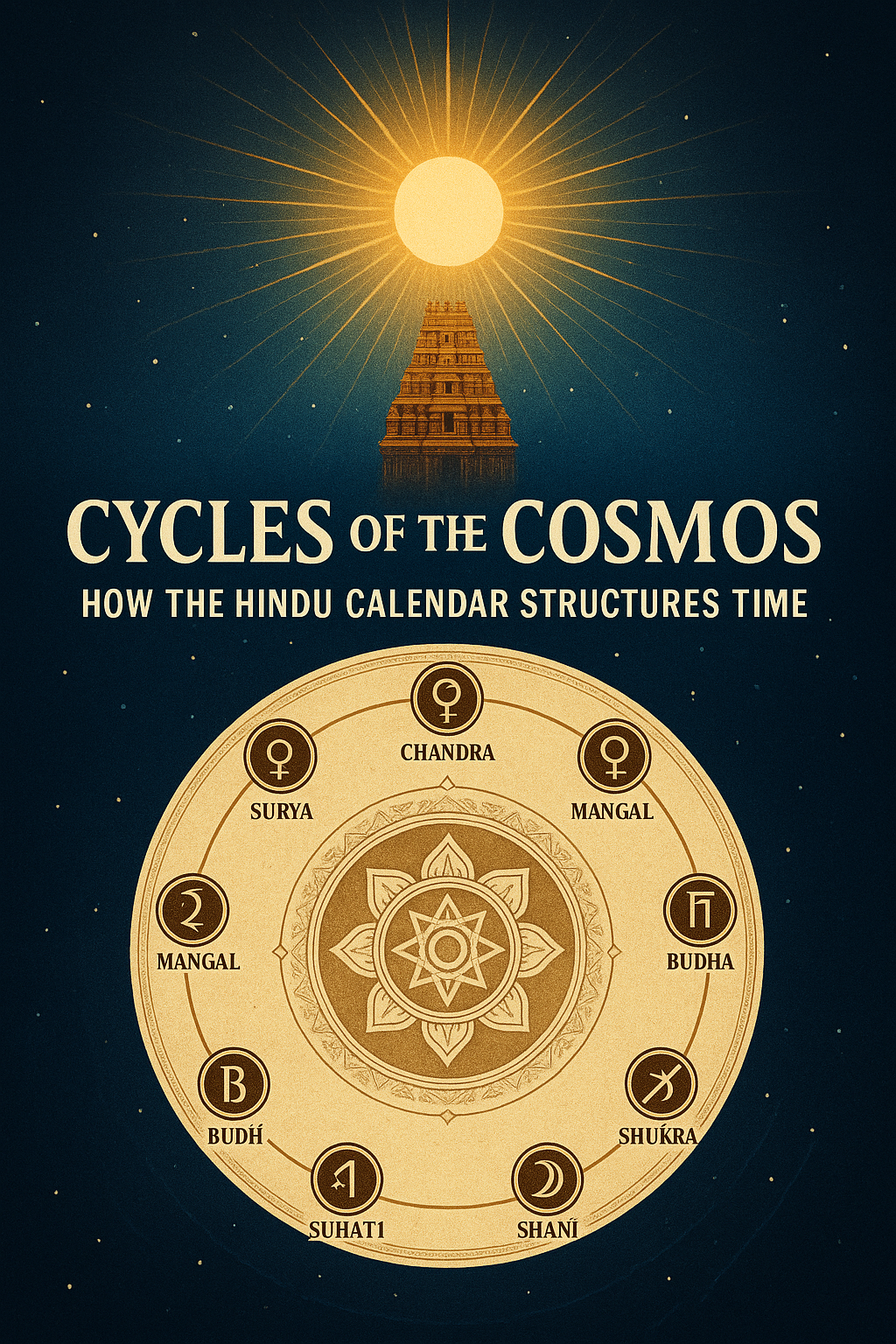
The Hora system’s mathematical logic assigns planetary rulerships in a fixed sequence, cycling through Shani, Brihaspati, Mangal, Surya, Shukra, Budh, and Chandra every 24 hours, with the 25th hour setting the next day’s ruling planet, ensuring a consistent seven-day cycle.
This system:
- Does not rely on visual size or proximity of planets.
- Follows strict orbital logic and cyclic time computation.
As explored in prior Hindu Infopedia articles, the pattern of assigning planetary influence through cyclical hours reflects the Hindu cosmological view of time as rhythmic, measurable, and recursive.
It mirrors the way Bhaskara II applied cyclical patterns in algebra and trigonometry [Ref 2] and how Aryabhata calculated eclipses with predictable trigonometric constants [Ref 3].
This mathematical clarity enabled the Hindu calendar’s portability, facilitating the spread of the planetary week and the term “Hora” into Hellenistic astronomy via cultural exchanges.
Cultural Context of the Hindu Calendar
The Hindu calendar’s mathematical precision was not an abstract exercise but a vital framework that shaped ancient Indian society. Its astronomical calculations guided essential activities, aligning human endeavors with cosmic cycles. In agriculture, the calendar dictated optimal times for sowing, transplanting, and harvesting, leveraging lunar phases and solar seasons. Texts like the Krishi-Parashara emphasize the use of tithis (lunar days) to schedule planting during auspicious periods, ensuring bountiful harvests in a monsoon-driven economy.
Festivals were deeply tied to the calendar’s celestial markers. Celebrations like Diwali, aligned with the new moon in Kartika, and Makar Sankranti, marking the Sun’s entry into Capricorn, were fixed by precise astronomical events described in the Surya Siddhanta. These festivals fostered cultural unity and spiritual harmony, as communities synchronized rituals with the cosmos.
In governance, the calendar informed administrative and judicial decisions. The Arthashastra of Kautilya references lunar and solar cycles to schedule tax collections, military campaigns, and royal ceremonies, aligning them with astrologically favorable moments. This integration of timekeeping into daily life highlights the Hindu calendar’s role as a practical bridge between astronomy and societal needs.
The Hindu calendar’s mathematical precision, embodied in the Hora system and seven-day week, provided a robust framework for measuring time in ancient India. This structure extended beyond theory, shaping societal practices in agriculture, festivals, and governance. As these applications solidified the calendar’s role in Indian life, its astronomical insights began to resonate globally. Through cultural exchanges along the Silk Road and interactions with Indo-Greek kingdoms, the planetary week and the concept of “Hora” reached the Greco-Roman world, laying the groundwork for modern timekeeping systems.
Comparative Analysis of Ancient Calendars
The Hindu calendar’s astronomical precision sets it apart from, yet connects it to, other ancient timekeeping systems. Like the Hindu calendar, the Egyptian calendar relied on solar cycles, using a 365-day year with 12 months of 30 days plus five intercalary days, as noted in Herodotus’ Histories [Ref 6]. However, it lacked the Hindu system’s planetary week and Hora-based hourly divisions, focusing instead on Nile flood cycles for agriculture.
The Chinese calendar, a lunisolar system described in the Shujing [Ref 7], shares the Hindu calendar’s integration of lunar and solar cycles to align festivals and agricultural planning. Yet, it emphasizes 12-year zodiac cycles over the Hindu calendar’s seven-day planetary week, reflecting a cultural focus on long-term cycles rather than daily planetary rulerships.
The Mayan calendar, with its complex interlocking cycles like the Tzolkin (260 days) and Haab (365 days) [Ref 8], mirrors the Hindu calendar’s mathematical sophistication but is distinct in its ritualistic focus and lack of a planetary week. Unlike these systems, the Hindu calendar’s Hora system and seven-day week, rooted in the Surya Siddhanta, provided a portable framework that influenced global timekeeping, notably through Greco-Roman adoption.
While no direct evidence confirms the Hindu calendar influencing these systems, its diffusion via the Silk Road likely shaped Hellenistic calendars, which in turn informed Roman and modern Western calendars [Ref 5]. This comparative perspective underscores the Hindu calendar’s unique blend of daily planetary cycles and astronomical precision, distinguishing it as a scientific and cultural milestone.
Bharat’s Gift to the World: From Hora to Horoscope
The mathematical rigor of the Hora system and seven-day week not only structured time in ancient India but also laid the foundation for its practical applications across society. As the Hindu calendar guided agriculture, festivals, and governance, its structured approach to timekeeping began to influence distant cultures. Through Indo-Greek exchanges and Silk Road trade, the planetary week and the term “Hora” spread to the Greco-Roman world, shaping the foundations of modern calendars.
The Sanskrit word “Hora” (होरा) later entered Greek as ὥρα (hōra) and Latin as “hora,” becoming the root of the term “horoscope.” Through Indo-Greek exchanges and Silk Road diffusion, the planetary week model reached Hellenistic astronomy, and then Rome.
What the West inherited was not borrowed myth—it was a scientific inheritance. The very structure of modern calendars and week-based scheduling stems from Bharat’s knowledge of planetary hour cycles, born from solar and lunar motion [Ref 5].
The Seven-Day Cycle is Hindu Science
The Hindu calendar’s seven-day week, Hora system, and planetary rulership logic form a rational, observable, and highly structured cosmological framework, validated by its enduring global influence.
- The Rigveda praised Sūrya as the all-seeing measure of time.
- The Surya Siddhanta laid out the planetary system and mathematical cycles.
- The Hora division precisely explains daily and weekly cycles—still followed globally today.
Just as the Raman Effect proved that ancient Indian theories of vibration had measurable consequences in light [Ref 1], so too does the Hora system prove that time in Bharat was never mythology—it was method.
Update 19 March 2026
The Hindu Calendar is a Multi-Dimensional Time Engine which synchronises human biological rhythms with lunar, solar, and planetary cycles with a precision that far exceeds the Gregorian model.
A — Add festival-context paragraph + internal link to new Ugadi post
After the final paragraph of the post, before the closing tags. If the post ends with a summary or conclusion section, insert after that section’s last paragraph.
Ugadi 2026: The Panchanga in Live Action
Today, Chaitra Shukla Pratipada of Shaka 1948 — Ugadi — is the most visible annual demonstration of everything this post documents. The five-limb Panchanga described above is not an abstraction. It is computed fresh today, broadcast publicly through the Panchanga Sravanam tradition in temples across Andhra Pradesh, Telangana and Karnataka, and used by millions of households to time their new year observances to the minute. The Adhik Maas correction mechanism, the tithi calculation, the Nakshatra position — all five Panchanga variables are live and operative on this day. For a detailed examination of the astronomical precision behind today’s date specifically, see our post on Ugadi Panchanga Precision: The Science of the Hindu New Year.
Feature Image: Click here to view the image.
Glossary of Terms
- Surya Siddhanta: An ancient Sanskrit astronomical treatise that outlines planetary positions, time cycles, and trigonometric methods for celestial calculations. Composed around 400–500 CE, it remains foundational to Hindu astronomy.
- Hora (होरा): A Sanskrit term meaning “hour,” referring to the 24 divisions of the day, each governed by one of the seven classical planets. The ruling planet of the first hour after sunrise determines the weekday.
- Rigveda: The oldest of the four Vedas, composed around 1500 BCE. It contains hymns praising natural forces like the Sun and serves as one of the earliest sources of Vedic cosmology and time concepts.
- Graha (ग्रह): A Sanskrit term for planetary bodies in Hindu astronomy and astrology. Traditionally includes Surya (Sun), Chandra (Moon), and five visible planets, often influencing days and horoscopic charts.
- Jyāgraha (ज्याग्रह): A term from Surya Siddhanta 2.15 referring to the first measurable segment of night. It represents the mathematical breakdown of nighttime into observable units.
- Shani (Saturn), Brihaspati (Jupiter), Mangal (Mars), Budh (Mercury), Shukra (Venus), Chandra (Moon), Surya (Sun): The seven classical planets (grahas) used in the Hora system to determine planetary hours and the seven-day week.
- Mandocca & Sighrocca: Technical terms in Indian astronomy representing the apogee of a planetary orbit (slowest and fastest orbital points), used for calculating orbital speed corrections.
- Tithi: A lunar day in the Hindu calendar, based on the angular distance between the Sun and the Moon. Tithis guide religious observances and agricultural activities.
- Kartika: A month in the Hindu lunar calendar, generally falling around October–November. Diwali is celebrated during this period, aligned with the new moon.
- Makar Sankranti: A solar festival marking the Sun’s entry into the zodiac sign of Capricorn (Makara). It signifies the winter solstice and is calculated using Surya Siddhanta astronomy.
- Krishi-Parashara: An ancient Sanskrit agricultural text attributed to Sage Parashara, detailing farming techniques and seasonal timing based on the Hindu calendar.
- Arthashastra: An ancient Indian treatise on statecraft, economics, and governance, attributed to Kautilya (Chanakya). It references lunar and solar calendars for strategic planning.
- Silk Road: A network of trade routes connecting India with Central Asia, the Middle East, and Europe. It facilitated the transmission of astronomical knowledge from Bharat to the Greco-Roman world.
- Yavanajataka: A Sanskrit text attributed to Sphujidhvaja (c. 150 CE) that blends Greek (Yavana) and Indian astrology, marking early Hellenistic influence on Indian horoscopic tradition.
- Tzolkin & Haab: Two interlocking calendar systems used by the ancient Mayans. Though mathematically sophisticated, they lack the planetary-week structure of the Hindu calendar.
#HinduCalendar #HoraSystem #SuryaSiddhanta #VedicAstronomy #HinduinfoPedia
📚 References
- [Ref 1] Raman, C. V. (1928). “A New Radiation.” Indian Journal of Physics, 2, 387–398.
- [Ref 2] Bhaskara II. (1150 CE). Lilavati. Translated by H. T. Colebrooke (1817).
- [Ref 3] Aryabhata. (499 CE). Aryabhatiya. Translated by W. E. Clark (1930).
- [Ref 5] Pingree, D. (1973). “The Mesopotamian Origin of Early Indian Mathematical Astronomy.” Journal for the History of Astronomy, 4(1), 1–12.
- [Ref 6] Herodotus. (5th century BCE). Histories, Book II. Translated by G. Rawlinson (1858).
- [Ref 7] Shujing (Book of Documents). (c. 1000 BCE). Translated by J. Legge (1865).
- [Ref 8] Aveni, A. F. (2001). Skywatchers: A Revised and Updated Version of Skywatchers of Ancient Mexico. University of Texas Press.
- [Ref 9] Yavanajataka of Sphujidhvaja. (c. 149–150 CE, versified 3rd century CE). Edited and translated by D. Pingree (1978). The Yavanajataka of Sphujidhvaja, Harvard Oriental Series. Cambridge, MA: Harvard University Press.
- [Ref 10] Surya Siddhanta Vol 1
- [Ref 11] Surya Siddhanta Vol 2
Previous Blogs on of the Series
- https://hinduinfopedia.com/cosmic-seed-of-universe/
- https://hinduinfopedia.com/bhagwan-varaha-and-his-tusks/
- https://hinduinfopedia.com/surya-siddhanta-astronomical-truth-of-rahus-bite/
- https://hinduinfopedia.com/vedic-astronomy-and-basic-concepts/
- https://hinduinfopedia.com/solar-eclipse-insights-from-hindu-texts/
- https://hinduinfopedia.com/astronomy-in-surya-siddhanta/
- https://hinduinfopedia.com/science-of-vedic-astronomy/
- https://hinduinfopedia.com/hindu-wisdom-in-yagna-fire-real-not-myth/
- https://hinduinfopedia.com/hindu-wisdom-in-ritual-and-food/
- https://hinduinfopedia.com/hindu-wisdom-in-surgery-sushruta-blades-are-rea/
- https://hinduinfopedia.com/surgeon-sushrutas-pioneering-procedures/
- https://hinduinfopedia.com/surgeon-sushrutas-scalpel-unveiled/
- https://hinduinfopedia.com/metal-mastery-hindu-zinc-science-not-myth/
- https://hinduinfopedia.com/hygiene-in-hindu-texts/
- https://hinduinfopedia.com/vegetarian-diet-of-hindu-wisdom/
- https://hinduinfopedia.com/vegan-food-and-hindu-wisdom/
- https://hinduinfopedia.com/varna-system-hindu-merit-not-myth/
- https://hinduinfopedia.com/gurukul-truths-of-hindu-wisdom/
- https://hinduinfopedia.com/science-hub-rituals-vedic-truths-unveiled/
- https://hinduinfopedia.com/genetic-testing-in-ancient-gotra-system/
- https://hinduinfopedia.com/peace-in-sanatana/
- https://hinduinfopedia.com/aryabhata-and-mathematical-astronomy-not-myth/
- https://hinduinfopedia.com/bhaskara-i-refining-vedic-mathematics-not-myth/
- https://hinduinfopedia.com/bhaskara-ii-algebra-to-gravity-not-myth/
- https://hinduinfopedia.com/shankaracharyas-vedic-mathematics-practical-applications/
- https://hinduinfopedia.com/raman-effect-unveiling-vedic-sciences-light/
[…] Originally published at: https://hinduinfopedia.com/hindu-calendar-scientific-timekeeping-not-a-myth/ […]
[…] framework rooted in ritual, astronomy, and timekeeping sciences — the very principles shown in Hindu Calendar Scientific Timekeeping and Vedic Astronomy and Basic Concepts, where cosmic order translated into societal […]
[…] साधना की तात्कालिकता स्वतः बढ़ती है। हिन्दू पंचांग की धार्मिक विधियाँ इसके लिए संरचित अवसर प्रदान करती […]
[…] Impermanence Regular reflection on life’s transient nature naturally increases urgency. The Hindu calendar’s ritual observances provide structured opportunities for such […]
[…] एकल-प्राचल प्रणाली दोहरा नहीं सकती। हिंदू पंचांग की वैज्ञानिक समय-गणना का … स्थापित करता है कि सौर-चंद्र मॉडल […]
[…] https://hinduinfopedia.com/hindu-calendar-scientific-timekeeping-not-a-myth/ […]