

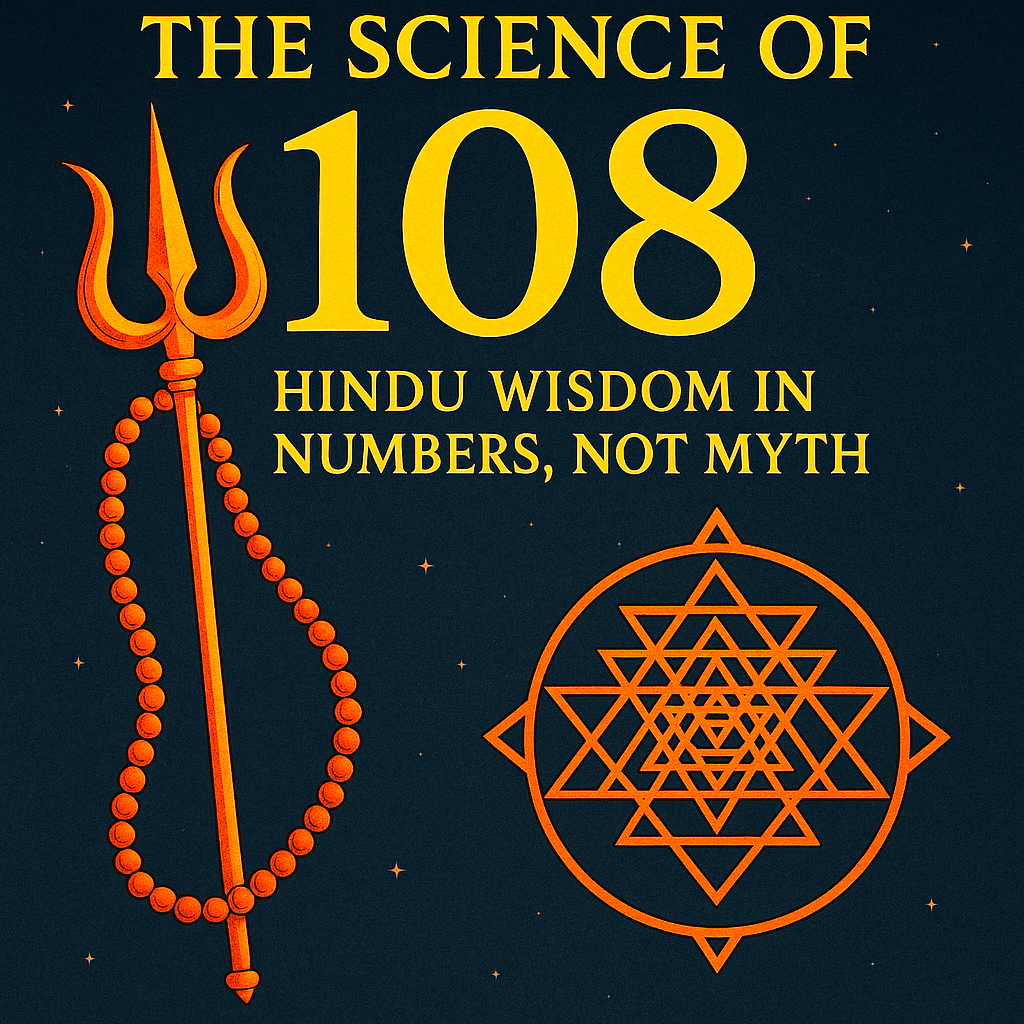
108 Meaning: Ancient Hindu Science, Not a Myth
108 Meaning Decoded
108 meaning in Hinduism goes far beyond symbolic faith—it holds deep scientific, astronomical, and mathematical significance. Found in mantras, yoga, and sacred texts, this number reflects ancient India’s empirical wisdom, not superstition. Continuing our “Not a Myth” series, this blog explores the scientific foundation of 108, revealing its cosmic logic and spiritual utility. Is 108 just a number—or a cosmic constant?
108 Meaning: Rediscovering Hindu Mathematical Wisdom
Building on prior insights from Vedic astronomy and metallurgy explored in earlier entries, we now turn to the number 108—not as a mystical relic, but as a convergence point of cosmic, mathematical, and physiological intelligence.
Meaning of 108 in Hindu Traditions
The number 108 appears across Hindu practices, reflecting a deep understanding of mathematics and cosmology:
- Mantra Chanting: Mantras are chanted 108 times, often using a mala with 108 beads, symbolizing a complete spiritual cycle.
- Yoga and Ayurveda: During equinoxes and solstices, many yoga practitioners across Bharat and the world perform exactly 108 sun salutations to mark transitions of celestial significance.
- Sacred Texts: The Upanishads, key philosophical texts, are often numbered at 108, embodying Vedic wisdom.
- Performing Arts: Bharatanatyam includes 108 karnas (dance postures), integrating precise movements with spiritual expression.
These instances suggest 108 was deliberately chosen, rooted in ancient observations of the cosmos.
Scientific Basis of 108
Claims circulating in modern documentaries and educational videos about 108’s cosmic connections require scrutiny but point to Hindu mathematical precision:
- Astronomical Proportions: The claim that the Earth-Sun distance is 108 times the Sun’s diameter is an approximation. Modern measurements show the ratio is about 107.5-108.4, varying due to orbital eccentricity. Similarly, the Earth-Moon distance ranges from 104.5 to 116.6 times the Moon’s diameter, not exactly 108. This range suggests ancient rishis observed celestial patterns, possibly encoding approximations in 108.
- Mathematical Patterns: The number 108 is the product of 12 zodiac signs and 9 planets (12 × 9 = 108), reflecting astrological calculations in Vedic texts like the Surya Siddhanta.
- Human Body: The claim of 108 nadis (energy lines) converging at the heart chakra aligns with yogic anatomy, though not empirically verified. It mirrors Ayurveda’s 108 marma points, suggesting a systematic approach to physiology.
- Geometric Symbolism: The Sri Yantra, a sacred geometric diagram, is said to have 108 convergence points, symbolizing cosmic harmony through mathematical precision.
These connections indicate 108’s role as a bridge between cosmic and human scales, not mere mysticism.
Cultural and Historical Context
The number 108 emerges from the Vedic tradition, which integrates mathematics, astronomy, and spirituality. Unlike modern science’s compartmentalized approach, Vedic rishis viewed numbers as carriers of cosmic truth. The use of 108 in mantras, yoga, and texts reflects a holistic understanding, akin to the Vaimanika Shastra’s blend of engineering and cosmology. Colonial scholars often dismissed such concepts as superstition, ignoring their empirical roots.
Environmental Context of 108’s Preservation
The knowledge of 108’s significance was preserved in Vedic texts despite centuries of invasions. From the 11th to 18th century, Turkic, Persian, and European powers targeted India’s learning centers like Takshashila, scattering manuscripts. Oral traditions and guru-shishya transmission ensured 108’s survival in practices like mantra chanting. However, colonial rule and modern neglect, including limited funding for Vedic studies post-independence, have obscured its scientific depth, warranting renewed research.
Rationale Behind Sacred Numbers
The choice of sacred numbers varies across cultures, with Hinduism’s ‘108 meaning’ distinguished by its evidence-based, multi-faceted foundation, drawn from celestial ratios like the Earth-Sun and Earth-Moon distances, bodily alignments of nadis and marma points, and the mathematical product of 12 and 9.
In contrast, other faiths, including ours, exhibit varied rationales or their absence.
For Islam, the number 786, derived from Abjad numerology summing the letters of ‘Bismillah al-Rahman al-Rahim,’ relies solely on linguistic symbolism within the text, holding no value beyond its scriptural context. Scholars like Sheikh Al-Munajjid view it as a cultural artifact rather than a divinely mandated number, with the faith living in isolation from nature and science.
Likewise, in Christianity, the numbers 7, based on the six creation days plus rest (Genesis 2:2-3), and 12, tied to the apostles (Matthew 10:2-4), depend entirely on narrative events, offering symbolic order without empirical grounding. Irrespective of scientific facts or the reality behind the universe’s genesis, the significance of 7 is principally sourced from texts, with no other basis, and the faith remains detached from nature and science.
Similarly, in Judaism, the numbers 18, from the gematria of ‘chai’ (life), and 613, the Torah’s commandments, are linguistically and legally derived, with no observable basis beyond textual origins. Unlike Hinduism’s integration of number with cosmos, these remain confined to internal symbolic logic.
We now see that the ‘108 meaning’ in Hinduism shines as a sacred number rooted in a rich, evidence-based foundation, weaving together celestial ratios, physiological alignments, and mathematical precision. In contrast, numbers like Islam’s 786, Christianity’s 7 and 12, and Judaism’s 18 and 613, while meaningful within their textual traditions, rely solely on linguistic or narrative symbolism, offering no connection to nature or science. This stark contrast underscores 108’s unique strength as a product of observed science, reclaiming its place as a testament to ancient Hindu wisdom..
Modern Relevance of 108
Today, the ‘108 meaning’ resonates beyond ancient texts. Meditation practitioners use 108-bead malas for mindfulness, aligning with breath cycles (108 per hour in deep states). Architects incorporate 108 in sacred geometry, like temple layouts. For instance, the layout of Angkor Wat and South Indian temples like Chidambaram reflect spatial encodings of 108, symbolizing cosmic order. Studies, such as those analyzing Vedic astronomy with NASA data, note 108’s proximity to celestial ratios (107.5-108.4), suggesting enduring precision. This relevance invites further exploration of its practical applications.
Meaning of 108 in the Series of Hindu Wisdom
This exploration of 108 aligns with our series’ mission to uncover Hindu scientific foundations. It echoes Bharat’s metallurgical lead in “Metal Mastery,” astronomical precision in “Surya Siddhanta,” and aeronautical insights in “Vaimanika Shastra.” Hindu texts consistently reveal a civilization driven by inquiry, with 108 embodying mathematical and cosmic wisdom that rivals modern understanding.
Reflecting on 108 Meaning
The number 108 is a testament to ancient India’s scientific ingenuity, weaving astronomy, mathematics, and spirituality into a single framework. Its presence in mantras, yoga, and texts challenges the notion of mere superstition, inviting us to reconsider the rishis’ advanced knowledge. As we continue this series, 108 stands as a beacon of Hindu wisdom, urging exploration of our scientific heritage.
Call to Action
What are your thoughts on 108’s cosmic and mathematical significance? If you research astronomy or Vedic texts, help decode its applications further. Share your insights in the comments and explore our series on HinduInfopedia.org for more revelations about Hindu scientific wisdom.
Feature Image: Click here to view the image.
Glossary of Terms
- 108 Meaning: A symbolic and scientific number in Hinduism representing the convergence of cosmic, mathematical, and physiological principles, such as Earth–Sun/Moon ratios, 108 energy lines, and 12 zodiac × 9 planetary deities.
- Mantra: A sacred sound or phrase repeated in meditation or ritual; in Hinduism, it is often recited 108 times for spiritual completeness.
- Mala: A string of prayer beads, traditionally consisting of 108 beads, used in mantra chanting and meditation for keeping count and focus.
- Surya Namaskar: A sequence of yogic postures known as Sun Salutation, often performed 108 times during solstices or sacred observances to align with cosmic transitions.
- Upanishads: Philosophical texts in Hinduism forming the concluding part of the Vedas, often traditionally numbered at 108, encapsulating metaphysical and cosmic knowledge.
- Karnas: Codified dance movements or postures described in the Natya Shastra and practiced in classical Indian dance forms like Bharatanatyam; traditionally enumerated as 108.
- Nadis: Subtle energy channels in yogic anatomy through which life force (prana) flows; 108 nadis are said to converge at the heart chakra.
- Marma Points: Vital energy points in Ayurveda and traditional Indian medicine, often totaling 108, used in healing and therapeutic practices.
- Sri Yantra: A sacred geometrical diagram representing the cosmos and the body in Tantric Hinduism; said to include 108 intersections or convergence points symbolizing universal harmony.
- Surya Siddhanta: An ancient Hindu astronomical treatise containing detailed calculations of planetary motions, time cycles, and zodiacal systems—integral to understanding Vedic cosmology.
- Vaimanika Shastra: A Sanskrit text attributed to sage Bharadwaja that describes ancient Indian aeronautics and engineering, referenced to illustrate holistic scientific thinking.
- Guru-Shishya Parampara: The traditional Hindu educational method of knowledge transmission from teacher (guru) to disciple (shishya), critical in preserving oral traditions like mantra chanting.
- Gematria: A Jewish alphanumeric code assigning numerical value to letters, used in interpreting sacred texts—mentioned to contrast with Hinduism’s observation-based numerology.
- Abjad Numerology: A method of assigning numerical values to Arabic letters, used in Islamic traditions (e.g., to derive the number 786), based on script rather than observation.
t#108Meaning #VedicScience #HinduWisdom #SacredNumbers #HinduinfoPedia
References
- Vedic texts (Rigveda, Upanishads, Surya Siddhanta).
- Ayurvedic and yogic literature on nadis and marma points.
- NASA data on Earth-Sun and Earth-Moon distances.
- Discussions on X about 108’s significance in Hindu traditions (e.g., posts by https://x.com/VedicMaths, 2024).
Previous Blogs on of the Series
- https://hinduinfopedia.com/cosmic-seed-of-universe/
- https://hinduinfopedia.com/bhagwan-varaha-and-his-tusks/
- https://hinduinfopedia.com/surya-siddhanta-astronomical-truth-of-rahus-bite/
- https://hinduinfopedia.com/vedic-astronomy-and-basic-concepts/
- https://hinduinfopedia.com/solar-eclipse-insights-from-hindu-texts/
- https://hinduinfopedia.com/astronomy-in-surya-siddhanta/
- https://hinduinfopedia.com/science-of-vedic-astronomy/
- https://hinduinfopedia.com/hindu-wisdom-in-yagna-fire-real-not-myth/
- https://hinduinfopedia.com/hindu-wisdom-in-ritual-and-food/
- https://hinduinfopedia.com/hindu-wisdom-in-surgery-sushruta-blades-are-rea/
- https://hinduinfopedia.com/surgeon-sushrutas-pioneering-procedures/
- https://hinduinfopedia.com/surgeon-sushrutas-scalpel-unveiled/
- https://hinduinfopedia.com/metal-mastery-hindu-zinc-science-not-myth/
- https://hinduinfopedia.com/hygiene-in-hindu-texts/
- https://hinduinfopedia.com/vegetarian-diet-of-hindu-wisdom/
- https://hinduinfopedia.com/vegan-food-and-hindu-wisdom/
- https://hinduinfopedia.com/varna-system-hindu-merit-not-myth/
- https://hinduinfopedia.com/gurukul-truths-of-hindu-wisdom/
- https://hinduinfopedia.com/science-hub-rituals-vedic-truths-unveiled/
- https://hinduinfopedia.com/genetic-testing-in-ancient-gotra-system/
- https://hinduinfopedia.com/peace-in-sanatana/
- https://hinduinfopedia.com/aryabhata-and-mathematical-astronomy-not-myth/
- https://hinduinfopedia.com/bhaskara-i-refining-vedic-mathematics-not-myth/
- https://hinduinfopedia.com/bhaskara-ii-algebra-to-gravity-not-myth/
- https://hinduinfopedia.com/shankaracharyas-vedic-mathematics-practical-applications/
- https://hinduinfopedia.com/raman-effect-unveiling-vedic-sciences-light/
- https://hinduinfopedia.com/hindu-calendar-scientific-timekeeping-not-a-myth/
- https://hinduinfopedia.com/hindu-calendar-traditions-timekeeping-in-ramayana-mahabharata/
- https://hinduinfopedia.com/vimana-shastra-ancient-hindu-aeronautics-unveiled/
[…] The Blog was originally posted at: https://hinduinfopedia.com/108-meaning-ancient-hindu-science-not-a-myth/ […]
[…] […]
[…] Discover how ancient mathematical principles shape modern understanding. Explore the deep significance of numbers in the Vedic tradition and why 108 stands at the heart of Hindu scientific thought. Explore the series → […]
Great article on the significance of 108 in Hindu traditions! The mathematical and astronomical connections are fascinating. This makes me wonder—are there other sacred numbers in different cultures that have similarly deep scientific or cosmic foundations?
For example, I recently came across a service that helps foreigners obtain a Spanish NIE number, which is essential for legal and financial processes in Spain. It got me thinking: do such identification numbers in other cultures carry any symbolic or historical weight, or are they purely administrative? Would love to hear your thoughts!