

Unrest From Bangladesh to Nepal: Is India the Real Target?
Part I: Unrest in India’s Neighbors
A Global Pattern of Unrest
Unrest today is no longer a local phenomenon. From Black Lives Matter in the United States to Shaheen Bagh in Delhi, and from the farmers’ protests on Delhi’s borders to the quota reform upheaval in Bangladesh and the social-media ban riots in Nepal, a single script seems to echo across continents: Faceless Protests. These uprisings appear decentralized, often leaderless, erupting suddenly with no clear negotiators, yet powerful enough to paralyze governments.
The pattern reflects the old proverb — kahin par nigahen, kahin par nishana meaning person seems to be looking somewhere, but the goal is elsewhere. The gaze appears fixed on local issues, but the real aim often lies elsewhere. Such movements, whether framed as struggles for justice or freedom of expression, frequently open doors for external commentary and diplomatic leverage.
For Bharat, which has consistently taken a firm line on economic sovereignty and the GMO trade trap and affirmed that sovereignty is supreme, these repeated catapults of unrest raise uncomfortable questions. Is the eruption of protests in neighboring states merely coincidental — or part of a broader design to pressure India?
Case Study 1: The Unrest in Bangladesh
The spark in Bangladesh came in June 2024, when students rallied against the entrenched quota system in government jobs. What began as a leaderless campus agitation soon swelled into nationwide unrest, with reports suggesting that Islamist groups and opposition parties hijacked the movement to amplify street violence. By August 5, 2024, Prime Minister Sheikh Hasina — in power for over 15 years — resigned, toppled by the momentum of what started as a student protest but grew into a broader, politically charged upheaval. It is relevant to state that Hasina had openly stated that USA was eyeing on St. Martin’s Island.
Government ministers described the protests as being hijacked by “third-party actors,” while Hasina and her son alleged that foreign intelligence agencies pushed Dhaka to “surrender sovereignty.” International bodies soon amplified the turmoil: the UK Parliament briefing chronicled how the protests escalated into regime change, while the OHCHR’s fact-finding report urged investigations into violations during the demonstrations.
This was not simply a domestic jobs issue. It became a textbook example of how localized grievances can be weaponized into nationwide upheaval, raising the specter of wider geopolitical orchestration. Analyses such as U.S. Hypocrisy Doctrine: When Peacemakers Become Pariahs and Global Trade vs Bharat’s Sovereignty argue that the language of human rights and democracy often becomes a tool to pressure governments that assert economic and political independence.
Case Study 2: The Unrest in Nepal
In September 2025, Nepal became the stage for a new wave of unrest after the government abruptly announced a sweeping ban on 26 social platforms, including Facebook, WhatsApp, X, and YouTube. Officials claimed the move was due to non-compliance with registration requirements, but the public saw it as an assault on free speech. Within days, thousands of young Nepalis — largely Gen Z students and first-time voters — filled the streets of Kathmandu, breaching the Parliament perimeter and branding the protest as their generational fight for voice and access. Police responded with water cannons, tear gas, and rubber bullets, leaving several people dead, according to Reuters’ reporting on the protests. Reports are abuzz that the upriser was promoted and funded with the support of external forces
The Kathmandu Post noted that the unrest coincided with a controversial revival of the Millennium Challenge Corporation (MCC) compact, which had earlier been frozen under U.S. foreign aid cuts. Earlier in 2025, U.S. development funding under the Millennium Challenge Corporation (MCC) was briefly frozen under an executive order halting foreign aid Reuters. In July, just as tensions with India were rising, MCC grants were pulled back from the brink, resuming vital infrastructure aid Reuters.
The sequencing raises questions: was this unrest purely about social media, or did it reflect deeper geopolitical maneuvering at a moment when India had just defied Western pressure in trade talks? For Bharat, the episode was a reminder that what looks like a digital protest next door can easily morph into a lever of strategic pressure against its own sovereignty, echoing India’s long-standing position that sovereignty is supreme.
The Connecting Threads: A Shared Modus Operandi
Placed side by side, the unrest in Bangladesh and the unrest in Nepal look strikingly similar. Both began with seemingly local grievances — job quotas in one, social media access in the other. Both escalated rapidly into street violence, overwhelming governments and forcing drastic political consequences. And in both, international voices soon framed the unrest in terms of democracy, rights, and freedoms.
The connecting thread lies in the foreign fingerprint. In Dhaka, Sheikh Hasina openly alleged the role of foreign intelligence agencies. In Kathmandu, the revival of the MCC Compact amidst regional tensions raises questions about leverage. In New Delhi, leaders have repeatedly warned against foreign interference through NGOs and aid pipelines. The playbook is consistent: highlight internal discontent, amplify through global media, and then apply economic or diplomatic pressure.
For India, this is not theory but lived experience. The Shaheen Bagh protests, the farmers’ agitation, and even attempts to stir unrest in Kanpur and Allahabad fit the same “faceless protest” model — hard to control, yet effective in generating headlines and foreign scrutiny. Each episode reinforces the need for vigilance, because in the larger geopolitical script, Bharat is not a bystander. Analyses such as Global Trade vs Bharat’s Sovereignty, the U.S. Hypocrisy Doctrine, and Economic Sovereignty and the GMO Trade Trap show how unrest repeatedly overlaps with India’s refusal to compromise on sovereignty.
By connecting these dots, it becomes clear that unrest is not random. It is a recurring instrument — calibrated differently in each country — but with one long-term consequence: increased pressure on nations that assert independence from global powers.
Reading the Background Noise for Unrest
Let us now examine if there is a pattern to what is observed in the case studies presented above. The parallels between Bangladesh and Nepal already suggest that unrest has become more than a local problem — it is part of a global pattern. To see this clearly, one only needs to read the background noise behind other uprisings.
When examining today’s global uprisings, it is tempting to treat each as a standalone movement. Yet the background noise behind many of them suggests otherwise.
Going back to the testbed of decentralized uprisings — The Black Lives Matter (BLM) — the parallels grow sharper. Black Lives Matter commanded global attention in 2020, and while protests were widely framed as symbolic of racial justice, academic research has shown they correlated with higher Democratic turnout in key counties (Neal Caren, 2023). That same year, mail-in voting surged, with over 65 million Americans casting ballots by post — a scale unseen before (Wikipedia). By 2024, turnout dipped slightly (from 66% to 64%), and a larger proportion of Trump’s 2020 supporters returned to the polls than Biden’s (Pew Research Center).
Nor does the spread of this unrest stop at America’s borders. The BLM template leapt across Europe like wildfire. But was that rational in an age when tens of Black Africans are killed every week on the African continent itself? Are those lives less important than that of George Floyd, a man with a documented criminal history?
Do the lives lost every single week in Syria — where the United States remains actively engaged — not matter at all?
The pattern sharpens when we move further afield. Is it coincidence that the BLM playbook, the unrest in Hong Kong, and the upheaval in Sri Lanka all look uncannily similar in organization, scale, and international amplification?
Is it coincidence that Pakistan’s Prime Minister Imran Khan was ousted soon after openly resisting pressure to bring his sovereign nation in line with external dictates?
Or that the United States refused to sell F-35 fighters to Turkey immediately after Ankara declined to cancel its order of S-400 air defense systems from Russia?
These episodes point to a broader truth: unrest, sanctions, and pressure tactics are rarely isolated acts. They are often part of a calibrated sequence aimed at disciplining states and societies that step out of line.
The goals for the Unrest: Is it the Last Stand?
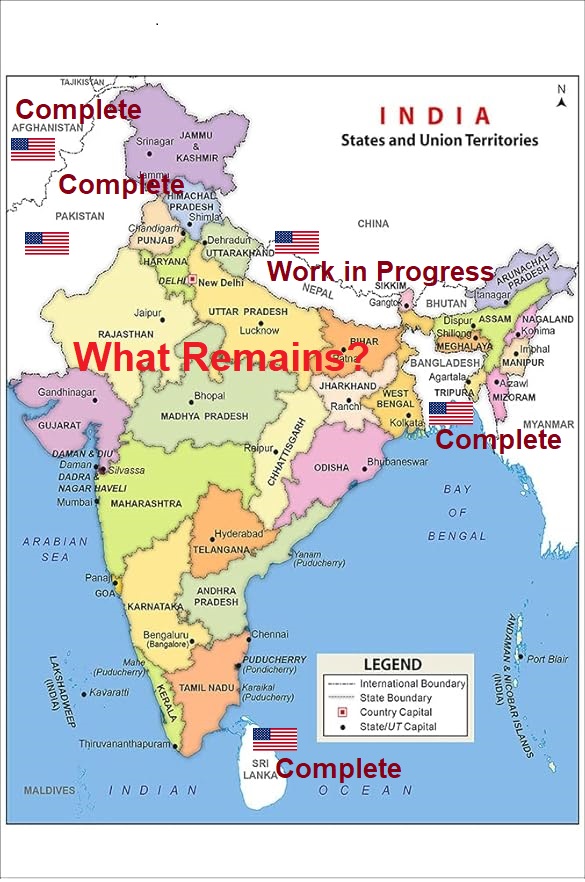
Placed against a map of Bharat and its neighbors, recent events begin to form a pattern. From Afghanistan and Pakistan in the west to Bangladesh and Sri Lanka in the south, and now Nepal to the north, episodes of unrest appear to line up around India. Some regions already seem settled in one direction, others remain a work in progress. What remains uncertain is whether these are coincidental ripples or parts of a larger tide.
The possible goals of such unrest are never declared in clear terms. Is the focus India itself? Is it to weaken sovereign governments that resist external pressure in trade, defense, or diplomacy? Or is it to generate narratives of instability that invite international scrutiny under the banner of democracy and human rights? Or perhaps the aim is simply to keep Bharat under constant watch, ensuring that its rise as an independent civilizational power is never free of surrounding turbulence. The trailer of this third option was vividly visible during the last leg of the Biden administration, when Canada and the U.S. directly undermined Bharat’s democratic institutions by openly supporting Khalistan elements on their soil.
In this sense, each “faceless protest” — whether in Shaheen Bagh, the farmers’ agitation, or the sudden eruptions in neighboring countries — deserves attention not only for what it represents locally, but also for the way it resonates beyond borders. Whether these movements are spontaneous or nudged from outside, their timing often intersects with moments when India has asserted that sovereignty is supreme.
An equally strong example lies in how some 5,000 to 10,000 wealthy and influential individuals from one of India’s richest states, Punjab — claiming themselves as farmers — managed to bring the government to its knees, forcing the rollback of reforms that were supported by the majority of farmers outside Delhi. That was not democracy in action, nor was it the triumph of democratic forces. It was the imprint of extraneous pressure, the same imprint visible in the unrest of BLM in the U.S., in Sri Lanka’s collapse, in Pakistan, in Bangladesh, and now playing out in Nepal.
Going back to the testbed for faceless protests — the BLM movement — the parallels grow sharper. Black Lives Matter commanded global attention in 2020, and while protests were widely framed as symbolic of racial justice, academic research has shown they correlated with higher Democratic turnout in key counties (Neal Caren, 2023). That same year, mail-in voting surged, with over 65 million Americans casting ballots by post — a scale unseen before (Wikipedia). By 2024, turnout dipped slightly (from 66% to 64%), and a larger proportion of Trump’s 2020 supporters returned to the polls than Biden’s (Pew Research Center).
Did these factors — BLM mobilization and record mail-in participation — give Biden an edge in 2020? The community that led the protests undeniably gained visibility, and many activists and allies found themselves in influential policy and advisory roles in the Biden administration. But the harder question remains: were those who participated in street violence, looting, and arson indirectly rewarded through political appointments and access to power?
This is why the question arises: is this the last stand? The outer circle looks increasingly unsettled, and the pressure appears to inch inward. Can Bharat soon find itself confronting the most critical test — how to safeguard its autonomy when unrest shifts from being a neighborhood phenomenon to a challenge within.
Is it a coincidence that a very large number of opposition leaders have repeatedly drawn parallel between Bangladesh and Sri Lanka should happen here?
This is why the question arises: this can be the last stand? The outer circle looks increasingly unsettled, and the pressure appears to inch inward. Can Bharat soon find itself confronting the most critical test — how to safeguard its autonomy when unrest shifts from being a neighborhood phenomenon to a challenge within.
These questions grow sharper when one recalls how often opposition leaders at home have invoked Bangladesh and Sri Lanka as cautionary examples. But whatever the echoes, the deeper issue is sovereignty itself.
The Challenge to India’s Strategic Autonomy
From Bangladesh’s upheaval to Nepal’s street protests, from Sri Lanka’s collapse to the echoes raised by opposition leaders within India, one truth emerges: unrest has become a calibrated instrument of pressure. Whether it appears as a faceless protest, a sudden economic breakdown, or a narrative repeated in foreign capitals and domestic speeches, its effect is the same — to create an environment where sovereignty looks negotiable.
For Bharat, the stakes are far higher than for its neighbors. As one of the few nations to openly reject GMO clauses in trade deals, to challenge the dominance of global cartels, and to build a post-dollar framework, India is both admired and resisted. Its consistent assertion that sovereignty is supreme makes it an inconvenient partner for those accustomed to compliance. That is why the “catapult strategy” does not begin at India’s borders; it begins in the periphery — Bangladesh, Sri Lanka, Nepal — softening the ground, shaping expectations, and signaling what could be attempted at the core.
This is not to deny that domestic grievances exist, or that every protest is engineered from outside. But when the timing of unrest overlaps so often with moments when India asserts independence, the pattern cannot be brushed aside as coincidence. Nor can it be ignored when senior voices at home invoke Bangladesh and Sri Lanka as examples, conditioning the public to accept that what happened there may happen here.
Bharat’s challenge is therefore twofold: to defend against direct interference and to anticipate the indirect — unrest in the neighborhood, rhetoric at home, or narratives abroad — that can be leveraged to erode its autonomy. The contest is no longer over borders or battlefields, but over perception, momentum, and the manipulation of grievances into political capital.
India has endured and outlasted many sieges before. The question now is whether it can resist this quieter one — an age of unrest where the weapons are not armies, but narratives, protests, and echoes repeated until they sound inevitable.
Feature Image: Click here to view the image.
Videos for the blog
There are two English Videos describing the contents of the blog
Here are two Hindi Videos on the topic
Glossary of Terms
-
Bharat: The traditional and constitutional name of India, often used to emphasize civilizational continuity and sovereignty.
-
Kahin Par Nigahen, Kahin Par Nishana: A Hindi proverb meaning “the gaze is fixed somewhere, but the target is elsewhere,” used to describe deceptive appearances or hidden agendas.
-
GMO Trade Trap: Reference to trade negotiations where developed nations attempt to push genetically modified crops and seeds into India’s market, seen as a threat to agricultural sovereignty.
-
Quota Reform Protests (Bangladesh): Student-led agitation in Bangladesh beginning June 2024 against government job reservation quotas, later escalating into nationwide unrest and political upheaval.
-
St. Martin’s Island: A small coral island in the Bay of Bengal belonging to Bangladesh, strategically significant and referenced by Sheikh Hasina in the context of alleged U.S. interest.
-
OHCHR (Office of the High Commissioner for Human Rights): A United Nations agency responsible for promoting and protecting human rights globally; issued reports on Bangladesh unrest.
-
MCC (Millennium Challenge Corporation): A U.S. foreign aid agency providing grants for infrastructure and development; its compact with Nepal has been a point of political controversy.
-
Kathmandu Post: A leading English-language daily newspaper in Nepal, often cited in discussions of Nepal’s politics and international aid.
-
Shaheen Bagh Protests: A prolonged sit-in protest in Delhi (2019–2020) against India’s Citizenship Amendment Act, emblematic of “faceless protest” movements.
-
Farmers’ Agitation (India): Large-scale protests (2020–2021) by Indian farmers, especially from Punjab and Haryana, against new agricultural reform laws; eventually forced repeal of the laws.
-
Black Lives Matter (BLM): A social movement originating in the U.S. to protest racial injustice, which gained global momentum in 2020 and is cited as a template for decentralized uprisings.
-
Faceless Protest: A descriptive term for decentralized, leaderless protests that spread quickly without clear negotiation structures, making them difficult for governments to address.
-
S-400 Air Defense System: Russian long-range surface-to-air missile system purchased by Turkey, which led to U.S. sanctions and denial of F-35 fighter jet sales.
-
Catapult Strategy: A metaphor used to describe how unrest is first fomented in smaller neighboring states to soften the ground before similar pressures are applied to larger targets like India.
-
Khalistan Elements: Refers to Sikh separatist groups advocating for an independent Khalistan state; their activities abroad (e.g., in Canada and the U.S.) have been linked to tensions with India.
#Unrest #Sovereignty #Narrative #India #HinduinfoPedia
Later Blog of the Series:
- https://hinduinfopedia.com/narrative-of-unrest-when-neighbors-become-examples/
- https://hinduinfopedia.com/money-trail-analyzing-financial-networks-behind-nepals-protests/
[…] For an in-depth look at how these events connect — and what they mean for India’s future — read the full blog here: https://hinduinfopedia.com/unrest-from-bangladesh-to-nepal-is-india-the-real-target/ […]
[…] […]
[…] […]
[…] how this playbook succeeded in Nepal and Bangladesh, it’s crucial to understand that India appears to be the ultimate target of these destabilization efforts. The encirclement strategy is unmistakable: regime changes in […]
[…] गुरुत्व-केंद्र पूर्व की ओर खिसकता है। “सक्रिय तटस्थता” बनाए रखने वाले भा… मध्य-पूर्वी कूटनीति के नए वास्तुकार […]
[…] warships were nearby but because Iran chose to. That goodwill — carefully cultivated through India’s deliberate neutrality — is what makes Indian passage possible. Naval assets deployed too close to the war zone risk […]
[…] थे, बल्कि इसलिए कि ईरान ने ऐसा चुना। भारत की सुविचारित तटस्थता के माध्यम से सावधानीपूर्वक अर्जित यह […]
[…] Unrest From Bangladesh to Nepal: Is India the Real Target? […]
[…] Unrest From Bangladesh to Nepal: Is India the Real Target? […]
[…] Unrest From Bangladesh to Nepal: Is India the Real Target? […]
[…] Unrest From Bangladesh to Nepal: Is India the Real Target? […]
[…] implication for South Asia is direct. The selective application of democracy framing to Bangladesh and Nepal — while silence surrounds P… The same narrative machinery that sells the Iran strikes as liberation is simultaneously being used […]
[…] […]
[…] ईरान संघर्ष से ठीक पहले के वर्षों में नियोजित राजनीतिक अस्थिरीकरण का अनुभव किया। यांत्रिकी एक समान थी: […]
[…] Unrest From Bangladesh to Nepal: Is India the Real Target? […]
[…] […]