

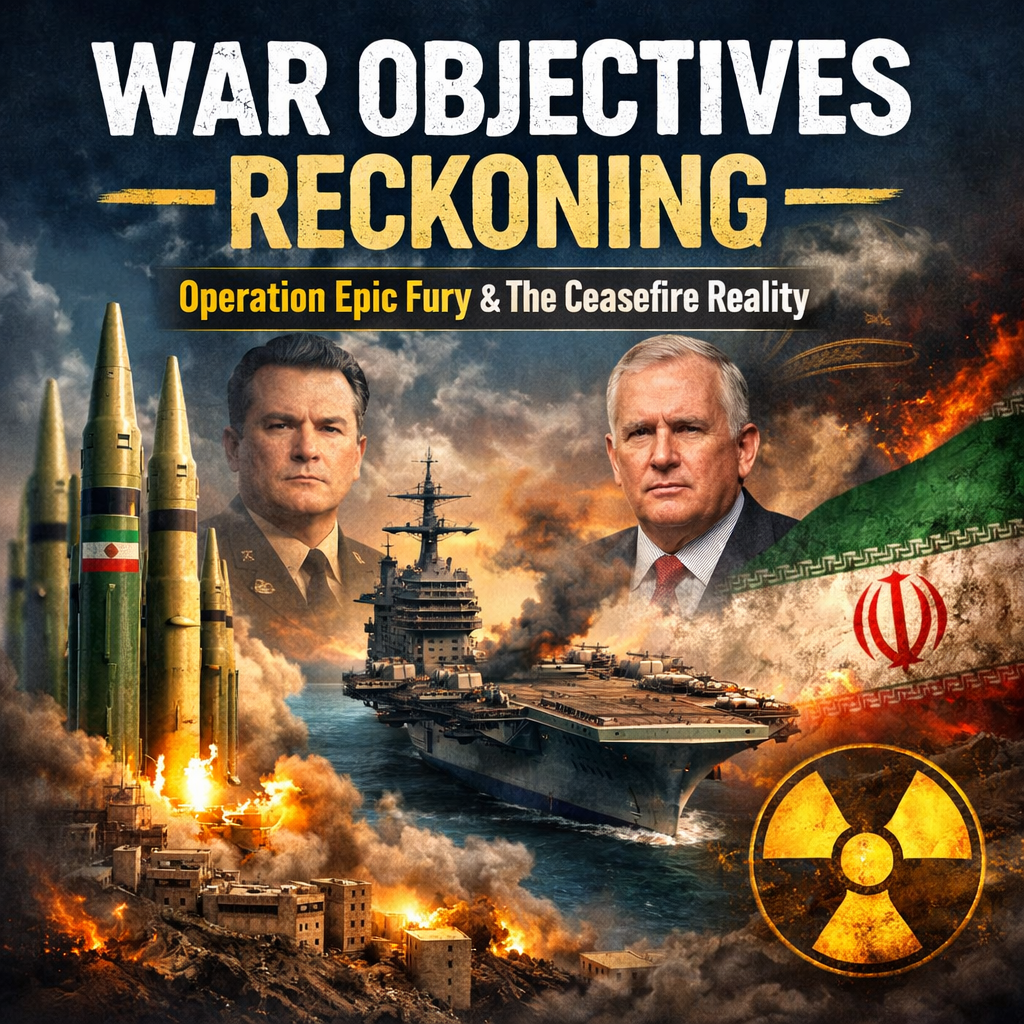
War Objectives Reckoning: A Reckoning of West Asia’s Endless War (28)
Part 28 of the West Asia’s Endless War Series
भारत / GB
What Operation Epic Fury Declared It Would Achieve — and What the Ceasefire Terms Actually Contain
Blog 27 broke the news of the April 7 ceasefire and stripped the victory claims to the documented terms. This blog begins the vindication arc — a systematic examination of what the ceasefire confirms about each argument this series has made. The War Objectives Reckoning starts at the beginning: what Operation Epic Fury declared it would achieve on Day 1, stated by the most senior officials of the United States government, published on the White House website, repeated at every press briefing for thirty-eight days — and what appears in the ceasefire terms.
War Objectives Reckoning: The Day 1 Declaration
War Objectives Reckoning: Four objectives declared on Day 1. None appear in the ceasefire terms. The record is now complete. On March 2, 2026 — two days after Operation Epic Fury began — Secretary of War Pete Hegseth stood at the Pentagon podium and stated the mission with precision: “The mission of Operation Epic Fury is laser-focused: destroy Iranian offensive missiles, destroy Iranian missile production, destroy their navy and other security infrastructure, and they will never have nuclear weapons.” Secretary of State Marco Rubio confirmed the same objectives from the same podium. Chairman of the Joint Chiefs General Dan Caine repeated them. Vice President Vance endorsed them. Press Secretary Leavitt cited them at every briefing. The White House published them on its official website under the heading “clear and unchanging objectives.”
The four objectives were stated so consistently and so publicly that the War Objectives Reckoning does not require interpretation. The administration left a precise documentary record. Objective One: destroy Iran’s ballistic missile arsenal and production capacity. Objective Two: destroy Iran’s navy. Objective Three: eliminate Iran’s nuclear weapons pathway. Objective Four: neutralise Iran’s regional proxies. These four objectives were described as “laser-focused,” “clear and unchanging,” “not utopian but realistic,” and explicitly “not Iraq, not endless.” They were the stated reason forty days of the most intense American air campaign since the Iraq War was conducted. They are the basis against which the ceasefire terms must now be read.
The Ceasefire Terms — Objective by Objective
Objective One — Destroy Iran’s missile arsenal and production capacity. The ceasefire terms contain no provision requiring Iran to surrender, hand over, destroy, or place under international supervision any remaining missile stockpile, production facility, or technical capacity. The ceasefire as announced by Trump and confirmed by Araghchi requires Iran to open the Strait of Hormuz and halt offensive operations for two weeks. It does not require Iran to demonstrate what remains of its missile capability, allow independent assessment, or commit to permanent dismantlement. The White House claimed on ceasefire day that “more than 85% of Iran’s defense industrial base” had been destroyed. The claim is unverifiable — Iran has not opened its remaining sites to inspection, and the ceasefire contains no inspection mechanism.
Objective Two — Destroy Iran’s navy. Iran’s naval capacity was the most comprehensively addressed objective of the campaign. The White House claimed substantial destruction of Iran’s surface fleet and naval infrastructure. This is the objective with the most credible claim to achievement — but its ceasefire relevance is limited. Iran did not close the Strait of Hormuz with its navy. It closed it with IRGC speedboats, drone swarms, mine threat, and the credible threat of attack that no conventional naval battle group can neutralise without continuous presence. The navy that was destroyed was not the instrument Iran used to hold Hormuz. The instrument Iran used — the IRGC maritime asymmetric capability — is not addressed in the ceasefire terms.
Objective Three — Eliminate Iran’s nuclear weapons pathway. The ceasefire terms contain no provision on nuclear enrichment, no requirement to transfer highly enriched uranium, no timeline for dismantlement, no inspection protocol. Iran’s position on uranium enrichment going into Islamabad talks remains unresolved — Tehran has not committed to ending enrichment as a condition of the ceasefire. The 15-point US proposal reportedly includes Iran committing to no nuclear weapons and handing over enriched uranium. Iran has not accepted these terms — it has accepted the US proposal as a basis for negotiation, not as a binding commitment. The nuclear objective that was cited as the primary justification for the war on Day 1 does not appear as a settled outcome in the ceasefire.
Objective Four — Neutralise Iran’s regional proxies. Israel launched its largest strikes on Lebanon within hours of the ceasefire announcement — because Hezbollah was explicitly not included in the ceasefire despite Pakistan’s prime minister saying otherwise. Israel’s opposition leader called the outcome “the worst diplomatic disaster in our history,” citing Iran’s proxies as having emerged from the war stronger in political legitimacy, not weaker. The ceasefire requires Iran to halt its own offensive operations. It contains no requirement to dismantle, disarm, or sever support for Hezbollah, the Houthis, or any other element of what Iran calls the Axis of Resistance.
Objective Four is absent from the ceasefire terms entirely. This creates a jarring dissonance: while the White House issued a victory declaration titled “Peace Through Strength: Operation Epic Fury Crushes Iranian Threat,” the regional reality was summarized by Israel’s opposition leader as “the worst diplomatic disaster in our history.” One narrative was written for a domestic audience in Washington; the other was written in the shadow of the Axis of Resistance emerging from the war with its proxy architecture untouched.
📌 The Nuclear Pretext That Started This War
The nuclear justification on Day 1 — and why it was always insufficient as a standalone rationale for a war of this scale and consequence.
War Objectives Reckoning: The Gap Between Declaration and Settlement
The War Objectives Reckoning is not a claim that the military campaign achieved nothing. Iran’s conventional military capacity has been substantially degraded. Khamenei is dead. The IRGC command has been disrupted. The navy has been reduced. The administration’s own messaging shifted continuously across the thirty-eight days — from unconditional surrender to a ceasefire on Iran’s framework. These are documented outcomes. The War Objectives Reckoning is a claim about something more specific: the gap between what was declared as the war’s purpose and what was accepted as the basis for ending it.
The war was declared to achieve four objectives. The ceasefire was reached on the basis of Iran’s 10-point proposal — a proposal that includes Iranian coordination of Hormuz transit, reconstruction compensation, removal of all sanctions, and withdrawal of US forces from regional bases. Iran’s Supreme National Security Council confirmed the ceasefire and stated that “nearly all war objectives have been achieved” — Tehran’s war objectives, not Washington’s. The White House published a statement claiming the ceasefire represented achievement of all military objectives. Iran published a statement claiming the ceasefire represented Washington’s acceptance of Iran’s negotiating framework. Both statements cannot be accurate. The ceasefire terms — stripped of all political framing — support one reading more than the other.
This series argued in Blog 3 that the stated justifications for the war would not survive contact with its outcomes. The War Objectives Reckoning is the documentation of that argument’s confirmation. Four objectives. Zero in the ceasefire terms as binding settled outcomes. The War Objectives Reckoning is complete. The most consequential military operation Washington has conducted since the Iraq War ended on the basis of the adversary’s proposal, with the adversary’s sovereignty claim over Hormuz institutionalised in the transit arrangements, and with negotiations on the adversary’s terms beginning in Islamabad on April 10.
📌 Why the War Was Really Fought
The petrodollar architecture, the colonial order enforcement logic, and the real objective behind the stated ones — the economic foundation the series documented from Blog 16 onward.
Next: Toll Booth Survives Reckoning — Blog 29 in West Asia’s Endless War examines the ceasefire’s most consequential single outcome: the Iran-Oman transit fee arrangement that institutionalises Iranian coordination of Hormuz passage during the ceasefire period — and what it means that the toll booth Washington went to war to demolish is still standing, now with a commercial licence. Part of the West Asia’s Endless War Series on hinduinfopedia.com.
Feature Image: Click here to view the image.
Videos
Glossary of Terms
- War Objectives Reckoning: The analytical framework comparing declared war objectives with actual ceasefire outcomes to assess alignment and effectiveness.
- Operation Epic Fury: The United States military campaign launched against Iran, defined by four publicly declared strategic objectives.
- Ceasefire Terms: The officially agreed conditions that halted active hostilities, forming the basis for evaluating war outcomes.
- Strait of Hormuz: A critical global oil transit chokepoint whose control and access became central to the conflict dynamics.
- Ballistic Missile Arsenal: Iran’s stockpile and production capability of long-range offensive missile systems targeted during the campaign.
- Defense Industrial Base: The infrastructure and facilities responsible for military production, claimed to have been heavily degraded.
- IRGC Maritime Capability: Asymmetric naval tactics used by Iran’s Revolutionary Guard, including fast boats, drones, and mine threats.
- Nuclear Weapons Pathway: The process involving uranium enrichment and weaponisation capability cited as a primary justification for the war.
- Highly Enriched Uranium: Uranium processed to high purity levels, critical for nuclear weapons development and a key negotiation issue.
- Axis of Resistance: Iran-aligned regional network including groups such as Hezbollah and the Houthis.
- Proxy Forces: Non-state armed groups supported by a state actor to extend influence without direct engagement.
- Asymmetric Warfare: Military strategy using unconventional tactics to offset conventional superiority.
- Strategic Degradation: Reduction of an adversary’s military capability without complete elimination.
- Ceasefire Framework: The broader negotiation structure shaping how and why hostilities were paused.
- Geopolitical Signalling: Public statements and actions intended to influence international perception and negotiation leverage.
#War #Geopolitics #Iran #USA #Ceasefire #MiddleEast #Conflict #Strategy #Analysis #HinduinfoPedia
Scan through the entire series at:
West Asia’s Endless War: Why This Series Exists
[…] भारत / GB […]
[…] Blog 28 delivered the War Objectives Reckoning: America’s four declared war objectives failed to materialise as binding terms in the ceasefire. This blog examines the ceasefire’s single most consequential structural detail: the toll booth Iran built across the Strait of Hormuz was not dismantled by forty days of the most intense American air campaign since Iraq. It was given a commercial licence. The Toll Booth Survives Reckoning is the vindication arc’s sharpest argument. […]
[…] War Objectives Reckoning: A Reckoning of West Asia’s Endless War (28) https://hinduinfopedia.com/war-objectives-reckoning-a-reckoning-of-west-asias-endless-war-28/ […]
[…] by the global south. Iran’s position enjoys the legal arguability of territorial sovereignty. Washington’s position, as Blog 28 documented, has none of its declared war objectives in the ceasefire terms as binding settled outcomes but […]
[…] military architecture operational, and its negotiating position stronger than before the conflict. Iran’s Supreme National Security Council assessed nearly all war objectives as achieved. Russia’s primary regional partner emerged from twelve weeks against the world’s most […]
[…] […]
[…] को समझते हैं। यही कारण है कि ब्लॉग 28 से आगे के विश्लेषण में एक बदलाव दिखाई देता है। राज्य […]