

Toll Booth Survives Reckoning: A Reckoning of West Asia’s Endless War (29)
Part 29 of the West Asia’s Endless War Series
भारत / GB
Iran’s Sovereignty Claim Over Hormuz Was the Real Strategic Objective — The Ceasefire Confirms It Succeeded
Toll Booth Survives Reckoning: What the Ceasefire Actually Says About Hormuz
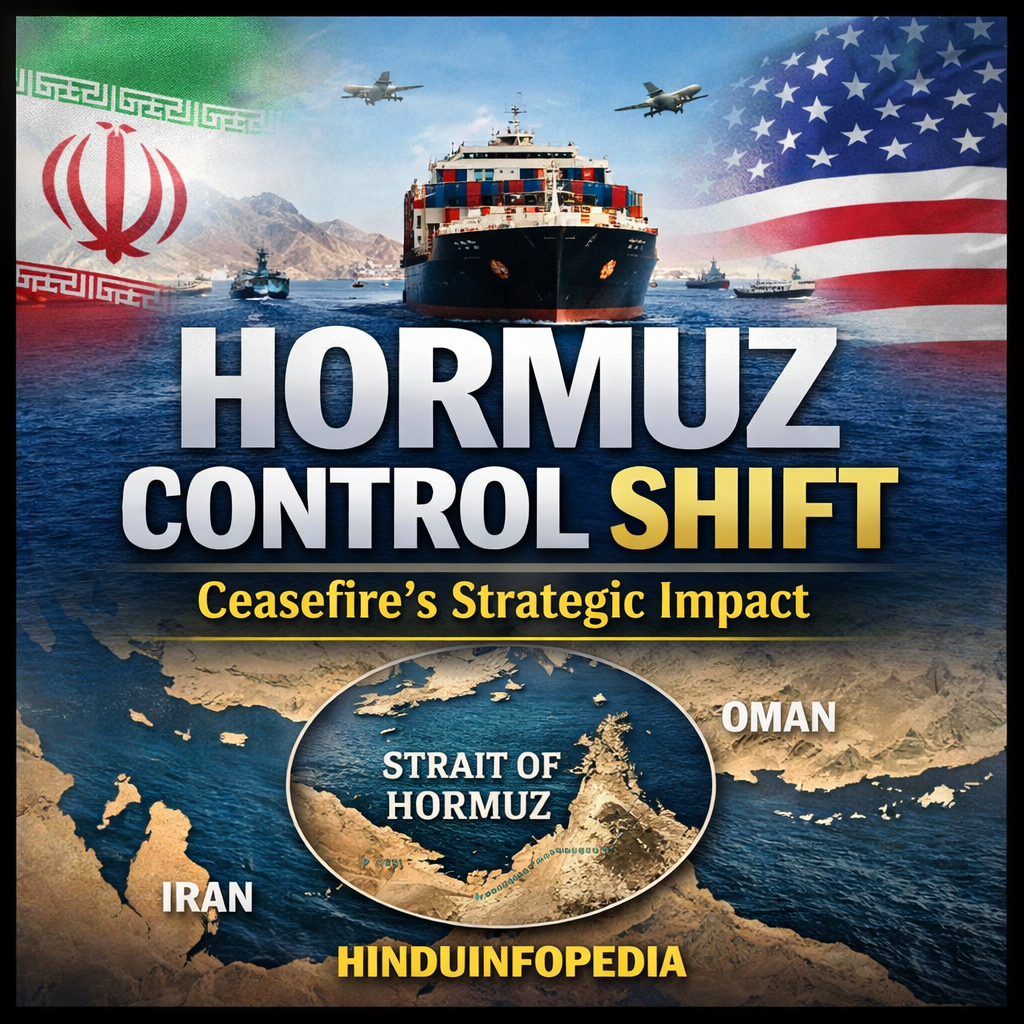
Toll Booth Survives Reckoning: The war that was launched to demolish Iran’s Hormuz control ended institutionalising it. The ceasefire announced on April 7 contains a specific provision on the Strait of Hormuz: Iran will allow “safe passage” during the two-week ceasefire period — via coordination with Iran’s armed forces, subject to technical limitations. Iran’s semi-official Tasnim News Agency subsequently reported that Iran and Oman plan to charge transit fees for vessels passing through the strait during the ceasefire, with funds earmarked for reconstruction. The United States has indicated it will participate in this transit fee arrangement.
Read those three sentences with precision. The strait reopens under Iranian coordination. Iranian armed forces control the passage protocol. Transit fees flow to Iran. Washington participates in the fee arrangement. This is not the reopening of an international waterway. This is the formalisation of Iranian sovereign authority over the strait — the precise outcome that the series documented Iran building, blog by blog, from March 1 onward. The Toll Booth Survives Reckoning is not a metaphor. The toll booth is operational, fee-collecting, and now ceasefire-legitimised. Iran’s parliament had already approved legislation to formalise transit fees as a permanent assertion of sovereignty over the strait.
Editor’s Note: As on the date of this post the traffic through the strait of Hormuz reflects continuation of the patterns as existed during the forty days of the war.
What This Series Documented — and What the Ceasefire Confirms
Blog 23 of this series — Iran Selective Blockade — documented the toll booth architecture in precise operational detail. The IRGC vetting system. The manifest and crew detail requirements. The route code issued after screening. The armed escort through Iranian territorial waters. The $2 million per transit fees. The yuan and cryptocurrency payment channels. The parliamentary legislation framing the fees not as a wartime measure but as a permanent assertion of Iranian sovereignty over the strait.
That blog argued: Iran is not closing Hormuz. It is reopening it on its own terms. The Iran Selective Blockade established a new order being constructed ship by ship — and warned that nations filing IRGC manifests, paying transit fees, and accepting Iranian naval escorts were, whether they intended to or not, acknowledging Iranian jurisdictional authority over the strait.
The ceasefire has now done what forty days of strikes could not: it has provided that acknowledgement at the state level. Trump’s ceasefire announcement accepted Iran’s coordination of Hormuz passage as the operative mechanism. Washington is participating in the fee arrangement. The United Nations Convention on the Law of the Sea — which establishes transit passage through international straits as universal and non-suspendable — has been bypassed not by Iran’s unilateral action but by the ceasefire framework Washington accepted. The Toll Booth Survives Reckoning is confirmed: Iran’s sovereignty claim has been operationally recognised by the state that launched the war to prevent it.
📌 How the Toll Booth Was Built
The IRGC vetting system, the $2 million fees, the parliamentary sovereignty legislation — the full architecture this series documented before the ceasefire confirmed it.
Toll Booth Survives Reckoning: The Strategic Logic Iran Executed
The Toll Booth Survives Reckoning requires understanding what Iran was actually trying to achieve with the Hormuz closure — and recognising that the ceasefire terms confirm the strategy succeeded.
Iran did not close Hormuz to win a military battle it could not win. It closed Hormuz to achieve three strategic objectives simultaneously.
- First, to impose economic cost on the adversary’s coalition at a rate that would exhaust political will faster than military pressure could produce Iranian compliance — which a future blog of this series will examine in full.
- Second, to establish a precedent of Iranin sovereign authority over the strait that would survive any ceasefire and any future negotiation — because a precedent embedded in a ceasefire framework is harder to undo than a unilateral claim.
- Third, to extract from Washington a formal acknowledgement — however framed — that Hormuz passage requires Iranian coordination.
All three objectives are present in the ceasefire terms. The economic cost was sufficient to exhaust Washington’s political will within ninety minutes of its own declared deadline. The sovereignty precedent is embedded in the ceasefire’s transit coordination framework. The formal acknowledgement is Washington’s participation in the fee arrangement. Iran’s Supreme National Security Council declared that “nearly all war objectives have been achieved.” On the specific question of Hormuz, the declaration is accurate.
The series argued in Blog 25 — Why Iran Will Not Blink — that Iran’s strategy was not survival but the progressive construction of a new order through sustained pressure. The toll booth is the new order’s most visible element. It survived the war that was launched to demolish it. It is now ceasefire-legitimised. It will be the foundation from which Iran negotiates the permanent framework in Islamabad. Whatever emerges from the Islamabad talks, Iran enters them as the de facto authority over the world’s most important energy chokepoint — not as a supplicant seeking relief from sanctions but as a state whose sovereignty claim has been operationally recognised by the United States of America. The Toll Booth Survives Reckoning is the single most consequential outcome of the war.
📌 Why Iran Was Always Going to Hold This Position
The civilisational chess game, the political clock, and the three structural reasons the Toll Booth Survives Reckoning was always the most probable outcome.
Next: Political Clock Reckoning — Blog 30 in West Asia’s Endless War examines the ceasefire’s most revealing single moment: Washington folded ninety minutes before its own declared deadline, accepting Iran’s 10-point framework as the basis for negotiation after forty days of the most intense American air campaign since Iraq. The political clock that this series argued would exhaust Washington before Iran has now run its first visible cycle. Part of the West Asia’s Endless War Series on hinduinfopedia.com.
Feature Image: Click here to view the image.
Videos
Glossary of Terms
West Asia’s Endless War: Why This Series Exists
[…] भारत / GB […]
[…] Toll Booth Survives Reckoning: A Reckoning of West Asia’s Endless War (29) https://hinduinfopedia.com/toll-booth-survives-reckoning-a-reckoning-of-west-asias-endless-war-29/ […]
[…] difference between Iran’s toll and Washington’s blockade is that Iran’s toll had a legal basis in territorial waters that Britain declined to challenge, and Washington’s blockade has a legal basis that Britain refused to recognise and no country […]
[…] Blog 29 (Toll Booth Survives Reckoning) established that the toll booth survived the war. The ceasefire confirmed it. Washington’s Operation Project Freedom — escorting ships through Hormuz — is not the elimination of the toll. It is Washington collecting the toll through military escort rather than Iran collecting it through territorial waters authority. The difference is who collects. The toll booth remains. The Hormuz Logical Trap is that the war was launched to eliminate the toll booth and has produced a situation where two powers are fighting over who collects the toll — which is a worse position than the one the war was meant to remedy. […]
[…] Read […]
[…] with Iran’s permission. Washington calls it extortion. Washington is not stopping it. Blog 29 (Toll Booth Survives Reckoning) established that the toll booth would survive the war. It has — with an institutional name, a fee […]
[…] फिर भी वाशिंगटन इसे रोक नहीं रहा है। ब्लॉग 29 (टोल बूथ सर्वाइव्स रेकनिंग) ने स्थापित किया था कि यह शुल्क […]