

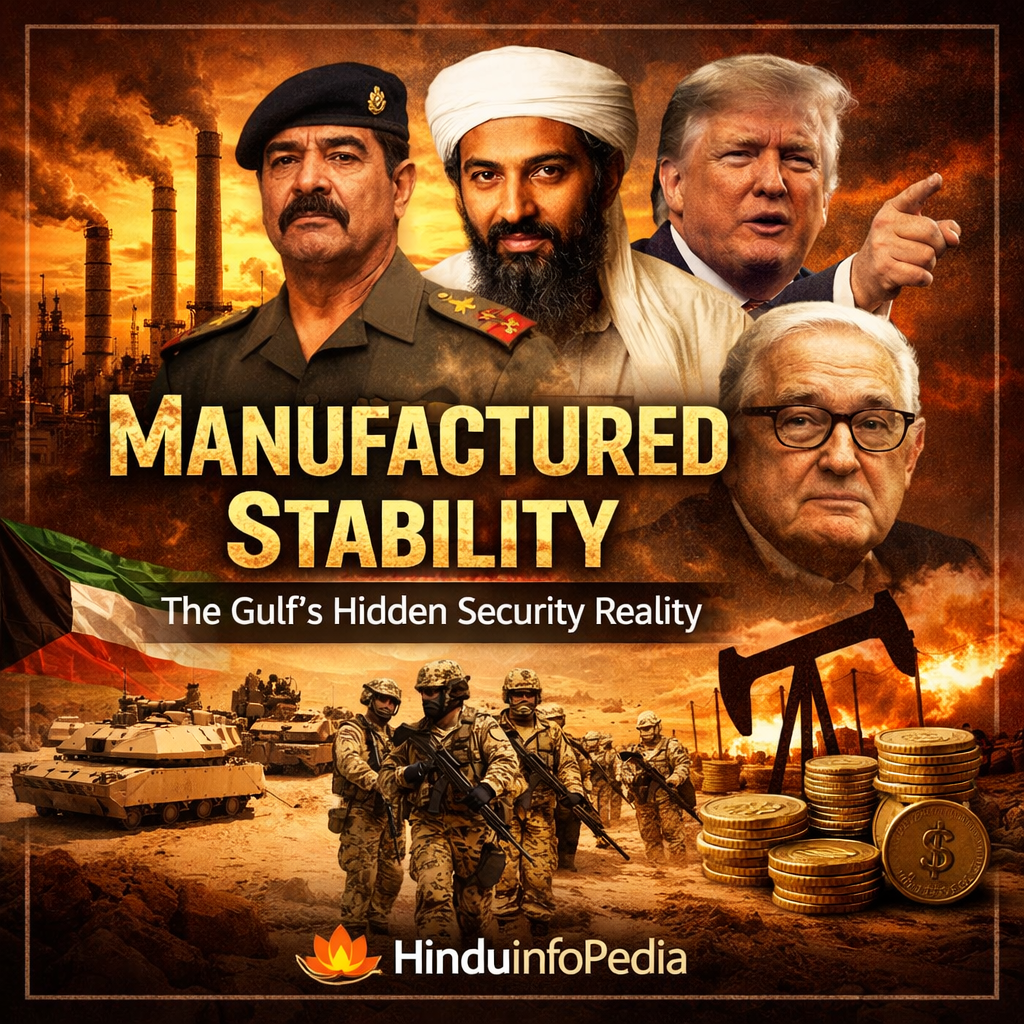
Manufactured Stability Reckoning: A West Asia’s War Reckoning (34)
Part 34 of the West Asia’s Endless War Series
भारत / GB
The Gulf Was Never Stable. It Was a Powder Keg With a Fifty-Year American Military Subsidy. The World Called It Strategic Cooperation.
Blog 33 established the Global Energy Reckoning — the Gulf’s dominance was fashion built on incumbency, not fundamentals. Blog 34 goes deeper: the Manufactured Stability Reckoning is the historical evidence that the Gulf’s “stability” was never organic. It was manufactured across three phases — built on a powder keg in 1974, maintained by a Praetorian Guard in 1990, and now collapsing as that guard receives its eviction notice. Understanding the manufacture is essential to understanding why the Islamabad talks, which Blog 35 will examine, produced the outcome they produced.
Manufactured Stability Reckoning: What 1974 Was Built On
Manufactured Stability Reckoning: The Gulf was a powder keg with an American military bodyguard. Africa had the same instability — without the bodyguard. The 1974 Kissinger-Saudi petrodollar deal that this series documented in Blog 18 is remembered as a moment of diplomatic architecture. What it actually was is more precise: a financial arrangement signed onto a region that was objectively dangerous, by a superpower that agreed to underwrite the danger in exchange for dollar loyalty and oil pricing. The world did not invest in the Gulf in 1974 because the Gulf was safe. It invested because the JECOR framework made it financially fashionable — and fashionable meant the risk was someone else’s problem to manage. The US “Twin Pillars” policy — relying on Saudi Arabia and the Shah’s Iran to police the Gulf after Britain’s East of Suez withdrawal — was Washington’s explicit admission that the region required external military management to remain investable.
Consider what the Gulf actually was in 1976 — two years after the petrodollar deal. The United Arab Emirates had unified only in 1971 — a loose federation of tribal sheikhdoms that many analysts expected to fragment within a decade. Oman’s Dhofar communist insurgency, backed by Soviet-aligned South Yemen, had only just been defeated in 1976 — with the help of the Iranian Shah’s troops and British officers. South Yemen itself was the first overtly Marxist state in the Arab world, a Soviet-backed base actively working to destabilise its monarchical neighbours. Pan-Arabist republicanism under Nasser’s legacy was still calling for the overthrow of every Gulf monarchy. In March 1975, King Faisal — the architect of the 1973 oil embargo and the primary Saudi signatory of the petrodollar architecture — was assassinated by his own nephew in Riyadh.
This was the region the world called stable. The Manufactured Stability Reckoning begins here: the stability was not in the Gulf. It was in the American military commitment to managing the instability on the world’s behalf — in exchange for oil priced in dollars and surpluses recycled into US Treasuries. The fashion was a mask for a powder keg. The mask was underwritten by Washington. Africa, facing comparable internal tensions, revolutionary movements, and post-colonial fragility in the same period, received no such underwriting. The world called Africa volatile and the Gulf stable because one had a superpower bodyguard and the other did not.
📌 The 1974 Architecture That Underwrote the Powder Keg
The Kissinger-Saudi petrodollar deal — the financial arrangement that made Gulf instability someone else’s problem while directing global energy investment toward a region that required permanent military management.
Manufactured Stability Reckoning: The Praetorian Guard of 1990
The Manufactured Stability Reckoning’s second phase is 1990. Saddam Hussein’s invasion of Kuwait stripped the mask entirely. The Gulf’s manufactured stability could not survive a single regional military actor acting against the arrangement’s interests — and the only way to restore it was to deploy more than 500,000 American troops onto the soil of the most religiously sensitive territory in the Islamic world.
King Fahd’s invitation of US forces onto the Land of the Two Holy Mosques — the Hijaz, home of Mecca and Medina — shattered the House of Saud’s primary source of religious legitimacy. The monarchy’s claim to rule rested on its role as Custodian of the Two Holy Mosques. Inviting non-Muslim troops to defend that custody was an admission that the monarchy could not perform its primary duty. The Salafist clergy and the radical Sahwa (Awakening) scholars declared it a blasphemy. Osama bin Laden — himself a product of the Saudi religious establishment — broke with the Saudi state on precisely this point. The 1995 Riyadh bombings and the 1996 Khobar Towers attack, which killed 19 American servicemen, were the amid the radicalization catalyzed by movement that the 1990 troop deployment catalysed.
The world saw stability in the Gulf during this period because the oil kept flowing for petrodollars and the monarchy survived. The Manufactured Stability Reckoning asks the question the fashion never asked: on what basis did it survive? The answer is that 500,000 American troops acted as the Praetorian Guard for a monarchy under siege by its own religious establishment. The manufactured stability held because the subsidy held. If an African nation had required 500,000 foreign troops to prevent its government from being toppled by internal insurgents, the fashion would have labelled it a failed state, suspended its investment ratings, and written long analyses about governance deficits. When Saudi Arabia did it, the fashion labelled it Operation Desert Shield — strategic cooperation. That differential labelling is the Manufactured Stability Reckoning’s sharpest single point. The bodyguard of manufactured stability carries a double standard as its primary weapon.
Manufactured Stability Reckoning: The Eviction Notice of 2026
The third phase of the Manufactured Stability Reckoning is the present. Iran’s 10-point peace proposal — which President Trump described as “a workable basis on which to negotiate” before the Islamabad talks collapsed — includes the withdrawal of all US forces from all bases and positions in the region. This is the eviction notice for the Praetorian Guard. The same states whose stability was manufactured by American military presence are being asked, by the adversary that just survived the most intense American-Israeli air campaign since the 2003 Iraq invasion, to accept a security architecture that does not include that presence.
The manufactured stability cannot survive the eviction. The Gulf monarchies know it — which is why the Gulf Betrayal Reckoning documented in Blog 28 onward shows states already repricing their security dependencies, hedging their defence supplier relationships, and diversifying their reserve holdings away from the dollar. The fashion is not just changing in energy investment. It is changing in the fundamental calculus of what the Gulf’s stability was ever based on.
The Global Energy Reckoning of 2026 is the correction of a fifty-year distortion. Africa’s energy was always there. Africa’s instability was always comparable to the Gulf’s — Dhofar insurgencies, revolutionary movements, post-colonial fragility, state legitimacy crises. The difference was never governance quality, cultural cohesion, or structural superiority. The difference was the 50-year military spine that allowed the Gulf to pretend it was a stable investment destination while the bodyguard managed the powder keg. The manufactured stability that made Gulf energy fashionable was always a military subsidy disguised as a diplomatic partnership. Once the subsidy is being withdrawn — once the Praetorian Guard is receiving its eviction notice — the fashion collapses to reveal the powder keg it was built on. And the world discovers that Africa had comparable energy and comparable instability all along. The only thing it lacked was the bodyguard. The Manufactured Stability Reckoning is the accounting of what that bodyguard actually cost.
📌 Why the Gulf States Are Now Repricing the Arrangement
The four-pillar dependency breaking simultaneously — security guarantee, dollar recycling, Lockheed Martin supply, US Treasury investment — and why the repricing was inevitable once the Praetorian Guard’s cost became visible.
🚨 This post has been fully updated on May 1, 2026
Manufactured Stability Reckoning: What 1974 Was Built On
Manufactured Stability Reckoning: The Gulf was a powder keg with an American military bodyguard. Africa had the same instability — without the bodyguard. The 1974 Kissinger-Saudi petrodollar deal that this series documented in Blog 18 is remembered as a moment of diplomatic architecture. What it actually was is more precise: a financial arrangement signed onto a region that was objectively dangerous, by a superpower that agreed to underwrite the danger in exchange for dollar loyalty and oil pricing. The world did not invest in the Gulf in 1974 because the Gulf was safe. It invested because the JECOR framework made it financially fashionable — and fashionable meant the risk was someone else’s problem to manage. The US “Twin Pillars” policy — relying on Saudi Arabia and the Shah’s Iran to police the Gulf after Britain’s East of Suez withdrawal — was Washington’s explicit admission that the region required external military management to remain investable.
Next: Manufactured Instability Reckoning — Blog 35 in West Asia’s Endless War examines the other side of the same policy: if Gulf stability was manufactured by American military underwriting, African instability was manufactured by the same actors, at the same time, for the same purpose. Angola, Congo, Libya, Somalia — the documented cases are in Washington’s own Senate records. France’s CFA franc, Britain’s selective withdrawal, Spain’s Western Sahara abandonment — the European instruments are in their own treaty documents. The Manufactured Instability Reckoning is not a conspiracy argument. It is a reading of the confession already in the public record. Part of the West Asia’s Endless War Series on hinduinfopedia.com.
Feature Image: Click here to view the image.
Videos
Glossary of Terms
- Petrodollar System: A global arrangement where oil trade is conducted in US dollars, reinforcing dollar dominance and linking energy markets to US financial systems.
- Manufactured Stability: A condition where apparent regional stability is externally sustained through military and financial support rather than internal equilibrium.
- JECOR (Joint Economic Commission on Saudi Arabia): A US–Saudi institutional mechanism created after nineteen seventy four to channel oil revenues into US-linked investments and infrastructure, operationalizing the petrodollar system.
- Twin Pillars Policy: A US strategy relying on Saudi Arabia and pre-revolution Iran to maintain regional order after British withdrawal from the Gulf.
- Henry Kissinger–Saudi Understanding: The nineteen seventy four strategic arrangement aligning oil pricing, dollar usage, and US security commitments.
- Dhofar Insurgency: A socialist-backed rebellion in Oman during the nineteen sixties and seventies, suppressed with external military assistance.
- Operation Desert Shield: The nineteen ninety US-led military deployment to Saudi Arabia after Iraq’s invasion of Kuwait.
- Saddam Hussein’s Kuwait Invasion: The nineteen ninety event that exposed the Gulf’s inability to maintain stability without external intervention.
- Praetorian Guard (Modern Context): A metaphor describing foreign military forces acting as protectors of regimes lacking internal security resilience.
- Sahwa Movement: A Saudi religious revival movement that opposed the presence of foreign troops during the Gulf crisis.
- Osama bin Laden Break with Saudi State: A key moment of ideological divergence triggered by opposition to foreign military deployment in Saudi Arabia.
- Khobar Towers Attack: A nineteen ninety six bombing targeting US military personnel in Saudi Arabia, reflecting internal backlash.
- Security Dependency: A structural reliance of states on external powers for defense and regime continuity.
- Dollar Recycling: The reinvestment of oil-generated revenues into US financial assets, especially treasury securities.
- Global Energy Reckoning: A structural shift in global energy dynamics challenging long-standing regional dominance and dependencies.
#Geopolitics #WestAsia #Petrodollar #MiddleEast #Energy #GlobalPolitics #Oil #Security #HinduinfoPedia
West Asia’s Endless War: Why This Series Exists
[…] भारत / GB […]
[…] and interventions, been involved in armed actions in over 70 of the 193 UN-recognised nations. Blog 34 established the Manufactured Stability Reckoning — the Gulf’s dominance was never organic […]
[…] 34, 35, and 36 established a trilogy: the Gulf’s stability was manufactured by American military […]
[…] Manufactured Stability Reckoning: A West Asia’s War Reckoning (34) https://hinduinfopedia.com/manufactured-stability-reckoning-a-west-asias-war-reckoning-34/ […]
[…] Read: Manufactured Stability Reckoning → […]
[…] both — creates an Article 5-equivalent collective defence architecture for a Sunni-majority bloc. Blog 34 (Manufactured Stability Reckoning) documented the SMDA as Saudi Arabia’s insurance policy against the American security […]
[…] रक्षा संरचना निर्मित करता है। ब्लॉग 34 (Manufactured Stability Reckoning) ने एसएमडीए को अमेरिकी सुरक्षा […]
[…] के स्थापना-तर्क से होती है जिसे ब्लॉग 34 (निर्मित स्थिरता समीक्षा) में स्थापित किया गया था। यह तर्क […]