

Dar Al Harb Ambivalence Pakistan: A Reckoning of West Asia’s Endless War (63)
Part 63 of the West Asia’s Endless War Series on hinduinfopedia.com
भारत / GB
Pakistan’s Ambivalence Is Not a Gap Between What Is Said and What Is Done. It Is a Bifurcated State Architecture in Which Both Are Official Policy Simultaneously. The FATF Named It. Geopolitics Rescued It. Pahalgam Confirmed It.
Blog 62 (Dar Al Harb Ambivalence) examined Saudi Arabia and Qatar — the theological substrate’s primary funders and the condemnation industry’s precisely documented cases in the Gulf. Blog 63 examines Pakistan — the third actor in the ambivalence, and qualitatively different from the first two. Saudi Arabia maintains a gap between its public condemnation and its private theological funding. Qatar maintains a gap between its diplomatic statements and its financial channels. Pakistan maintains no gap — it operates two parallel policies simultaneously as official state strategy, one for international consumption and one for operational deployment. Blog 63 then closes the three-blog ambivalence arc with the universal argument: the pattern is not Islamic. It is institutional. And its mirrors in the Western world are exact.
Dar Al Harb Ambivalence Pakistan: The Bifurcated State
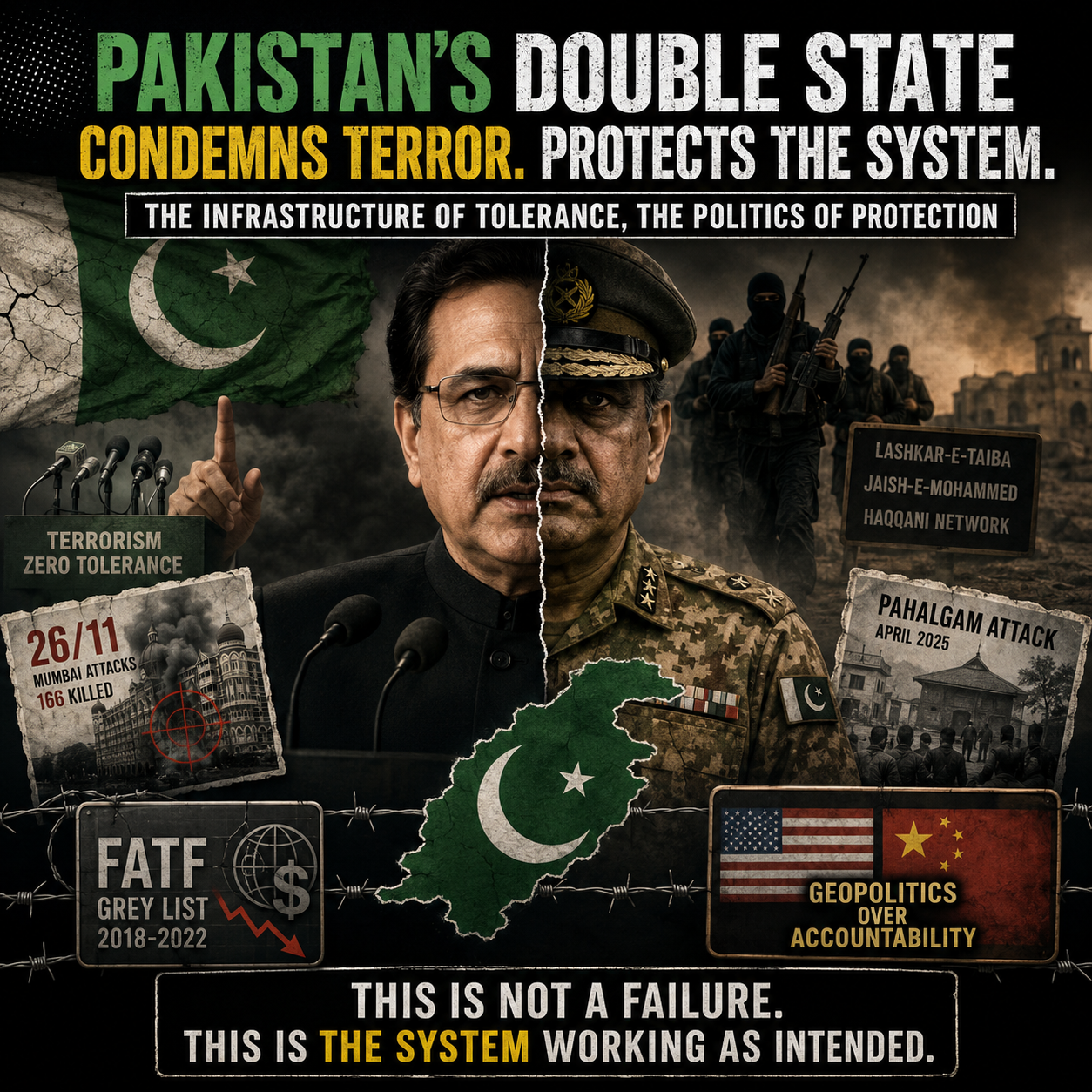
Dar Al Harb Ambivalence Pakistan: Pakistan’s ambivalence is not a gap between condemnation and substrate. It is a bifurcated state architecture — two parallel policies operating simultaneously as official strategy. FATF named it. Geopolitics rescued it. Pahalgam confirmed it. The distinction from Saudi Arabia and Qatar is structural. Saudi Arabia’s Wahhabi establishment and its royal family are in permanent tension — the 1979 Grand Mosque seizure documented the tension becoming operational. Qatar’s royal family and its Brotherhood funding represent a strategic choice rather than a domestic political necessity. Pakistan’s bifurcation runs deeper: the ISI — Pakistan’s primary intelligence service and a state institution — has maintained operational relationships with organisations that its government publicly designates as security threats. This is not a rogue agency. It is a feature of the Pakistani state architecture that has been documented across three decades of judicial proceedings, intelligence assessments, and diplomatic cables in India, the United States, Afghanistan, and Pakistan itself.
The US State Department’s Country Reports on Terrorism have documented Pakistan-based organisations responsible for cross-border attacks across multiple consecutive years — Lashkar-e-Taiba responsible for the 2006 Mumbai train bombings killing 209 and the 2008 26/11 attacks killing 166, Jaish-e-Mohammed responsible for the 2019 Pulwama attack killing 40 Indian paramilitary personnel, and the Haqqani Network responsible for multiple major attacks in Afghanistan. All three operated from Pakistani territory. All three maintained ISI relationships that multiple judicial proceedings across three countries have documented. Pakistan’s government condemned each attack publicly. Pakistan’s state architecture sustained the operational infrastructure that made each attack possible.
The Dar Al Harb Ambivalence Pakistan’s bifurcation is most precisely visible in the 26/11 case. Blog 61 (Dar Al Harb Hardened) documented the invoice the manufactured extremism has presented across four continents. The 26/11 attacks represent the invoice’s most precisely documented Pakistan connection — the Lashkar-e-Taiba attack was planned on Pakistani soil, trained on Pakistani soil, launched from Pakistani soil, and operationally supported through Pakistani communications infrastructure. The Pakistani government condemned the attacks. The Pakistani judicial system prosecuted Zaki-ur-Rehman Lakhvi — the operation’s commander — for years in proceedings that consistently failed to produce conviction or meaningful detention. The bifurcation between the condemnation and the operational infrastructure is not accidental. It is structural to a state that uses non-state armed actors as instruments of foreign policy while maintaining the condemnation as the international face of that policy.
📌 The Saudi-Pakistan Architecture the SMDA Formalised
Saudi Arabia signed a mutual defence pact with Pakistan in September 2025 — bringing in as its replacement security guarantor a state whose ISI is the primary operational channel of the Dar Al Harb Ambivalence’s most damaging expression.
Dar Al Harb Ambivalence Pakistan: The FATF Verdict and Its Geopolitical Rescue
The Financial Action Task Force grey-listed Pakistan from June 2018 to October 2022 specifically for failure to prosecute terrorist financing — a formal multilateral verdict that Pakistan’s financial system was being used to sustain the operational infrastructure of organisations its government publicly condemned. Pakistan was grey-listed not for supporting terrorism in theory but for maintaining the financial architecture that sustained it in practice while publicly declaring that it was being dismantled. The FATF grey-listing is the international financial system’s equivalent of the rope-and-snake observation: the international community seeing the snake and being told repeatedly it is a rope, eventually running its own assessment and finding the fang marks.
The Dar Al Harb Ambivalence Pakistan’s FATF chapter does not end with the grey-listing. Pakistan’s exit from the grey list in October 2022 was not earned through genuine dismantlement. It was geopolitically managed. The United States and China — whose st rategic interests in Pakistan’s stability diverge on every other question but converge on the shared interest in avoiding Pakistan’s financial system’s formal exclusion from global dollar clearing — exercised their FATF weighted influence to prevent escalation from grey-listing to black-listing and to facilitate exit. The Dar Al Harb Ambivalence Pakistan operates not only within Pakistan’s state architecture but within the multilateral framework designed to monitor it: the same geopolitical interests that make Pakistan’s bifurcation structurally stable make the international monitoring system’s enforcement structurally limited.
The evidence that the Dar Al Harb Ambivalence Pakistan persists is not historical. It is current. The April 2025 Pahalgam attack — in which 26 civilians were killed in Indian-administered Kashmir — was followed by documented public appearances in which designated terrorist organisations and their leaders shared stages with Pakistani authorities, and in which coffins of terrorists killed in subsequent Indian military action were carried by Pakistani officials. Reuters documented Pakistani officials appearing at public ceremonies alongside representatives of organisations listed as terrorist entities by multiple governments. Pakistan remains outside the FATF grey list as of May 2026 — not because the snake has become a rope but because the states with the power to name it prefer, for their own strategic reasons, to continue calling it by the safer name.
Dar Al Harb Ambivalence Pakistan: The Universal Institutional Pattern
The Dar Al Harb Ambivalence’s closing argument prevents the analysis from being read as a civilisational indictment of Islam or of Muslim-majority states. The pattern documented across Saudi Arabia, Qatar, and Pakistan is not Islamic. It is institutional — and its most recognisable expressions in the Western world are precise mirrors of the three cases above.
The Catholic Church spent decades condemning child abuse in every public statement while internally managing perpetrators, suppressing victims, and protecting institutional reputation over human cost — the same logic as Saudi Arabia condemning ISIS while protecting the Wahhabi curriculum that ISIS draws from. The tobacco industry funded carcinogen research, received results showing lethal causation, and spent fifty years calling it a rope in public while the substrate continued to kill — the same logic as Qatar funding the Brotherhood while condemning terrorism in multilateral forums. American gun manufacturers call mass shooting statistics a rope while Washington calls Pakistan’s terrorism infrastructure a rope — the same state, two different substrates, one institutional logic: the revenue from maintaining the substrate exceeds the reputational cost of the condemnation until the cost becomes existential.
The Dar Al Harb Ambivalence Pakistan closes with the observation that makes the analysis universal. The difference between the Western cases and the three documented in Blogs 62 and 63 is not moral. It is in the nature of the substrate: cigarettes and guns kill their own populations. The Dar Al Harb substrate — the jihadist theology, the madrassa infrastructure, the ISI operational channels — kills at home and across borders, across religions, and across the civilisational lines that the doctrine itself draws. Blog 35 (Manufactured Instability Reckoning) documented Washington manufacturing the instability it uses to justify intervention. The Dar Al Harb Ambivalence is that manufacture’s institutional maintenance phase — and it is not maintained by three states alone. It is maintained by the entire network of geopolitical relationships that makes accountability — whether through FATF, through the UN Security Council, or through bilateral pressure — structurally impossible for the states with the power to apply it. This is not a failure of the international system. It is the international system functioning precisely as the states that designed it require. Blog 14 (Responsibility Blockade) named the mechanism — Washington assigns consequences to others for behaviours it practices itself. The Dar Al Harb Ambivalence Pakistan is the mechanism applied to the multilateral accountability framework.
📌 The Geopolitical Rescue That Made FATF Accountability Impossible
Washington’s Global Control War — the war against economic independence from Washington — and why Pakistan’s strategic position makes its grey-listing geopolitically unacceptable to both the US and China simultaneously.
Next: Iran’s Revolutionary Doctrine — Blog 64 in West Asia’s Endless War examines the third observation from the peer review of the Dar Al Harb Doctrine series: Iran does not publicly invoke Dar al-Harb, but its 1979 revolutionary constitution’s Mustad’afin mandate, its proxy architecture across four countries, and forty-seven years of strategic constraint produce a state whose silence on the doctrine is calculation, not conversion. The silence is not surrender. It is discipline. Part of the West Asia’s Endless War Series on hinduinfopedia.com.
Feature Image: Click here to view the image.
Videos
Glossary of Terms
- Dar Al Harb Ambivalence: A phrase used in the series to describe the institutional contradiction in which states publicly condemn extremism while simultaneously preserving ideological, financial, or operational systems linked to it.
- Bifurcated State Architecture: A governing structure where two parallel policies operate simultaneously, one for public international diplomacy and another for strategic or covert operational purposes.
- FATF (Financial Action Task Force): An international body that monitors money laundering and terror financing. Pakistan remained on its grey list from two thousand eighteen to two thousand twenty two over deficiencies in counter terror financing measures.
- Lashkar e Taiba: A Pakistan based militant organisation accused of carrying out the two thousand eight Mumbai attacks that killed one hundred sixty six people.
- Jaish e Mohammed: A Pakistan based militant organisation accused of conducting the two thousand nineteen Pulwama attack in Jammu and Kashmir.
- Haqqani Network: An armed Islamist network active in Afghanistan and Pakistan, frequently accused by Western intelligence agencies of maintaining links with elements inside Pakistan’s security establishment.
- Twenty Six Slash Eleven Mumbai Attacks: Coordinated terrorist attacks in Mumbai in November two thousand eight involving shootings and bombings across multiple locations.
- Pahalgam Attack: A two thousand twenty five militant attack in Indian administered Kashmir referenced in the blog as a contemporary example in the Pakistan accountability debate.
- Grey List: A monitoring category used by FATF for countries placed under increased scrutiny for weaknesses in financial controls related to money laundering or terror financing.
- Proxy Warfare: A conflict model in which states indirectly support non state actors or armed groups to advance strategic objectives without formal direct military engagement.
- Responsibility Blockade: A phrase coined in the series describing the geopolitical practice where powerful states prevent or dilute accountability mechanisms against strategic allies.
- Manufactured Instability: A recurring concept in the series describing how geopolitical powers sustain instability in certain regions to justify intervention, influence, or strategic control.
- Operational Infrastructure: The combined financial, logistical, communication, training, and territorial systems that allow militant organisations to function.
- Strategic Assets Doctrine: A term used by analysts to describe the belief that certain militant groups are treated as instruments of regional strategy rather than purely as security threats.
- Institutional Maintenance Phase: A phrase used in the series to describe the stage where international systems preserve and normalize existing geopolitical arrangements despite public condemnation.
#Pakistan #FATF #Terrorism #MumbaiAttacks #Pahalgam #Geopolitics #SouthAsia #WestAsia #ISI #HinduinfoPedia
West Asia’s Endless War: Why This Series Exists
[…] https://hinduinfopedia.com/dar-al-harb-ambivalence-pakistan-a-reckoning-of-west-asias-endless-war-63… […]
[…] whose democratisation of political Islam is existentially threatening to hereditary monarchy. Blog 63 (Dar Al Harb Ambivalence Pakistan) documented Pakistan’s bifurcated state architecture maintaining operational relationships […]
[…] Blog 63 (Dar Al Harb Ambivalence Pakistan) established Pakistan’s bifurcated state architecture — two parallel policies operating simultaneously as official strategy. Pakistan’s ISI has maintained documented operational relationships with Lashkar-e-Taiba, Jaish-e-Mohammed, and the Haqqani Network — organisations whose theology is the Wahhabi-Deobandi maximalist synthesis that simultaneously threatens the Saudi monarchy’s domestic legitimacy. The SMDA brings Pakistan’s army into Saudi Arabia as a supplementary security force against the internal Islamist challenge that the 1979 Grand Mosque seizure first made visible. Blog 62 (Dar Al Harb Ambivalence) documented that Saudi Arabia uses American military forces to contain the domestic Wahhabi threat while funding the same Wahhabi infrastructure abroad. The SMDA replaces the American forces with Pakistani forces — whose ISI maintains institutional relationships with the Brotherhood-adjacent organisations that represent precisely the ideological threat the Pakistani forces are supposed to suppress. The US State Department’s own Country Reports on Terrorism document Pakistan-based organisations responsible for attacks across multiple consecutive years — the same Pakistan whose army is now the SMDA’s primary military instrument. […]