

Manufactured Extremism: A Reckoning of West Asia’s Endless War (77)
Part 77 of the West Asia’s Endless War Series on hinduinfopedia.com
भारत / GB
Washington Did Not Make Bitter Gourd From Sugarcane. It Found a Dagdhabeej Seed That Was Losing Its Potency — and Revived It. Provided the Three Raktbeej Germination Essentials. Created the Self-Replicating Condition That Natural Decay Would Have Prevented. The War on Terror Has Been Spraying DDT on the DDT-Resistant Organisms Washington Bred by Spraying DDT on Their Predecessors.
Blog 76 (Iran Decapitation Template) established that the template applied to Iran three times produced a more resistant organism each time — because the method of attack is the mechanism of replication. Blog 77 examines the same mechanism applied to the theological infrastructure: the Manufactured Extremism arc that Blogs 60-63 documented in the Dar Al Harb sequence, now assembled as the complete historical argument. From the Dagdhabeej seed losing potency to the Raktbeej condition Washington created to the DDT-resistant organisms the War on Terror has produced — the full arc of what Washington built, what it has been fighting, and why the instrument consistently deepens the condition it was designed to address.
Manufactured Extremism: The Seed Was Always Bitter Gourd
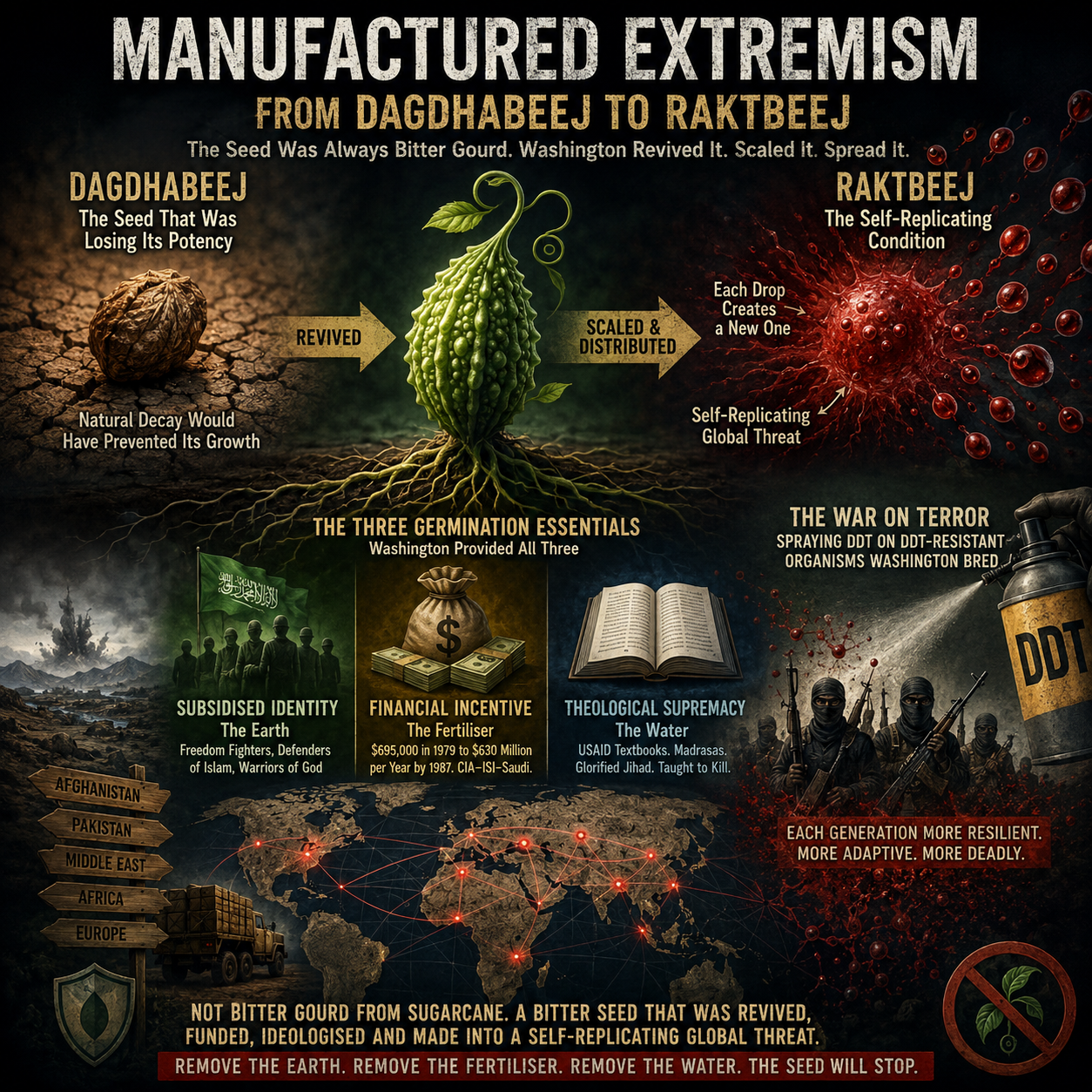
Manufactured Extremism: The Wahhabi seed was Dagdhabeej — losing potency through internal contradiction. Washington revived it, provided the three Raktbeej germination essentials, and created the self-replicating condition. The War on Terror has been spraying DDT on DDT-resistant organisms Washington bred by spraying DDT on their predecessors. The Manufactured Extremism argument begins with the precise correction that Blog 60 (Dar Al Harb Doctrine) established: Washington did not make bitter gourd from sugarcane. The seed was always bitter gourd. The Wahhabi theological tradition — carrying the takfir doctrine, the obligation of jihad against un-Islamic governance, the maximalist interpretation of Dar al-Harb — existed since Muhammad ibn Abd al-Wahhab’s 18th century compact with the House of Saud. The bitterness was always there.
What was also there — and what the Manufactured Extremism argument requires naming precisely — is the seed’s condition before Washington’s intervention. The Wahhabi seed was not merely dormant. It was Dagdhabeej. Within the Patanjali Yoga Sutra tradition, the Dagdhabeej principle identifies a seed that has been roasted until it loses germinating capacity — it remains but cannot colonise the future. The Raktbeej and Starfish Thesis on hinduinfopedia.com applies this precisely: the Wahhabi seed had not produced a single global jihadist movement in two centuries. The Ottoman Caliphate had collapsed. Pan-Islamic political unity had failed repeatedly. The Shia-Sunni irresolvability, the monarchy-jihadism tension, and the caliphate’s repeated failure were producing fragmentation rather than consolidation. The natural trajectory of the seed, left to the passage of time and its own internal contradictions, was toward impotence. Washington removed the passage of time.
The distinction matters analytically because it determines the series’ historical accountability argument. Washington did not create the extremist impulse. Washington revived a seed that was burning itself out — and in reviving it, created the Raktbeej condition that the natural Dagdhabeej process would have prevented. The manufacturer did not make the bitterness. The manufacturer prevented the bitterness from completing its natural decay, scaled its production to industrial level, and distributed the product across four continents before the natural decay could resume.
📌 The Hardening That Produced the Raktbeej Condition
$695,000 in 1979 growing to $630 million per year by 1987. CIA-ISI-Saudi Arabia. USAID textbooks. 100,000 trained fighters. The manufacturing sequence that converted the Dagdhabeej seed into the Raktbeej condition.
Manufactured Extremism: The Three Germination Essentials Washington Provided
The Raktbeej and Starfish Thesis identifies the three essentials that any Raktbeej blood drop requires to germinate into a new demon: Subsidised Identity as the earth, Financial Incentive as the fertiliser, and Theological Supremacy as the water. Washington’s Afghan proxy operation provided all three simultaneously — creating not merely a local insurgency but the self-replicating global Raktbeej condition.
Subsidised Identity — the earth.
The mujahideen were given a comprehensive identity architecture: freedom fighters against Soviet oppression, defenders of Islamic civilisation, warriors of God against the atheist empire. Reports documented that Washington’s identity manufacturing was deliberate — the Carter and Reagan administrations framed the Afghan jihad in terms that gave the fighters an ideological identity that transcended their geographic, tribal, and theological diversity. The subsidised identity was not Wahhabi in origin — Afghanistan’s religious tradition was Sufi and Hanafi, far from the Wahhabi maximalism the operation imported. The identity was manufactured by the same external power that provided the money: Washington subsidised the Wahhabi identity to replace the local tradition, creating the earth in which the Raktbeej seed could germinate where it could not have germinated naturally.
Financial Incentive — the fertiliser.
The Guardian documented that CIA funding through the ISI grew from $695,000 in 1979 to $630 million per year by 1987 — matching dollar for dollar by Saudi Arabia, producing a total annual investment of over $1.2 billion at peak. The financial incentive architecture converted jihadist activity from a theological vocation into a commercial one: fighters were paid, madrassas were funded, weapons were supplied, families were compensated. The Raktbeej blood could now land on financially prepared ground. Each drop that hit the earth — each fighter, each madrassa graduate, each trained commander — was sustained by a financial architecture that made continued engagement economically rational rather than requiring pure theological conviction. The fertiliser was applied at industrial scale for a decade.
Theological Supremacy — the water.
USAID-funded textbooks printed at the University of Nebraska — distributed across Pakistan’s madrassa network — glorified violent jihad, presented the killing of non-believers as a religious obligation, and taught arithmetic through the counting of weapons and dead enemies. The theological infrastructure was not imported from the Wahhabi tradition alone — it was manufactured in Nebraska, distributed through ISI channels, and presented to a generation of madrassa students as the authentic Islamic teaching. The water that completed the Raktbeej germination condition was produced by the same state that funded the identity and supplied the financial incentive. All three essentials came from the same source. The Raktbeej condition — requiring all three simultaneously for germination — was comprehensively provided.
Manufactured Extremism: The DDT-Resistant Organism and the War on Terror
The Manufactured Extremism’s third dimension is the one the series has been building toward since Blog 1: the War on Terror is the instrument whose application deepens the condition it was designed to address. Not because the instrument is ineffective in isolation — individual operations have eliminated individual targets — but because the instrument is categorically the wrong response to the Raktbeej condition it faces.
The DDT analogy is precise. DDT was effective against mosquitoes in the 1940s. Mosquito populations exposed to DDT developed resistance through natural selection: the susceptible individuals died, the resistant individuals survived and reproduced. Each generation of DDT application eliminated the susceptible and selected for the resistant — producing, after several cycles, a mosquito population that DDT cannot kill. The World Health Organization documented DDT resistance emerging across multiple mosquito species globally — the direct consequence of the insecticide’s partial effectiveness. The 90,000 fighters trained in Afghanistan trained others. Al-Qaeda trained ISIS. ISIS trained its affiliates. Each generation is more operationally experienced, more ideologically hardened, more geographically distributed, and more resistant to the suppression instruments that eliminated the previous generation. CSIS documented that despite nearly two decades of US-led counterterrorism operations, there are nearly four times as many Sunni Islamic militants today as there were on September 11 2001 — 67 Salafi-jihadist groups across the globe in 2018, up from fewer than 10 in 2001.
The Manufactured Extremism argument closes with the observation that Brzezinski’s 1998 confession — documented in Blog 61 — is not a statement about the past. It is a statement about the present. “What is most important to the history of the world? The Taliban or the collapse of the Soviet empire? Some stirred-up Moslems or the liberation of Central Europe?” The stirred-up Moslems are now the global jihadist movement whose DDT-resistant organisms operate across five continents, whose Raktbeej condition the War on Terror cannot resolve because the War on Terror is the DDT, and whose connection to the Hormuz war of 2026 runs through the same CIA-ISI-Saudi Arabia manufacturing channel that Blog 61 documented. The Islamic Republic was born in Paris from Western liberal policy. The global jihadist movement was born in Peshawar from Western covert policy. Blog 67 (The West That Built Its Enemy) documented both in the same year. The Manufactured Extremism argument closes with the Dagdhabeej principle’s prescription: the only resolution available is the withdrawal of the three germination essentials — the subsidised identity, the financial incentive, and the theological supremacy — that Washington provided and that every actor sustaining the Raktbeej condition has maintained since. Not more DDT. The removal of the water, the fertiliser, and the earth that makes the seed germinate. Washington’s Global Control War is prosecuted with the instrument that deepens the condition. The condition will not resolve until the instrument is recognised as the mechanism of replication rather than the mechanism of elimination.
📌 The Dar Al Harb Ambivalence That Maintains the Condition
Saudi Arabia, Qatar, and Pakistan — publicly condemning the product while maintaining the three Raktbeej germination essentials. The condemnation industry and the substrate it launders are the same institution.
Next: Philosophy Real Battlefield — Blog 78 in West Asia’s Endless War examines the series’ most fundamental argument: the real battlefield is not Hormuz, not the West Bank, not the Afghan madrassa network. It is the framework through which populations understand their condition. Whoever names the conflict controls its outcome. Washington’s freedom-and-democracy universalism, Iran’s Mustad’afin universalism, the Global South’s resource-imperialism narrative, and the Raktbeej ecosystem’s martyrdom curriculum are all competing for the same cognitive territory. The philosophy is not the commentary on the war. It is the war’s primary theatre. Part of the West Asia’s Endless War Series on hinduinfopedia.
Feature Image: Click here to view the image.
Videos
Glossary of Terms
- Manufactured Extremism: A key concept in this blog describing the argument that existing extremist ideologies were not created by external powers but were amplified, financed, institutionalized, and globalized through geopolitical intervention.
- Dagdhabeej: A Sanskrit term meaning “burnt seed.” In the series, it refers to an ideology or movement that still exists but is gradually losing its ability to expand or reproduce due to internal contradictions and historical decline.
- Raktbeej: A demon from Hindu tradition whose spilled blood generated new demons. In this series, it symbolizes self-replicating ideological or militant movements that regenerate faster than conventional suppression can eliminate them.
- Raktbeej Condition: The self-replicating environment created when ideological identity, financial support, and doctrinal legitimacy combine to continually reproduce extremist networks.
- Raktbeej and Starfish Thesis: A framework developed in the series arguing that decentralized ideological movements behave like both Raktbeej and a starfish—capable of regeneration even when individual parts are destroyed.
- Subsidised Identity: The first Raktbeej germination essential. It refers to externally supported narratives that provide individuals with a powerful collective identity and mission.
- Financial Incentive: The second Raktbeej germination essential. It refers to monetary support, funding networks, compensation structures, and institutional resources that sustain militant ecosystems.
- Theological Supremacy: The third Raktbeej germination essential. It refers to doctrinal claims asserting exclusive religious legitimacy, thereby providing ideological justification for expansion and conflict.
- Dar al-Harb: An Islamic jurisprudential concept traditionally translated as “Abode of War,” referring to territories outside Islamic governance. The series examines its role in ideological mobilization and conflict narratives.
- Takfir: The practice of declaring another Muslim to be an unbeliever or apostate. It has historically been used by some extremist groups to justify violence against fellow Muslims.
- Wahhabism: An 18th-century Islamic reform movement associated with Muhammad ibn Abd al-Wahhab and later linked to the Saudi state. The blog discusses its influence on modern jihadist ideologies.
- Operation Cyclone: The covert CIA program that supported Afghan resistance fighters during the Soviet-Afghan War, becoming one of the largest covert operations of the Cold War.
- Mujahideen: Islamic fighters engaged in jihad. In the Afghan context, the term refers to anti-Soviet resistance groups supported by multiple foreign governments during the 1980s.
- War on Terror: The global military, intelligence, and security campaign launched after the September 11 attacks to combat terrorist organizations and transnational extremist networks.
- DDT-Resistant Organism: A central analogy in the blog comparing adaptive extremist networks to insect populations that evolve resistance after repeated exposure to the same suppression method.
#WestAsia #MiddleEast #Iran #Terrorism #Jihad #CIA #Afghanistan #SaudiArabia #Geopolitics #WarOnTerror #Islamism #History #Conflict #GlobalPolitics #HinduinfoPedia
West Asia’s Endless War: Why This Series Exists
Refer to Various Arks Referred to in the Blog
https://hinduinfopedia.com/proof-of-endless-war-master-reference-table/
[…] भारत / GB […]
[…] https://hinduinfopedia.com/manufactured-extremism-a-reckoning-of-west-asias-endless-war-77/ […]