

The Art of Not Fighting: A Reckoning of West Asia’s Endless War (78)
Part 78 of the West Asia’s Endless War Series
भारत / GB
The Art of Not Fighting Was Written 2,500 Years Ago in China, Encoded in India’s Oldest Epic, Demonstrated in Hindu Civilisational Organisation, and Confirmed by Modern Western Commercial History. Iran Practiced It for 47 Years. Washington Violated Every Principle. The Entity That Chose When Not to Fight Is Collecting Tolls. The Entity That Fought Every Time Is Trapped.
Blog 77 (Manufactured Extremism) established the Dagdhabeej-to-Raktbeej arc — Washington reviving an impotent seed, creating the self-replicating condition, and then spraying DDT on DDT-resistant organisms it bred by spraying DDT on their predecessors. Blog 78 examines the philosophical and strategic architecture that explains why Washington keeps spraying DDT and why Iran keeps producing resistant organisms: the Art of Not Fighting — the accumulated wisdom of multiple civilisational traditions that identifies the single strategic principle separating the entities that won from the entities that lost across every theatre the series has documented.
The Art of Not Fighting: Four Traditions, One Principle
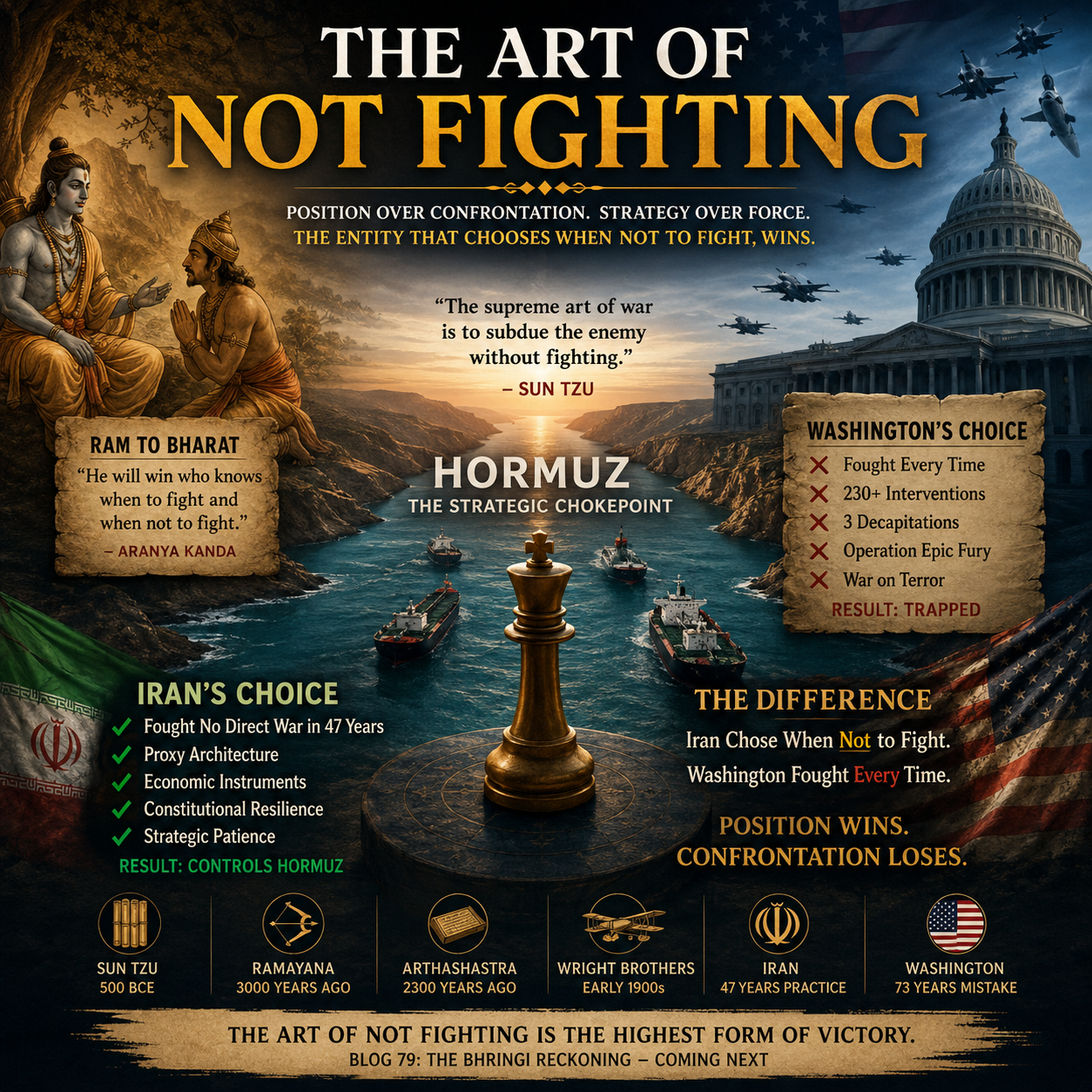
The Art of Not Fighting: Sun Tzu wrote it 2,500 years ago. Valmiki encoded it in Aranya Kanda. The Wright Brothers proved its cost. Iran practiced it for 47 years. Washington violated every principle. The entity that chose when not to fight is collecting tolls. The entity that fought every time is trapped. The principle is consistent across every tradition that has examined strategic conduct: the entity that selects its battles — that builds position rather than winning arguments, that outlasts the adversary through patience rather than exhausting itself through force — defeats the entity that fights every battle, wins every argument, and loses the position.
Sun Tzu — The Art of War, 500 BCE:
Sun Tzu wrote in Chapter Three: “The supreme art of war is to subdue the enemy without fighting.” And in Chapter Three: “He will win who knows when to fight and when not to fight.” These are not motivational aphorisms. They are the strategic observations of a philosopher who documented, across thirteen chapters, that force is the most expensive and least reliable instrument available to any strategic actor. Britannica documents The Art of War as one of the oldest and most influential military treatises in the world — its core insight being that the highest strategic achievement is victory without battle. The cheapest victory is the one that requires no battle. The most expensive defeat is the one produced by fighting every battle.
Applied to the Hormuz war: Iran has not fought Washington directly in a single conventional engagement across 47 years. Every Iranian action has been through proxies, through economic instruments, through the constitutional architecture designed to survive without direct engagement. Washington has fought directly every time — 230 interventions, three decapitations, Operation Epic Fury, the War on Terror. The Hormuz Logical Trap (Blog 56) is what happens when an entity that fights every battle encounters an entity practicing the Art of Not Fighting. The trap has no exit because the trapped entity does not know how to stop fighting.
Valmiki’s Ramayana — Aranya Kanda, Sarga 33:
Before Bharat could explain why he had come to Chitrakoot, Bhagwan Ram asked him a detailed series of questions about statecraft — not about the throne, not about Kaikeyi, not about Dasharatha’s death. Ram’s first concern was governance: *”yeSaam nara indraaNaam caaraH ca koshaH ca nayaH ca a sva adhiinaa te praakR^itaiH janaiH samaaH”* — those kings that do not retain spies, treasuries and strategies under their own control, but vouchsafe them to others, they are of a piece with the peasantry (Verse Number may differ from publisher to publisher and Edition to Edition).
Ram’s questions to Bharat are the series’ most precise diagnostic instrument applied to every actor in the Hormuz war. Does Washington retain its spies under its own control? The DIA Director was fired for honest reporting. Does it keep counsel secret? Hegseth told Congress before a War Powers vote that the administration ignores their authority. Does it see situations distantly through long-sighted intelligence? The Hormuz closure happened within 24 hours through standing orders Washington did not know existed. By Ram’s statecraft standard, Washington has vouchsafed its spies, its treasury, and its strategies — and has become of a piece with the peasantry.
Iran answers Ram’s questions differently. Secret counsel — the IRGC Mosaic’s standing orders whose existence Washington discovered only when they activated. Multiple layers of intelligence — the four-proxy architecture each operating independently. Long-sighted vision — proxy positioning across Lebanon, Gaza, Yemen, and Iraq across three decades before the war began. Blog 39 (IRGC Mosaic Reckoning) documented the architecture. The Aranya Kanda prescribed it 3,000 years earlier.
📌 The War Logic That Practiced This Principle
Three doctrines — Mustad’afin mandate, Velayat-e Faqih, IRGC Mosaic — that make compliance structurally impossible and the Art of Not Fighting structurally sustainable. The organism that chose when to fight and when not to fight.
The Art of Not Fighting: The Varna Observation and the Wright Brothers
The Hindu varna observation — programmed behavioural patterns and civilisational memory:
Hindu civilisational philosophy observes that different communities and cultures develop distinct strategic temperaments shaped by centuries of accumulated memory. The Vaishya orientation — the merchant-accumulator mode — is wired to prioritise long-term position-building, commercial resilience, risk avoidance in direct confrontation, and compounding advantage through patience. The Kshatriya orientation — the warrior-protector mode — is wired toward direct engagement, honour defence, immediate confrontation, and the acceptance of battle as a necessary cost of dignity.
These are not rigid castes but archetypal patterns of civilisational thinking. Hindu philosophy did not invent them; it named and analysed tendencies visible across human societies. The same Vaishya-like strategic memory appears wherever a civilisation chooses accumulation over exhaustion: the Gulf Arab monarchies’ careful diversification (UAE’s post-OPEC positioning, commercial realignment via Abraham Accords), and China’s decades-long economic patience (petroyuan architecture, Belt and Road positioning). None of these actors needed to fight major wars to advance their position. They simply refused to fight on unfavourable terms.
In contrast, Washington’s post-1953 strategic culture operates in a predominantly Kshatriya mode — programmed to engage, project power directly, and treat non-confrontation as weakness. Hindu philosophy would recognise this as a high-risk orientation when the battlefield is not one of pure military superiority but of endurance, economic resilience, and narrative control. Kautilya’s Arthashastra, written in the same era as Sun Tzu, makes the identical observation: the wise ruler exhausts every instrument of indirect influence before committing force, because force, once used, creates binding obligations and drains the treasury.
The Wright Brothers — the Western cautionary example:
Orville and Wilbur Wright invented powered flight at Kitty Hawk on December 17 1903 — the most consequential single technological achievement of the 20th century. The Smithsonian documented what followed: the Wright Brothers spent the next decade in patent litigation against Glenn Curtiss and other aviation pioneers — winning legal battles, collecting judgements, defending their intellectual property through courts. The argument was won. The position was lost. While the Wright Brothers litigated, the aviation industry developed around them. By the time the patent wars ended, Curtiss and European manufacturers had overtaken the inventors in every practical measure of aeronautical capability. The Wright Brothers died having won every legal argument and lost the technological race to the industry their invention had created.
The application to the series is the Art of Not Fighting’s most precise modern Western illustration: Washington has spent 73 years winning every legal and military argument against Iran — sanctions judgements, UN Security Council resolutions, nuclear deal signings, decapitation operations, Operation Epic Fury. Each argument won. Each judgement collected. The position lost. Iran today controls Hormuz — 20% of global oil — has achieved fourth power status, operates a proxy architecture across four countries, and is charging tolls on shipping while Washington negotiates an MoU it cannot ratify. The Wright Brothers fought the argument. Curtiss built the industry. Washington fought every battle. Iran built the position. The Council on Foreign Relations documented Iran’s consistent pattern of strategic patience — absorbing external pressure while building long-term regional influence through proxy networks and economic positioning rather than direct military engagement.
The Art of Not Fighting: What the Series Has Documented
The Art of Not Fighting closes the series’ ideology arc with its most precise single observation: the strategic wisdom available to any actor in the Hormuz war was not secret, was not modern, and was not difficult to access. Sun Tzu wrote it in 500 BCE. Valmiki encoded it in the Ramayana’s most precise statecraft passage — Ram’s questions to Bharat in the Aranya Kanda. The Hindu civilisational organisation embedded it in the Vaishya temperament’s cultural programming. The Wright Brothers demonstrated its cost by ignoring it in 1903.
Iran read the prescription. Not through any single text but through 47 years of maximum external pressure that progressively eliminated every component of the Iranian strategic architecture that was not Art-of-Not-Fighting grade resilient. Blog 67 (The West That Built Its Enemy) established that Washington created Iran’s organism through the pressure designed to eliminate it. The Aranya Kanda’s prescription — retain your spies, your treasury, and your strategies under your own control; see distantly; keep counsel secret — describes exactly what the IRGC Mosaic, the Mustad’afin mandate, and the Velayat-e Faqih governance model collectively produce. The organism Washington created to fight is the organism that most precisely fulfils Ram’s statecraft prescription.
Washington violated every principle across 73 years: it fought every battle (Kshatriya programming over strategic calculation), vouchsafed its treasury to Gulf states earning zero real return (Blog 49), revealed its strategies before Congressional votes (Hegseth’s pre-vote declaration), fired its intelligence directors for honest reporting, and pursued the Wright Brothers’ path — winning every argument while losing the position to the entity that chose when not to fight. Washington’s Global Control War (Blog 46) is the most comprehensively documented case in modern history of a state with overwhelming force advantage losing position to a state with overwhelming Art-of-Not-Fighting advantage. The prescription was available. The reading was not done. The toll authority is Iran’s. The trap is Washington’s. The Art of Not Fighting’s most important lesson is the one Washington has not yet learned: the art is not in knowing how to fight. It is in knowing when the fight is already lost before the first strike is launched.
📌 The Persian Civilisation That Read the Prescription
3,000 years of civilisational depth — the strategic patience that makes the Art of Not Fighting structurally sustainable across 47 years of maximum external pressure.
Next: The Bhringi Reckoning — Blog 79 in West Asia’s Endless War examines the series’ most concentrated single argument: US tried to capture Iran. US got captured instead. The Bhringi — from the Srimad Bhagavatam’s 24 teachings of Bhagwan Dattatreya — is the organism that captures an insect and hums around it until the insect transforms into the Bhringi’s own kind. Iran is the Bhringi. Washington is the transforming insect. The presidential imprisonment, the censorship apparatus, the military leadership purge conducted on the loyalty criterion — the captured insect becoming its captor’s image. Part of the West Asia’s Endless War Series on hinduinfopedia.
Feature Image: Click here to view the image.
Videos
Glossary of Terms
- Art of Not Fighting: The central strategic principle of this blog, describing the practice of building long-term position, influence, and resilience by avoiding unnecessary direct confrontation and choosing battles selectively.
- Sun Tzu: Ancient Chinese military philosopher and author of The Art of War, famous for advocating victory through strategy, deception, and avoiding costly battles whenever possible.
- Aranya Kanda: A section of the Valmiki Ramayana containing discussions on governance, intelligence gathering, statecraft, and strategic decision-making.
- Bharat: Brother of Bhagwan Ram in the Ramayana, whose meeting with Ram at Chitrakoot includes a celebrated discussion on governance and statecraft.
- Long-Sighted Kings (Dirgha Chakshushah): A Ramayana concept describing rulers who see distant developments through effective intelligence networks and informed statecraft.
- IRGC Mosaic: A decentralized command-and-control structure attributed to Iran’s Islamic Revolutionary Guard Corps, designed to maintain operational continuity even under severe military pressure.
- Mustad’afin Mandate: An ideological concept in Iranian revolutionary thought referring to the protection and support of the oppressed or marginalized.
- Velayat-e Faqih: Iran’s governing doctrine that places ultimate political and religious authority in the hands of a senior Islamic jurist.
- Hormuz Logical Trap: A term coined in this series describing a situation where a superior military power becomes strategically constrained by a weaker actor controlling escalation dynamics around the Strait of Hormuz.
- Proxy Architecture: A network of aligned groups, organizations, or forces that advance a state’s interests without requiring direct military engagement by the sponsoring state.
- Vaishya Orientation: A civilisational archetype discussed in Hindu philosophy emphasizing accumulation, commerce, patience, risk management, and long-term position-building.
- Kshatriya Orientation: A civilisational archetype emphasizing direct engagement, protection, honour, decisive action, and willingness to confront adversaries openly.
- Arthashastra: An ancient Indian treatise on governance and statecraft traditionally attributed to Kautilya, emphasizing diplomacy, intelligence, economics, and strategic restraint before warfare.
- Dagdhabeej-to-Raktbeej Arc: A recurring series concept describing how attempts to eliminate a threat can unintentionally create conditions for its regeneration and multiplication.
- Bhringi Reckoning: A concept introduced for the next blog, derived from the teachings of Bhagwan Dattatreya, symbolizing a process whereby the captor gradually transforms the captured into its own image.
#Iran #Hormuz #MiddleEast #War #Geopolitics #SunTzu #Ramayana #Strategy #US #Persia #Oil #Defense #History #India #HinduinfoPedia
West Asia’s Endless War: Why This Series Exists
Refer to Various Arks Referred to in the Blog
https://hinduinfopedia.com/proof-of-endless-war-master-reference-table/
[…] https://hinduinfopedia.com/the-art-of-not-fighting-a-reckoning-of-west-asias-endless-war-78/ […]
[…] Blog 78 (The Art of Not Fighting) established that the entity which chooses when not to fight — building position through strategic patience — defeats the entity that fights every battle and loses the position. Blog 79 examines what losing the position looks like from the inside: the personal and institutional cost to the President who launched the Hormuz war. Not as a political argument for or against any party. As the documented human consequence of the Hormuz Logical Trap that Blog 56 established has no exit. […]
[…] The Via Media does not remove the pressure. It reclassifies it. Iran’s toll authority, its fourth power status in the world, its proxy architecture across four countries, and its demonstrated ability to […]