

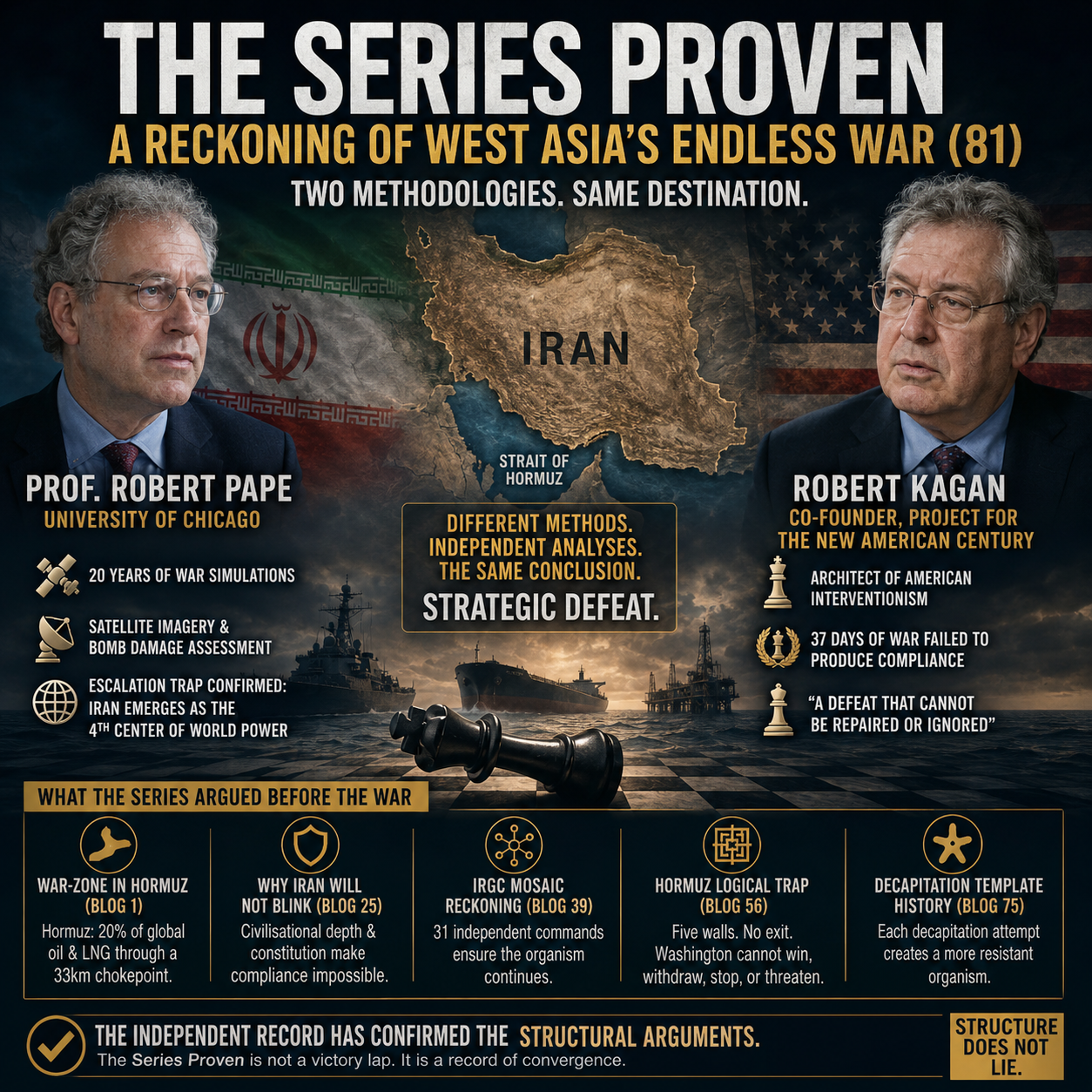
The War Series Proven: A Reckoning of West Asia’s Endless War (81)
Part 81 of the West Asia’s Endless War Series
भारत / GB
The Series Made Arguments Before the Events It Describes. The Independent Record Now Confirms Them. A University of Chicago Political Scientist Arrived at the Same Conclusions Through Satellite Imagery and War Simulations. The Intellectual Architect of American Interventionism Arrived at the Same Conclusions Through the Evidence of His Own Failure. Two Methodologies. Same Destination.
Blog 80 (The Via Media Reckoning) documented Washington’s constructed exit from the Iran trap — not victory, not defeat, but the middle path that allows neither to be named. Blog 81 steps back from the current moment to examine what the series argued across 80 blogs against what two independent analysts from within the Western establishment have now confirmed: Professor Robert Pape of the University of Chicago, and Robert Kagan, co-founder of the Project for the New American Century and one of the intellectual architects of American military interventionism. The War Series Proven is not a victory lap. It is a record of convergence — the series’ framework and the independent analytical record arriving at the same place through different methods.
The War Series Proven: What the Series Argued
The War Series Proven begins with a precise summary of what the series established before the events it describes — not after. The series did not analyse outcomes. It analysed structural conditions and predicted outcomes from those conditions. The War Series Proven documents the structural conditions and the outcomes that confirmed them.
Blog 1 (War-Zone in Hormuz) established that the Hormuz Strait is the world’s most critical single chokepoint — 20% of global oil and LNG through a passage 33km wide at its narrowest. Any conflict activating Iranian control of Hormuz would produce global economic consequences disproportionate to the military exchange.
Blog 25 (Why Iran Will Not Blink) established that Iran’s civilisational depth, constitutional architecture, and distributed military organisation make compliance structurally impossible regardless of the pressure applied. The series argued this before Operation Epic Fury. The Hormuz closure within 24 hours of the opening strikes confirmed it.
Blog 39 (IRGC Mosaic Reckoning) established that Iran’s 31 independent military commands were designed to continue operating after decapitation of the central authority. The series argued this before Khamenei’s assassination. The organism continued without interruption.
Blog 56 (Hormuz Logical Trap) established five walls of the trap — Washington cannot win, cannot withdraw, cannot stop, cannot make a binding deal, cannot credibly threaten. The series argued this before the war produced the MoU with no content, the War Powers revolt, the Senate 50-49 vote, and the Ford’s departure without resolution.
Blog 75 (Decapitation Template History) established that the decapitation template applied to Iran produces a more resistant organism each time — because Washington targets a state and Iran is an organism. The series argued this before Operation Epic Fury. Mojtaba Khamenei was appointed within 72 hours. The organism continued.
These were not predictions of specific events. They were structural arguments about the conditions governing the war’s outcomes. The outcomes have confirmed the structural arguments.
📌 The Hormuz Logical Trap — The Central Argument
Five walls, no exit — established before the war produced the evidence that confirmed each wall. The structural argument the independent record has now validated from outside the series.
The War Series Proven: Professor Robert Pape
Professor Robert Pape is the Director of the Chicago Project on Security and Threats at the University of Chicago. He has advised every White House from 2001 to 2024. He spent 20 years simulating a war with Iran before it began. His Substack — Escalation Trap — is the primary academic commentary on the 2026 Iran war. His Foreign Affairs essay “Why Escalation Favors Iran” documented the structural reasons airpower tactical success cannot produce strategic compliance. His methodology is satellite imagery, bomb damage assessment, and political science theory. The series’ methodology is structural analysis of doctrine, financial architecture, and civilisational history. The two methodologies arrived at the same destination.
Pape told Democracy Now on April 9 2026: “Donald Trump started this war with essentially a three-day air plan. Instead of disabling Iran, causing the regime to collapse, it got stronger. It is now a more vicious, a stronger regime than before.” This is the Decapitation Template History argument (Blog 75) stated through bomb damage assessment rather than doctrine analysis. The template produced a stronger organism. Both methodologies confirmed the same outcome.
Pape posted on X: “Huge strategic defeat for the US, biggest loss since Vietnam. Shows the surge of Iran as the emerging 4th center of world power.” This is the Hormuz Logical Trap argument (Blog 56) stated through strategic assessment rather than structural analysis. The trap produced the strategic defeat both methodologies predicted.
On Iran as fourth global power: “Iran is far stronger than it was just 40 days ago. It is in control of 20% of the world’s oil. It is now an emerging fourth center of power. The United States is on one side, and the rivals are China, Russia and now Iran.” This is the Washington’s Global Control War (Blog 46) argument’s documented outcome — the war designed to preserve unipolarity has accelerated the multipolar transition it was designed to prevent.
Pape’s most precise convergence with the series is his escalation trap mechanism: airpower creates forward positions, positions become targets, targets require protection, protection requires ground forces — a process rather than a series of independent policy decisions. The series documented the structural conditions making this inevitable. Pape documented the observable logistics chain confirming it is underway.
The War Series Proven: Robert Kagan
Robert Kagan is a co-founder of the Project for the New American Century. Senior fellow at the Brookings Institution. Vocal advocate for the Iraq War. One of the three decades’ most prominent intellectual architects of American military interventionism. On May 10 2026 he published “Checkmate in Iran” in The Atlantic.
The significance of Kagan’s Atlantic assessment “Checkmate in Iran” published May 10 2026 is not its content alone. It is its authorship. The series arrived at the structural defeat argument from outside the American foreign policy establishment — through doctrine analysis, financial architecture, and civilisational history. Kagan arrived at it from inside — a man who advocated for the war’s strategic premise for three decades writing: “It’s hard to think of a time when the United States suffered a total defeat in a conflict, a setback so decisive that the strategic loss could be neither repaired nor ignored.”
This is the Toll Booth Survives Reckoning (Blog 29) confirmed by the man who built the intellectual framework that produced the war designed to eliminate the toll booth. The series argued the toll booth would survive before the war began. Kagan confirmed it after 37 days of the most intensive air campaign in the region’s history failed to eliminate it.
The War Series Proven’s closing observation is precise: two independent analysts from within the Western analytical and policy establishment — one through 20 years of war simulation and satellite imagery, one through three decades of advocacy for the strategic premise the war was built on — have arrived at the same conclusions the series established through structural analysis of doctrine, financial architecture, and civilisational history. The War Series Proven’s analytical value is precisely this convergence — which is not proof the series is correct. It is evidence that the structural arguments the series made are visible through multiple analytical methodologies to analysts whose professional interests are not served by confirming them. Blog 65 (Iran’s War Logic) established that Iran’s constitutional architecture was designed to make compliance structurally impossible. The Raktbeej and Starfish Thesis on hinduinfopedia.com established that the organism was designed to replicate under pressure. The War Series Proven documents that the design functioned as designed — confirmed by the University of Chicago and the co-founder of the Project for the New American Century, independently, through methods entirely different from the series’ own.
📌 The Iran Organism That Confirmed Both Analyses
Distributed function, decentralised intelligence, replicative resistance — the three properties that made both Pape’s and Kagan’s assessments structurally inevitable before the first strike was launched.
Next: Every Solution Fails — Blog 82 in West Asia’s Endless War assembles the series’ most complete single argument: every solution Washington has applied to the Iran problem — the 1953 coup, the Shah, the sanctions architecture, the nuclear deal, the decapitation template, Operation Epic Fury, the Via Media — has deepened the condition it was designed to resolve. The Dagdhabeej principle applied to the full 73-year arc. Part of the West Asia’s Endless War Series on hinduinfopedia.com.
Feature Image: Click here to view the image.
Videos
Glossary of Terms
- The War Series Proven: The key phrase of the blog, referring to the argument that conclusions developed throughout the West Asia’s Endless War series were later echoed by independent analysts using different methodologies.
- Hormuz Strait: A narrow maritime passage between Iran and Oman through which roughly one-fifth of the world’s oil and LNG trade passes, making it one of the world’s most important energy chokepoints.
- Operation Epic Fury: The military operation referenced in the series as a major escalation point in the 2026 Iran conflict.
- IRGC Mosaic Structure: A distributed command framework of the Islamic Revolutionary Guard Corps designed to maintain operational continuity through multiple regional commands even during severe disruptions.
- Decapitation Template: A strategic doctrine that seeks to weaken a state or organization by eliminating its top leadership in the expectation that the wider system will collapse.
- Hormuz Logical Trap: A term coined in the series describing a situation in which Washington cannot decisively win, withdraw, stop escalation, secure a binding agreement, or rely on threats to achieve its objectives.
- Escalation Trap: Professor Robert Pape’s concept describing how limited military actions create commitments that require additional deployments and deepen involvement in a conflict.
- Civilisational Depth: The historical, cultural, political, and social continuity of a nation that contributes to its resilience during external pressure or conflict.
- Bomb Damage Assessment (BDA): A military evaluation process used to determine the effectiveness and impact of attacks on strategic targets.
- Project for the New American Century (PNAC): An American policy organization founded in 1997 that advocated a more assertive U.S. global role and military engagement abroad.
- Multipolar Transition: The shift from a world dominated by a single superpower toward a system in which multiple major powers influence international affairs.
- Strategic Defeat: A situation in which military actions fail to achieve their larger political or geopolitical objectives despite tactical successes.
- Via Media: A Latin phrase meaning “middle path,” used in the series to describe a political or diplomatic exit that avoids openly declaring either victory or defeat.
- Raktbeej and Starfish Thesis: A concept developed in the series comparing resilient systems to entities that regenerate or replicate when subjected to external pressure.
- Fourth Center of World Power: A phrase used by Robert Pape to describe Iran’s emergence as a significant independent pole in an increasingly multipolar international system.
#Iran #Hormuz #MiddleEast #Geopolitics #Strategy #War #Energy #USA #WestAsia #HinduinfoPedia
West Asia’s Endless War: Why This Series Exists
Refer to Various Arks Referred to in the Blog
https://hinduinfopedia.com/proof-of-endless-war-master-reference-table/