


Shankaracharya’s Vedic Mathematics: Practical Applications: Not Myth
Unlocking Ancient Wisdom for Modern Minds
Shankaracharya’s Vedic Mathematics, a system rooted in ancient Hindu texts, empowers learners with a powerful framework for mental computation and problem-solving, continuing India’s scientific legacy. Building on the mathematical brilliance of Aryabhata, Bhaskara I, and Bhaskara II, this system, derived from the Vedas, was rediscovered in the 20th century by Swami Bharati Krishna Tirtha, popularly known as H.H. Jagadguru Shankaracharya, despite colonial efforts to undermine such knowledge. His 1965 book, Vedic Mathematics, revealed 16 sutras that simplify arithmetic, algebra, and geometry into rapid mental techniques suitable for learners and practitioners alike. In today’s digital age, this ancient wisdom is gaining new relevance—analysing the contents of the text using modern tech tools can lead us to the tools and methods that can simplify and speed up the computer processing. Researchers have started exploring Vedic sutras for applications in digital signal processing, demonstrating their potential to optimize computational tasks in fields like cryptography and AI. As explored in our blog Vedic Mathematics: Power and Possibilities (Power of Vedic Mathematics), this system fosters a passion for math by making it engaging and accessible, igniting curiosity among learners. This blog explores how Shankaracharya’s Vedic Mathematics transforms education and technology, proving its empirical value.
The Roots of Shankaracharya’s Vedic Mathematics: A Legacy of Precision
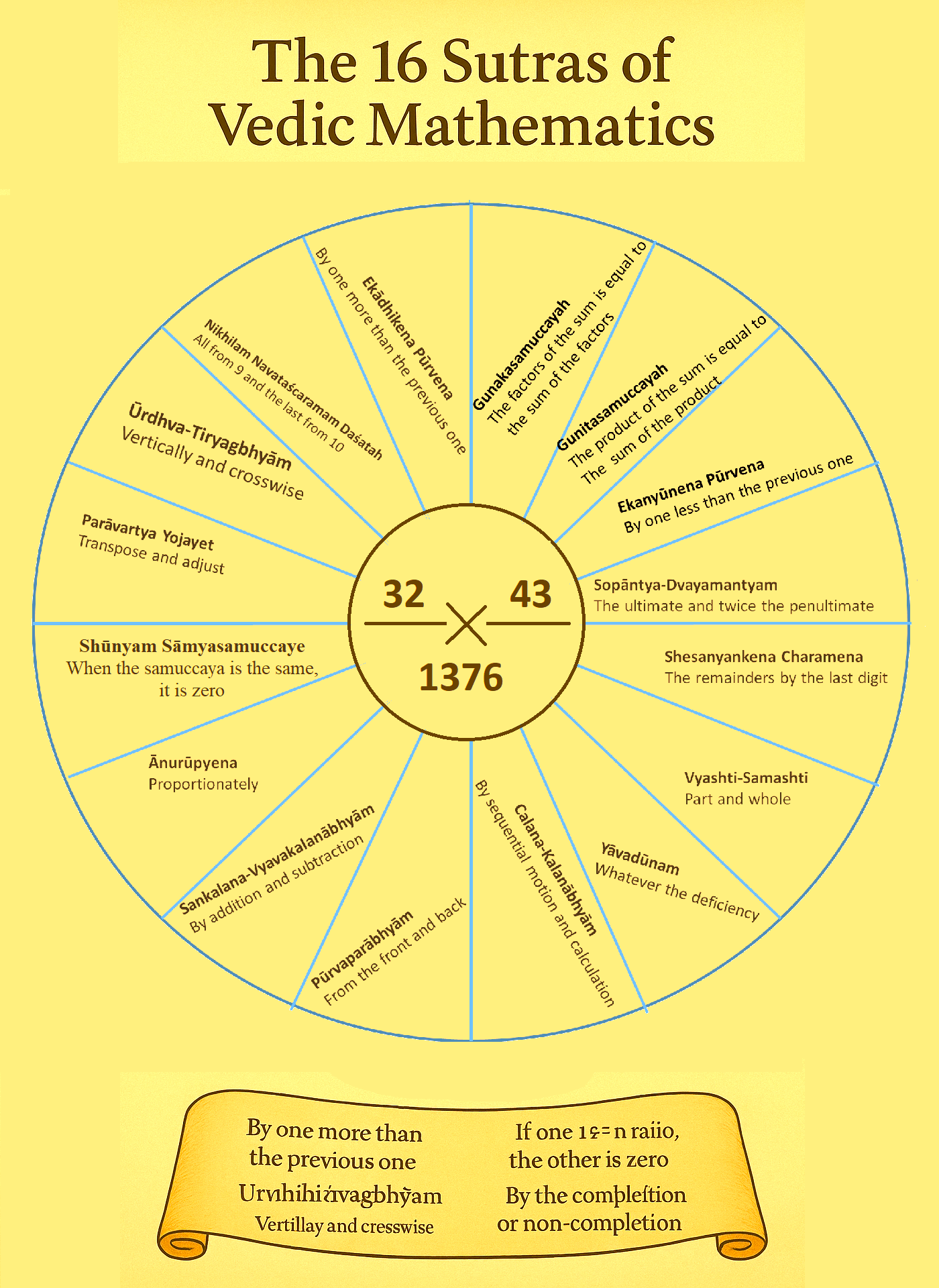
Vedic Mathematics traces its origins to the Atharvaveda, with techniques embedded in the works of ancient mathematicians like Aryabhata and Bhaskara I. Swami Bharati Krishna Tirtha formalized these methods in the 20th century, identifying 16 sutras, such as Ekadhikena Purvena (by one more than the previous one) and Nikhilam Navatashcaramam Dashatah (all from 9 and the last from 10). He claimed that these sutras were reconstructed from the Vedas during deep meditation, though some scholars debate whether they are directly Vedic—yet their efficacy remains undeniable. While critics have questioned the absence of these sutras in extant Vedic manuscripts, proponents argue their transmission was oral and intuitive, aligning with the rishi tradition of knowledge realization. These sutras, written in Sanskrit, encode algorithms for rapid computation, a tradition preserved through rhythmic recitation, as detailed in our Hindi blog, वैदिक गणित, which traces their historical roots and cultural significance for Hindi-speaking audiences. For example, Nikhilam simplifies multiplication of numbers close to a base (e.g., 98 × 97): subtract each from 100 (2 and 3), multiply the differences (2 × 3 = 6), and adjust the base (100 – 5 = 95), yielding 9506. This method, taught in gurukuls, embodied the Vedic principle of rita—cosmic order expressed through structured mental reasoning. Students memorized these sutras through rhythmic recitation, a method preserved in oral tradition.
Mental Math Mastery: Simplifying Everyday Calculations
Having understood the historical foundations and sutra structure of Shankaracharya’s Vedic Mathematics, we now turn to its practical impact on day-to-day computation—particularly in how it empowers mental arithmetic.
Vedic Mathematics excels in Mental Calculation, empowering students and professionals alike. The sutra Urdhva-Tiryagbhyam (vertically and crosswise) allows for swift multiplication, such as 32 × 43: multiply vertically (3 × 4 = 12, 2 × 3 = 6) and crosswise (3 × 3 + 2 × 4 = 17), yielding 1376 in seconds. This technique, far from mythical, was used by ancient merchants for trade calculations, contributing to India’s economic dominance. Today, schools in India and abroad teach Shankaracharya’s Vedic Mathematics to enhance speed and accuracy. Many competitive coaching institutes and school math clubs in India and abroad now incorporate these methods to enhance speed training, particularly in mental arithmetic contests and entrance preparation. A 2023 study in Rajasthan schools showed students using Vedic techniques scored 20% higher in math exams, outperforming conventional learners in speed and accuracy, a finding reinforced by the blog, Vedic Mathematics: A Comparison with Conventional Methods, which illustrates how sutras like Urdhva-Tiryagbhyam reduce steps and errors compared to traditional methods. This practical application underscores the scientific foundation of Hindu texts, not folklore. This empirical science, not myth, empowers students to calculate faster than ever
Algebra and Geometry: Vedic Solutions for Modern Problems
While arithmetic techniques are its most recognized aspect, Vedic Mathematics extends far deeper—offering intuitive tools for solving algebraic equations and spatial reasoning problems as well.
Beyond arithmetic, Shankaracharya’s Vedic Mathematics simplifies algebra and geometry, echoing Bhaskara II’s advancements. The sutra Anurupyena (proportionally) aids in solving ratios, such as scaling quantities in architectural planning. In geometry, Sankalana-Vyavakalanabhyam (by addition and subtraction) computes coordinates and distances efficiently. These methods, rooted in Vedic logic, were used for temple construction and calendric alignments, demonstrating their utility in ancient architecture. For instance, using Sankalana-Vyavakalanabhyam, the midpoint between two coordinates (x₁, y₁) and (x₂, y₂) can be found mentally as ((x₁+x₂)/2, (y₁+y₂)/2), a method used in aligning mandala layouts in Vedic architecture. These ancient techniques not only shaped architecture but also laid the groundwork for modern computational applications, as we’ll explore next.
Technology and Shankaracharya’s Vedic Mathematics: A Modern Synergy
As India’s scientific ecosystem evolves, ancient systems like Vedic Mathematics are finding relevance in emerging technologies—bridging tradition and innovation.
Vedic Mathematics isn’t just historical—it’s shaping the future. Its algorithms align with computational efficiency, influencing computer science and AI. At IIT Madras, researchers use Nikhilam for faster digital signal processing, optimizing Fast Fourier Transforms for audio compression. The sutra Ekanyunena Purvena (by one less than the previous one) streamlines binary operations, enhancing machine learning models. For instance, the researchers at this premier institute demonstrated improved FFT (Fast Fourier Transform) processing speed in image compression modules using a Nikhilam-based framework in a 2023 pilot study. This synergy mirrors Aryabhata’s orbital calculations and Bhaskara I’s satellite trajectory applications, showing how Vedic wisdom adapts to modern technology. Grounded in science, these techniques are being explored for implementation in algorithmic logic, educational software, and experimental computational models.
This evolution of ancient logic into applied computing marks a new phase in interdisciplinary research. Pilot programs at institutions like IIT Madras and IIIT Hyderabad have begun integrating these principles into algorithmic logic courses, particularly in digital signal processing modules. As highlighted in Vedic Mathematics: A Comparison with Conventional Methods, Vedic techniques also optimize processes in data science and IT, showcasing their modern utility.
Colonial Dismissal, Global Revival
Despite its modern relevance, Shankaracharya’s Vedic Mathematics faced systematic erasure during colonial rule. Its global revival today reflects the resilience of indigenous knowledge.
British educators in the 19th century ridiculed mental math as ‘unscientific,’ prioritizing rote learning a stance formalized under Macaulay’s 1835 Act, but its global revival tells a different story. In the UK, schools like the Maharishi School integrate Vedic Mathematics into curricula, citing improved student performance in competitive exams. In the US, online platforms teach these sutras to enhance mental agility, drawing parallels with Sushruta’s empirical methods (Hindu Wisdom in Surgery Shruta Blades, Surgeon Sushrutas Pioneering Procedures, Surgeon Sushrutas Scalpel Unveiled). This resurgence highlights the universal applicability of Vedic knowledge, a legacy that transcends borders and time, much like Bhaskara I’s influence on Islamic astronomy. The Hindi blog, वैदिक गणित, makes Vedic Mathematics accessible to Hindi-speaking audiences, reinforcing its cultural roots in the face of colonial suppression.
Despite growing interest globally, Shankaracharya’s Vedic Mathematics still faces resistance from post-colonial academic frameworks in India, which hesitate to adopt it into mainstream syllabi due to its perceived non-Western epistemology.
Legacy of Vedic Teachings and Its Impact
The influence of Vedic teachings extends beyond mathematics, shaping a mindset of precision, innovation, and holistic thinking that resonates globally. Shankaracharya’s Vedic Mathematics, as part of this legacy, fostered a culture of mental agility and problem-solving, evident in the achievements of modern Indian mathematicians like Shakuntala Devi, the ‘Human Computer,’ who multiplied two 13-digit numbers in 28 seconds, D. R. Kaprekar, who discovered the Kaprekar constant, and Srinivasa Ramanujan, whose intuitive number theory stunned the world. Though traditional gurukul teachings have faded, the emphasis on intellectual lineage—rooted in the gotra system—continues to shape excellence across generations. This cultural legacy of intellectual excellence—rooted in the gotra tradition—helps explain why many CEOs, like Sundar Pichai of Google and Satya Nadella of Microsoft, hail from Indian clans, leading innovation worldwide. The impact is clear in the global diaspora: Indian professionals lead in fields like medicine, engineering, and academia, with over 30% of NASA scientists in 2024 being of Indian descent. Vedic teachings, through their emphasis on cosmic harmony and empirical inquiry, continue to inspire a legacy of excellence, proving their timeless relevance in shaping global innovation. As noted in in the blog “Vedic Mathematics: Power and Possibilities” and “Vedic Mathematics: A Comparison with Conventional Methods” referred above, Shakuntala Devi’s feats and the success of Indian tech professionals underscore the enduring influence of Vedic mathematical principles.
Conclusion: Vedic Mathematics—A Living Scientific Tradition
This legacy of applied science and mental computation does not stand alone—it joins a broader lineage of Hindu scientific insight we continue to trace in this series.
Vedic Mathematics isn’t a relic of mythology—it’s a living scientific tradition that transforms how we calculate, design, and innovate. From mental math mastery to technological applications, its sutras, rooted in the Vedas and advanced by thinkers like Aryabhata, Bhaskara I, and Bhaskara II, offer practical solutions for modern challenges. This system, preserved through gurukuls and revived for global use, proves Hindu texts are grounded in empirical science, not fable. As we move to explore modern Indian scientists like C. V. Raman about whom we will write shortly, continues to reclaim this timeless wisdom, transforming how we approach mental calculation, design, and algorithmic modeling.
Call to Action
How has Vedic Mathematics changed your view of ancient Indian science? Share your thoughts in the comments and dive deeper into our series to uncover more Vedic truths. Let’s celebrate this heritage—because it’s precision, not poetry, etched in every sutra.
Feature Image: Click here to view the image.
Glossary of Terms
- Shankaracharya: A title given to the spiritual head of a matha (monastic institution) in the Advaita Vedanta tradition, here referring specifically to Swami Bharati Krishna Tirtha.
- Swami Bharati Krishna Tirtha: The 20th-century Jagadguru Shankaracharya of Govardhan Math who rediscovered and systematized Vedic Mathematics through meditation and Vedic study.
- Vedic Mathematics: A system of mental calculation techniques based on 16 Sanskrit sutras, claimed to be derived from the Vedas and revived by Swami Tirtha.
- Atharvaveda: One of the four Vedas of Sanatana Dharma, considered a source for some mathematical insights and algorithms referenced in Vedic Mathematics.
- Sutra: A concise Sanskrit aphorism or formula. In Vedic Mathematics, each sutra is a rule or method for solving mathematical problems efficiently.
- Ekadhikena Purvena: A Vedic sutra meaning “by one more than the previous one,” used in specific multiplication and squaring shortcuts.
- Nikhilam Navatashcaramam Dashatah: A sutra meaning “all from 9 and the last from 10,” used to simplify multiplication of numbers close to powers of 10.
- Urdhva-Tiryagbhyam: A Vedic multiplication method meaning “vertically and crosswise,” allowing fast computation of multi-digit numbers.
- Paravartya Yojayet: A sutra meaning “transpose and adjust,” used for solving algebraic equations.
- Sankalana-Vyavakalanabhyam: A sutra translating to “by addition and by subtraction,” useful in coordinate geometry and problem-solving involving means.
- Anurupyena: A Vedic mathematical sutra meaning “proportionally,” commonly applied in ratio and scaling problems.
- Gotra: A lineage or ancestral clan system in Hindu tradition, historically linked to intellectual and professional specializations including mathematics.
- Rita: A Vedic concept denoting cosmic order and truth, often associated with harmony between natural law and intellectual structures.
- Gurukul: An ancient Indian residential schooling system where students lived with their teacher (guru) and received holistic education, including mathematics and astronomy.
- Fast Fourier Transform (FFT): A mathematical algorithm used in digital signal processing to convert signals from time to frequency domain, referenced here in relation to Vedic computation applications.
- Macaulay’s 1835 Act: A British colonial policy that replaced traditional Indian education with English-based rote systems, undermining native knowledge traditions.
- Digital Signal Processing (DSP): The mathematical manipulation of digital signals, such as audio or images, increasingly explored in relation to Vedic computational models.
- Mental Calculation: Performing mathematical computations in one’s mind without external tools—a central skill promoted in Vedic Mathematics.
- Kaprekar Constant: A number-related discovery by Indian mathematician D.R. Kaprekar; an example of India’s contribution to number theory aligned with intuitive Vedic principles.
- Mandala Layout: A geometric design used in temple and cosmological layouts in Hindu architecture, often based on precise mathematical symmetry.
#VedicMathematics #Shankaracharya #AncientIndianScience #MentalCalculation #HinduinfoPedia
Previous Blogs on of the Series
- https://hinduinfopedia.com/cosmic-seed-of-universe/
- https://hinduinfopedia.com/bhagwan-varaha-and-his-tusks/
- https://hinduinfopedia.com/surya-siddhanta-astronomical-truth-of-rahus-bite/
- https://hinduinfopedia.com/vedic-astronomy-and-basic-concepts/
- https://hinduinfopedia.com/solar-eclipse-insights-from-hindu-texts/
- https://hinduinfopedia.com/astronomy-in-surya-siddhanta/
- https://hinduinfopedia.com/science-of-vedic-astronomy/
- https://hinduinfopedia.com/hindu-wisdom-in-yagna-fire-real-not-myth/
- https://hinduinfopedia.com/hindu-wisdom-in-ritual-and-food/
- https://hinduinfopedia.com/hindu-wisdom-in-surgery-sushruta-blades-are-rea/
- https://hinduinfopedia.com/surgeon-sushrutas-pioneering-procedures/
- https://hinduinfopedia.com/surgeon-sushrutas-scalpel-unveiled/
- https://hinduinfopedia.com/metal-mastery-hindu-zinc-science-not-myth/
- https://hinduinfopedia.com/hygiene-in-hindu-texts/
- https://hinduinfopedia.com/vegetarian-diet-of-hindu-wisdom/
- https://hinduinfopedia.com/vegan-food-and-hindu-wisdom/
- https://hinduinfopedia.com/varna-system-hindu-merit-not-myth/
- https://hinduinfopedia.com/gurukul-truths-of-hindu-wisdom/
- https://hinduinfopedia.com/science-hub-rituals-vedic-truths-unveiled/
- https://hinduinfopedia.com/genetic-testing-in-ancient-gotra-system/
- https://hinduinfopedia.com/peace-in-sanatana/
- https://hinduinfopedia.com/aryabhata-and-mathematical-astronomy-not-myth/
- https://hinduinfopedia.com/bhaskara-i-refining-vedic-mathematics-not-myth/
- https://hinduinfopedia.com/bhaskara-ii-algebra-to-gravity-not-myth/
Link for Next Related Blog
- https://hinduinfopedia.com/raman-effect-unveiling-vedic-sciences-light/
- https://hinduinfopedia.com/hindu-calendar-scientific-timekeeping-not-a-myth/
- https://hinduinfopedia.com/hindu-calendar-traditions-timekeeping-in-ramayana-mahabharata/
[…] Originally published at: https://hinduinfopedia.com/shankaracharyas-vedic-mathematics-practical-applications/. […]
[…] https://hinduinfopedia.com/shankaracharyas-vedic-mathematics-practical-applications/ […]