

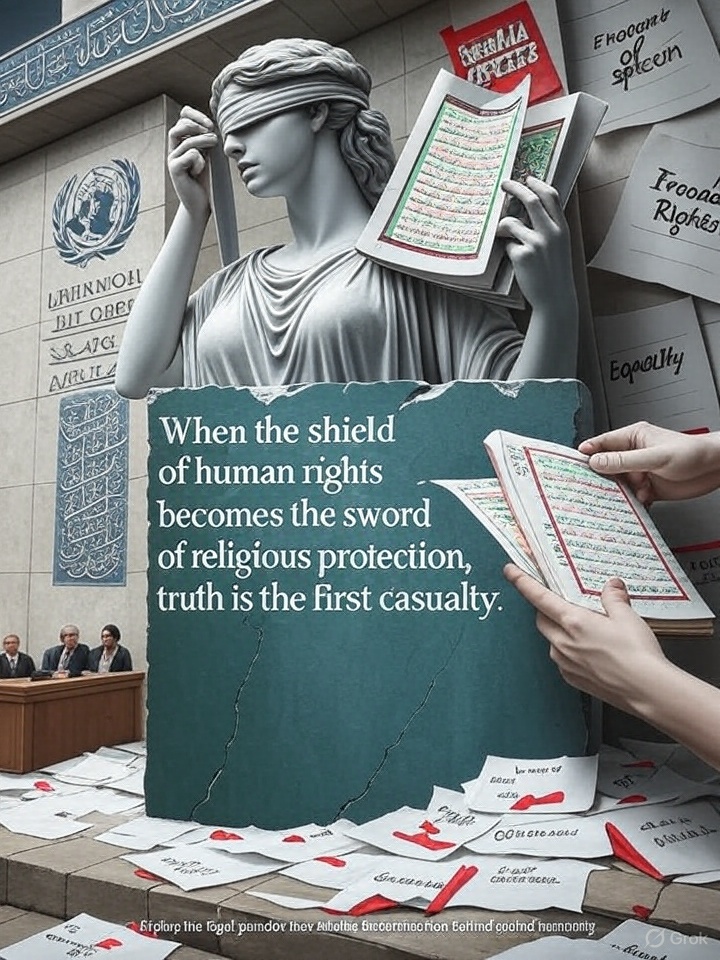
International Law Under Siege: How Taqiyya Invalidates Legal Frameworks
Part 1 of Sacred Texts vs Universal Rights: The Global Dilemma
Sacred Texts vs Universal Rights — The Global Dilemma
When Sacred Protection Dismantles Secular Justice
International law, once envisioned as a universal shield for human dignity, is now trapped in a paradox. It defends human rights on one hand—yet protects the very doctrines that undermine them on the other.
This contradiction became explicit with United Nations Resolution 76/254, which seeks to criminalize criticism or desecration of the Quran as an act of religious hatred. While noble in its surface intent, this resolution shelters a text that directly challenges the core principles of international law: equality, freedom of conscience, and protection from discrimination. Quranic verses such as 9:5, 4:34, and 9:29 pose a direct challenge to the principles of secular society that international law is meant to protect.
These verses are not fringe interpretations; they are supported by canonical tafsirs (exegeses) from classical scholars such as Ibn Kathir and Al-Tabari.
Yet under the current global legal framework, criticism of these verses—even in the defense of universal human rights—is increasingly labeled as “Islamophobia” and criminalized.
International law now finds itself safeguarding doctrines that dismantle its own foundations. This blog explores how one specific doctrine—Taqiyya, the Islamic legal concept of strategic deception—further exposes the fragile assumptions that international law rests upon.
The Legal Paradox Exposed
In 2022, UN Resolution 76/254 passed, with significant backing from the Organisation of Islamic Cooperation (OIC). The resolution demands legal and institutional responses to any act of perceived Islamophobia, including Quran desecration, satire, or public critique.
But the Quran, far from being a universally peaceful text, contains verses that:
- Justify violence against disbelievers (9:5 – “Slay the idolaters wherever you find them”)
- Promote legal inequality between men and women (4:34 – “Men are in charge of women… beat them if they disobey”)
- Call for the subjugation of Jews and Christians (9:29 – “Fight those who do not believe… until they pay the jizya”)
Rather than being rejected or reinterpreted by traditional scholars, these verses remain active elements in Islamic jurisprudence (fiqh) across Sunni and Shia traditions. They form part of the sacred legal architecture that is now immune to critique under international legal protection.
Thus, international law is faced with a self-defeating contradiction:
- It upholds freedom of religion while protecting doctrines that suppress other faiths
- It defends gender equality while criminalizing critique of verses endorsing domestic violence
- It promotes freedom of speech but penalizes speech that exposes discriminatory scripture
This contradiction is not merely academic—it is structural. And it is increasingly being weaponized through a specific Islamic jurisprudential doctrine that may explain the systematic nature of these legal contradictions: Taqiyya, the religiously sanctioned practice of strategic deception.
The Doctrine of Strategic Deception
Central to this structural vulnerability is the Islamic jurisprudential doctrine of Taqiyya—the legal permission to deceive under certain conditions, particularly when dealing with non-Muslims or hostile governments.
Juridical Roots of Taqiyya
While Taqiyya originated in Shia theology as a form of protective dissimulation, Sunni scholars have long accepted its use for strategic purposes. Major tafsir scholars like Ibn Kathir, Al-Tabari, and Al-Ghazali legitimized Taqiyya when:
- The Islamic cause could be endangered by honesty
- Truth-telling could result in harm or political failure
- Deception would help advance Islam in non-Islamic lands
Taqiyya operates on three levels:
- Verbal Deception – Saying something you don’t believe to avoid scrutiny or harm
- Behavioral Deception – Outwardly acting contrary to Islamic doctrine in non-Muslim environments
- Strategic Deception – Engaging in long-term narrative shaping, including moderating verses or doctrines for public consumption, while retaining the original teachings internally
Implications for International Law
This doctrine presents a severe challenge for any legal system that assumes good-faith testimony. When Islamic representatives present diluted, “moderate” readings of Quranic verses in English-language forums, but reinforce literalist interpretations in Arabic sermons, international legal bodies are left vulnerable to systematic misrepresentation.
And because Taqiyya is protected as part of religious freedom, there are no legal mechanisms to distinguish between honest moderation and tactical deceit.
How can international courts uphold fair proceedings when one party is legally allowed to lie?
This question doesn’t reflect prejudice—it reflects a legal reality that must be addressed.
Contemporary Case Studies in Legal Deception
Recent legal proceedings reveal how this theoretical problem manifests in practice. In 2019, during UK parliamentary hearings on Islamic education, representatives from several major Islamic organizations testified that Quranic verses about warfare were “purely historical.” However, internal curriculum documents obtained through Freedom of Information requests showed these same organizations teaching that verses 9:5 and 9:29 remain “eternally valid” and applicable “when Muslims have sufficient strength.”
Similarly, in European Court of Human Rights proceedings involving Sharia law compatibility, Islamic legal scholars consistently present “modernized” interpretations in court submissions, while their Arabic-language publications for Muslim audiences maintain traditional jurisprudential positions that directly contradict their European testimony.
The most striking example occurred in France’s 2021 “separatism” law hearings, where French Muslim leaders assured parliamentarians that Islamic law poses no challenge to French secular principles—while simultaneous recordings from mosque sermons revealed detailed discussions of establishing parallel legal systems “when demographic conditions permit.”
The Interpretive Crisis — A Tale of Two Tongues
The legal implications of Taqiyya become clearer when we examine how Islamic teachings are systematically presented differently to different audiences—creating an interpretive crisis for international law: which version of a religious doctrine should courts recognize as legally relevant?
Islamic teachings are frequently presented in two registers:
- Arabic original and intra-community discourse: Literal, rigid, and often exclusivist. This includes direct calls to violence, religious supremacy, and discriminatory social rules
- English (or Western-language) public discourse: Moderated, symbolic, and framed in terms of coexistence, tolerance, or metaphor
This bifurcation is not accidental—it aligns with the strategic dissimulation permitted by Taqiyya.
For example, the verses such as 4:34, 9:5 and 3:28 have two distinctly different interpretations meant for Western media and that meant for followers of Islam who red the Arabic version.
These contradictory narratives make it impossible for international law to determine intent or sincerity—both essential components in criminal and civil law.
The Institutional Impact
This interpretive crisis has already begun affecting international legal institutions. The International Criminal Court’s 2020 preliminary examination of Afghanistan faced significant challenges when Islamic legal experts provided conflicting testimony about Sharia law’s compatibility with international humanitarian law—with English-language submissions emphasizing mercy and proportionality, while Arabic source documents revealed detailed justifications for collective punishment and civilian targeting.
The European Court of Human Rights has struggled similarly, with several judges noting in minority opinions their concern about accepting religious testimony that may be strategically moderated for legal proceedings while maintaining harsher applications in practice.
Why This Matters to International Law
Legal systems rely on verifiable, consistent, and transparent testimony. Courts punish perjury because truth is essential to justice.
But what happens when a religious doctrine permits lying to protect itself—and that doctrine is protected by law?
Taqiyya undermines international law at three levels:
- Credibility Crisis: Courts cannot reliably accept statements by individuals who may be doctrinally permitted to lie
- Policy Paralysis: Lawmakers fear passing neutral regulations—such as on religious education or speech—because of potential backlash labeled as “Islamophobia”
- Asymmetric Justice: Other religions and ideologies are subject to full legal scrutiny, while Islam is shielded under blasphemy protections, anti-discrimination statutes, and diplomatic immunity for its scriptures
A Legal Framework to Reclaim Neutrality
To restore fairness and consistency, international law must develop robust mechanisms for evaluating religious doctrines that conflict with universal rights, while accounting for strategic deception.
1. Literal Text Evaluation Protocol
International courts must evaluate the direct, original-language content of religious scriptures, not their reinterpreted or diplomatically softened versions. This requires establishing standardized translation protocols using multiple independent scholars, including native speakers who are not adherents of the faith in question.
Just as courts examine the actual text of contracts rather than parties’ preferred interpretations, religious doctrines claiming legal protection must be assessed on their literal content. The precedent exists: hate speech laws already evaluate texts like Mein Kampf and The Protocols of the Elders of Zion by their actual content, not by apologists’ alternative readings.
Implementation would require courts to maintain certified translations of major religious texts, updated regularly and verified by independent linguistic experts. Any legal proceeding involving religious doctrine would reference these standard texts rather than advocate-provided interpretations.
2. Uniform Evidentiary Standards Across All Ideologies
Religious claims must face the same legal scrutiny as secular ideologies. This means applying consistent tests for motive, impact, causation, and internal consistency. No belief system—religious or otherwise—should receive special evidentiary privileges that exempt it from standard legal analysis.
Courts already apply this principle when evaluating political movements or corporate cultures. Religious organizations claiming legal protection or exemptions must demonstrate that their core teachings genuinely support their public claims, using the same burden of proof required of any other institution.
This includes examining whether religious groups’ internal training materials, leadership communications, and community practices align with their public testimony. Discrepancies between internal and external presentations would trigger enhanced scrutiny, not protected accommodation.
3. Comprehensive Disclosure Requirements
Legal proceedings involving religious doctrine must require full disclosure of relevant teachings, including interpretations used within that faith community. The legal standard should mirror corporate disclosure requirements: organizations cannot claim protection based on incomplete information.
This means religious representatives in legal proceedings must provide complete documentation of their doctrine’s position on relevant issues, including traditional scholarly interpretations and contemporary applications. Claims of “symbolic meaning” must be substantiated by demonstrating universal teaching of that interpretation within the faith community.
Courts would maintain independent verification systems, similar to expert witness protocols, to confirm the accuracy and completeness of religious doctrinal claims. Ex-adherent scholars, independent linguists, and comparative religion experts would serve as neutral validators.
4. Strategic Deception Detection Mechanisms
International law must develop institutional capacity to identify and account for religiously sanctioned deception. This requires training legal professionals to recognize patterns of tactical moderation and establishing verification procedures for religious testimony.
Detection mechanisms would include cross-referencing public statements with internal community teachings, examining consistency across different language presentations, and tracking historical patterns of doctrinal presentation by religious organizations.
Courts would employ teams of independent experts—including ex-adherent scholars, linguists specializing in religious texts, and specialists in strategic communication—to evaluate the reliability of religious testimony. This follows existing models used in financial crime detection, where experts identify patterns of deliberate misrepresentation.
Legal immunity for “religious sincerity” would require demonstrating consistent teaching across all contexts and languages, not just convenient presentations for specific legal proceedings.
International law and Legal System Worthy of Its Ideals
International law was founded on post-Holocaust principles: human dignity, equality before the law, and protection from hate.
But by shielding sacred texts—even those that advocate inequality and violence—it is now at risk of protecting the very ideologies it was designed to restrain.
Taqiyya is not simply a fringe concept. It is an embedded legal loophole that turns law into an instrument of surrender.
If international law is to survive as a force for justice, it must stop fearing labels—and start confronting realities.
Coming Next in the Series:
Blog 2: Human Rights Paradox — The UN’s Islamic Exception to Universal Standards
Having established how Taqiyya undermines the reliability of religious testimony in legal proceedings, our next analysis examines how international institutions have created a two-tier system of rights protection—where Islamic doctrine receives special immunity from the very human rights standards the UN claims to uphold universally. We’ll explore how strategic deception enabled the capture of global human rights machinery.
Feature Image: Click here to view the image.
Watch Related Videos
Glossary of Terms
- Taqiyya: An Islamic jurisprudential doctrine that permits Muslims to conceal their beliefs or intentions in hostile environments or to protect the Islamic cause. It allows for strategic deception, especially in dealings with non-Muslims.
- Quran Verse 9:5 (Sword Verse): A verse in the Quran instructing Muslims to “slay the idolaters wherever you find them”—interpreted by traditional scholars as a command applicable under certain conditions of conflict or authority.
- Quran Verse 4:34: A verse that establishes male guardianship over women and permits physical punishment in cases of perceived disobedience. Often cited in debates about gender equality within Islamic jurisprudence.
- Quran Verse 9:29: A verse instructing Muslims to fight non-believers (specifically Jews and Christians) until they pay the jizya tax and accept a subordinate status under Islamic rule.
- Jizya: A tax historically levied on non-Muslims (dhimmis) living under Islamic rule. It was intended as a form of submission in return for protection but is widely criticized for institutionalizing religious inequality.
- Tafsir: Islamic exegesis or commentary on the Quran. Tafsirs are used to interpret the meanings, implications, and legal applications of Quranic verses. Classical tafsirs, such as those by Ibn Kathir and Al-Tabari, are still widely referenced.
- Ibn Kathir: A 14th-century Islamic scholar whose tafsir (Quranic commentary) is one of the most influential in Sunni Islam. His interpretations are frequently cited in traditionalist and literalist contexts.
- Al-Tabari: A 9th-century Islamic historian and scholar known for his extensive Quranic exegesis. His works continue to be foundational in Islamic jurisprudence and theology.
- Organisation of Islamic Cooperation (OIC): An intergovernmental organization comprising 57 member states, established to promote Muslim solidarity. The OIC often advocates for blasphemy laws and anti-Islamophobia resolutions at the United Nations.
- United Nations Resolution 76/254: A 2022 resolution supported by the OIC calling for global legal responses to perceived Islamophobia, including the criminalization of Quran desecration and public critique of Islamic teachings.
- Sharia: Islamic religious law derived from the Quran and Hadith. It governs all aspects of Muslim life, including religious practices, family law, and criminal justice.
- Fiqh: Islamic jurisprudence or the human understanding and application of Sharia law. It includes schools of thought within both Sunni and Shia traditions.
- Ex-Adherent Scholars: Former practitioners or believers of a religion who now study and analyze its doctrines from an external or critical perspective. Frequently used in legal or academic contexts for unbiased testimony.
- Interpretive Duality: The phenomenon of presenting religious doctrines in a moderated, symbolic form for public or legal consumption while maintaining literal and exclusivist interpretations within internal community discourse.
- Strategic Deception: The use of calculated misinformation or narrative manipulation to influence perception or gain advantage, often used here in a religious-legal context.
- Blasphemy Protections: Legal or diplomatic measures that prohibit criticism or perceived disrespect of religious beliefs or texts, often invoked in international human rights debates.
- Diplomatic Immunity for Scriptures: The informal or legal practice of exempting sacred texts from public scrutiny or legal challenge under the guise of religious freedom or cultural sensitivity.
- Literal Text Evaluation Protocol: A proposed legal standard where courts assess religious texts based on their direct, original-language content rather than softened or symbolic interpretations offered by representatives.
- Uniform Evidentiary Standards: The principle that all ideologies—religious or secular—should be evaluated with the same burden of proof and legal scrutiny in courts of law.
- Strategic Deception Detection Mechanisms: Proposed legal tools and procedures to identify when religious testimony may be moderated for public forums while retaining doctrinal literalism in private teachings.
#InternationalLaw #FreeSpeech #ReligiousFreedom #Taqiyya #HinduinfoPedia
#SacredTextsvsUniversalRights
References
🏛️ UN Resolutions and International Legal Documents:
- UN General Assembly Resolution 76/254 (2022) – Official UN Document – A/RES/76/254
- UN Resolution 16/18 on Combatting Religious Intolerance – UNHRC Resolution Text
🧠 Taqiyya and Strategic Deception:
- Definition and Explanation of Taqiyya (Oxford Islamic Studies) – Oxford Reference – Taqiyya
- Taqiyya in Sunni and Shia Islam – Britannica – Britannica – Taqiyya
- Raymond Ibrahim’s Analysis of Taqiyya – Middle East Forum: Taqiyya – Raymond Ibrahim
🏛️ Legal Case Studies & Testimonies:
- UK Parliament – Evidence on Islamic Education (2019) – UK Parliament Archives – Islamic Education Hearings
- ECHR Ruling on Sharia Law – Refah Partisi Case – HUDOC – ECHR Judgment: Refah Partisi v. Turkey
- French Separatism Law Hearings (2021) – France24 Summary – French Law on Separatism
⚖️ Jurisprudence, Perjury & Legal Challenges:
- European Court Opinions on Contradictory Testimony – ECHR Official Site
- ICC Preliminary Report on Afghanistan (2020) – International Criminal Court – Afghanistan Preliminary Examination
📚 Comparative Frameworks for Legal Standards:
- Hate Speech Laws & Mein Kampf Classification – Yad Vashem – History of Mein Kampf Legal Status
- Protocols of the Elders of Zion – Legal Responses – ADL: The Protocols of the Elders of Zion
Other Related Blogs
- https://hinduinfopedia.com/population-growth-or-jihad/
- https://hinduinfopedia.com/population-trends-and-the-power-of-belief/
- https://hinduinfopedia.com/fertility-and-faith-when-welfare-rewards-the-womb/
- https://hinduinfopedia.com/fertility-and-muslim-growth-state-benefits-benefit-population-growth/
- https://hinduinfopedia.com/population-dividend-or-demographic-risk/
- https://hinduinfopedia.com/halal-food-or-exclusivist-agenda-faith-commerce-intersection/
- https://hinduinfopedia.in/waqf-amendment-act-2025-reform/
- https://hinduinfopedia.in/waqf-act-protests/
- https://hinduinfopedia.in/waqf-act-debate/
- https://hinduinfopedia.in/protests-against-waqf-act-2025/
- https://hinduinfopedia.in/waqf-act-unrest-is-this-just-about-waqf/
- https://hinduinfopedia.in/judicial-response-to-waqf-act-unrest/
- https://hinduinfopedia.in/waqf-act-and-judging-justice/
- https://hinduinfopedia.in/selective-judgement-of-waqf-act/
- https://hinduinfopedia.in/waqf-law-an-excuse/
- https://hinduinfopedia.in/safety-sharia-and-stark-realities/
- https://hinduinfopedia.in/sharia-law-in-practice/
- https://hinduinfopedia.in/quran-quote-that-sparked-a-firestorm-rubika-and-the-fear-of-facts/
- https://hinduinfopedia.com/islamic-marriage-and-deceptive-conversions/
[…] International Law Under Siege: How Taqiyya Invalidates Legal Frameworks […]
[…] legal and institutional dimensions of this challenge are explored in our analysis of how international law is under siege and the emergence of the human rights paradox that increasingly works against Hindu […]
[…] https://hinduinfopedia.com/international-law-under-siege/ […]
[…] serve systematic elimination rather than preventing it. As I documented in my analysis of international law under siege and the human rights paradox, even international legal frameworks designed to protect minority […]
[…] selective laws empower one community disproportionately. Similarly, in the global arena, blogs like International Law Under Siege and The Human Rights Paradox have exposed how international frameworks often protect Islamic […]
[…] This is the question that this series will explore, building on earlier examinations of how International Law Under Siege: How Taqiyya Invalidates Legal Frameworks and Human Rights Paradox: The UN’s Islamic Exception to Universal Standards revealed the […]
[…] differences, it reveals that Hindu Haq Is threatens a system built on Hindu disadvantage. When international law gets weaponized against the world’s oldest continuous civilization, it shows the stakes […]
[…] Read: International Law Under Siege: Why It Fails Religious Minorities → […]
[…] reflect deliberate institutional engineering. As detailed in our civilizational pattern analysis, international declarations, UN votes, transnational clerical networks, and media ecosystems interact to translate doctrinal […]
[…] reflect deliberate institutional engineering. As detailed in our civilizational pattern analysis, international declarations, UN votes, transnational clerical networks, and media ecosystems interact to translate doctrinal […]
[…] International Law and Religious Minorities […]
[…] International Law and Religious Minorities […]
[…] International Law and Religious Minorities […]
[…] International Law Under Siege […]
[…] International Law Under Siege […]
[…] International Law and Religious Minorities […]
[…] कि हमारी अंतरराष्ट्रीय विधि संकट में श्रृंखला में दर्ज है, ऐसी […]
[…] Before proceeding, one clarification is necessary. Islam is not internally uniform. It contains deep and often irreconcilable contradictions—Sunni and Shia schisms, jurisprudential schools, sectarian violence, and even caste-like social stratifications observable in India, Pakistan, and Bangladesh. These internal divisions are well known and are actively being fought today, including in Yemen’s ongoing Sunni–Shia war. Yet despite this fragmentation, Islamic scholarship, theology, and political advocacy consistently present Islam outwardly as a single, monolithic system—especially when engaging non-Muslim societies. It is this externally unified authority posture, not internal theological harmony, that this analysis examines. This external unity is asserted even in minority-Muslim contexts, where religious claims are often framed through victimhood, secular posture, or legal exceptionalism, as examined in International Law Under Siege. […]
[…] International Law Under Siege How legal frameworks get weaponized in civilizational conflicts. […]
[…] https://hinduinfopedia.com/international-law-under-siege/ […]
[…] द्वारा वर्णित taqiya के रणनीतिक उपयोग के साथ यह ढाँचा […]
[…] coupled with what critics describe as the instrumental use of taqiya as a tactical concealment strategy, makes such movements especially difficult for Western political […]
[…] documented in our International Law Under Siege series, these international declarations aren’t neutral peacemaking tools—they’re […]
[…] This demonstrates how international law becomes besieged when religious law supersedes secular authority. […]
[…] institutions manipulations and International Law Under Siege: Global institutions convert Islamic dominance into “minority rights,” pressuring states to […]
[…] differential treatment isn’t ancient history. It operates today in how international law gets selectively applied and how human rights frameworks create paradoxes when theological hierarchies collide with […]
[…] केवल प्राचीन इतिहास नहीं है। यह आज भी अंतरराष्ट्रीय क़ानून के चयनात्मक प्र… और मानवाधिकार ढाँचों के विरोधाभासों […]
[…] France Unrest Series (14 blogs) […]
[…] threats 🔹 Mathematical Evidence – Data-driven analysis of systematic targeting 🔹 International Law Under Siege – How frameworks enable demographic […]
[…] अंतरराष्ट्रीय कानून पर घेराबंदी – ढांचे कैसे जनसांख्यिकीय युद्ध को सक्षम बनाते हैं […]
[…] law selectively to delegitimize non-Muslim sovereignty while protecting Muslim territorial claims. International Law Under Seize shows how the UN system functions under ideological capture shaped by Islamic political […]
[…] दावों की रक्षा के लिए किया गया। घेराबंदी में अंतरराष्ट्रीय क़ानूनयह दर्शाता है कि संयुक्त राष्ट्र […]
[…] बाहरी आधिपत्य को संभव बनाता है: 🔹 घेराबंदी में अंतरराष्ट्रीय विधि – जनसांख्यिकीय विस्थापन को सक्षम […]
[…] Internal Division Enables External Conquest: 🔹 International Law Under Siege – Global frameworks enabling demographic displacement 🔹 Human Rights Paradox – […]
[…] दावों की रक्षा के लिए किया गया। घेराबंदी में अंतरराष्ट्रीय क़ानून यह दर्शाता है कि संयुक्त राष्ट्र […]
[…] remnant — repeated across every territory that came under sustained Islamic rule. As our analysis of how taqiyya invalidates legal frameworks documents, the mechanisms of this transformation are doctrinal, not […]
[…] शासन के अधीन रहा। जैसा कि हमारे विश्लेषण में दर्शाया गया है कि कैसे धा…, इस रूपांतरण की प्रक्रियाएँ आकस्मिक […]
[…] France Unrest Series (14 blogs) […]
[…] How Courts Fail Ancient Principles: 🔹 Dharma vs Jurisprudence Framework 🔹 RSS Vision for Dharmic Society 🔹 International Law Under Siege […]
[…] https://hinduinfopedia.com/international-law-under-siege/ […]
[…] https://hinduinfopedia.com/international-law-under-siege/ […]
[…] France Unrest Series (14 blogs) […]
[…] France Unrest Series (14 blogs) […]
[…] https://hinduinfopedia.com/international-law-under-siege/ […]
[…] बिना चुनावी दबाव में बदल जाते हैं। अंतरराष्ट्रीय विधि घेरे में: तकिय्या … क्यों पश्चिमी विधिक ढांचे — […]
This post touched my heart 😊 and made me think about kindness today
Perfect 💖 timing always
[…] [Ad 2: Constitutional and International Capture] See how media capture connects to broader constitutional confusion from divine mandates and international institutional override. […]
[…] आदेशों से उत्पन्न संवैधानिक भ्रम तथा अंतरराष्ट्रीय संस्थागत अतिक्रमण से किस प्रकार जोड़ा जाता […]
[…] […]
[…] Legislative accommodation – Hate speech laws expanded as documented in international law under siege […]
[…] subject to the Islamic Shari’ah.” This creates parallel human rights framework where international law becomes besieged by religious override, serving 1.8 billion people—more than any other human rights instrument—and thereby working […]
[…] इसी कारण कुछ विश्लेषक मानते हैं कि अंतरराष्ट्रीय विधि धार्मिक अधिरोहण क… और सार्वभौमिक मानवाधिकारों की […]
[…] International law under siege – frameworks designed to protect civilians weaponized against democracies […]