

Global Energy Reckoning: A Reckoning of West Asia’s Endless War (33)
Part 33 of the West Asia’s Endless War Series
भारत / GB
Africa’s Energy Was Always There. The World Simply Chose Not to See It — Until the Gulf Became Unchoosable.
Building on the social, political, economic and religious aspects of the West Asia Endless war, in the last blog, 32 in the series, established the Gulf Dollar Exit Reckoning — the petrodollar arrangement’s load-bearing pillars breaking simultaneously, with Saudi Arabia’s 2024 non-renewal of the 50-year deal the most precise signal that the repricing was already underway before the first missile fell. Blog 33 examines the structural consequence for global energy: the Hormuz war as the event that broke the Gulf’s fashion monopoly — not its economic advantage, not its technical superiority, but the self-reinforcing incumbency that had directed global energy investment toward one corridor for fifty years. The Global Energy Reckoning opens a new arc in the series — the world that the war is building while the ceasefire negotiations proceed in Islamabad.
Global Energy Reckoning: The Fashion Argument
Global Energy Reckoning: The Gulf dominated not because it was best but because it was fashionable. Forty days changed the fashion. People do not eat pizza because it is the healthiest food. They eat it because everyone around them is eating it — the social reinforcement of a choice that becomes self-validating through repetition. Global energy investment followed the same logic for fifty years. The Gulf was not cheaper in any structural sense that Africa could not match. It was not more reliable — it has been a conflict zone for half a century. It was not more efficient — the Cape of Good Hope route from West Africa to Asia is longer in nautical miles but not prohibitively so. It was fashionable. The petrodollar architecture made dollar-denominated Gulf supply the path of least resistance, and the path of least resistance became the path everyone took, which made it more fashionable still.
The Global Energy Reckoning is the documentation of what happens when that fashion breaks. The Hormuz war has not transformed sub-Saharan Africa into a replacement for the Gulf. But it has done something equally important: it has elevated a select group of African producers into the front line of global energy supply. This elevation did not require Africa to become better. It required the Gulf to become obviously risky. Fashion is more fragile than economics. Economic advantages take years to erode. Fashion can reverse in Forty days.
Africa’s Energy — Always There, Never Fashionable
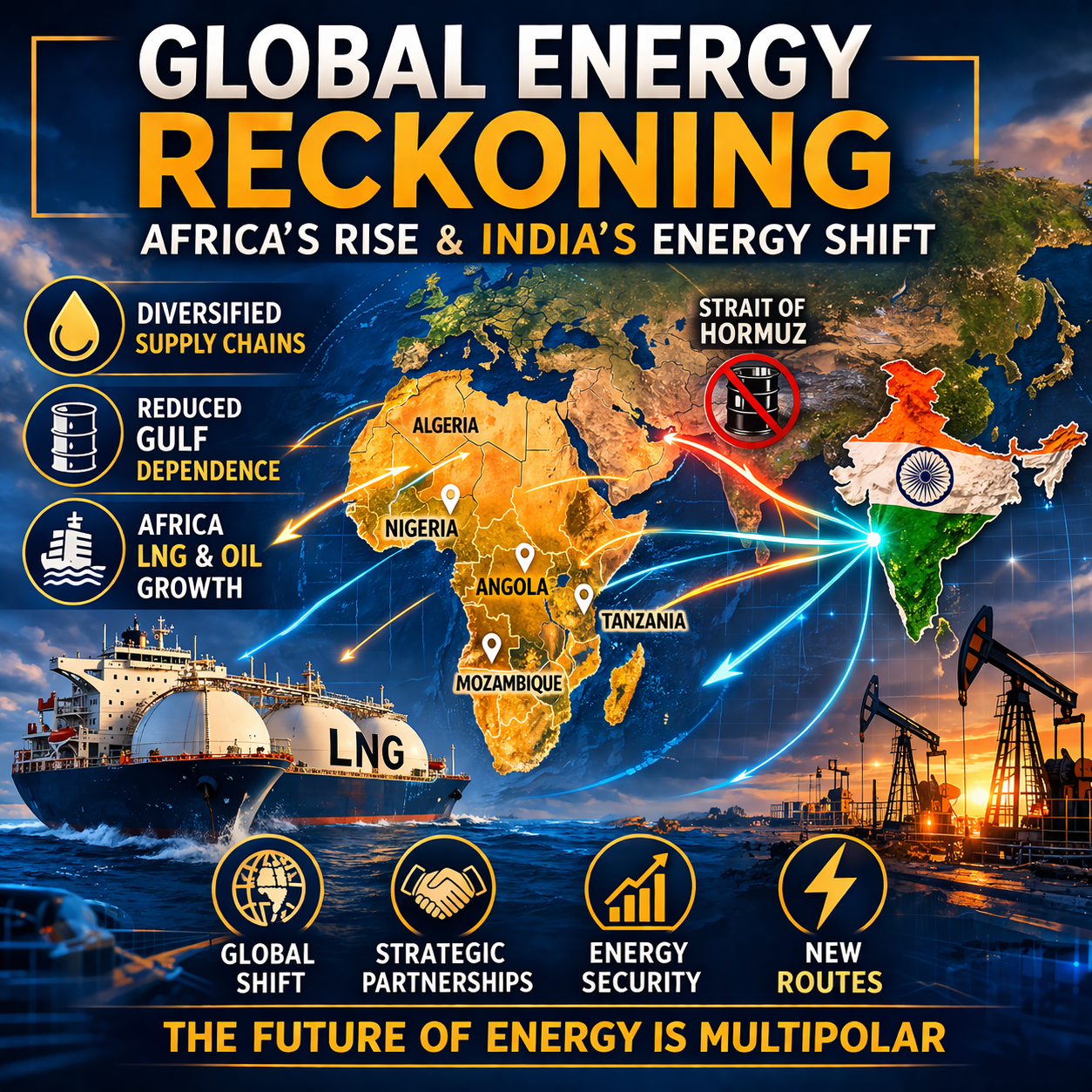
The Global Energy Reckoning begins with a fact that predates the war by decades. Africa’s energy resources were never a discovery of the Hormuz crisis. Nigeria remains Africa’s largest oil producer, averaging 1.5 million barrels per day. Angola averages 1.1 million barrels per day of consistent offshore and deepwater production. Algeria averages 940,000 to 950,000 barrels per day with hydrocarbons accounting for 95 per cent of export revenue. Mozambique holds offshore gas reserves described as transformational when discovered. Equatorial Guinea has operational LNG capacity. Cameroon has untapped reserves. Tanzania is finalising a $42 billion LNG project whose timelines have been accelerated by the global supply shock.
None of this is new. These resources existed throughout the fifty years the world reflexively directed energy investment toward the Gulf. The primary reason they were not exploited at scale was not technical inferiority or logistical impossibility. It was the fashion effect: the Gulf had first-mover advantage in the petrodollar architecture, which meant Gulf supply was dollar-denominated, Gulf infrastructure received the capital, Gulf relationships received the diplomatic attention, and Gulf LNG received the long-term offtake contracts. The switching cost was social and institutional rather than economic. It was simply easier, more normal, and more fashionable to source from the Gulf — until the Gulf closed.
The bridge between the Gulf’s fashion dominance and Africa’s emergence is not the war itself but what the war revealed: that the corridor everyone assumed was permanent is closeable by a single state that Washington cannot simply eliminate. That revelation is the Global Energy Reckoning’s central mechanism. Once a supply corridor is revealed as closeable, it is no longer fashionable — regardless of whether it reopens. The fashion has already changed.
📌 How the Gulf’s Fashion Monopoly Was Built
The 1974 petrodollar arrangement that made dollar-denominated Gulf supply the global default — and why incumbency, not fundamentals, was always its load-bearing pillar.
Global Energy Reckoning: India’s Emergency Contracts as Live Proof
The Global Energy Reckoning’s most concrete evidence is India’s emergency energy procurement since the Hormuz closure. India is now sourcing LPG from Nigeria, Algeria, and Angola, while LNG imports involve Cameroon, Equatorial Guinea, and Mozambique — with some cargoes already secured and negotiations with other suppliers in advanced stages. Six African nations stepped forward simultaneously. The question the Global Energy Reckoning asks is not merely why they could — they always could — but why the call was answered without hesitation.
The answer is Vaccine Maitri and Operation Sanjeevani. In 2021, when India had surplus Covid vaccine capacity and Africa was in crisis, India dispatched vaccines and medicines to dozens of African nations including those now supplying LNG — without trade calculation, without conditionality, without the transaction logic that Western aid programmes typically deploy. The relationship capital built in 2021 translated into energy supply contracts in 2026 not because goodwill is sentimental but because trusted relationships reduce transaction costs and risk premiums in ways that money alone cannot replicate. Washington can offer Africa money for energy contracts. India called and Nigeria answered on the basis of a relationship. That is the causal transmission from geopolitical investment to economic return.
India has expanded crude oil sourcing from 27 countries to 41 over the past decade, reducing dependence on the Strait of Hormuz from 45 per cent to 30 per cent. The Africa LNG emergency is not a pivot — it is the acceleration of a strategy already in motion. The Angola deal alone could create $2–3 billion in annual trade value, with transit times 10–15 days shorter than North American sources. These contracts, once signed under emergency conditions, become permanent infrastructure relationships. Routes built under crisis outlast the crisis.
Global Energy Reckoning: The Map Being Redrawn
The new supply routes established under emergency conditions are not temporary workarounds. They are the physical infrastructure of a new energy architecture — and the Global Energy Reckoning’s final argument is about who builds that architecture first.
Major pipeline projects already underway include the $25 billion Nigeria-Morocco Gas Pipeline traversing 13 West African states, the Trans-Saharan Gas Pipeline connecting Nigeria to Algeria, and the $1.5 billion Mozambique-Zambia pipeline. These are not proposals catalysed by the Hormuz war. They were already in construction. The war has given them a strategic urgency and an investor case that normal market conditions would have taken years to establish. Tanzania expects to finalise agreements for its $42 billion LNG project in 2026, with the current supply shock strengthening its position as global buyers actively seek to diversify away from Middle Eastern gas.
The new routes — African LNG to India, South American LNG to Europe, Central Asian gas to China — are not replacing the Gulf in volume overnight. They are doing something more consequential: they are establishing the alternative architecture that makes the Gulf optional rather than mandatory. Once the Gulf is optional, its leverage disappears. The petrodollar’s enforcement power rested on the Gulf being unavoidable. The Global Energy Reckoning is the documentation of the Gulf becoming avoidable — not by any deliberate strategic decision, but by the fashion breaking under Forty days of disruption that the world now knows can happen again. The new energy map is being drawn by emergency contracts, accelerated pipelines, and relationship capital built through vaccine diplomacy five years before the war. The states that move first in this architecture will hold the first-mover advantage that Washington held from 1974. India is building it in Africa. The Global Energy Reckoning has begun.
📌 The Dollar Exit the New Energy Map Is Accelerating
The Gulf Dollar Exit Reckoning — why the fashion shift in energy is inseparable from the repricing of the petrodollar arrangement that made Gulf supply the global default.
Next: EU Mediator Vacuum — Blog 34 in West Asia’s Endless War examines Europe’s failure to insert itself into the Hormuz ceasefire negotiations despite being a JCPOA co-signatory, an LNG importer through Hormuz, and a self-declared defender of the rules-based order. The EU convened 41 countries. Pakistan brokered the peace. The mediator vacuum reveals what the rules-based order looks like when its self-appointed guardian lacks an enforcement mechanism independent of Washington. Part of the West Asia’s Endless War Series on hinduinfopedia.com.
Feature Image: Click here to view the image.
Videos
Glossary of Terms
- Petrodollar System: The global financial arrangement where oil is priced and traded primarily in US dollars, reinforcing dollar dominance in global trade.
- Global Energy Reckoning: A conceptual framework describing the shift in global energy supply chains following disruption in traditional corridors like the Gulf.
- Strait of Hormuz: A critical maritime chokepoint between the Persian Gulf and Arabian Sea through which a significant portion of global oil supply transits.
- LNG (Liquefied Natural Gas): Natural gas cooled to liquid form for easier storage and transportation over long distances.
- Offtake Contracts: Long-term agreements between energy producers and buyers ensuring steady supply and revenue stability.
- Incumbency Advantage (Energy Context): The structural benefit enjoyed by established suppliers due to existing infrastructure, contracts, and financial systems.
- Energy Corridor: A geographical route through which energy resources like oil and gas are transported globally.
- Vaccine Maitri Initiative: India’s diplomatic effort during COVID-19 to supply vaccines to multiple countries, particularly in Africa and Asia.
- Operation Sanjeevani: India’s medical assistance program during COVID-19 providing essential medicines and support to partner nations.
- Supply Shock: A sudden disruption in the availability of a key resource, leading to price volatility and market shifts.
- Energy Diversification: The strategy of sourcing energy from multiple regions to reduce dependency on a single supplier or route.
- LNG Infrastructure: Facilities including terminals, pipelines, and shipping systems required for LNG production, transport, and regasification.
#Energy #Oil #Gas #LNG #Africa #India #Geopolitics #Petrodollar #Hormuz #Trade #Economy #GlobalShift #EnergyCrisis #SupplyShock #HinduinfoPedia
West Asia’s Endless War: Why This Series Exists
[…] भारत / GB […]
[…] Global Energy Reckoning: A Reckoning of West Asia’s Endless War (33) https://hinduinfopedia.com/global-energy-reckoning-a-reckoning-of-west-asias-endless-war-33/ […]
[…] the adversary it should be configured to contain was quietly accumulating the strategic dividend. China’s oil continued flowing through Hormuz under Iranian authorisation while American-allied shipping was blocked. China called for a […]
[…] buying Russian natural gas at approximately $8 per MMBtu through Nord Stream 1 and Nord Stream 2. American LNG delivered to European terminals trades at $12-15 per MMBtu — a 50-90% structural premium on every unit of energy. This is not a marginal price difference. […]
[…] pipeline destructions have systematically eliminated. It is the proof of concept stated as a boast. The Global Energy Reckoning documented the emergency LNG contracts flowing from the Hormuz disruption. The vessels infesting […]
[…] energy infrastructure. Blog 33 documented the African LNG emergency contracts that India and Europe signed when the Gulf alternative was disrupted. China had been financing […]
[…] […]
[…] हटे। अन्य सभी विकल्प समाप्त किए गए। वैश्विक ऊर्जा विश्लेषण इस प्रवाह को दर्ज करता है। यह आकस्मिक […]
[…] to Gulf crude grades. India’s emergency LNG contracts with six African nations, documented in Global Energy Reckoning (Blog 33), represent India’s independent energy diversification response — a response that mirrors […]
[…] Read […]