

Manufactured Instability Reckoning: West Asia’s Endless War Analysis (35)
Part 35 of the West Asia’s Endless War Series
भारत / GB
Gulf Stability and African Instability Were Not Two Outcomes. They Were One Policy Operating at Two Ends of the Same Financial Architecture.
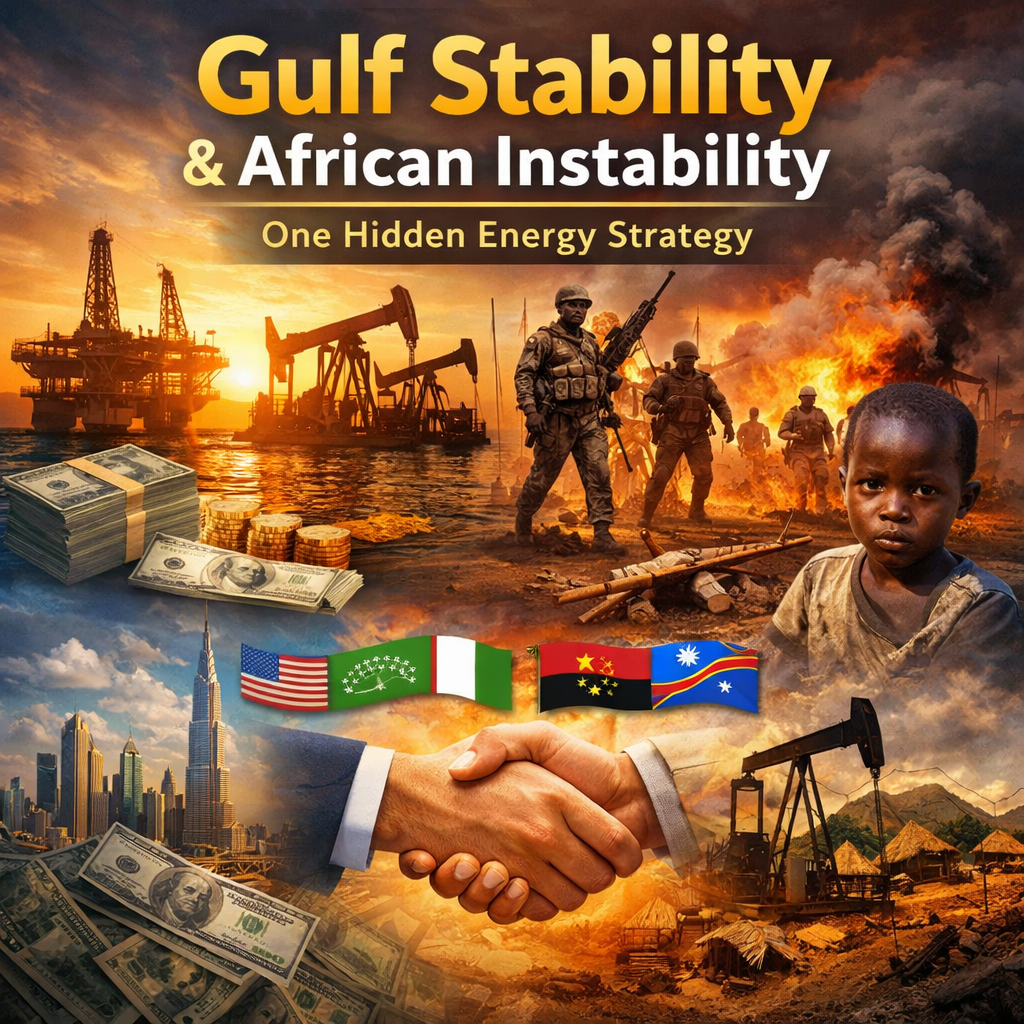
Blog 34 established the Manufactured Stability Reckoning — the Gulf’s dominance was never organic stability but a fifty-year American military subsidy, built on a powder keg in 1974 and maintained by a Praetorian Guard in 1990. Blog 35 is its necessary complement. The Manufactured Instability Reckoning examines the other side of the same policy: if Gulf stability was manufactured by American military underwriting, African instability was manufactured by the same actors, at the same time, for the same purpose. The evidence for both arguments comes from the same source — Western governments’ own declassified records, parliamentary investigations, and treaty documents. No allegation is required. The confession is already in the public record.
Manufactured Instability Reckoning: The toolkit
Since the formation of the United Nations in 1945 — the institution created to end precisely this kind of behaviour — the United States has invaded or fought over 70 of the 193 UN-recognised nations. Researchers documenting regime change operations count over 70 separate instances of US involvement in coups, election interference, and military-backed government removal during the Cold War alone. Broad counts of all US military conflicts — including blockades, covert operations, and proxy wars — exceed 230 separate engagements. These figures are not compiled by adversaries. They are drawn from US government records, congressional testimony, and declassified intelligence documents — Washington’s own account of what Washington did. The Manufactured Instability Reckoning does not argue that America is uniquely evil among great powers. Every great power has used force to protect its economic architecture.
The argument is more precise: the 230-intervention pattern had a consistent economic logic, and that logic — in the period relevant to this series — was the protection of the petrodollar energy architecture built in 1974.
The manufactured instability argument reaches its most concentrated single expression in 1979 — the year two separate Western policy streams produced Washington’s two most consequential adversaries simultaneously. The Shah of Iran, Washington’s installed ruler since the CIA’s 1953 operation, faced a revolutionary opposition led by Ayatollah Khomeini. When Iraq expelled Khomeini in October 1978 under the Shah’s pressure, France granted him asylum at Neauphle-le-Château outside Paris. For four months, under full French state protection, Khomeini held international press conferences, gave interviews to Western media who framed him as a democratic opposition leader against an authoritarian shah, recorded sermons distributed into Iran on cassette tapes, and coordinated the revolution’s final phase through international telephone lines that no underground network could have accessed. The BBC Persian Service broadcast his statements with a reach that compressed months of revolutionary organising into weeks. Simultaneously, the Carter administration’s human rights policy applied pressure on the Shah to liberalise — weakening the security apparatus that was the Shah’s primary instrument of governance. The extreme liberal policy — asylum rights, free press, non-interference in political speech — was the operational instrument through which the most anti-liberal state in the modern world was brought into existence. In the same year, Zbigniew Brzezinski authorised Operation Cyclone — the covert manufacture of the global jihadist movement through CIA-ISI-Saudi funding of the Afghan mujahideen. The extreme liberal policy created the Islamic Republic. The extreme covert policy created the global jihadist movement. Both were products of 1979. Both were products of Western policy architecture. The manufactured instability argument does not require inferring intent from pattern. In 1979 the pattern produced its own documentation.
Africa was not a special case. It was one theatre in a global doctrine whose purpose was to ensure that the Gulf remained the world’s only fashionable energy source.
Manufactured Instability Reckoning: One Policy, Two Directions
Manufactured Instability Reckoning: The same actors who made the Gulf stable made Africa unstable. The evidence is in their own records. Blog 33 established that Africa’s energy was always there — Nigeria, Angola, Algeria, Mozambique, Equatorial Guinea, Cameroon — chronically undervalued not because of structural inferiority but because the Gulf fashion made it unnecessary. Blog 34 established that the Gulf’s stability was not natural but manufactured through American military force. The Manufactured Instability Reckoning completes the argument: the world did not choose Gulf energy over African energy because Gulf energy was better. It chose Gulf energy because Washington made the Gulf stable and made Africa unstable — simultaneously, deliberately, using the same financial architecture as the instrument.
The bridge between these two manufactured outcomes is precise: manufactured Gulf stability and manufactured African instability are not two separate policies. They are one policy operating at two ends of the same petrodollar architecture. The Gulf had to be the fashionable energy source. For the Gulf to be fashionable, alternatives had to be unfashionable. For alternatives to be unfashionable, they had to be — or appear to be — unstable, ungovernable, and risky. Washington and its European partners ensured they were. The Manufactured Instability Reckoning documents how.
Washington’s Direct Role: The Documented Cases
Angola — Operation IA Feature, 1975
Angola gained independence from Portugal in November 1975 — the same year the petrodollar architecture was being consolidated. Angola holds the offshore oil reserves that are now supplying India’s emergency LNG. Before independence was three months old, the CIA was running Operation IA Feature — covertly funding UNITA (Jonas Savimbi’s movement) and the FNLA against the MPLA government that had Soviet and Cuban backing. The US Senate Church Committee’s 1975 report documented CIA operations in Angola in detail — Washington investigating and confessing its own intervention in the same year it was conducting it. The civil war that followed lasted until 2002 — twenty-seven years. Angola’s offshore oil production, which could have been a stable global energy alternative for nearly three decades, was instead exploited by foreign corporations operating in the margins of a manufactured conflict while the Angolan state remained too fractured to negotiate sovereign terms.
Congo/Zaire — Lumumba and Mobutu, 1960-1997
What followed was Mobutu Sese Seko: thirty-two years of Systemic Corruption, maintained by Western financial institutions, armed by Washington, and sustained by the same powers that called his rule “stability.” The Democratic Republic of Congo has more hydroelectric potential than almost anywhere on earth. It has been kept systematically underdeveloped for sixty years. Its mineral wealth — coltan, cobalt, copper — has been extracted at terms that never allowed sovereign industrial development. The Manufactured Instability Reckoning names this precisely: the Congo’s underdevelopment was not a failure of governance. It was a policy outcome.
Libya — 1986 to 2011
Muammar Gaddafi nationalised Libya’s oil in 1970 and used the revenues to build the highest Human Development Index in Africa by 2010. In 2011, NATO’s intervention — conducted under UN Security Council Resolution 1973, framed as civilian protection — destroyed the Libyan state entirely. Libya is now a failed state with warring factions, two competing governments, and foreign military forces from multiple countries operating on its soil. Its oil, which could have been a stable Mediterranean energy source for Europe and Africa, flows through chaos at terms no sovereign government can negotiate. The state that had among the highest Human Development Index in Africa in 2010 does not exist in any functional sense in 2026. Barack Obama described the Libya intervention as his worst mistake in office — specifically, the failure to plan for the day after Muammar Gaddafi’s ouster. In a 2016 Fox News interview, he stated: ‘Probably failing to plan for the day after, what I think was the right thing to do in intervening in Libya.’ This remains one of the most consequential admissions by an architect of the policy that the outcome in Libya became a catastrophe. At the risk of slipping out of context, it is worth putting on record that the same man was awarded the Nobel Peace Prize in 2009.
Somalia — the Ogaden abandonment, 1977-1978
Somalia’s state collapse — which produced the warlordism, the piracy, and ultimately Al Shabaab — has a documented origin. Washington armed Somalia during the Ogaden War (1977-1978), encouraging Somalia’s invasion of Ethiopia. When the Soviet Union switched sides to support Ethiopia, Washington abandoned Somalia with a militarised society, a defeated army, and no functional government. The state that collapsed was the state Washington had built and then discarded. The Manufactured Instability Reckoning does not require a conspiracy theory to explain Somalia’s chaos. It requires only reading the sequence: arm, use, abandon, inherit the wreckage, use the wreckage as justification for the next intervention.
📌 The Stability That Required These Interventions
The Gulf’s manufactured stability — built on a powder keg in 1974, maintained by 500,000 troops in 1990, now collapsing as the Praetorian Guard receives its eviction notice.
Manufactured Instability Reckoning: Europe’s Instruments
Washington did not act alone. The Manufactured Instability Reckoning’s second layer is the role of France, Britain, and Spain — the former colonial powers whose continuing extraction arrangements in Africa provided the institutional infrastructure through which manufactured instability was maintained long after the formal colonial period ended.
France — Françafrique
France maintained a network of covert operations, military interventions, and client regimes across its former African colonies — Gabon, Cameroon, Côte d’Ivoire, Chad, the Central African Republic, and Equatorial Guinea — that kept African states politically dependent on Paris and economically oriented toward French extraction rather than sovereign development. The CFA franc — the currency used by 14 African nations — is controlled by the French Treasury, meaning these states cannot conduct independent monetary policy, cannot devalue to compete for exports, and cannot set interest rates to manage their own economic cycles. Three of the six African nations now supplying India’s emergency LNG — Cameroon, Equatorial Guinea, and partially Gabon — were kept inside this financial architecture for decades. The Manufactured Instability Reckoning notes the precise irony: the nations that are now emerging as alternative energy suppliers are the same nations whose sovereign economic development was systematically prevented by the currency arrangement of their former coloniser. Burkina Faso, Mali, and Niger only broke from French military presence in 2023-2024 — and were immediately subjected to sanctions and diplomatic pressure from Paris for doing so.
Britain — the selective withdrawal
Britain’s 1971 East of Suez withdrawal — which created the security vacuum that the Twin Pillars policy and the petrodollar deal was designed to fill — was a selective withdrawal. Britain withdrew from Gulf security responsibilities, handing them to Washington and the Shah’s Iran, while maintaining its own extraction arrangements in Africa through less visible means. The British military role in Oman’s Dhofar counter-insurgency was conducted simultaneously with the East of Suez withdrawal — British officers directed the suppression of a communist insurgency that threatened Gulf stability while British corporate interests continued to extract African resources without comparable security investment. British and American oil companies operated throughout Angola’s civil war — extracting offshore oil while the onshore state collapsed around them, paying taxes and royalties to whichever faction controlled the relevant territory contributing nothing to the citizens, with no interest in the conflict’s resolution.
Spain — Western Sahara, 1975
Spain’s deliberate abandonment of Western Sahara in November 1975 — through the Madrid Accords, signed at the precise moment the petrodollar deal was being consolidated — handed a phosphate-rich, Atlantic-coastline territory to Morocco without a self-determination process. The United Nations has documented Western Sahara’s unresolved status for fifty years, with the territory’s population — the Sahrawi people — living in refugee camps in Algeria while Morocco extracts phosphates and Spain receives preferential fishing access to Sahrawi waters. Western Sahara’s Atlantic position makes it strategically significant for any North African energy transit architecture that could have been an alternative to Gulf supply. It has been kept in limbo for five decades.
Manufactured Instability Reckoning’s Conclusion
The manufactured instability across these cases — Angola’s civil war, Congo’s Systemic Corruption, Libya’s destruction, Somalia’s collapse, Françafrique’s currency trap, Western Sahara’s frozen conflict — is not a series of unrelated events. It is the operating environment in which Gulf energy remained fashionable because the alternatives remained ungovernable. That operating environment was created and maintained by the same powers that simultaneously underwrote Gulf stability. The Manufactured Instability Reckoning’s conclusion is the Global Energy Reckoning’s foundation: the emergency LNG contracts that India signed with Nigeria, Algeria, Angola, Cameroon, Equatorial Guinea, and Mozambique in April 2026 are not just a response to a crisis. They are the first significant breach in a fifty-year architecture of manufactured African energy unfashionability. The Global South is not discovering African energy in 2026. It is finally being allowed to act on what it has always known.
📌 The New Energy Architecture Now Being Built
The Global Energy Reckoning — how the Hormuz war broke the Gulf’s fashion monopoly and why Africa’s emergency LNG contracts are the foundation of a new architecture, not a temporary workaround.
Next: Islamabad Reckoning — Blog 37 in West Asia’s Endless War examines the April 11-12 talks: 21 hours, agreement on most points, collapse on nuclear and Hormuz toll — and Washington’s response: a naval blockade of Iranian ports that targets its own allies more than its adversary. The Islamabad Reckoning is the moment Washington demonstrated it has no answer to Iran’s strategy except to adopt it, without Iran’s legal standing, territorial claim, or civilisational patience. Part of the West Asia’s Endless War Series on hinduinfopedia.com.
Feature Image: Click here to view the image.
Videos
Glossary of Terms
- Manufactured Instability Reckoning: The central thesis of this blog — the argument that African instability was deliberately engineered by the same Western powers that manufactured Gulf stability, to ensure Gulf energy remained the world’s preferred (“fashionable”) source under the petrodollar system.
- Manufactured Stability Reckoning: The complementary concept from Blog 34 describing how the Gulf’s apparent stability was artificially sustained through American military subsidy and security guarantees rather than organic development.
- Petrodollar Architecture: The post-1974 global financial-energy system in which oil is primarily priced and traded in US dollars, with petrodollar surpluses recycled into US Treasuries and Western markets in exchange for security guarantees to Gulf states.
- Praetorian Guard: Refers here to the massive US military presence (especially post-1990 Gulf War) acting as a protective force for Gulf monarchies, maintaining the stability side of the petrodollar arrangement.
- Françafrique: The network of political, military, and economic ties through which France maintained influence over its former African colonies long after formal independence, including covert operations and client regimes.
- CFA Franc: The currency (Communauté Financière Africaine / Coopération Financière en Afrique) used by 14 African nations, pegged to the euro and historically controlled via the French Treasury, limiting independent monetary policy.
- Operation IA Feature: The 1975 CIA covert operation that funded anti-MPLA factions (UNITA and FNLA) in Angola, contributing to the long civil war that prevented stable sovereign oil development.
- Madrid Accords: The 1975 agreement signed in Madrid by Spain, Morocco, and Mauritania that effectively partitioned Western Sahara without a self-determination referendum for the Sahrawi people, timed with the consolidation of the petrodollar system.
- Global Energy Reckoning: The broader series theme examining how the 2026 Hormuz-related crisis and India’s emergency LNG contracts with African nations signal the beginning of the end of the fifty-year Gulf energy monopoly.
- East of Suez Withdrawal: Britain’s 1971 strategic decision to reduce its military presence east of the Suez Canal, creating a vacuum that the US Twin Pillars policy and later petrodollar security arrangements filled.
- Human Development Index (HDI): UNDP composite metric (life expectancy, education, income) that ranked Libya among the highest in Africa in 2010–2011 before the 2011 NATO intervention caused a sharp decline.
- Church Committee: The 1975–76 US Senate investigation that documented CIA covert operations, including in Angola, providing primary-source evidence of direct US intervention.
#WestAsia #Petrodollar #AfricaInstability #GulfStability #Libya #Angola #Françafrique #HinduinfoPedia
West Asia’s Endless War: Why This Series Exists
[…] भारत / GB […]
[…] https://hinduinfopedia.com/manufactured-instability-reckoning-west-asias-endless-war-analysis-35/ […]
[…] by a Praetorian Guard in 1990, and now collapsing as that guard receives its eviction notice. Blog 35 returns to the present moment: the Islamabad talks failure and Washington’s response. The […]
[…] Manufactured Instability Reckoning: West Asia’s Endless War Analysis (35) https://hinduinfopedia.com/manufactured-instability-reckoning-west-asias-endless-war-analysis-35/ […]
[…] एलएनजी अनुबंध लागू हो चुके हैं। मैन्युफैक्चर्ड इंस्टेबिलिटी हिसाब ने दिखाया कि अफ्रीका में अस्थिरता के […]
[…] does not exist. The investigation was blocked. The American LNG contracts are signed. The Manufactured Instability Reckoning established that African instability was documented in Washington’s own Senate records. The […]
[…] कोई संप्रभु सरकार स्वीकार नहीं करती। निर्मित अस्थिरता विश्लेषण ने अफ्रीका के संदर्भ में यह तर्क […]
[…] हुआ, पेट्रोडॉलर व्यवस्था समाप्त हुई, अफ्रीकी ऊर्जा उभरी, रूस ने अपना लाभ प्राप्त किया, यूरोपीय […]
[…] closed, NATO fractured, the EU mediated nothing, the Gulf was betrayed, the petrodollar ended, African energy emerged, Russia collected its dividend, European energy was captured, Ukrainian agriculture was feudalised. […]
[…] was designed and funded specifically to reverse Mossadegh’s nationalisation of Iranian oil. Blog 35 (Manufactured Instability Reckoning) documented Washington’s 230-intervention record across 130 years — a consistent pattern of […]
[…] के लिए तैयार और वित्तपोषित योजना थी। ब्लॉग 35 ने 130 वर्षों में 230 हस्तक्षेपों का […]
[…] Read […]
[…] whose strategic constraint is mistaken for theological moderation — have done to this framework. Blog 35 (Manufactured Instability Reckoning) documented Washington’s pattern of manufacturing the instability it then uses to justify […]
[…] is the series’ most documented case of the Dagdhabeej thread at civilisational scale. Blog 35 (Manufactured Instability Reckoning) documented Washington’s pattern of manufacturing instability it then uses to justify […]
[…] borders, across religions, and across the civilisational lines that the doctrine itself draws. Blog 35 (Manufactured Instability Reckoning) documented Washington manufacturing the instability it uses to justify intervention. The Dar Al […]
[…] […]
[…] Read: Manufactured Instability Reckoning → […]
[…] construction sequence that preceded the Iran war — and the same sequence that preceded Venezuela. Blog 35 (Manufactured Instability Reckoning) documented Washington’s 230-intervention record and the consistent pretext architecture […]
[…] वेनेज़ुएला से पहले भी दिखाई दिया था। ब्लॉग 35 (मैन्युफैक्चर्ड इंस्टेबिलिटी … ने वाशिंगटन के 230 हस्तक्षेपों के […]