

Gulf Dollar Toll: The West Asia’s Endless War Dynamics (51)
Part 51 of the West Asia’s Endless War Series
भारत / GB
Blog 49 Proved the Drain. Blog 50 Named the Machine. Blog 51 Measures the Toll Per Transaction — Six Dimensions, Precise Arithmetic, One Conclusion.
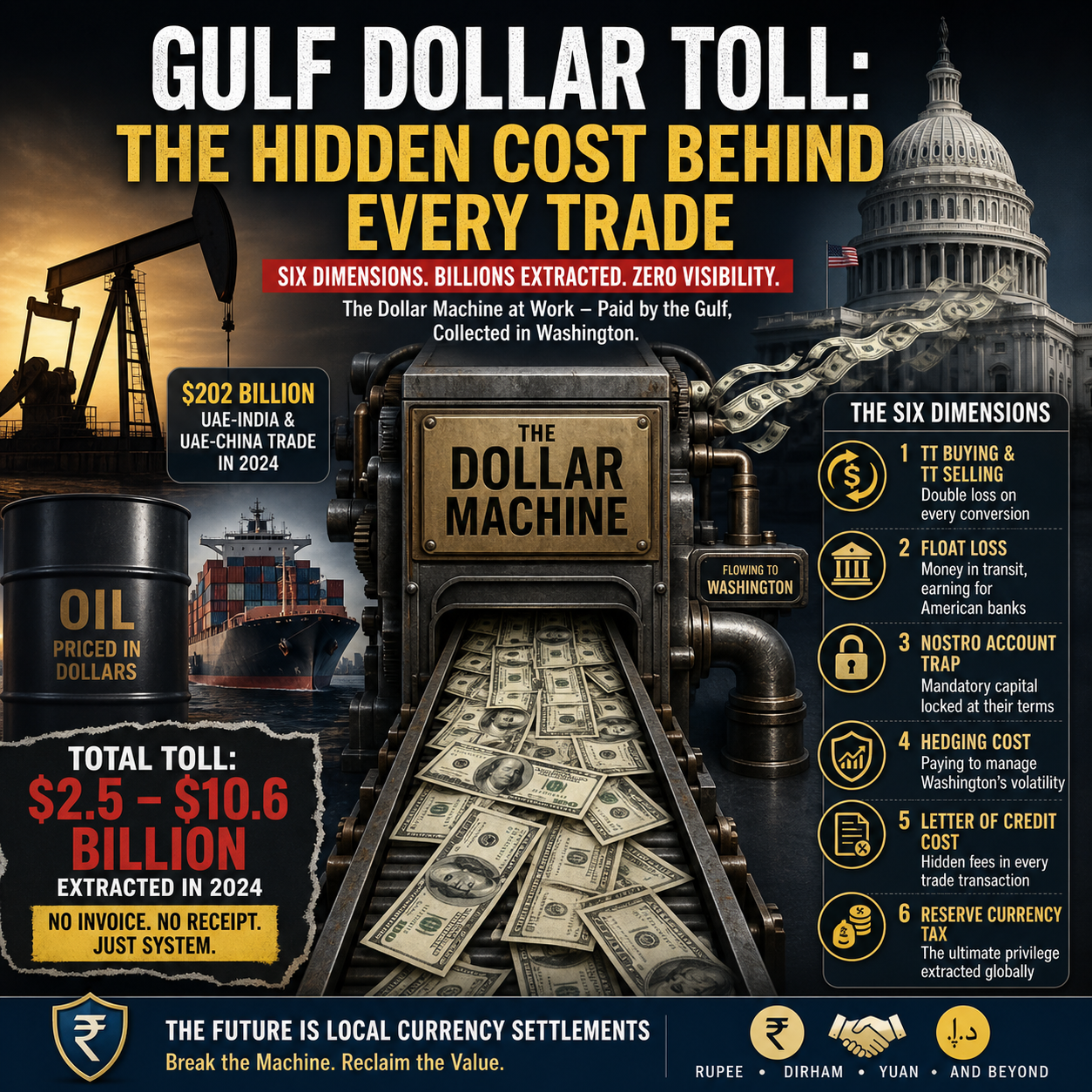
Blog 49 (Gulf Petrodollar Drain) established the fifty-year investment loss — $100 billion in 1974 Treasuries worth $100 billion in real value today, zero real gain across three debasement cycles. Blog 50 (The Dollar’s Gulf Mint) named the five-component extraction machine — Tax-and-Buy, Council Bills equivalent, Home Charges, Commercial Captivity, Surveillance Architecture. Blog 51 brings the argument to the transaction level: what does the Gulf Dollar Toll actually cost on every oil sale, every commodity trade, every payment received and converted? The base is precise — $100 billion in UAE-India trade and $101.8 billion in UAE-China trade in 2024, about $202 billion total. The toll is measured across six dimensions. The total is not small.
Gulf Dollar Toll: The Six Dimensions
Gulf Dollar Toll: On about $202 billion of UAE-India and UAE-China trade in 2024, six toll dimensions extracted $2.5 to $10.6 billion — paid to Washington without Washington being party to a single transaction. Each dimension operates independently. Each is invisible as a line item in any individual transaction. Together they constitute the transaction-level expression of the Dollar Machine that Blog 50 mapped as a structural architecture. The six dimensions are presented in order of visibility — from the most visible toll the Gulf sees on every statement to the most invisible toll that never appears on any statement at all.
Dimension One — TT Buying and TT Selling: The Double Loss.
Every bank publishes two rates for every currency pair. The TT Selling rate — at which the bank sells foreign currency to a buyer — is above mid-market. The TT Buying rate — at which the bank buys foreign currency from a seller — is below mid-market. The mid-market rate is the real rate displayed on Reuters and Bloomberg. Neither the Gulf producer nor its trading partners ever transact at the mid-market rate. Both transact at rates that move away from mid-market in the bank’s favour.
When China’s bank acquires dollars to pay UAE for oil — TT Selling — China pays above mid-market. When UAE converts those dollars to dirhams — TT Buying — UAE receives below mid-market. The same transaction is taxed twice, in opposite directions, both times in favour of the dollar-system bank executing the conversion. The Bank for International Settlements confirmed that approximately 88% of all global foreign exchange transactions involve the US dollar on one side — meaning the TT spread is collected on the vast majority of international commerce by American and Western banks that dominate dollar inventory and FX clearing. UAE government converting $1 billion of oil revenue to dirhams for domestic budget spending loses $2.5-5 million on the TT Buying spread alone — every single conversion, every single time, with no alternative available as long as oil is priced in dollars and the dirham is pegged to the dollar.
Dimension Two — Float Loss: Money in Transit Earning for American Banks.
SWIFT transfers do not settle instantly. International dollar payments take 1-5 business days to clear through the correspondent banking system. During those days the payment is in transit — sitting in intermediary accounts at American clearing banks, earning interest at the prevailing Fed funds rate for those banks, not for the Gulf producer waiting to receive it.
On $201.8 billion of annual UAE-India and UAE-China trade, at an average two-day settlement period, approximately $1.1 billion is in transit float at any given time. At the Federal Reserve’s 2024 benchmark rate of approximately 5.25-5.5%, the interest earned on $1.1 billion for two days is approximately $315,000 per day — $115 million annually — flowing to JPMorgan Chase, Citibank, and the handful of American banks that dominate dollar clearing. UAE produced the oil. China bought it. Washington’s clearing banks collected $115 million in float interest on the payment that travelled between them.
Dimension Three — Nostro Account Trap: Mandatory Capital at American Banks’ Terms.
To conduct dollar-denominated international trade, every UAE commercial bank must maintain Nostro accounts — dollar accounts held at American correspondent banks. These accounts must carry minimum balances at all times to ensure payment capacity. SWIFT’s own correspondent banking documentation confirms that maintaining adequate Nostro balances is a regulatory and operational requirement for any bank conducting international dollar transactions. UAE’s major banks — First Abu Dhabi Bank, Emirates NBD, ADCB — collectively maintain billions in minimum balance Nostro accounts at American correspondent banks. These balances earn whatever rate the American bank decides to pay — typically well below the Fed funds rate, often near zero during the QE era. The Nostro requirement converts a portion of UAE’s banking system capital into a permanent, mandatory, below-market deployment at American banks’ discretion.
📌 The Machine That Runs These Six Tolls
The five-component Dollar Machine — Tax-and-Buy, Council Bills equivalent, Home Charges, Commercial Captivity, Surveillance Architecture — the structural architecture that makes the Gulf Dollar Toll mandatory and invisible simultaneously.
Gulf Dollar Toll: Dimensions Four, Five, and Six
Dimension Four — Hedging Cost: Paying to Manage Washington’s Volatility.
UAE producers and importers price contracts in dollars but operate in dirhams. Between the contract signing date and the settlement date, the dollar’s value moves — driven by Fed decisions, American inflation data, US employment figures, and American political cycles. None of these have anything to do with UAE’s trade with India or China. But because the transaction is denominated in dollars, UAE must manage the dollar volatility risk that Washington’s monetary management creates. The global FX derivatives market — dominated by American and Western banks — processes trillions in hedging instruments annually. UAE exporters and importers pay 0.1-0.5% of trade value annually in hedging premiums — forward contracts, options, and currency swaps — to protect against a currency risk that would not exist if oil were priced in dirhams or in a basket of trading partners’ currencies. On $201.8 billion of UAE-India and UAE-China trade: $200 million to $1 billion annually paid to Western bank hedging desks to manage dollar volatility Washington creates.
Dimension Five — Letter of Credit Fees: The Commodity Trade Tax.
A significant proportion of Gulf commodity trade — oil, gas, metals, petrochemicals — uses Letters of Credit as the payment guarantee mechanism. An LC is issued by the buyer’s bank, confirmed by a correspondent bank, and settled through dollar clearing. Each stage carries fees. The International Chamber of Commerce documents standard LC fee structures: issuance fee 0.1-0.5% of trade value, confirmation fee 0.1-0.75%, amendment fees for any change in terms, and discounting fees if the exporter accelerates payment receipt. On $201.8 billion of UAE-India and UAE-China trade, LC fees across the full transaction lifecycle run $400 million to $2.5 billion annually — paid almost entirely to Western banks in the dollar clearing system that confirm and settle the instruments. The LC mechanism, designed to provide payment security, has become an additional dollar system toll embedded in the structure of commodity trade itself.
Dimension Six — Reserve Currency Tax: The Deepest and Most Invisible Toll.
This dimension does not appear on any transaction statement. It is not charged per trade. It is collected through the global monetary architecture that oil pricing in dollars creates — and it flows not from any specific Gulf transaction but from the mandatory global dollar demand that oil pricing generates.
Because oil is priced in dollars, every oil-importing country in the world must maintain dollar reserves — China, India, Japan, South Korea, Indonesia, Germany, France. The collective global demand for dollars manufactured by the petrodollar oil pricing requirement suppresses Washington’s borrowing cost. IMF analysis estimates the dollar’s reserve currency status reduces Washington’s borrowing costs by approximately 0.5-1% below what they would otherwise be. On $36 trillion of US national debt, that 0.5-1% subsidy is worth $180-360 billion per year to Washington — paid collectively by every country that holds dollar reserves to buy oil. The Gulf’s share of this reserve currency tax — proportional to the Gulf’s contribution to global dollar reserve demand through oil pricing — is approximately $5-15 billion annually. It is paid without a single transaction. It arrives in Washington’s accounts as lower interest payments on debt, funded by the entire world’s obligation to hold the currency that Gulf oil pricing makes mandatory.
Gulf Dollar Toll: The Arithmetic Table
| Toll Dimension | Rate | Low $B/yr | High $B/yr | Eliminated by local currency? |
|---|---|---|---|---|
| TT Buying/Selling spread | 0.75–3.0% | $1.51B | $6.05B | ✅ Yes |
| Float loss (2-day settlement) | 0.027–0.05% | $0.05B | $0.11B | ✅ Yes |
| Nostro account minimums | 0.05–0.15% | $0.10B | $0.30B | ✅ Yes |
| Hedging cost (dollar volatility) | 0.1–0.5% | $0.20B | $1.01B | ✅ Yes |
| Letter of Credit fees | 0.2–1.25% | $0.40B | $2.52B | ✅ Yes |
| Reserve currency tax (Gulf share) | 0.1–0.3% | $0.20B | $0.61B | ❌ No — until oil pricing changes |
| Total annual Gulf Dollar Toll | 1.2–5.3% | $2.46B | $10.60B | $2.26–10.0B eliminated by local currency |
The table covers only UAE’s trade with India and China — $201.8 billion out of UAE’s total trade of approximately $670 billion. Scaling to UAE’s full trade volume at the same toll rates: the Gulf Dollar Toll on UAE alone runs $8-36 billion annually. Scaled to the entire Gulf Cooperation Council’s combined trade — Saudi Arabia, UAE, Kuwait, Qatar, Bahrain, Oman — the annual dollar toll on Gulf commerce runs into the hundreds of billions.
The table’s final column contains the Gulf Dollar Toll’s most strategically significant observation. Five of the six toll dimensions are eliminated entirely by dirham-rupee and dirham-yuan settlement — the local currency settlement frameworks that UAE has been building with India and China since 2023. The Reserve Bank of India confirmed the framework for invoicing, payment, and settlement of exports and imports in Indian rupees — a mechanism that UAE and India began operationalising for gold, crude oil, and food products in 2023. Blog 48 (UAE OPEC Split) established that the OPEC exit removes the collective enforcement floor for dollar oil pricing. The local currency settlement frameworks remove the transaction-level toll on the two trade relationships that account for about $202 billion of UAE’s commerce. One dimension — the reserve currency tax — remains until oil pricing itself changes. But the five dimensions that are eliminable represent $2.3-10 billion in annual savings on UAE-India and UAE-China trade alone — savings that the dirham-rupee MoU signed in July 2023 and the dirham-yuan swap agreements are beginning to realise. The BIS Innovation Hub’s mBridge project — in which UAE, China, Hong Kong, Thailand, and Saudi Arabia are all participants — is building the multi-CBDC platform that would replace SWIFT dollar clearing for participating economies entirely, eliminating all five eliminable toll dimensions simultaneously.
📌 The Fifty-Year Investment Loss the Toll Built Upon
$100 billion invested in 1974 US Treasuries is worth $100 billion in real value today — zero real gain across fifty years. The Gulf Dollar Toll is the transaction-level extraction. The Gulf Petrodollar Drain is the investment-level extraction. Both running simultaneously, both invisible, both continuous.
The Gulf Dollar Toll’s closing argument connects the transaction-level arithmetic to the series’ central thesis. Washington’s Global Control War (Blog 46) established that the endless war is not against Iran — it is against economic independence from Washington wherever it exists. The Gulf Dollar Toll is the financial expression of that war running in peacetime, on every transaction, automatically. The UAE OPEC Split weakens the institutional enforcement floor. The dirham-rupee and dirham-yuan settlement frameworks eliminate five of six toll dimensions on about $202 billion of trade. The reserve currency tax — Dimension Six — remains until the oil pricing denomination itself changes. That change is the final frontier of Gulf economic sovereignty, and it is the one Washington will defend most fiercely — because without mandatory global dollar demand from oil pricing, the reserve currency tax ends, Washington’s $180-360 billion annual borrowing subsidy disappears, and the entire Dollar Machine loses the power source that has run it for fifty years.
Next: India Energy Exposure — Blog 52 in West Asia’s Endless War examines India’s position in the commercial architecture the Iran war has restructured: 90 lakh workers in Gulf states, Chabahar investment in Iran, defence partnership with Israel, energy dependency across four competing supply chains simultaneously, and a Strategic Defence Partnership with UAE signed nineteen days before the war began. India sits inside the Gulf Dollar Toll on every oil import it pays — and is simultaneously building the rupee-dirham bilateral settlement architecture that begins to bypass it. Part of the West Asia’s Endless War Series on hinduinfopedia.com.
Feature Image: Click here to view the image.
Videos
Glossary of Terms
- Gulf Dollar Toll: The cumulative financial cost imposed on Gulf trade transactions due to reliance on the US dollar system, measured across six hidden dimensions per transaction.
- Petrodollar System: A global monetary arrangement where oil is priced and traded primarily in US dollars, creating sustained international demand for the currency.
- TT Buying Rate: The exchange rate at which banks purchase foreign currency from customers, typically below the mid-market rate, causing conversion losses.
- TT Selling Rate: The rate at which banks sell foreign currency, usually above the mid-market rate, creating an additional cost for buyers.
- Mid-Market Rate: The real exchange rate between two currencies, commonly displayed on financial platforms but rarely accessible in actual transactions.
- Float Loss: Earnings generated by intermediary banks during the time delay (1–5 days) in international payment settlements via systems like SWIFT.
- Nostro Account: A foreign currency account maintained by a domestic bank in a foreign bank, required for conducting international dollar transactions.
- Hedging Cost: Expenses incurred by traders to protect against currency volatility through instruments like forwards, options, and swaps.
- Letter of Credit (LC): A financial instrument issued by banks guaranteeing payment in international trade, involving multiple fee layers.
- Reserve Currency Tax: The indirect cost borne globally due to mandatory dollar reserves for oil trade, reducing US borrowing costs.
- Dollar Machine: A coined term describing the structural system of financial mechanisms (tax, trade, surveillance, and control tools) extracting value globally.
- Commercial Captivity: A condition where countries are locked into dollar-based trade systems with limited alternatives, ensuring continued dependency.
- Local Currency Settlement (LCS): Trade settlement mechanism using domestic currencies (e.g., rupee-dirham), bypassing the dollar system.
- mBridge Platform: A multi-CBDC (central bank digital currency) initiative aimed at enabling direct cross-border payments without SWIFT dependency.
- Reserve Currency Status: The position of a currency (like the US dollar) as globally accepted for trade and reserves, granting economic advantages to its issuer.
#Dollar #Petrodollar #GlobalTrade #Forex #OilTrade #Currency #SWIFT #Economics #Finance #India #UAE #China #HinduinfoPedia
West Asia’s Endless War: Why This Series Exists
[…] भारत / GB […]
[…] https://hinduinfopedia.com/gulf-dollar-toll-the-west-asias-endless-war-dynamics-51/ […]
[…] investment, The Dollar’s Gulf Mint named the five-component extraction machine, and the Gulf Dollar Toll measured $2.5-10.6 billion extracted annually from UAE-India and UAE-China trade alone through six transaction-level dimensions. Blog 52 addresses the question the trilogy […]
[…] Read: Gulf Dollar Toll → […]
[…] Read […]
[…] Persian Gulf Strait Authority — the formal institutional claim to toll collection on Hormuz shipping — is operational. Ships are transiting with Iran’s permission. Washington calls it […]
[…] की पर्शियन गल्फ स्ट्रेट अथॉरिटी—होरमुज से गुजरने वाले जहाजों पर शुल्क …—के साथ कार्यरत है। जहाज ईरान की […]