

Gulf Dollar Silence: A Reckoning of West Asia’s Endless War (52)
Part 52 of the West Asia’s Endless War Series
भारत / GB
A Captive Cannot Speak. A Silent Actor Chooses Not To. The Gulf Was the Latter — And the Choice Was Rational.
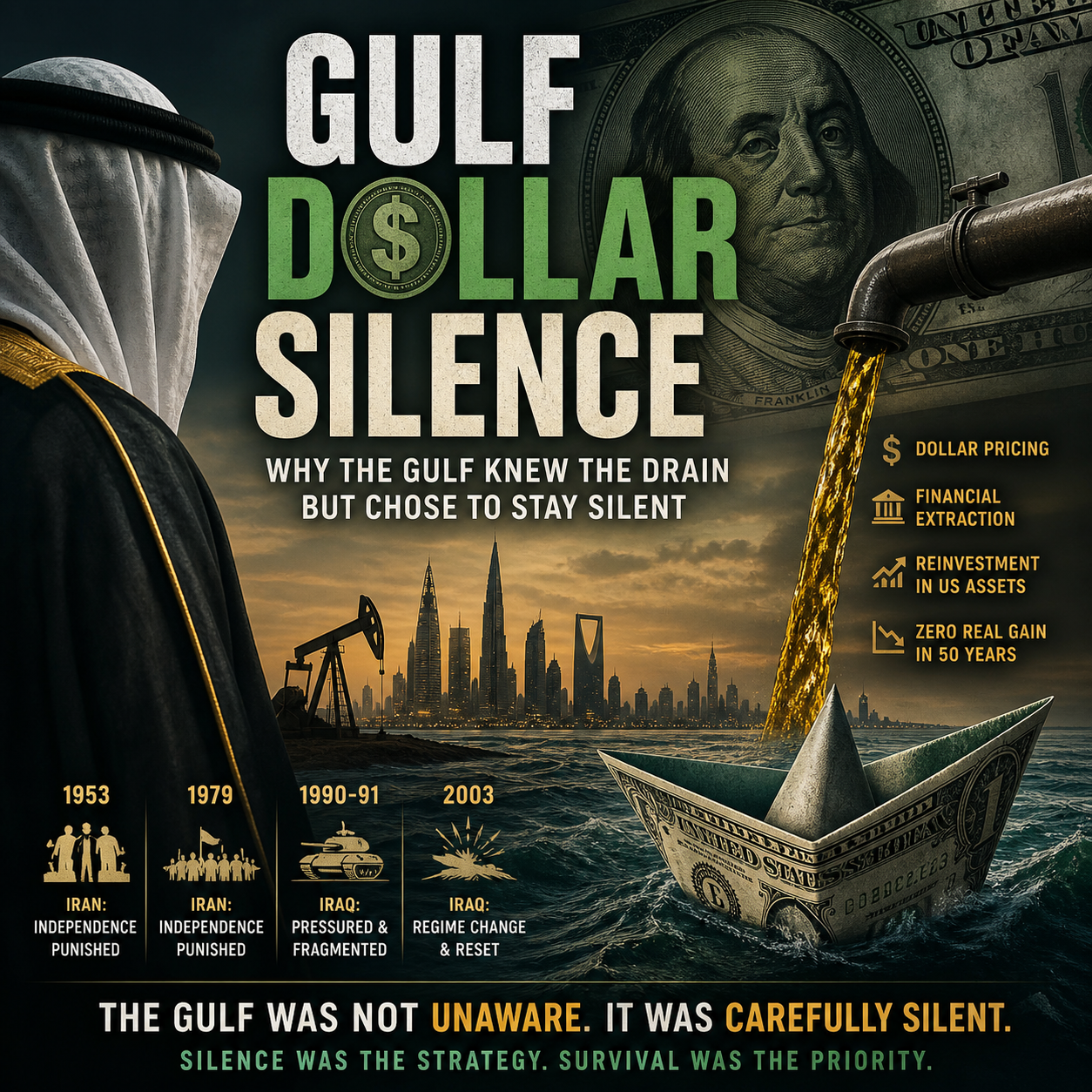
Blogs 49, 50, and 51 established the trilogy: the Gulf Petrodollar Drain proved zero real gain across fifty years of Treasury investment, The Dollar’s Gulf Mint named the five-component extraction machine, and the Gulf Dollar Toll measured $2.5-10.6 billion extracted annually from UAE-India and UAE-China trade alone through six transaction-level dimensions. Blog 52 addresses the question the trilogy produces: if the drain was this large and this documented — why did the Gulf accept it for fifty years without saying so publicly? The Gulf Dollar Silence is not the silence of ignorance. It is the silence of a rational actor operating under explicit and demonstrated threat. Two reasons made speaking dangerous. Three more made exit structurally impossible regardless of what was said. Blog 52 covers the first two.
Gulf Dollar Silence: The Knowledge Was Always There
Gulf Dollar Silence: The Gulf knew the drain. It did not speak — not from ignorance but from the knowledge that Iraq priced oil in euros in 2000, As documented in Blog 4, on the pretext of weapons of mass destruction, Iraq was invaded in 2003. The enforcement was the silence. The distinction between ignorance and strategic silence is the entire argument of this blog. A captive cannot speak. A silent actor chooses not to. The Gulf monarchies that signed the petrodollar arrangement in 1974, managed it across five decades, and began dismantling it in 2024-2026 were not uninformed about the extraction mechanism. The Gulf Dollar Silence was the rational response of states that understood speaking was dangerous — and that demonstrating that understanding publicly would itself trigger the enforcement mechanism they were trying to avoid.
The clearest evidence that the Gulf understood the extraction is in the behaviour of its most sophisticated actor at the founding moment. Blog 37 (Petrodollar Duress Reckoning) documented that King Faisal did not sign the 1974 JECOR framework as a willing commercial partner. He threatened to burn the oil fields. He watched Washington’s invasion plan fail to materialise. He signed because the deal was preferable to the alternative — not because he did not understand the deal’s terms. The JECOR framework — Joint Commission on Economic Cooperation — formalised the petrodollar recycling requirement: Saudi Arabia would price oil in dollars and invest surpluses in US Treasury securities, in exchange for American military protection and political support for the Saudi monarchy. A ruler who understood this exchange well enough to threaten to incinerate his primary asset understood precisely what he was agreeing to when he submitted. The Gulf Dollar Silence began the moment the pen touched the paper — not because the Gulf did not know, but because the Gulf knew exactly what would happen to states that said so publicly.
Gulf Dollar Silence: Two Reasons Speaking Was Dangerous
We now list the two reasons the describe why the silence was maintained.
Reason One — The 1953 enforcement mechanism was visible and was refreshed.
Every Gulf ruler from 1974 onward had watched Mohammed Mossadegh nationalise Iranian oil in 1951, watched the CIA remove him in 1953, watched the Shah restore Western corporate access to Iranian oil fields within months. The CIA formally confirmed its role in the 1953 Iranian coup in 2013 — declassified documents showing Operation AJAX was designed and funded specifically to reverse Mossadegh’s nationalisation of Iranian oil. Blog 35 (Manufactured Instability Reckoning) documented Washington’s 230-intervention record across 130 years — a consistent pattern of independent resource management, US-backed destabilisation, compliant successor government, and commercial access restored. The 1953 operation was not ancient history. It was the operational precedent that defined what happened to states that challenged dollar-denominated resource order. The Gulf Dollar Silence was, in its first instance, the silence of states that had studied that precedent and drawn the only rational conclusion available.
The enforcement was refreshed in living memory. In September 2000 Saddam Hussein switched Iraqi oil sales from dollars to euros — citing the dollar’s declining value as justification. The Guardian documented that Iraq began receiving oil payments in euros in November 2000, and that dollar pricing was restored within weeks of the 2003 invasion — before any postwar political settlement had been reached, before the occupation was even complete. The sequencing was unmistakable: challenge the dollar oil pricing in public, face invasion, pricing restored immediately. The Gulf Dollar Silence deepened after 2003 because the enforcement mechanism had been refreshed at scale, in real time, in a neighbouring state. Speaking was not merely dangerous in theory. It had been demonstrated to be existentially dangerous in practice, on a country the Gulf could see from its own territory.
The Gulf’s response to the Iraq enforcement was not defiance but adjustment. Gulf sovereign wealth funds quietly diversified their holdings — adding gold, adding equities, adding non-dollar assets at the margins — without announcing the diversification, without challenging the dollar pricing publicly. Reuters documented that Saudi Arabia had been quietly purchasing gold for years, adding 48 tonnes to its reserves in 2023 alone — a non-announcement that contrasted sharply with the formal Saudi silence on dollar pricing criticism. The Gulf Dollar Silence was not passive acceptance. It was active management of the extraction within the constraints that the enforcement architecture imposed. Blog 32 (Gulf Dollar Exit Reckoning) documented the culmination of this quiet management: Saudi Arabia’s 2024 decision not to renew the 50-year petrodollar agreement — confirmed by Bloomberg — marked the first open institutional step away from the long-standing framework, timed precisely when the enforcement architecture had weakened sufficiently to make resistance viable.
📌 What the Silence Cost — Measured Precisely
$100 billion in 1974 Treasuries worth $100 billion in real value today. $2.5-10.6 billion in annual transaction-level tolls on UAE-India and UAE-China trade alone. The arithmetic of fifty years of Gulf Dollar Silence.
Reason Two — The dollar’s network effect made exit commercially suicidal even when speaking became safer.
The Gulf Dollar Silence had a second dimension that operated independently of the threat of enforcement. Even if a Gulf state had found a moment when Washington’s attention was elsewhere — when enforcement seemed unlikely — the commercial architecture of dollar oil pricing made exit self-defeating regardless. Dollar oil pricing was embedded in every oil trading contract, every commodity futures instrument, every insurance policy, every Letter of Credit in the global energy market simultaneously. The IMF’s 2023 analysis of geoeconomic fragmentation confirmed that the dollar’s dominance in commodity trade invoicing created switching costs so large that individual states cannot exit unilaterally without sustaining commercial losses that exceed the benefits of exit.
A Gulf state that unilaterally announced non-dollar oil pricing in 1990 or 2005 would have faced: no established futures market in the alternative currency capable of providing price discovery, no correspondent banking infrastructure capable of clearing the transaction volumes, no insurance market priced in the alternative currency for cargo and shipping, and no established legal framework for enforcing oil contracts in non-dollar terms. SWIFT, through which the vast majority of international dollar transactions are cleared, operates under US jurisdiction — giving Washington the technical ability to exclude any non-compliant state from the global payment system before a single alternative barrel had been sold. Blog 51 (Gulf Dollar Toll) documented the six transaction-level dimensions of dollar extraction — each one embedded in financial infrastructure that took decades to construct and could not be replaced without an equivalent non-dollar infrastructure existing first. The Gulf Dollar Silence on Reason Two was therefore not about fear of enforcement but about commercial rationality: exit without a viable alternative produces worse commercial outcomes than remaining within the extractive system. The BIS confirmed that 88% of all global FX transactions involve the dollar on one side — meaning the dollar’s network effect was not a Gulf-specific phenomenon but a global commercial reality that no individual state could overcome through sovereign decision alone.
The Gulf Dollar Silence on these two dimensions — the threat of enforcement and the network effect of dollar commercial infrastructure — was rational, continuous, and strategically managed across fifty years. It was not the silence of states that did not know. It was the silence of states that knew precisely and calculated that speaking without the conditions to act would produce consequences without producing benefits. Washington’s Global Control War (Blog 46) named the design the Gulf had been silent about. The Gulf Dollar Silence is the name for the fifty years of calculated restraint that preceded the naming — and Blog 53 examines the three structural reasons that made exit impossible even when the restraint might have been relaxed.
📌 The Machine That Made the Silence Profitable for Washington
Five components — Tax-and-Buy, Council Bills equivalent, Home Charges, Commercial Captivity, Surveillance Architecture — the structural architecture that extracted value continuously from the Gulf’s silence.
Next: Gulf Dollar Captivity — Blog 53 in West Asia’s Endless War examines the three structural reasons that made petrodollar exit impossible regardless of what was said: the Gulf’s domestic development was financed through the same system that extracted from it, the American security guarantee was the price of the arrangement and the Gulf genuinely needed it, and no viable alternative settlement architecture existed until China built one across 2015-2025. Why the silence finally ended — and what changed simultaneously to make ending it viable. Part of the West Asia’s Endless War Series on hinduinfopedia.com.
Feature Image: Click here to view the image.
Videos
[…] https://hinduinfopedia.com/gulf-dollar-silence-a-reckoning-of-west-asias-endless-war-52/ […]
[…] Blog 52 (Gulf Dollar Silence) established why speaking was dangerous — the 1953 enforcement mechanism demonstrated through Iraq in 2003, and the dollar’s network effect making commercial exit self-defeating without an alternative infrastructure. Blog 53 examines the three structural reasons that made exit impossible regardless of what was said: the Gulf’s domestic development was financed through the same system that extracted from it, the American security guarantee was the price of the arrangement and the Gulf genuinely needed it, and no viable alternative settlement architecture existed until China built one across 2015-2025. Gulf Dollar Captivity is the name for those fifty years of structural impossibility — and the UAE OPEC Split of May 1, 2026, is the name for the moment the three structural constraints dissolved simultaneously. […]