

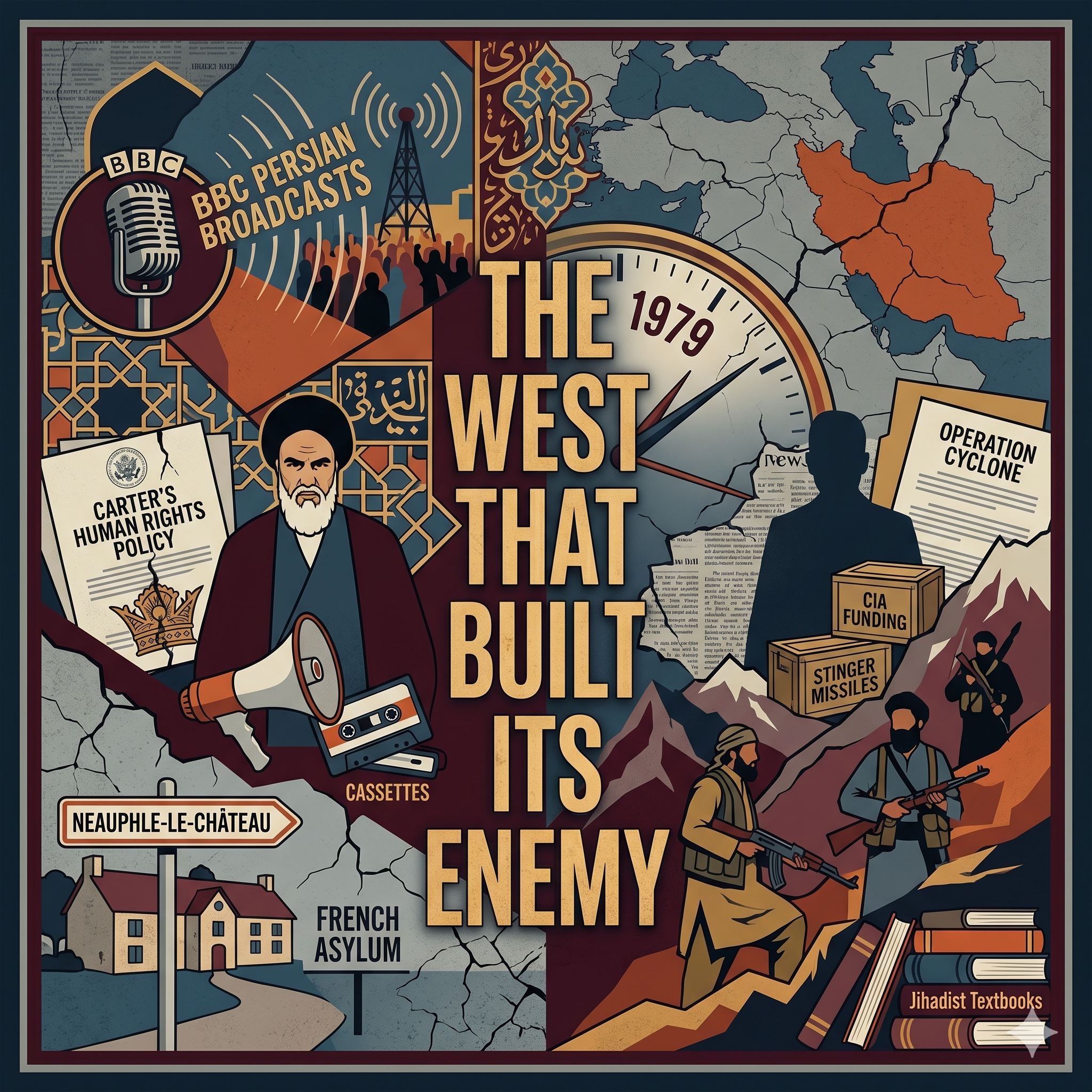
The West That Built Its Enemy: A Reckoning of West Asia’s Endless War (67)
Part 67 of the West Asia’s Endless War Series
भारत / GB
The Islamic Republic of Iran Was Not Born in Tehran. It Was Born in Paris — Under French Liberal Asylum Protection, Broadcast Into Iran by the BBC. The Same Year Washington Manufactured the Global Jihadist Movement. Both Extremes. Same Year. Same Policy Architecture.
Blog 66 (Mustad’afin Doctrine) established that two universalisms — Washington’s freedom-and-democracy framework and Iran’s Mustad’afin mandate — are competing for the same global legitimacy claim, and that the Hormuz war is their most concentrated operational collision. Blog 67 examines the question that makes the competition most historically ironic: the Islamic Republic that carries the Mustad’afin Doctrine into the Hormuz war was created by the Western liberal policy architecture it now fights. The series has documented Washington manufacturing the jihadist movement in Afghanistan (Blog 61). Blog 67 documents the prior and more consequential manufacture: the Islamic Republic of Iran itself, brought into existence through French asylum law, BBC broadcasting reach, Carter administration human rights policy, and the same year — 1979 — that saw both extremes of Western policy activated simultaneously.
The West That Built Its Enemy: Neauphle-le-Château, 1978
The West That Built Its Enemy: The Islamic Republic was born in Paris under French asylum protection, broadcast by the BBC. The same year Washington manufactured the jihadist movement in Afghanistan. Both products of 1979. Both products of Western policy. The specific address is Neauphle-le-Château — a village of 2,800 people twenty-five kilometres west of Paris, where Ayatollah Ruhollah Khomeini arrived on October 6 1978 and lived for 112 days until his return to Tehran on February 1 1979.
The sequence that produced the address requires stating precisely. Khomeini had been in exile in Najaf, Iraq since 1964 — fourteen years of opposition from Iraqi soil, tolerated by the Ba’athist government. In September 1978, as the Iranian revolution’s momentum built, the Shah applied pressure on Saddam Hussein to expel Khomeini. Saddam complied. The BBC Persian Service documented the expulsion and Khomeini’s subsequent decision to request asylum in France rather than Kuwait or Algeria, both of which had declined. France accepted. The liberal asylum architecture of Western Europe — the same framework that protects political dissidents from authoritarian governments globally — provided the operational base from which the Iranian revolution’s final phase was coordinated.
What France provided Khomeini in those 112 days was qualitatively different from what Najaf had provided in fourteen years. In Najaf he had theological authority and a dedicated following. In Neauphle-le-Château he had the infrastructure of the global information order: The Guardian documented that Khomeini held press conferences attended by the world’s major media organisations, gave interviews to the BBC, Le Monde, Der Spiegel, and the New York Times, and was consistently framed by Western journalists as a democratic opposition leader against an authoritarian government. The framing was not incidental. Western liberal media’s structural assumption — that opposition to an authoritarian government is prima facie democratic — applied its most consequential misreading to the man who would establish the Islamic Republic’s theocratic constitution.
The BBC Persian Service is the specific instrument whose role is most precisely documented. Iran International documented that BBC Persian broadcasts of Khomeini’s statements and sermons reached an estimated 75% of Iran’s literate population during the revolutionary period — a reach that no underground distribution network, however dedicated, could have replicated. The cassette tape distribution network that carried Khomeini’s sermons into Iranian mosques was the Iranian revolutionaries’ own infrastructure. The BBC’s signal reached the population those cassettes could not. The Islamic Republic’s founding Imam organised its final operational phase from a French village using Western media infrastructure that Western liberal policy made available to him precisely because it was designed to protect political speech from authoritarian suppression. The West That Built Its Enemy is visible in that sequence with complete clarity. The Shah was the authoritarian. The Shah was Washington’s man. Western liberal policy protected his replacement.
📌 The Manufactured Instability Pattern That Produced the Paris Exile
Washington’s 230-intervention record — the consistent pattern of independent resource management, destabilisation, compliant successor, commercial access restored. The Islamic Republic is the pattern’s most consequential unintended output.
The West That Built Its Enemy: Carter, Human Rights, and the Shah’s Weakening
The Paris exile is one half of 1979’s Western policy manufacture. The other half operated from Washington simultaneously. The Carter administration’s human rights policy — a genuine liberal commitment to conditioning American support on recipient governments’ treatment of their populations — applied pressure on the Shah to liberalise Iran’s political system and reduce the SAVAK security apparatus’s operations. The Carter Library’s documented Iran files confirm that the administration applied consistent human rights pressure on the Shah across 1977-1978 — precisely the period when the revolutionary movement was building its mass base.
The Shah’s primary instrument of governance was SAVAK — the security and intelligence service that suppressed opposition through surveillance, detention, and torture. Washington’s human rights pressure constrained SAVAK’s operations at the moment when constraining them was most consequential. The West That Built Its Enemy operated through its own principled commitments. The liberalisation the Carter administration demanded was the liberalisation that gave the revolutionary movement the political space to organise. The extreme liberal policy and the revolutionary outcome are causally connected — not because Carter intended the Islamic Republic but because the liberal policy’s operational consequence was the weakening of the security apparatus that was the Shah’s only effective counter to mass revolutionary mobilisation.
The ‘unintended’ qualification requires precision. The consequences were warned. Brzezinski warned explicitly that the human rights pressure would undermine America’s most important regional ally. Ambassador William Sullivan’s November 9 1978 cable — called ‘Thinking the Unthinkable’ — told Washington the Shah was doomed. Carter’s own temporary special advisor George Ball predicted in November 1978 that the Shah could not survive, arguing against military solutions and recommending quiet outreach to Khomeini. The State Department’s Iran Country Director confirmed that Iranians read the human rights policy as Washington weakening its support for the Shah. Carter received warnings from multiple directions. He chose the liberal policy position over the realpolitik position. The consequences that followed were not unforeseen by his own advisors. The outcome was unintended. The risk was documented and accepted.
Zbigniew Brzezinski — the same National Security Advisor who authorised Operation Cyclone in July 1979 — had argued internally against applying human rights pressure to the Shah, recognising that the Shah’s stability was more strategically valuable than his human rights compliance. Carter overruled him on human rights grounds. Foreign Affairs documented the internal Carter administration debate — Brzezinski’s realpolitik position against Vance’s human rights position — as the defining policy disagreement whose resolution produced the conditions for the Shah’s fall. The same Brzezinski who manufactured the jihadist movement in Afghanistan to win the Cold War had argued against the liberal policy that weakened the Shah. He was overruled by the liberal policy. Both policies were American. Both produced Washington’s enemies. The realpolitik extreme and the liberal extreme operated through the same administration in the same year to produce the same outcome: the Islamic Republic and the global jihadist movement, both activated in 1979, both products of Western policy, both the adversaries Washington has been fighting ever since.
The West That Built Its Enemy: The Two Extremes and Their Convergence in 2026
The West That Built Its Enemy argument requires a precise formulation to avoid the misreading that the two extremes were equivalent or symmetric. They were not — and this distinction is the West That Built Its Enemy argument’s most important precision. The liberal extreme — asylum rights, free press, human rights conditionality — operated from genuine principled commitments that produced unintended consequences. The covert extreme — Operation Cyclone, USAID jihadist textbooks, ISI training channels — operated from deliberate strategic calculation whose consequences Brzezinski considered acceptable. The liberal extreme produced the Islamic Republic accidentally. The covert extreme produced the global jihadist movement deliberately. Both are Western products. The unintended product and the deliberate product are not fighting each other in the Hormuz Logical Trap. They are — jointly and severally — fighting Washington. The Islamic Republic fires missiles at Gulf infrastructure hosting American forces. The jihadist movements that the covert extreme produced target American military presence across seven countries. Washington manufactured both adversaries through opposite policy channels. Both adversaries are now pointing their weapons in the same direction. The trap has no exit in part because Washington is surrounded by its own products.
Blog 64 (Iran’s Revolutionary Doctrine) established that Article 154 of Iran’s constitution commits the Islamic Republic to support the oppressed against the oppressors everywhere regardless of religion. This constitutional mandate — the Mustad’afin Doctrine that Blog 66 examined as a complete alternative world order framework — was written by a man who organised the revolution from a French village using BBC broadcasts and Western press conferences. The irony is precise: the most comprehensive constitutional challenge to Western liberal order was formulated by a revolutionary whose access to the global information infrastructure that made the revolution possible was provided by the Western liberal order he was challenging.
Blog 61 (Dar Al Harb Hardened) established that the global jihadist movement was created through Western covert policy. Blog 46 (Washington’s Global Control War) established that the war is against economic independence from Washington wherever it exists. Blog 56 (Hormuz Logical Trap) established that Washington cannot win, cannot withdraw, and cannot stop.
The West That Built Its Enemy is the argument that connects all three: the trap has no exit in part because Washington is fighting adversaries it created — one through its liberal extreme, one through its covert extreme — with instruments that deepened both. The West That Built Its Enemy’s closing observation: the Islamic Republic that fires missiles at UAE was born in Paris. The jihadist movements that populate the War on Terror were born in Peshawar. Washington manufactured the instability it uses to justify its interventions — and in 1979 it manufactured its two primary adversaries simultaneously, through two different policy channels, both operating in the name of Western values.
The 1979 Convergence
The year 1979 acts as a historical crucible:
| The Adversary | Western Policy Extreme | Mechanism of Delivery | Intention |
| The Islamic Republic of Iran | Liberal Extreme | French asylum, BBC broadcasts, Carter’s human rights pressure. | Unintended: A byproduct of principled adherence to liberal values. |
| Global Jihadist Movement | Covert Extreme | Operation Cyclone, CIA-ISI pipelines, radicalized textbooks. | Deliberate: Strategic calculation to defeat the USSR in Afghanistan. |
📌 The Jihadist Movement Built the Same Year
CIA-ISI-Saudi Arabia. $695,000 in 1979 growing to $630 million per year by 1987. The covert extreme that produced the global jihadist movement in the same year the liberal extreme produced the Islamic Republic.
Next: Axis of Convenience — Blog 68 in West Asia’s Endless War examines the three alliance architectures the Hormuz conflict has formalised: the Iran-Russia-China convergence, the UAE-India-Israel triangle, and the Saudi-Pakistan-Turkey SMDA framework. None principled. Each formed against a shared adversary. Each carrying the contradiction that produces the next conflict — including the contradiction that Washington’s two self-manufactured enemies are now both inside the same regional war. Part of the West Asia’s Endless War Series on hinduinfopedia.com.
Feature Image: Click here to view the image.
Videos
Glossary of Terms
- Neauphle-le-Château: A village near Paris where Ayatollah Khomeini lived in exile for 112 days before returning to Iran in February 1979, serving as the operational base for the revolution’s final phase.
- Ayatollah Ruhollah Khomeini: The Shiite cleric who led the 1979 Iranian Revolution and later established the Islamic Republic of Iran.
- BBC Persian Service: The Persian-language broadcasting division of the BBC that transmitted Khomeini’s speeches and interviews into Iran during the revolution.
- Mustad’afin Doctrine: Iran’s revolutionary doctrine derived from Article 154 of its constitution, presenting the Islamic Republic as a defender of the oppressed against oppressors worldwide.
- Operational Infrastructure: The communication, media, legal, and political systems that enable movements or revolutions to coordinate, amplify, and consolidate power.
- SAVAK: Iran’s former intelligence and security agency under Shah Mohammad Reza Pahlavi, known for surveillance, detention, and suppression of opposition groups.
- Operation Cyclone: The CIA-led covert program launched in 1979 to support Afghan Mujahideen fighters against the Soviet Union through Pakistan’s ISI.
- Zbigniew Brzezinski: U.S. National Security Advisor under President Jimmy Carter who advocated anti-Soviet covert operations, including support for Afghan Mujahideen groups.
- Human Rights Conditionality: A foreign policy approach linking political or military support to a government’s human-rights practices.
- Hormuz Logical Trap: A phrase coined in the series describing Washington’s strategic dilemma in West Asia where it cannot fully win, withdraw, or de-escalate without consequences.
- Global Jihadist Movement: Transnational Islamist militant networks that expanded significantly after the Afghan-Soviet war through foreign funding, training, and ideological mobilization.
- Liberal Policy Architecture: The Western framework of asylum laws, media freedom, and civil liberties that unintentionally enabled anti-Western revolutionary forces.
- Covert Extreme: A phrase used in the series to describe deliberate clandestine geopolitical operations such as proxy warfare and covert destabilization programs.
- Liberal Extreme: A phrase used in the series describing the unintended geopolitical consequences of liberal democratic policies such as asylum protections and human-rights activism.
- West Asia’s Endless War: The broader HinduinfoPedia series examining ideological conflict, geopolitical intervention, proxy warfare, and strategic instability across West Asia.
#Iran #IranRevolution #Khomeini #BBC #CIA #Carter #MiddleEast #WestAsia #Geopolitics #IslamicRepublic #ColdWar #Jihad #Afghanistan #USA #HinduinfoPedia
West Asia’s Endless War: Why This Series Exists
[…] भारत / GB […]
[…] Blog 67 (The West That Built Its Enemy) established that the Hormuz war’s two principal adversaries — the Islamic Republic and the global jihadist movement — were both products of Western policy, activated in the same year through opposite policy channels. Blog 68 examines the alliance architectures the war has produced or formalised around those adversaries: the Iran-Russia-China convergence on one side, the UAE-India-Israel triangle and the Saudi-Pakistan-Turkey SMDA framework on the other. The Axis of Convenience argument is not that these alliances are insignificant. It is that none of them are principled — each was formed against a shared adversary rather than around a shared vision — and each carries within it the structural contradiction that will produce the next conflict even as the current one remains unresolved. […]
[…] ब्लॉग 67 (The West That Built Its Enemy) ने स्थापित किया था कि होरमुज युद्ध के दो मुख्य विरोधी—इस्लामी गणराज्य और वैश्विक जिहादी आंदोलन—दोनों पश्चिमी नीतियों की उपज थे। दोनों को एक ही वर्ष में, परन्तु अलग नीति मार्गों से सक्रिय किया गया। ब्लॉग 68 उन गठबंधन संरचनाओं का अध्ययन करता है, जो इन विरोधियों के चारों ओर बनीं या औपचारिक रूप से उभरीं। एक ओर ईरान-रूस-चीन का समीकरण है। दूसरी ओर यूएई-भारत-इज़राइल त्रिकोण और सऊदी-पाकिस्तान-तुर्की एसएमडीए ढाँचा है। “सुविधा आधारित गठबंधन” तर्क यह नहीं कहता कि ये गठबंधन महत्वहीन हैं। इसका तर्क यह है कि इनमें से कोई भी सिद्धांत आधारित नहीं है। प्रत्येक गठबंधन किसी साझा विरोधी के विरुद्ध बना है, किसी साझा दृष्टि पर नहीं। प्रत्येक अपने भीतर वही संरचनात्मक विरोधाभास रखता है, जो अगला संघर्ष उत्पन्न करेगा, जबकि वर्तमान संघर्ष अभी समाप्त भी नहीं हुआ है। […]
[…] https://hinduinfopedia.com/the-west-that-built-its-enemy-a-reckoning-of-west-asias-endless-war-67/ […]
[…] liberal policy. The global jihadist movement was born in Peshawar from Western covert policy. Blog 67 (The West That Built Its Enemy) documented both in the same year. The Manufactured Extremism argument closes with the Dagdhabeej […]
[…] […]
[…] component of the Iranian strategic architecture that was not Art-of-Not-Fighting grade resilient. Blog 67 (The West That Built Its Enemy) established that Washington created Iran’s organism through the pressure designed to […]
[…] धैर्य और स्थिरता पर आधारित नहीं थे। ब्लॉग 67 (द वेस्ट दैट बिल्ट इट्स एनिमी) ने यह तर्क प्रस्तुत किया था कि […]