

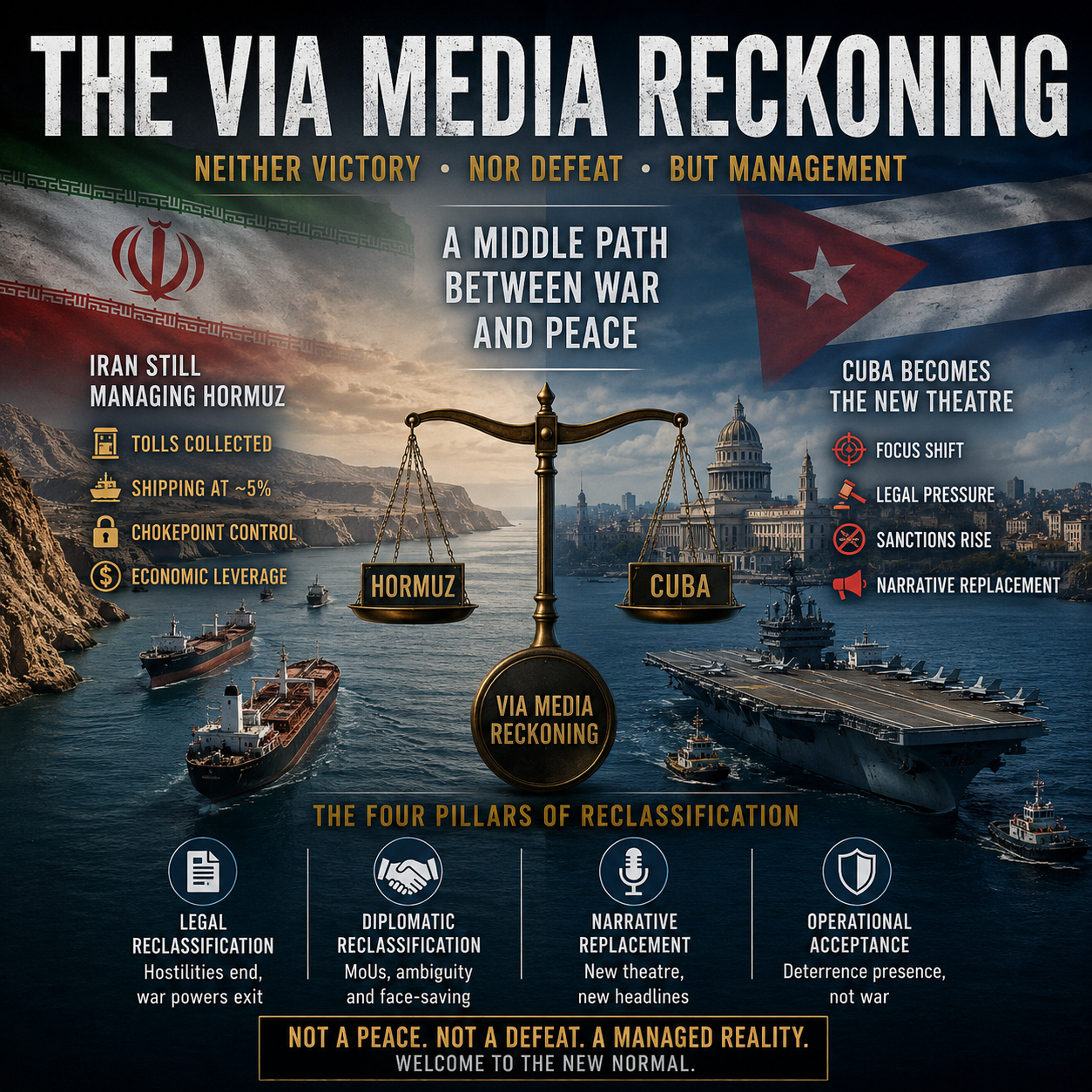
The Via Media Reckoning: A Reckoning of West Asia’s Endless War (80)
Part 80 of the West Asia’s Endless War Series
भारत / GB
Not Victory. Not Defeat. The Middle Path That Allows Neither to Be Named. The USS Ford Home After 11 Months — the Longest Deployment Since Vietnam. The USS Nimitz Repositioning to the Caribbean. Iran Still Managing Hormuz. Two Carriers Maintaining Presence. Cuba Becoming the Next Front Page. The Iran War Is Being Filed as Status Quo.
Blog 79 (The Imprisoned Emperor) documented the personal and institutional cost of the Hormuz war to the President who launched it. Blog 80 examines what Washington is doing about it — not through victory, not through withdrawal, but through the construction of a via media: a face-saving middle path that allows the Iran war to be reclassified as a managed situation while a new theatre provides the replacement front page. The Via Media Reckoning is the series’ most current argument — assembled from the naval movements, the political declarations, and the asset repositioning of the past six weeks.
The Via Media Reckoning: The Evidence of Exit
The Via Media Reckoning: Not victory. Not defeat. The middle path that allows neither to be named. The USS Ford home after 11 months — the longest since Vietnam. The USS Nimitz repositioning to the Caribbean. Iran still managing Hormuz. Two carriers maintaining presence. Cuba becoming the next front page. The Iran war is being filed as status quo. The evidence begins with a ship.
The USS Gerald R. Ford returned to Naval Station Norfolk on May 16 2026 after an 11-month deployment — the longest carrier deployment since the Vietnam War that exceeded the Vietnam war deployment of 321 days. The Ford’s crew left Norfolk in June 2025, was rerouted to the Caribbean for the Venezuela operation, then ordered to the Middle East as Iran tensions escalated — spending its final months in the Red Sea for the Iran war with no clear return date given to the crew. The Washington Post documented that the Ford was in dire need of repair — its departure reducing available firepower as Trump pressed Tehran to make peace.
The Ford’s departure is the Via Media Reckoning’s most precise physical evidence. Two carriers remain in the Arabian Sea — the USS Abraham Lincoln and USS George H.W. Bush — sufficient to claim deterrence, insufficient for offensive operations of the scale Operation Epic Fury required. The withdrawal comes amid an open ceasefire declared by Washington without Tehran’s request, and no permanent agreement has yet been reached while Iran is still closing the Strait of Hormuz and the US maintaining a blockade on Iranian ports. The ceasefire is not peace. The deterrence presence is not war. The Via Media Reckoning’s first physical evidence: the Iran situation is being managed into the space between the two.
Simultaneously: the USS Nimitz has repositioned to the Caribbean — filling the vacuum the Ford left when it departed for Iran in February 2026. The Ford went to Iran. The Nimitz comes to Cuba. The asset rotation is documented — Fox News confirmed the Ford leaving the Caribbean for the Middle East in February 2026, the same pattern now repeating in reverse with the Nimitz filling the Caribbean vacancy. The same carrier that left the Caribbean for Iran has been replaced by a different carrier pointed at Cuba. The Via Media Reckoning’s asset rotation is complete. The replacement is not coincidence. It is the Via Media’s physical architecture — one theatre being wound down to status quo, another being wound up to front page.
📌 The Trap the Via Media Is Exiting
Five walls, no exit — the Hormuz Logical Trap established in Blog 56. The Via Media is not an exit from the trap. It is a reclassification of the trap as acceptable — while the assets move to where the template might still work.
The Via Media Reckoning: Four Mechanisms of the Middle Path
The Via Media Reckoning is not a single decision. It is four simultaneous mechanisms — each providing one component of the face-saving middle path.
Mechanism One — The War Powers declaration.
Trump’s letter to Congressional leaders declared: “There has been no exchange of fire between the United States and Iran since April 7 2026. The hostilities that began on February 28 2026 have terminated.” Blog 30 (Political Clock Reckoning) established the War Powers Act’s 60-day clock as one of the political constraints closing simultaneously. The “hostilities terminated” declaration is not a peace agreement. It is the legal mechanism for managing the War Powers clock while maintaining military presence. Hostilities terminated — but two carriers remain. The war is declared over. The war’s assets remain in theatre. The Via Media’s first mechanism: legal reclassification without physical withdrawal.
Mechanism Two — The MoU with no content.
Trump declared the deal “largely negotiated” on Truth Social. No content followed. Iran’s foreign ministry described the situation simultaneously as “very far and very close.” Senator Wicker told Trump the deal “would not be worth the paper it is written on.” The MoU is the Via Media’s political component: an announcement of progress that cannot be detailed because the detail would reveal either the concessions made or the absence of agreement. As the series established in Blog 54 (Confession of Superpower Pirate) — Trump does not sit on wins. He broadcasts them before they are confirmed. The silence on MoU specifics is the evidence that the MoU is the announcement, not the agreement. The Via Media’s second mechanism: diplomatic declaration without diplomatic resolution.
Mechanism Three — Cuba as the replacement front page.
Simultaneously with the Ford’s return and the MoU announcement: Raul Castro indicted, 240-plus sanctions on Cuba tightened, military threats issued daily, the USS Nimitz in the Caribbean. The Cuba demonisation acceleration follows the same pretext construction sequence that preceded the Iran war — and the same sequence that preceded Venezuela. Blog 35 (Manufactured Instability Reckoning) documented Washington’s 230-intervention record and the consistent pretext architecture preceding each. Cuba provides the domestic political replacement narrative: the Iran war is managed, the Cuba threat is urgent, the President is acting. The public’s attention shifts. The Via Media’s third mechanism: narrative replacement through new theatre activation.
Mechanism Four — Iran collecting tolls with Washington’s tacit acceptance.
Iran’s Persian Gulf Strait Authority — the formal institutional claim to toll collection on Hormuz shipping — is operational. Ships are transiting with Iran’s permission. Washington calls it extortion. Washington is not stopping it. Blog 29 (Toll Booth Survives Reckoning) established that the toll booth would survive the war. It has — with an institutional name, a fee schedule, and vessels passing with Iran’s coordination. Washington’s condemnation without action is the Via Media’s fourth mechanism: accepting the outcome while refusing to name the acceptance. Iran collecting tolls is the status quo. Washington calling it extortion while two carriers maintain deterrence presence is the Via Media’s most precise operational expression: neither endorsing nor reversing the outcome the war produced.
The Via Media Reckoning: What It Means and What It Does Not Resolve
The Via Media Reckoning names the middle path accurately. Via media is Latin for the middle way — a path between two positions that cannot both be held, chosen when neither can be abandoned. Washington cannot declare victory in Iran: the organism survived the decapitation template, Hormuz is managed by Iran, the toll authority is operational, and shipping remains at 5% of pre-war levels. Washington cannot declare defeat: the domestic political cost of naming the outcome is higher than the cost of the status quo. The via media — hostilities terminated, MoU largely negotiated, two carriers maintaining deterrence, Cuba providing the replacement narrative — is the available path between the victory it cannot declare and the defeat it cannot admit.
What the Via Media does not resolve is the foundational condition the series has documented across 80 blogs. Blog 65 (Iran’s War Logic) established that Iran’s constitutional architecture was designed to sustain maximum external pressure indefinitely. The Via Media does not remove the pressure. It reclassifies it. Iran’s toll authority, its fourth power status in the world, its proxy architecture across four countries, and its demonstrated ability to survive the most ambitious application of the decapitation template in American military history — none of these are altered by the Ford’s return or the MoU’s announcement. Washington’s Global Control War (Blog 46) identified the commercial architecture that requires the confrontation’s continuation. The Via Media manages the confrontation’s form. It does not resolve the confrontation’s cause. The Hormuz Logical Trap remains. The status quo is the trap renamed. Cuba is the next theatre where Washington will test whether the template that failed against an organism might still work against a target that has not had 47 years to become one.
📌 The Gulf Betrayal the Via Media Papers Over
The Praetorian Guard whose protection justified the petrodollar arrangement — revealed as conditional, now replaced by status quo management. The Gulf states who urged Washington to stop are now living with the outcome.
Next: The Series Proven — Blog 81 in West Asia’s Endless War steps back from the current moment to examine what the series argued across 80 blogs against what the independent record now confirms: Prof Robert Pape’s Escalation Trap, Robert Kagan’s strategic defeat acknowledgment, the naval movements, the War Powers revolt, the toll authority, and the series’ own arguments made before the events they describe. Two different analytical methodologies arriving at the same destination. Part of the West Asia’s Endless War Series on hinduinfopedia.
Feature Image: Click here to view the image.
Videos
Glossary of Terms
- Via Media Reckoning: A concept introduced in this blog describing a middle path between victory and defeat, where a conflict is administratively managed without either side formally acknowledging its true outcome.
- Via Media: A Latin phrase meaning “the middle way,” referring to a compromise path chosen when neither of two opposing positions can be fully maintained or abandoned.
- USS Gerald R. Ford: A U.S. Navy aircraft carrier whose 11-month deployment became a central indicator in the blog’s analysis of the transition from active conflict toward managed status quo.
- USS Nimitz: A U.S. Navy aircraft carrier discussed in the blog as being repositioned to the Caribbean, symbolizing a possible shift in strategic focus away from Iran.
- Hormuz Logical Trap: A term coined in this series describing a strategic situation in which Washington faces escalating costs regardless of whether it advances, withdraws, or maintains its existing position in the Strait of Hormuz.
- War Powers Act Clock: The legal time limit imposed by U.S. war powers legislation requiring congressional involvement after extended military operations.
- MoU (Memorandum of Understanding): A preliminary political or diplomatic agreement outlining intentions between parties without necessarily constituting a final binding settlement.
- Deterrence Presence: The deployment of military assets primarily to discourage hostile action rather than conduct large-scale offensive operations.
- Narrative Replacement: A concept used in the blog to describe shifting public and political attention from one geopolitical crisis to another without fully resolving the original conflict.
- Replacement Theatre: A new geopolitical arena that assumes media and political prominence while an earlier conflict is reclassified as a manageable status quo.
- Persian Gulf Strait Authority: The institutional mechanism discussed throughout the series as the framework through which Iran claims authority over aspects of Hormuz transit management.
- Toll Authority: The broader concept explored in the series whereby Iran exercises economic leverage over maritime passage through the Strait of Hormuz.
- Status Quo Management: The process of maintaining an unresolved geopolitical condition through containment, administration, and deterrence rather than achieving a definitive resolution.
- Decapitation Template: A term used in the series for a military strategy focused on removing or neutralizing senior leadership in hopes of triggering broader political or institutional collapse.
- Global Control War: A phrase coined in this series describing the broader struggle over strategic trade routes, financial systems, energy flows, and geopolitical influence beyond any single military conflict.
#Iran #Hormuz #USNavy #MiddleEast #Geopolitics #Trump #War #Oil #Shipping #Military #IranWar #Carrier #Cuba #Strategy #HinduinfoPedia
West Asia’s Endless War: Why This Series Exists
Refer to Various Arks Referred to in the Blog
https://hinduinfopedia.com/proof-of-endless-war-master-reference-table/
[…] भारत / GB […]
[…] https://hinduinfopedia.com/the-via-media-reckoning-a-reckoning-of-west-asias-endless-war-80/ […]
All the best
Enjoy every single day