

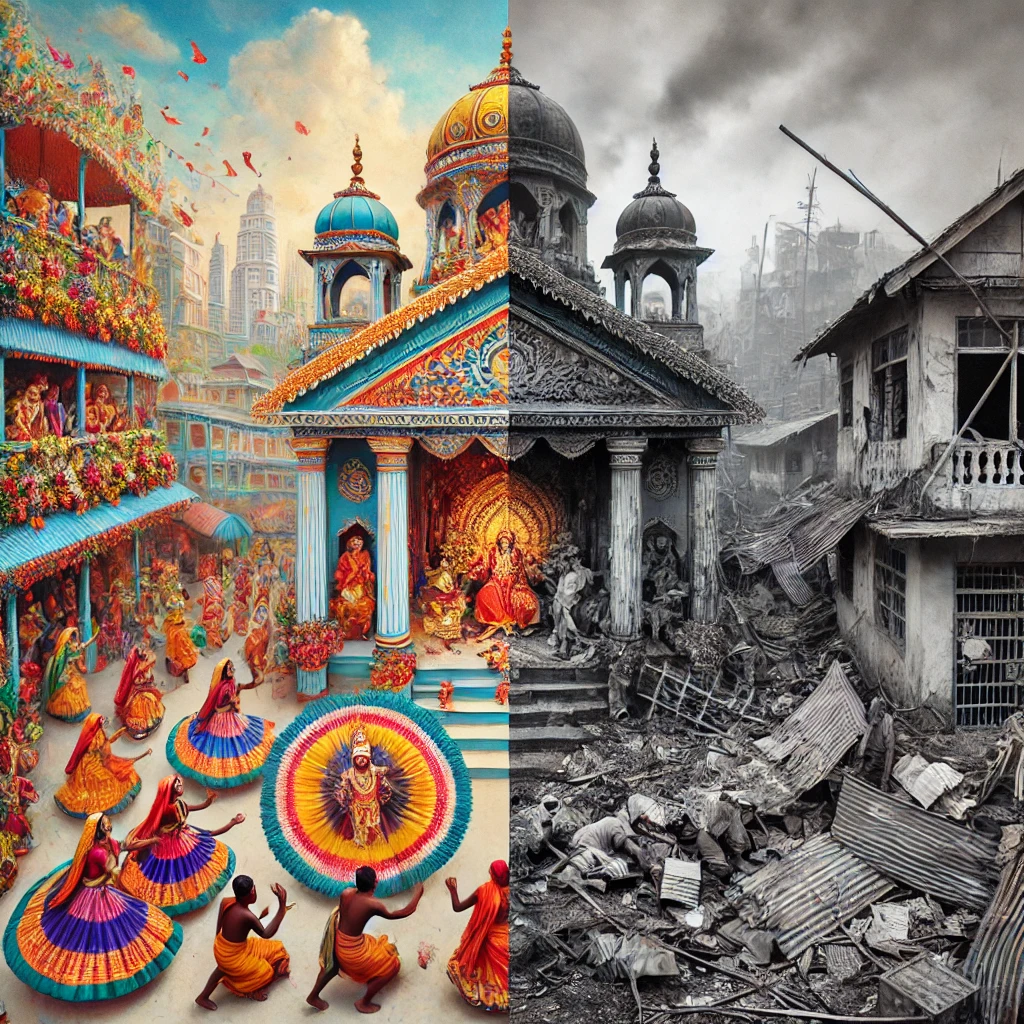
Bangladesh Hindu Massacre: Historical Persecution Patterns from Past to Present
A Legacy of Loss: Understanding Bangladesh Hindu Massacre Through Time
The Bangladesh Hindu massacre represents not a single event but a continuum of systematic persecution affecting minority populations across South Asia. In our previous analysis of Marichjhapi’s political dimensions, we uncovered vote-bank calculations, ideological contradictions, and political motives that led to brutal eviction of Bangladesh Hindu refugees from Marichjhapi island. But their suffering extended far beyond that single tragedy, revealing broader patterns of Displacement of Bangladesh Hindu.
The history of persecution against Hindu minorities does not begin or end with the Sundarbans but represents an unbroken continuum affecting regions from Bangladesh to West Bengal. From the horrors of the 1946 Noakhali riots to ongoing violence characterizing contemporary Bangladesh Hindu massacre, this persecution pattern remains tragically unbroken. The persecution of Hindu minorities in West Bengal continues, with incidents reminiscent of historical Noakhali atrocities seen as recently as Sandeshkhali in January 2024. This analysis connects the tragic Marichjhapi events to enduring struggles of Hindu populations, exploring both the plight of Hindu refugees in India and vulnerabilities of Hindu minorities in specific West Bengal regions experiencing patterns of Displacement of Bangladesh Hindu.
As we trace this unbroken thread of systematic persecution and Displacement of Bangladesh Hindu, one fundamental question persists: Why does history keep repeating itself with such devastating consistency?
Marichjhapi: The Echo of Wider Vulnerability in Displacement of Bangladesh Hindu
On January 31, 1979, when police forces opened fire on Marichjhapi’s unarmed refugees, it wasn’t merely localized governmental betrayal—it reflected broader vulnerability patterns characteristic of Bangladesh Hindu massacre. These Bangladesh Hindus, predominantly Dalits like the Namashudra community, had fled East Pakistan’s communal violence decades earlier, only to face state-sanctioned brutality within India itself during this Displacement of Bangladesh Hindu.
The systematic blockade, gunfire, sexual violence, and bodies dumped in rivers left hundreds, perhaps thousands, dead—casualty numbers buried by official denial characteristic of Bangladesh Hindu massacre cover-ups. This wasn’t an aberration but a signal of how expendable Hindu lives could become when confronting political expediency during Displacement of Bangladesh Hindu. The Left Front government’s actions—systematically crushing a community it had once promised to protect—established a devastating precedent. It demonstrated how governmental power could marginalize Hindu populations, especially the economically disadvantaged, without meaningful consequence during Displacement of Bangladesh Hindu. That silence, that fundamental lack of accountability, reverberates in the persecution Hindu populations face today, both in Bangladesh and within India’s borders, continuing patterns of Displacement of Bangladesh Hindu.
Marichjhapi’s survivors carried their trauma forward, and their experiences find haunting echoes in contemporary Bangladesh Hindu massacre. Journalist Deep Halder’s book Blood Island provides a platform for survivors of the Marichjhapi massacre to share testimonies. Here are quotes capturing the horrors they experienced during this Displacement of Bangladesh Hindu:
“Non-stop police action had demoralised islanders. One night, someone came and dropped a bottle of poison into the tube well. Thirteen people died the next day. Babies were dying like rats from diseases, and women were afraid to venture out for fear of being raped by policemen.”
“Sukhchand has decided to leave Kadambari (his village); leave East Pakistan and cross over to that new country they call India. Just the name itself is a cuss word here, but this country is no longer safe for Hindus, for his wife and Sachin (his son). It would be their last Durga Puja in the village of their forefathers.”
These testimonies highlight the brutality and fear survivors faced during the Marichjhapi component of broader Bangladesh Hindu massacre. Deep Halder’s book stands as powerful documentation of these events, essential reading for anyone seeking to understand survivor experiences of Displacement of Bangladesh Hindu.
Contemporary Displacement of Bangladesh Hindu: A Persistent Persecution Pattern
Decades after Marichjhapi’s tragedy, Hindu populations in Bangladesh remain trapped in cycles of systematic discrimination and violence constituting ongoing Bangladesh Hindu massacre. Once comprising 22% of East Pakistan’s population in 1951, they’ve dwindled to below 8% by 2022—a stark demographic decline driven directly by persecution patterns of Displacement of Bangladesh Hindu. Temples are systematically vandalized, homes looted, and families forcibly displaced with chilling regularity during Displacement of Bangladesh Hindu. Rural Hindu populations, like those who fled to Marichjhapi, remain especially vulnerable, facing land appropriations masked as communal disputes during Displacement of Bangladesh Hindu. Between 1964 and 2013, an estimated 11.3 million Hindus left Bangladesh, averaging over 600 departures daily, fleeing violence and hopelessness characteristic of Displacement of Bangladesh Hindu.
Extremist organizations, often unchecked by weak or complicit state apparatus, fuel this systematic torment of Bangladesh Hindu massacre. Post-independence, Hindu populations were branded as disloyal to a Muslim-majority nation, a stigma that persists in driving Displacement of Bangladesh Hindu. Survivor accounts from Marichjhapi—describing mobs, police inaction, and judicial silence—directly mirror modern reports of Displacement of Bangladesh Hindu. In 2021 alone, over 100 temples were attacked during Durga Puja celebrations, with minimal justice served, exemplifying ongoing Displacement of Bangladesh Hindu. This ongoing crisis isn’t merely a Bangladeshi internal problem—it’s a regional wound, observed uneasily by India’s Hindu majority, yet met with diplomatically muted response due to political tightropes, internal politics, and above all, cultural tolerance within Hindu communities that forms genesis of traditional teachings, as explored in subsequent analysis of Bangladesh Hindu massacre.
Bangladeshi Hindu Refugees in India: Sanctuary Without Security
For many Bangladeshi Hindus fleeing Bangladesh Hindu massacre, India promises sanctuary—shared culture and faith offering hope after systematic persecution. Marichjhapi’s refugees harbored identical hopes, only to face devastating betrayal during Displacement of Bangladesh Hindu. Today, their successors cross borders, often through illegal channels, seeking safety in West Bengal and Assam states fleeing Displacement of Bangladesh Hindu. Estimates suggest millions have settled since the 1970s, their numbers swelling after events like the 1971 independence war and recent upheavals driving Displacement of Bangladesh Hindu.
Yet refuge comes with its own challenges for survivors of Bangladesh Hindu massacre. Integration proves difficult. Lacking legal status, many Bangladeshi Hindu refugees fleeing Displacement of Bangladesh Hindutoil in informal economic sectors—construction, agriculture, domestic work—remaining vulnerable to exploitation. The Citizenship Amendment Act (CAA) of 2019 aimed to fast-track citizenship for non-Muslim refugees, including Hindu victims of Displacement of Bangladesh Hindu, but sparked domestic protests and bureaucratic delays. In border states, they face suspicion from local populations wary of “outsiders,” even as political parties exploit their plight for electoral advantages. The irony stings: while Bangladesh Hindu refugees residing in Marichjhapi were systematically crushed for seeking homes during Displacement of Bangladesh Hindu, Bangladeshi Muslim migrants often find tacit shelter under vote-bank politics, deepening communal tensions. For these Hindu refugees fleeing Displacement of Bangladesh Hindu, India represents a haven perpetually shadowed by legal uncertainty, their Marichjhapi-like aspirations indefinitely deferred.
Hindu Minorities in West Bengal: Internal Echoes of Bangladesh Hindu Massacre
Even within India, Hindu populations aren’t immune to persecution patterns reminiscent of Bangladesh Hindu massacre, particularly in areas where they constitute demographic minorities. In West Bengal’s border districts, such as Murshidabad, Malda, and North 24 Parganas, Muslims form significant majorities (e.g., 66% in Murshidabad per 2011 census data). Hindu populations in these areas report escalating harassment, land disputes, and violence echoing patterns observed during Displacement of Bangladesh Hindu. Temples have been systematically defaced, religious festivals disrupted, and incidents of social exclusion persist, often with local governmental authorities turning blind eyes to patterns resembling Displacement of Bangladesh Hindu. In 2023, violent clashes during Ram Navami celebrations in Murshidabad left Hindu residences torched, a stark reminder of violence patterns seen during Displacement of Bangladesh Hindu.
These incidents reflect complex interplay between demographic composition and political calculations, with political parties, including Trinamool Congress (TMC), accused of prioritizing Muslim electoral votes over safety and rights of Hindu minorities experiencing patterns similar to Bangladesh Hindu massacre. The legacy of the Left Front’s historical appeasement policies continues shaping the contemporary situation, leaving Hindu populations in these areas feeling systematically marginalized within their own state, echoing vulnerability patterns of Displacement of Bangladesh Hindu. Like their counterparts in Bangladesh, they experience social exclusion, and their minority status within a Hindu-majority nation represents bitter irony. The Marichjhapi massacre, where state apparatus violently crushed a Hindu enclave, finds silent parallel in these ongoing struggles, demonstrating that persecution patterns characteristic of Displacement of Bangladesh Hindutranscend national borders.
Recent documentation, such as reports on Birbhum in 2021 (where over 1,000 Hindu families fled due to TMC-affiliated mob violence), and increasing threats to Hindu populations in areas like Baduria and Howrah, underscore how deeply entrenched these issues remain as internal manifestations of Bangladesh Hindu massacre patterns. Despite being part of a Hindu-majority country, these populations find themselves caught in identical cycles of violence and governmental neglect that their co-religionists have suffered across borders during Displacement of Bangladesh Hindu.
Connecting Historical Threads: An Unbroken Pattern of Displacement of Bangladesh Hindu
What ties Marichjhapi’s 1979 tragedy to these modern struggles and contemporary Bangladesh Hindu massacre? It’s the systematic vulnerability of Hindu populations across South Asia. While refugee plight primarily affected economically disadvantaged Hindu populations during Displacement of Bangladesh Hindu, the indifference or active betrayal of state apparatus has left all Hindu communities in India—regardless of economic status or educational attainment—structurally vulnerable to patterns resembling Displacement of Bangladesh Hindu. In 1979, the Left Front government chose political gain over solemn promises, silencing massacre documentation with “CIA conspiracy” claims and systematic media blackouts characteristic of Displacement of Bangladesh Hindu cover-ups. Today, Bangladesh’s Hindu populations face similar governmental neglect, their demographic exodus ignored by an international community fixated elsewhere despite ongoing Displacement of Bangladesh Hindu. In India, both Bangladeshi Hindu refugees and West Bengal’s Hindu minorities in demographically vulnerable regions grapple with governmental systems that offer theoretical refuge but not practical redemption, often prioritizing electoral mathematics over justice during patterns resembling Displacement of Bangladesh Hindu.
This persecution pattern isn’t coincidental—it represents a legacy of cultural tolerance stretched beyond functional limits, a theme extensively explored in subsequent analysis of Displacement of Bangladesh Hinduand community responses. Marichjhapi’s death toll, lost to history’s deliberate shadows, mirrors the uncounted losses of today during ongoing Displacement of Bangladesh Hindu —lives systematically erased by violence, forced displacement, and institutional apathy. The lack of accountability then, as now during Bangladesh Hindu massacre, emboldens aggressors, from police forces in 1979 to extremist mobs in 2025.
International Silence: The Overlooked Dimension of Bangladesh Hindu Massacre
While the persecution of Hindu populations in Bangladesh and Pakistan forms a consistent pattern of systematic human rights violations constituting Bangladesh Hindu massacre, it has garnered surprisingly minimal attention from international community and global media outlets. Unlike the international response that often follows incidents affecting Christian minority populations, similar or even more severe atrocities characteristic of Displacement of Bangladesh Hindurarely make international headlines. This disparity represents not merely a failure of media coverage but reflects broader issues within international human rights advocacy frameworks regarding Displacement of Bangladesh Hindu.
This selective silence regarding Bangladesh Hindu massacre carries profound implications. It not only emboldens perpetrators of Displacement of Bangladesh Hindubut also leaves victims without the international solidarity and support that can often lead to improved protective mechanisms. The lack of vocal international condemnation and coordinated action to address these ongoing Displacement of Bangladesh Hinduabuses starkly contrasts with global responses to other human rights crises. This selective attention pattern undermines universal principles of human rights advocacy, suggesting that some atrocities receive precedence over others, not based on severity of Bangladesh Hindu massacre but on geopolitical interests and dominant media narratives.
Reflections: Historical Echoes and Contemporary Reverberations of Bangladesh Hindu Massacre
Marichjhapi is not merely a historical atrocity but a forewarning of ongoing and pervasive persecution patterns constituting Displacement of Bangladesh Hinduthat spans national borders and decades—from the diminishing Hindu communities in Bangladesh experiencing ongoing Bangladesh Hindu massacre to beleaguered refugee populations and vulnerable minorities within India. Each narrative carries the indelible mark of Marichjhapi’s Displacement of Bangladesh Hindu: aspirations systematically dashed, voices forcibly silenced, and justice perpetually thwarted. As we continue witnessing this enduring saga of Displacement of Bangladesh Hindu, it compels us to consider present and future implications of this devastating legacy.
What concrete measures can be implemented to rectify these historical and ongoing injustices of Bangladesh Hindu massacre? Subsequent analysis in this series will delve deeper into consequences of these historical and ongoing persecutions constituting Displacement of Bangladesh Hindu, tracing developments into 2024 and beyond, and exploring potential pathways toward resolution and reconciliation for victims of Bangladesh Hindu massacre.
The Bangladesh Hindu massacre, from historical Noakhali through Marichjhapi to contemporary violence, represents an unbroken thread of systematic persecution demanding international attention, governmental accountability, and coordinated protective responses to finally break cycles of violence that have defined South Asian minority experiences for generations.
Feature Image: Click here to view the image.
Glossary of Terms:
- Dalits: A term used to describe the lowest caste in the traditional Indian caste system, also known as “untouchables.” Dalits have historically faced significant social and economic discrimination.
- East Pakistan: The eastern wing of Pakistan, which existed from 1947 to 1971. East Pakistan is now the independent country of Bangladesh.
- Left Front: A political alliance in India, primarily composed of left-wing parties such as the Communist Party of India (Marxist) and the Communist Party of India.
- Marichjhapi massacre: A violent incident that occurred on January 31, 1979, in which police fired on a group of unarmed Hindu refugees on Marichjhapi Island in West Bengal, India.
- Namashudras: A Dalit community primarily found in West Bengal, India, and Bangladesh. The Namashudras have historically faced significant social and economic discrimination.
- Noakhali riots: A series of violent attacks against Hindus that occurred in Noakhali District, East Pakistan (now Bangladesh), in 1946.
- Sundarbans: The largest mangrove forest in the world, located in the Ganges River Delta region of West Bengal, India, and Bangladesh.
- Trinamool Congress (TMC): A regional political party in India, primarily active in West Bengal with its uncontrsted leader, Mamata Banerjee.
- West Bengal: A state located in eastern India, bordering Bangladesh.
#HinduPersecution #MarichjhapiMassacre #BangladeshHindus #RefugeeCrisis #PoliticalExploitation
References
- https://www.opindia.com/2021/05/1000-hindu-families-in-birbhum-leave-homes-to-escape-tmc-mob-in-west-bengal-reports/
- https://timesofindia.indiatimes.com/india/sc-entertains-pil-seeking-protection-of-hindus-in-west-bengal/articleshow/84051401.cms
- https://moderndiplomacy.eu/2021/06/06/the-unrecognized-demographic-situation-of-west-bengal-and-consequences-yet-to-occur/
- https://swarajyamag.com/politics/ground-report-driven-to-the-wall-hindus-of-let-tainted-baduria-unite-to-battle-a-vicious-islamist-threat
- https://www.newslaundry.com/2021/03/20/strong-base-and-bengali-hindutva-in-howrah-far-right-hindu-samhati-comes-to-bjps-rescue
Related Posts
- https://hinduinfopedia.com/unrest-from-bangladesh-to-nepal-is-india-the-real-target/
- https://hinduinfopedia.com/bangladesh-hindu-persecution-the-historical-cost-of-tolerance/
- https://hinduinfopedia.com/bangladesh-hindu-killings-at-marichjhapi-1979/
- https://hinduinfopedia.com/bangladesh-hindu-rights-abuse-the-2024-crisis-and-the-loss-of-sanctuary/
- https://hinduinfopedia.com/bangladesh-hindu-displacement-from-1947-partition-to-the-marichjhapi-tragedy/
Other related posts
- https://hinduinfopedia.org/bangladesh-hindu-killings-marichjhapi-the-untold-story-part-i/
- https://hinduinfopedia.org/bangladesh-hindu-displacement-from-partition-to-marichjhapi-part-ii/
- https://hinduinfopedia.org/bangladesh-hindu-killings-politics-of-massacre-part-iii/
- https://hinduinfopedia.org/bangladesh-hindu-killings-kumirmari-a-sky-of-hope-lost-part-v/
- https://hinduinfopedia.org/bangladesh-hindu-persecution-cost-of-tolerance-and-unity-call-part-vi/
- https://hinduinfopedia.org/hindu-persecution-in-west-bengal-the-struggles-of-the-minority/
- https://hinduinfopedia.org/attacks-on-hindus-a-threat-to-identity/
Follow us:
- English YouTube: https://www.youtube.com/@Hinduofficialstation
- Hindi YouTube: https://www.youtube.com/@HinduinfopediaIn
- X: https://x.com/HinduInfopedia
- Instagram: https://www.instagram.com/hinduinfopedia/
- Facebook: https://www.facebook.com/Hinduinfopediaofficial
- Threads: https://www.threads.com/@hinduinfopedia
[…] does this legacy persist? The Blog: Persecution Past and Present traces the thread from 1979 to now, revealing a continuum of […]
[…] The interim government led by Muhammad Yunus, a political non-entity, unexpectedly positioned at the helm, has struggled to manage the situation effectively. Reports of Hindu women assaulted and families fleeing echo Marichjhapi’s horrors—state betrayal replaced by state paralysis. Once a sky on their heads, Bangladesh has morphed into a battleground, leaving Hindus exposed to the falling comets as detailed in the blog Bangladesh Hindu Massacre: Persecution Past and Present Part-IV. […]
[…] faced by Hindus in India frequently, in areas with significant Muslim presence (visit blog Persecution Past and Present-IV). Uttar Pradesh’s Sambhal (1978) and Muzaffarnagar (2013) riots displaced thousands, setting a […]
[…] Bangladesh Hindu Massacre: Persecution Past and Present Part-IV […]
[…] next blog, “Bangladesh Hindu Killings Sundarbans: Persecution Past and Present-IV,” uncovers the ongoing struggles of Hindus in Bangladesh and India, tracing how systemic […]