

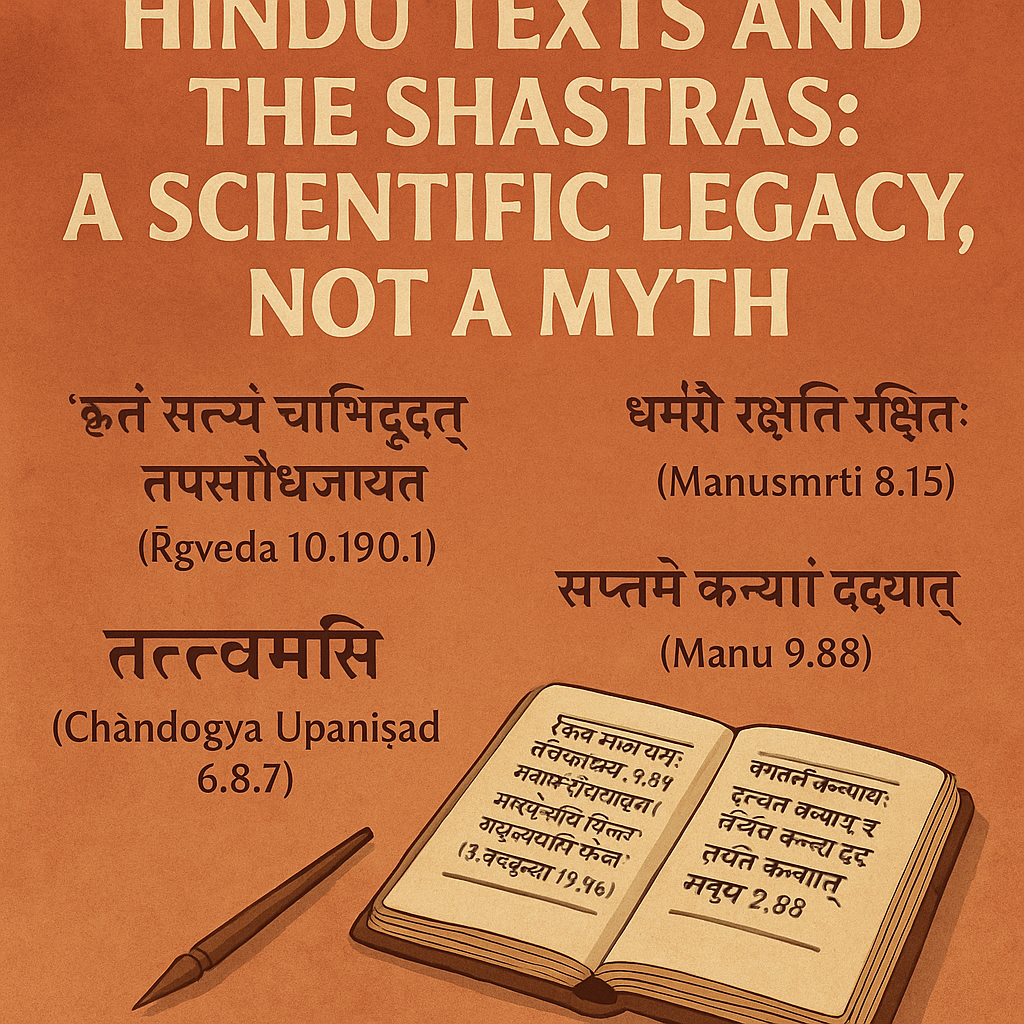
Hindu Texts and the Shastras: A Scientific Legacy, Not a Myth
Unraveling a Holistic Guide
The “Not a Myth” series—featuring “Genetic Testing in Ancient Gotra System: Science, not Myth?,” “Genetic Vedic Lineage Wisdom (Part 2): Your Spiritual DNA, Not Myth,” “Genetic Hindu Spiritual Heritage: Social, Gender & Royal Codes Forgotten,” and “Genetic Vedic Lineage Revival: Reclaiming Your Rishi’s Legacy, Not Myth”—has revealed the practical wisdom of Hindu traditions. This fifth blog explores the goal of Shastras, the vast Hindu scriptures, showcasing their purpose as a holistic guide to life, not a myth. From the Rigveda’s ऋतं सत्यं चाभीद्धात् तपसोऽध्यजायत (R̥taṁ satyaṁ cābhīddhāt tapasō’dhyajāyata) on cosmic order to Manusmriti’s धर्मो रक्षति रक्षितः (dharmo rakṣati rakṣitaḥ) on societal preservation, the Shastras, Hindu Texts integrate dharma, artha, kama, and moksha with science, serving as a password to future wisdom. We’ll contrast this with Abrahamic faiths, where the focus leans toward artha and kama—often framed in narrower, gender-regulated terms—highlighting Shastras’ inclusive and expansive scope. Join us on HinduInfopedia.org to rethink this legacy.
A Shastra is not merely a Hindu text. It is a codified manual of inquiry—systematically linking dharma, knowledge, and application—tested through logic, validated through time, and transmitted through disciplined study.
Dharma: Engineering Ethical Society, Not Blind Obedience
The Shastras, especially the Dharmashastras like the Manusmriti, aim to establish dharma—righteous living and societal harmony. They prescribe codes for family roles, caste duties, and justice, shaping a structured society. The Manusmriti’s rule—‘सप्तमे कन्यां दद्यात्’ (Manu 9.88), meaning marriage after the seventh year, and its emphasis on sagotra avoidance—‘समानप्रवरा हि चेत् तयोर्विवाहो न विधीयते’—reflect Gotra’s genetic logic, aligning with Gotra’s genetic logic, ensured lineage health, while the Ramayana exemplifies dharma in governance through Rama’s rule. This practical intent guided ancient India, proving Shastras are societal blueprints, not mere rituals. In contrast, Abrahamic texts—the Torah, Bible, and Quran—focus on moral and legal frameworks (e.g., Ten Commandments, Sharia laws) but lack detailed societal codes like caste or lineage systems. Their emphasis on divine law over social structure highlights Shastras’ broader scope, challenging the myth of their irrelevance.
Shastras on Wealth and Desire: Scientific, Inclusive, Not Repressed
The Shastras address artha (wealth) and kama (desire) as legitimate pursuits within dharma. Kautilya’s Arthashastra—stating ‘कोश मूलो दण्डः’ (The treasury is the root of state power)—outlined taxation, resource use, and surveillance long before modern economic theory provides economic policies, taxation, and statecraft, while The Kamasutra explores desire as an art, balancing sensual and ethical aspects for all genders. Hindu texts reflect a scientific approach to human needs, integrating material and personal fulfillment. In contrast to this inclusive and gender-balanced approach, Abrahamic traditions often regulate wealth and desire through prohibitive or gender-skewed prescriptions. Shastras approach artha and kama as sciences of balance—not suppression—reflecting their holistic goal. This contrast underscores Shastras’ holistic intent, debunking the myth of their limited purpose.
Shastras on Liberation: Inner Science Beyond Afterlife Promises
Moksha, the ultimate liberation, is a core goal of the Shastras, explored in the Upanishads through self-realization and meditation.
Tat tvam asi (तत्त्वमसि) — ‘Thou art that’ (Chandogya Upanishad 6.8.7) — captures the Upanishadic revelation that the individual self and the cosmic truth are one and the same — from the Chandogya Upanishad reflects this inner journey toward truth, asserting unity between the self and the ultimate.
Beyond spirituality, they impart knowledge—Surya Siddhanta’s precise astronomical calculations and Charaka Samhita’s medical insights demonstrate a scientific pursuit, laying the groundwork for their broader legacy. This knowledge pursuit extends into practical innovations, setting the stage for the Shastras’ scientific contributions. This dual focus sets Shastras apart. Abrahamic traditions emphasize salvation as divine reward, often without a structured path of inner realization. In contrast, the Shastras construct moksha as a process of self-discovery and intellectual liberation through guided introspection. Shastras’ blend of philosophy and science challenges the myth of their exclusivity to faith.
Scientific Legacy: Evidence Against Myth
The scientific legacy of the Shastras dismantles the myth label. Far from ritualistic lore, they encode rigorous empirical knowledge across disciplines—from astronomy and surgery to metallurgy and pharmacology.
Vedanga Jyotisha accurately predicted eclipses. Agastya’s texts detailed alloy creation. Sushruta Samhita (Chikitsa Sthana 1.8) described surgical reconstruction of the nose using forehead skin (nasikā bandhana) — the earliest record of plastic surgery like rhinoplasty centuries before modern plastic surgery.
These weren’t isolated insights—they followed a methodical process:
- Tattva-sameekshanam – observation and defining the pad (term) and artha (meaning),
- Tattva-pareekshanam – experimentation and logical testing,
- Siddhanta-pareekshanam – validation through repeatable results.
Take Sushruta’s rhinoplasty method. First, he observed the social and functional loss from nose disfigurement—this was Tattva-sameekshanam, identifying the term ‘nasika’ and its role. Then, through Tattva-pareekshanam, he experimented with forehead skin grafts and curved surgical tools, testing on cadavers and live cases. Finally, through Siddhanta-pareekshanam, consistent successful outcomes made it a validated technique. This wasn’t mythology—it was iterative science. In Ayurveda, Charaka tested turmeric by observing its wound-healing properties, adjusting dosage through trial. The Mimamsa school refined the Agnihotra ritual, correcting inconsistencies through debate and Tantrayukti such as ‘उपनयः’ (application of principles) and ‘निगमन’ (inference), codified in Mimamsa texts like Jaimini Sutras.
This structured method mirrors the modern scientific process—centuries ahead of its formal codification in the West.
This sets Hindu Shastras apart as civilizational manuals of repeatable, empirical reasoning—centuries ahead of their time.
This difference underscores why Shastras are not myths, but dynamic manuals of inquiry—designed for validation, application, and innovation.
Skeptics argue that ancient Shastras lack laboratory records or peer-reviewed studies. But in Hindu epistemology, oral transmission (Shruti-Pravachan), Tantrayukti (logic), and community validation performed that function. The absence of papyrus doesn’t mean absence of proof—it reflects a different civilizational model of scientific rigor
Comparison with Abrahamic Faiths: Scope and Focus
Hindu Shastras provide a holistic framework, integrating dharma, artha, kama, and moksha with science, reflecting a balanced life approach. Abrahamic faiths—Judaism, Christianity, and Islam—focus primarily on artha (wealth management) and kama (regulated desire), with a spiritual goal of salvation or divine favor. The Torah and Bible guide economic stewardship and marital ethics, while the Quran emphasizes trade and structures kama within male-oriented frameworks. Where Shastras universalized kama as life-art accessible to all, Abrahamic laws often limited it to procreation or gendered privileges. Moksha-like liberation is absent, replaced by a linear afterlife narrative. Shastras’ scientific and societal scope far exceeds this, challenging the myth of their narrow intent and affirming their role as a comprehensive guide.
Relevance Today: A Password to Future Wisdom
The Shastras remain remarkably relevant in today’s world. Their core principles address modern challenges with timeless clarity.
- Dharma offers a framework for ethical governance. For example, the Panchayati Raj system, rooted in ancient Sabha-Samiti structures, embodies decentralised decision-making and local justice—principles found in Manusmriti and Arthashastra.
- Artha, once codified in Hindu texts like the Arthashastra, now informs sustainable economics, responsible taxation, and resource management.
- Moksha—once pursued through meditation and detachment—now finds resonance in global mindfulness movements, with yoga and pranayama techniques validated by neuroscience.
The Shastras’ scientific legacy continues to inspire. From astronomy to surgery, their insights fuel research into ancient knowledge systems—seen in the global revival of Ayurveda, Vastu, and Sanskrit-based computing. AI researchers at IITs have begun modelling Vedic Sanskrit grammar from Panini’s Shastra for computational linguistics—a direct application of Shastric logic to machine learning.
While critics cite the lack of empirical records, the oral tradition (Pravachan) ensured accuracy through memorization and transmission, a cognitive feat modern pedagogy now re-examines with admiration, especially considering practices like ‘एकश्लोकी शास्त्र ज्ञान’—mastering entire Hindu texts from single compressed verses.
Unlike Abrahamic texts, which influence charity and moral codes but remain theologically anchored, the Shastras offer a holistic model—one that integrates science, spirituality, and society.
Even the concept of Swadhyaya (self-study) now shapes educational reforms focused on self-reflection and critical thinking.
The Shastras are not relics. They are roadmaps—designed not only to preserve tradition, but to shape the future.
Conclusion: Unlocking Ancient Wisdom
The goal of Shastras is not a myth but a dynamic blueprint for life, integrating spirituality, society, and science. Unlike faith systems that isolate spirituality from science or governance—often defined by theological restrictions—the Shastras’ holistic intent, evidenced by astronomy, medicine, and governance, proves their enduring relevance and practical value. As part of the “Not a Myth” series, this exploration positions Shastras as the key to future wisdom, a legacy to reclaim before it fades. Let’s honor this ancient code, ensuring its light guides generations to come.
Call to Action
What do the Shastras’ goals mean to you? Share your thoughts or explore their wisdom in practice. Dive deeper into our series on HinduInfopedia.org to continue the “Not a Myth” journey.
Feature Image: Click here to view the image.
Glossary of Terms
- Shastra: A Sanskrit term meaning “treatise” or “manual,” referring to codified texts on subjects ranging from philosophy and law to science and health in Hindu tradition.
- Purusharthas: The four fundamental goals of human life in Hindu philosophy—Dharma (ethical living), Artha (material prosperity), Kama (desire or emotional fulfillment), and Moksha (liberation).
- Dharma: Righteous conduct, duty, and the moral order that sustains society and the cosmos; central to Hindu ethical and legal thinking.
- Artha: The pursuit of wealth and resources in an ethical and socially responsible way; one of the four Purusharthas.
- Kama: Legitimate sensual and emotional pleasure, often misunderstood as mere lust; balanced in Hinduism with dharma and artha.
- Moksha: Liberation from the cycle of birth and death (samsara) through self-realization; considered the highest of the four Purusharthas.
- Gotra: A hereditary lineage system in Hindu society, originally referring to descendants of a specific rishi (sage), used for marriage and spiritual identity.
- Pravara: The lineage of sages (rishis) associated with a person’s gotra; used in Vedic rituals to trace spiritual ancestry.
- Tat Tvam Asi: A Mahāvākya (great saying) from the Chandogya Upanishad meaning “Thou art That,” symbolizing the unity of individual self (Atman) and cosmic reality (Brahman).
- Tantrayukti: Logical and rhetorical tools used in Shastric literature to structure arguments, including inference, application, and analogy.
- Upanaya: A Tantrayukti technique involving the application of a general rule or idea to a specific case.
- Nigamana: A logical conclusion or inference drawn from reasoning, often used in Mimamsa and Nyaya schools of philosophy.
- Shruti-Pravachan: The oral tradition of transmitting knowledge, where Shruti (heard texts like the Vedas) was memorized and taught through recitation and discourse.
- Nasikā Bandhana: A surgical technique described in the Sushruta Samhita for reconstructing the nose using forehead skin—early evidence of plastic surgery.
- Tattva-sameekshanam: The process of observation and defining terms and concepts in classical Shastric methodology.
- Tattva-pareekshanam: Logical testing and experimentation to verify truths in Shastric science.
- Siddhanta-pareekshanam: Final validation of theories through repeatable results, equivalent to modern peer review.
- Vedanga Jyotisha: A limb of the Vedas dealing with astronomy and time-keeping, used for calculating rituals, eclipses, and calendars.
- Surya Siddhanta: An ancient Hindu astronomical text that accurately describes planetary motions, eclipses, and Earth’s rotation.
- Chikitsa Sthana: A section of the Sushruta Samhita dealing with therapeutic procedures and treatments, including surgery.
- Ekashloki Shastra Jnana: The traditional ability to condense an entire Shastra (discipline) into a single verse or aphorism—a hallmark of memorization in Indian pedagogy.
References:
- Vedas: Cosmic order and rituals (e.g., Rigveda).
- Upanishads: Philosophy and moksha (Chandogya Upanishad).
- Dharmashastras: Societal codes (Manusmriti).
- Arthashastra: Governance and economics.
- Torah: Moral and legal frameworks.
- Bible: Wealth and marital ethics.
- Quran: Trade and marital laws.
#HinduinfoPedia #VedicScience #Shastras #SanatanaDharma #AncientWisdom
Previous Blogs on of the Series
- https://hinduinfopedia.com/cosmic-seed-of-universe/
- https://hinduinfopedia.com/bhagwan-varaha-and-his-tusks/
- https://hinduinfopedia.com/surya-siddhanta-astronomical-truth-of-rahus-bite/
- https://hinduinfopedia.com/vedic-astronomy-and-basic-concepts/
- https://hinduinfopedia.com/solar-eclipse-insights-from-hindu-texts/
- https://hinduinfopedia.com/astronomy-in-surya-siddhanta/
- https://hinduinfopedia.com/science-of-vedic-astronomy/
- https://hinduinfopedia.com/hindu-wisdom-in-yagna-fire-real-not-myth/
- https://hinduinfopedia.com/hindu-wisdom-in-ritual-and-food/
- https://hinduinfopedia.com/hindu-wisdom-in-surgery-sushruta-blades-are-rea/
- https://hinduinfopedia.com/surgeon-sushrutas-pioneering-procedures/
- https://hinduinfopedia.com/surgeon-sushrutas-scalpel-unveiled/
- https://hinduinfopedia.com/metal-mastery-hindu-zinc-science-not-myth/
- https://hinduinfopedia.com/hygiene-in-hindu-texts/
- https://hinduinfopedia.com/vegetarian-diet-of-hindu-wisdom/
- https://hinduinfopedia.com/vegan-food-and-hindu-wisdom/
- https://hinduinfopedia.com/varna-system-hindu-merit-not-myth/
- https://hinduinfopedia.com/gurukul-truths-of-hindu-wisdom/
- https://hinduinfopedia.com/science-hub-rituals-vedic-truths-unveiled/
- https://hinduinfopedia.com/genetic-testing-in-ancient-gotra-system/
- https://hinduinfopedia.com/peace-in-sanatana/
- https://hinduinfopedia.com/aryabhata-and-mathematical-astronomy-not-myth/
- https://hinduinfopedia.com/bhaskara-i-refining-vedic-mathematics-not-myth/
- https://hinduinfopedia.com/bhaskara-ii-algebra-to-gravity-not-myth/
- https://hinduinfopedia.com/shankaracharyas-vedic-mathematics-practical-applications/
- https://hinduinfopedia.com/raman-effect-unveiling-vedic-sciences-light/
- https://hinduinfopedia.com/hindu-calendar-scientific-timekeeping-not-a-myth/
- https://hinduinfopedia.com/hindu-calendar-traditions-timekeeping-in-ramayana-mahabharata/
- https://hinduinfopedia.com/vimana-shastra-ancient-hindu-aeronautics-unveiled/
- https://hinduinfopedia.com/108-meaning-ancient-hindu-science-not-a-myth/
- https://hinduinfopedia.com/genetic-vedic-lineage-wisdom-your-spiritual-dna-not-myth/
[…] Past-life spiritual practice creates favorable संस्कार, explaining why some progress rapidly with minimal apparent effort. This principle appears throughout Hindu philosophical texts. […]