

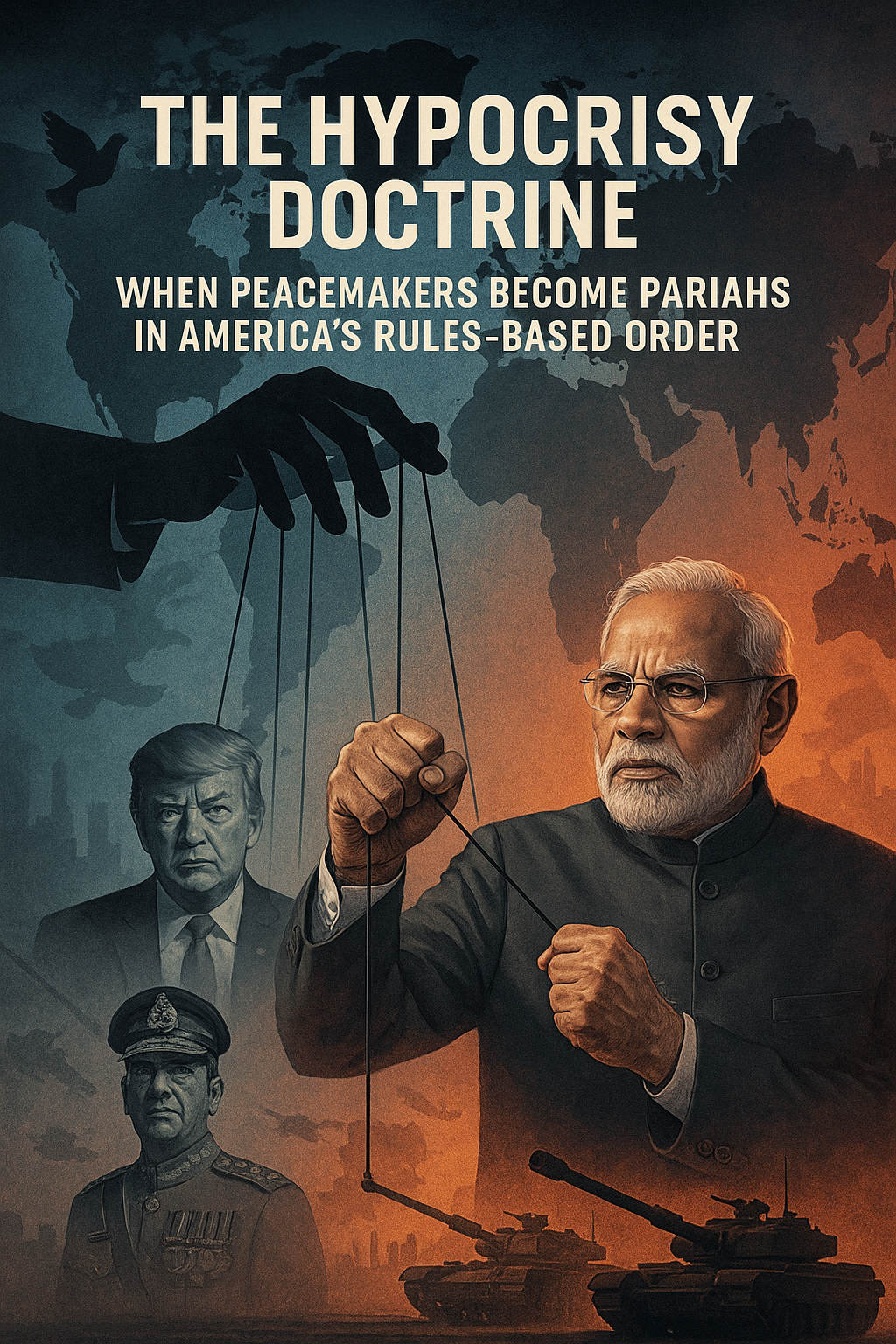
US Hypocrisy Doctrine: When Peacemakers Become Pariahs in America’s Rules-Based Order
Part V of the India-US Trade War Series
The US Hypocrisy Doctrine Unveiled
The phone call that never came again speaks louder than the one that did. On June 17, when Prime Minister Modi refused to validate false American mediation claims about the India-Pakistan ceasefire, he unwittingly exposed what we might call the US Hypocrisy Doctrine – America’s fundamental principle that narrative control matters more than truth, compliance more than friendship, and perception more than reality.
Within months, the “dear friend” became the target of 50% tariffs. The crime? Speaking diplomatic truth instead of diplomatic convenience. The pattern is now clear: in America’s rules-based order, the primary rule is that America writes the rules, rewrites the history, and punishes those who refuse to play along. The US Hypocrisy Doctrine demands that allies validate false claims, accept blame for problems they didn’t create, and bear punishment for principles they won’t abandon.
Modi’s India has become the perfect case study for understanding how this doctrine operates – and why it’s failing in a multipolar world.
The Anatomy of American Contradiction: The US Hypocrisy Doctrine in Practice
The False Mediator’s Gambit
The June 17 exchange revealed the doctrine’s mechanics. Trump wanted public acknowledgment of U.S. “mediation,” but the ceasefire was in fact the product of direct India–Pakistan communication, requested by Islamabad itself. The gap between claim and reality was stark, and Modi’s refusal to bridge it with flattery marked the breaking point.
The irony was hard to miss. Even as Trump extended an invitation to Modi, the very Pakistani Army chief and terror-linked figure, General Munir, was being hosted as a state guest by the U.S. President. In other words, Washington expected New Delhi to flatter its false mediation claims while simultaneously legitimizing Pakistan’s military leadership that India held responsible for sponsoring cross-border terrorism.
For Modi, validating the American narrative under such conditions would not have been diplomacy—it would have been complicity. His refusal was not just diplomatic honesty, but a categorical rejection of the US Hypocrisy Doctrine’s central demand: that truth must yield to America’s need for credit.
The doctrine operates on a simple premise: if you won’t help America look good, America will make you look bad. Modi chose truth over flattery, and the consequences were immediate.
From Peacemaker to Pariah: The US Hypocrisy Doctrine’s Punishment Protocol
The slide from “dear friend” to tariff target within months illustrates how dissent is penalized. What changed was not India’s behavior on the ground, but its unwillingness to lend credibility to an American storyline. Refusing to act as validator became reason enough to recast India as a spoiler of global order.
At the very moment when most major powers aligned themselves with one or the other bloc in the Ukraine–Russia conflict, India stood alone as the only major country maintaining true neutrality. New Delhi chose dialogue over alignment, energy security over slogans, and principle over pressure.
The accusations came fast: India was “financing Russia’s war” through oil purchases. India was undermining Western unity. India was choosing the wrong side of history. Each accusation revealed another layer of the US Hypocrisy Doctrine: those who resist American narrative control are automatically assigned malevolent motives, regardless of their actual actions or intentions.
The Price of Truth: Measured Fallout
The transformation from “dear friend” to tariff target within months perfectly illustrates the US Hypocrisy Doctrine’s punishment protocol. The same leader who was praised for maintaining stability in South Asia suddenly became a threat to global order—not because his actions changed, but because his willingness to validate American narratives ended.
At the very moment when most major powers aligned themselves with one or the other bloc in the Ukraine–Russia conflict, India stood alone as the only major country maintaining true neutrality. New Delhi chose dialogue over alignment, energy security over slogans, and principle over pressure.
The accusations came fast: India was “financing Russia’s war” through oil purchases. India was undermining Western unity. India was choosing the wrong side of history. Each accusation revealed another layer of the US Hypocrisy Doctrine: those who resist American narrative control are automatically assigned malevolent motives, regardless of their actual actions or intentions.
This was not an isolated episode. The same pattern has surfaced repeatedly—where serial human-rights violators such as Afghanistan, Pakistan, Iran, Bangladesh, or even China escape censure, while Bharat was branded in 2022 by U.S. agencies as among the “worst states” on rights. Such selective morality underlines that the US Hypocrisy Doctrine is not about universal values—it is about narrative convenience.
Jaishankar’s Counter-Narrative: Dismantling the US Hypocrisy Doctrine
The Numbers That Expose the US Hypocrisy Doctrine
External Affairs Minister S. Jaishankar has become the master of dismantling the US Hypocrisy Doctrine with uncomfortable facts. His responses to Western accusations about Russian oil purchases reveal the doctrine’s fundamental dishonesty:
“If you have problems buying oil from India… don’t buy it.” This wasn’t just diplomatic pushback – it was an expose of the US Hypocrisy Doctrine’s central contradiction. The same nations condemning India for buying Russian oil were purchasing India’s refined petroleum products worth billions. They wanted the benefits of India’s energy processing while maintaining the moral authority to condemn India’s energy sourcing.
The irony runs deeper: Washington, quick to impose tariffs on Indian goods, remains heavily dependent on Chinese supply chains and debt financing. The very state portrayed as America’s primary rival still dictates key terms of U.S. trade and manufacturing. In effect, the U.S. kneels before Beijing’s economic leverage while demanding that India, a fellow democracy, bend on principle.. The doctrine’s rule became clear: it’s not about the size of your Russian trade, it’s about the size of your willingness to accept American narrative control.
The Cyprus revelation was particularly damaging to the US Hypocrisy Doctrine: “EU buying more oil and gas from Russia than India imports.” Yet somehow, in the doctrine’s twisted logic, India became the primary villain while Europe remained the moral authority. The US Hypocrisy Doctrine revealed itself as fundamentally about power, not principles.
The “Encouraged to Help” Contradiction
Perhaps the most devastating exposure of the US Hypocrisy Doctrine came from Jaishankar’s reminder that the US had “encouraged countries like India in recent years to help stabilise the global energy market – a call that also included purchasing oil from Russia.” The doctrine’s hypocrisy was laid bare: America had actively encouraged the very behavior it was now punishing.
This wasn’t policy evolution – it was the US Hypocrisy Doctrine’s core operating principle. First, encourage behavior that serves American interests. Then, when that same behavior becomes politically inconvenient, punish it. The doctrine’s victims are expected to understand that American interests change, but their loyalty should remain constant.
The Genesis Problem: How the US Hypocrisy Doctrine Creates Its Own Enemies
A Global Pattern: The US Hypocrisy Doctrine in Other Relationships
India is not the only nation to face punitive backlash for refusing to serve American optics. The US Hypocrisy Doctrine has played out globally—turning sovereign decisions into provocations and reshaping partnerships into punishments.
2018 – Turkey and the S-400 Sanctions: When Turkey, a NATO ally, procured Russian S-400 missile systems, the U.S. responded not with diplomacy but with CAATSA sanctions and the removal of Turkey from the F-35 program. Ankara’s sovereign defense choice was branded a betrayal, and its military cooperation was revoked.
2022 – Germany and Nord Stream 2: Germany’s pursuit of energy security through Nord Stream 2 led to sustained American pressure, culminating in the pipeline’s shutdown. Despite being a democratic ally, Berlin’s choice was framed as enabling Russian aggression—even though U.S. LNG exports to Europe quietly increased.
2023 – Brazil and Lula’s Ukraine Neutrality: When President Lula da Silva refused to align Brazil with Western narratives on Ukraine and called for peace negotiations involving Russia and China, he was accused of being “soft on autocracy.” Brazil’s independent diplomacy was spun as complicity, echoing the US Hypocrisy Doctrine’s binary framing.
India’s punishment was not because it acted alone—but because it stood alone. While other democratic allies like Germany and Japan quietly complied with U.S. expectations—even when contrary to their energy or security interests—India refused. Germany terminated Nord Stream 2 under pressure. Japan froze long-standing defense autonomy initiatives. Both submitted without confrontation.
This is what made India’s refusal uniquely threatening. The U.S. could tolerate a compliant ally or an adversarial one—but a democratic partner with spine and options? That was dangerous. It threatened the illusion that all alliances require submission. That’s why Trump singled out India—not because it was disobedient, but because it was dignified.
The US Hypocrisy Doctrine isn’t triggered by disagreement; it is triggered by visible resistance from nations who should be malleable. India’s act of saying “No” shattered the illusion of democratic consensus and exposed the control framework America silently relied on.
These examples reinforce the core pattern: compliance with American narrative is treated as virtue, while sovereignty is punished as disloyalty—regardless of legality, morality, or mutual interest.
Manufacturing Crises, Demanding Solutions
The US Hypocrisy Doctrine extends beyond individual relationships to systematic crisis creation. The Ukrainian situation perfectly exemplifies this pattern: Western backing created a comedian actor as president whose entertainment background hardly prepared him for geopolitical complexity. The resulting governance challenges and geopolitical tensions were predictable.
Yet under the US Hypocrisy Doctrine, those who warned about the risks of this experiment are now blamed for its consequences. Russia’s response to NATO expansion and regime change operations becomes “unprovoked aggression.” India’s refusal to join sanctions becomes “financing the war machine.” The doctrine consistently shifts blame from its architects to its critics.
The US Hypocrisy Doctrine operates on manufactured moral clarity: every crisis has clear villains and heroes, and America always gets to choose who plays which role. Nuance, historical context, and American responsibility disappear under the doctrine’s binary worldview.
The Pattern of Convenient Leaders
From the “Nobel laureate” presented as Bangladesh’s democratic hope to the “defacto dictator” reality that followed, the US Hypocrisy Doctrine consistently elevates convenient over competent leadership. The pattern is always the same: Western backing creates leaders who prioritize Western approval over local competence, leading to inevitable governance failures.
Hindus are still being killed in the most inhumane manner even today under the watchful five eyes of the English-speaking cartel.
Afghanistan is another stark reminder. Two decades of Western-engineered governance collapsed overnight, handing power back to the Taliban and leaving vulnerable communities — especially Hindus and Sikhs — exposed to renewed persecution.
When these manufactured leadership experiments collapse, the US Hypocrisy Doctrine demands that regional powers clean up the mess while America maintains moral authority. Those who refuse to bear the costs of American experiments become threats to the “rules-based order.
The Intelligence Paradox: The US Hypocrisy Doctrine’s Self-Destruction
Punishing the Partnership That Powers America
One of the US Hypocrisy Doctrine’s most self-destructive traits is its treatment of the Indian-American community. The very intelligentsia powering America’s technological edge—from Silicon Valley CEOs to leading researchers to H-1B professionals—are turned into collateral damage in tariff wars and policy disputes rooted in diplomatic ego.
The logic is strikingly counterproductive: penalize the community that sustains American competitiveness simply because their ancestral homeland refused to endorse a fabricated narrative. It shows how the US Hypocrisy Doctrine consistently elevates image management above strategic advantage.
The contradiction is sharper when viewed through economics. Indian-Americans are among the highest per-capita taxpayers in the United States, adding disproportionately to the national revenue base through their professional success. Yet they remain one of the most distrusted and targeted groups in the political discourse. By contrast, communities with lower average tax contributions and higher welfare reliance often receive warmer political embrace and social recognition.
The message to Indian-Americans is unmistakable: your measurable contributions to America’s prosperity matter less than your willingness to remain silent when falsehoods are pushed as truth. Under the US Hypocrisy Doctrine, even the partnerships most vital to America’s future are treated as expendable if they refuse to conform to narrative control.
The Strategic Blindness of the US Hypocrisy Doctrine
The US Hypocrisy Doctrine has created a peculiar form of strategic blindness where America pursues image management at the expense of genuine partnership. Rather than managing disagreement within a strong alliance, the doctrine demands total narrative compliance or total punishment.
This approach worked in a unipolar world where alternatives were limited. In today’s multipolar reality, the US Hypocrisy Doctrine becomes America’s greatest strategic liability. It transforms natural allies into necessary adversaries and creates incentives for the very partnerships it seeks to prevent.
The Optics of Influence: How the US Hypocrisy Doctrine Rewards Compliance
Golden Gestures vs. Principled Positions
The US Hypocrisy Doctrine operates through a sophisticated rewards system that makes its punishments even more stark. Consider the contrast: Tim Cook provides a 24-karat gold Apple tribute and announces $100 billion in US manufacturing commitments, receiving lavish praise and policy consideration. Qatar gifts a $400 million Boeing jet, earning recognition as a valuable partner.
Meanwhile, Modi refuses to validate false mediation claims and faces 50% tariffs. The US Hypocrisy Doctrine’s message is unmistakable: bend the knee and receive gold; stand firm and face sanctions. The doctrine has created an influence ecosystem where compliance is rewarded with golden tributes while independence is punished with economic warfare.
The Gift Economy of Geopolitics
Under the US Hypocrisy Doctrine, global politics operates as a gift economy where symbolic gestures matter more than substantive partnerships. Those who provide the right symbols – golden apples, expensive jets, public validation of false claims – receive policy consideration. Those who provide substantive cooperation but refuse symbolic submission face punishment.
The Criptic Cripto Trade
Consider the case of Pakistan. As India abstained from validating American mediation narratives, Pakistan secured a strategic crypto partnership with WLF, a Trump-family-backed firm, while receiving overt diplomatic warmth.
Modi’s India threatens this system precisely because it offers genuine partnership without symbolic submission. The US Hypocrisy Doctrine cannot accommodate allies who contribute without genuflecting, cooperate without capitulating, or partner without pretense.
Rules-Based Order or Rule-by-Design?
Rules-Based Order or Rule-by-Design?
The term “rules-based order” has been repeatedly invoked by Western powers—but rarely defined. What rules? Whose order? India has seen firsthand how these so-called universal rules operate. WTO norms were disregarded when punitive tariffs were imposed. TRIPS agreements—meant to ensure fair intellectual property practices—were selectively enforced when India sought vaccine and pharma exemptions. Climate finance promises made to the Global South were quietly abandoned, while India was blamed for burning coal to lift its poor out of poverty.
The nuclear domain shows the same double standard. The NPT locked in nuclear privilege for a few states while denying that right to others, even when they faced existential security threats. The CTBT, meanwhile, sought to ban further nuclear testing but froze technological advantage with those who had already perfected their arsenals. In both cases, “rules” were written not to ensure fairness, but to cement asymmetry.
Under the US Hypocrisy Doctrine, the “rules” are not legal frameworks—they are tools of narrative control. When they align with U.S. interests, they are binding. When they don’t, they are dismissed. This flexible morality is not global leadership—it is structured coercion in multilateral clothing.
India’s growing refusal to accept these manipulated rules isn’t rebellion. It is a demand to universalize universals. A truly rules-based order must begin with rule-based conduct, not narrative enforcement masquerading as multilateralism.
The Multipolar Response: Why the US Hypocrisy Doctrine is Failing
What began as a single disagreement has since crystallized into a deeper recognition: the US Hypocrisy Doctrine is not a one-off irritation but a recurring operating principle. India’s refusal to play along revealed the costs of insisting on dignity in a system built on compliance. At its core, this doctrine reflects a recurring pattern in U.S. foreign relations: a preference for narrative control over factual clarity, compliance over partnership, and perception over reality.
Within months, the “dear friend” of Washington became the target of 50% tariffs. The reason? Upholding diplomatic truth over diplomatic performance. This shift wasn’t incidental—it was structural. In what’s often termed a “rules-based order,” the unspoken rule is clear: America defines the rules, rewrites the record, and penalizes those who do not play along.
India’s refusal to participate in this narrative compliance model makes it a unique case study—and a test of whether multipolar diplomacy can offer a principled alternative to performative alliance behavior.
The Broader Pattern: How the US Hypocrisy Doctrine Punishes Peace
The Peacemaker’s Penalty
The US Hypocrisy Doctrine has created a perverse incentive structure where neutral mediators face greater punishment than partisan actors. Those who work for genuine peace without accepting American credit become threats to American prestige. Those who create conflicts while accepting American mediation become valuable partners.
This reveals the doctrine’s fundamental priority: American narrative control matters more than actual peace. A conflict resolved without American involvement is less valuable than a conflict prolonged with American mediation. The US Hypocrisy Doctrine consistently chooses process over outcomes when process serves American image management.
The Long-term Costs of Short-term Narrative Wins
The US Hypocrisy Doctrine’s obsession with immediate narrative control creates long-term strategic disasters. Punishing India for refusing to validate false mediation claims may preserve American pride, but it destroys American influence. The doctrine consistently trades strategic relationships for tactical narrative victories.
This pattern extends beyond India to every relationship where the US Hypocrisy Doctrine operates. Allies learn that American friendship depends not on mutual benefit but on mutual deception. Partners discover that American cooperation requires not just policy alignment but reality distortion.
Conclusion: The US Hypocrisy Doctrine’s Inevitable Failure
Modi’s silence following the June 17 exchange does not represent diplomatic indifference—it reflects a deeper assertion of principle. The US Hypocrisy Doctrine’s insistence on symbolic validation encountered India’s insistence on sovereign dignity. When truth and loyalty are made mutually exclusive, principled actors will inevitably choose neither.
This pattern reveals a troubling shift: the U.S., once valued for partnerships rooted in mutual benefit, now risks alienating allies through an overreliance on narrative control. In an increasingly multipolar world, trust cannot be built on selective truths and conditional respect.
India did not challenge American dominance—it simply refused to endorse a story that wasn’t true. That refusal, measured yet firm, signals a broader realignment: partnerships based on parity, not patronage. The US Hypocrisy Doctrine, by overreaching, has weakened the very alliances it was designed to control.
As the world moves toward more distributed power centers, the credibility of leadership will depend less on who controls the story and more on who respects the truth. The US Hypocrisy Doctrine has not only failed—it has outlived its utility.
Feature Image: Click here to view the image.
Glossary of Terms
- US Hypocrisy Doctrine: A coined term in the blog referring to the U.S. practice of prioritizing narrative control over factual accuracy, demanding compliance from allies, and punishing those who resist.
- Rules-Based Order: A term used by Western powers to describe the global system of governance based on “universal” rules; in practice, often criticized as selectively applied to favor U.S. and allied interests.
- CTBT (Comprehensive Nuclear-Test-Ban Treaty): A treaty adopted by the UN in 1996 banning all nuclear test explosions. Criticized for cementing existing nuclear hierarchies by preventing further development in states that had not yet perfected nuclear arsenals.
- NPT (Nuclear Non-Proliferation Treaty): A 1968 treaty aimed at preventing the spread of nuclear weapons. It divides the world into recognized nuclear-weapon states and non-nuclear states, creating long-term asymmetry.
- TRIPS (Trade-Related Aspects of Intellectual Property Rights): A WTO agreement that sets minimum standards for intellectual property regulation globally, often criticized for restricting access to affordable medicines and vaccines in developing countries.
- WTO (World Trade Organization): An intergovernmental body that regulates international trade rules. Accused of overlooking violations when powerful nations impose tariffs or bypass commitments.
- CAATSA (Countering America’s Adversaries Through Sanctions Act): A U.S. law passed in 2017 that mandates sanctions on countries engaging with Russia, Iran, or North Korea in defense or intelligence sectors. Used to penalize Turkey for purchasing Russian S-400 systems.
- S-400: A Russian-made advanced air-defense missile system, purchased by Turkey in 2017–18, leading to U.S. sanctions and Ankara’s expulsion from the F-35 fighter program.
- Nord Stream 2: A natural gas pipeline project linking Russia to Germany through the Baltic Sea. Canceled under U.S. pressure in 2022, illustrating Washington’s influence over European energy policy.
- Global South: A collective term for developing nations, primarily in Asia, Africa, and Latin America, often contrasted with Western industrialized states in debates about fairness in international governance.
- Munir (General Asim Munir): Current Chief of Army Staff of Pakistan, described in the blog as “terror-linked” and noted for being hosted as a U.S. state guest even while Pakistan is accused of sponsoring cross-border terrorism.
- Five Eyes: An intelligence-sharing alliance between the U.S., UK, Canada, Australia, and New Zealand. Criticized in the blog as part of the “English-speaking cartel” overseeing selective human-rights scrutiny.
- Multipolar World: A global order characterized by multiple centers of power (e.g., U.S., China, India, EU, Russia), replacing the earlier unipolar dominance of the U.S. after the Cold War.
- WLF (World Liberty Financial): A crypto company backed by the Trump family that entered into a strategic partnership with Pakistan, cited as an example of transactional geopolitics.
- Narrative Control: The practice of shaping or enforcing a preferred version of events to maintain political advantage, even at the cost of factual accuracy.
#HinduinfoPedia #HypocrisyDoctrine #India #US #Geopolitics #Trade #Diplomacy #Multipolar
Previous Blogs on of the Series
- https://hinduinfopedia.com/global-trade-vs-bharats-sovereignty-seeds-serums-and-sanctions/
- https://hinduinfopedia.com/economy-sovereignty-bharats-gmo-rejection-explained/
- https://hinduinfopedia.com/economic-sovereignty-and-the-gmo-trade-trap/
- https://hinduinfopedia.com/rupee-rebellion-how-india-is-building-the-post-dollar-world/
[…] 👉 To explore how this doctrine of selective punishment shapes global politics, read the full blog: The Hypocrisy Doctrine: When Peacemakers Become Pariahs in America’s Rules-Based Order at https://hinduinfopedia.com/us-hypocrisy-doctrine-when-peacemakers-become-pariahs-in-americas-rules-b… […]
[…] […]